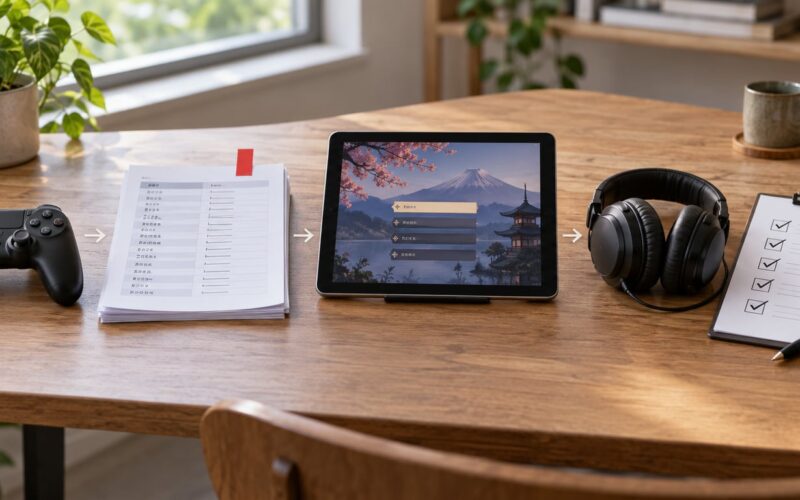
To import Japanese video games safely, you confirm your console can actually run the region and language of the release, buy through a seller that ships internationally or a proxy with a Japanese warehouse address, add up the full landed cost, choose tracked shipping, declare the value honestly, and inspect the parcel the moment it arrives. Most bad imports come from skipping one of those five checks.
Nothing about the process is difficult once you know where to look. The tricky parts are boring ones: whether a Super Famicom cartridge physically fits your slot, whether a Japanese PlayStation 2 disc will spin on a North American console, whether the forwarded package gets held at the border, and whether the cart in the box is the real thing.
This guide covers all of it, step by step, for collectors buying retro carts, fans chasing Japan-only titles, and anyone who has been burned once by a parcel that arrived crushed or a disc that never played.
Table of Contents
- 1What You Need
- 2Step-by-Step: How to Import Japanese Video Games Safely
- 3How to Import Japanese Video Games Safely: Check the platform and region
- 4Confirm the seller and product details
- 5Compare the total landed cost
- 6Choose the safest payment and shipping method
- 7Track the shipment and prepare for customs
- 8Inspect the package and game on arrival
- 9Test the game and preserve the package
- 10Common Mistakes
- 11Frequently Asked Questions
- 12Do I need to pay customs if I buy games from Japan?
- 13Is it legal to import Japanese video games for personal use?
- 14Are used or sealed Japanese games safe to buy?
- 15What should I do if my Japanese package arrives damaged?
- 16Is the Japanese PS5 or PS4 region locked?
- 17Is it cheaper to buy games in Japan after all the fees?
- 18Conclusion
What You Need
Before you order anything, gather five things. Without them you are guessing, and guessing is what turns a cheap import into an expensive mistake.
- Your console model, exactly. Not the family, the model. A Japanese Wii and a North American Wii look identical and behave completely differently, and the same is true of the Nintendo 64 and the GameCube.
- The Japanese catalog number. Every Japanese release carries a JAN code and a company prefix on the box or disc, something like JAN code 4562370762118. Paste that number into Amazon Japan and you get the canonical listing for that edition, which makes comparing prices and condition across stores quick.
- Seller history. Ratings, count of sales, how old the account is, and whether the seller photographs the actual item rather than a stock image. For used carts, ask for a photo of the label side and the connector pins.
- A payment method with buyer protection. A card that offers a dispute path or a payment platform that holds funds until delivery. Bank transfers and friends-and-family payments give you nothing when a parcel never arrives.
- Address, paperwork and packing. Your real delivery address in the destination country, a phone number the carrier can use, a note of the order number and declared value, plus bubble wrap and a rigid mailer if the seller is shipping you something fragile.
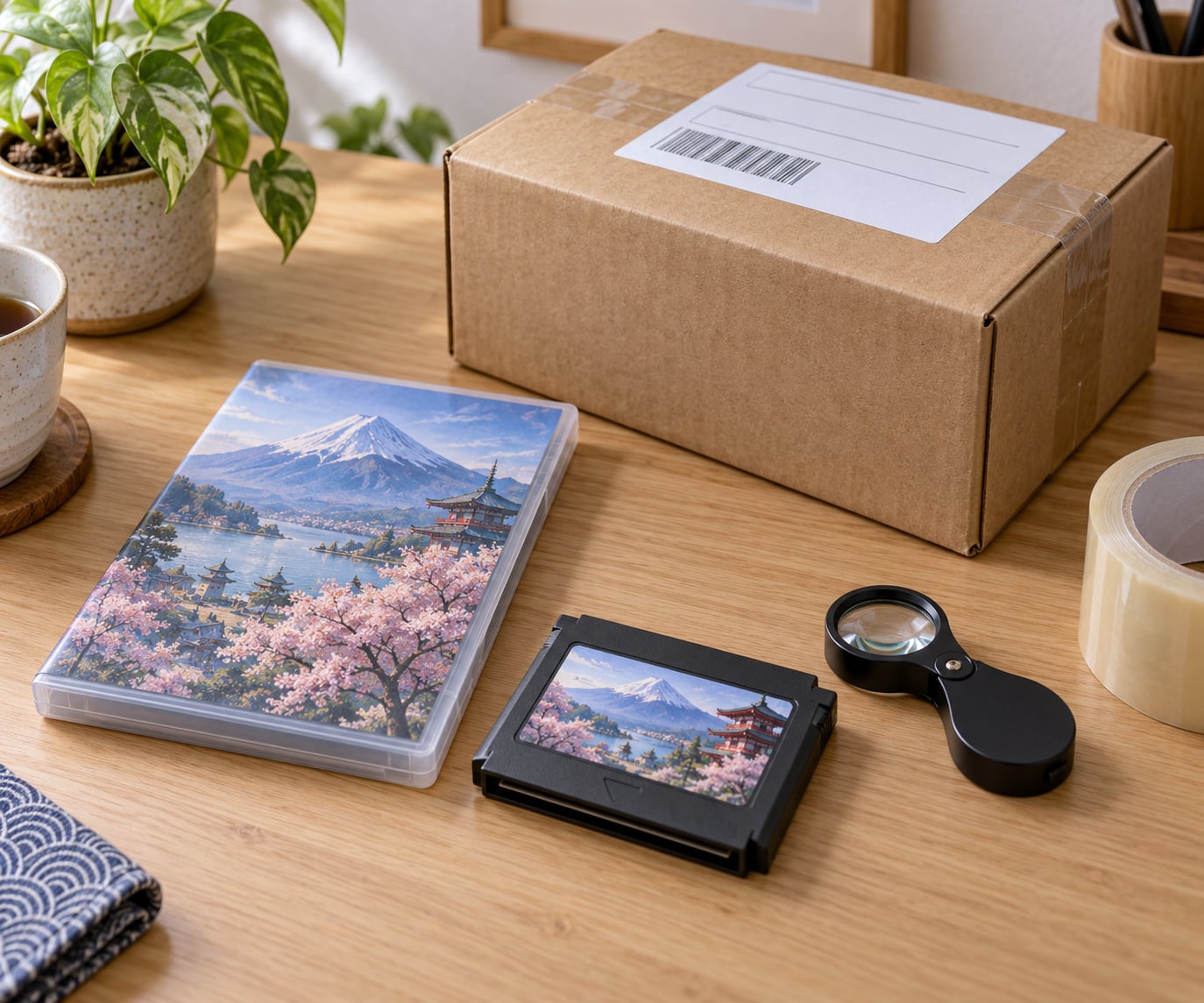
Two more tools earn their keep. A tracking page bookmarked before you order, so you are not hunting for it in a panic, and a small USB microscope or loupe for inspecting cartridge pins and disc surfaces. That loupe has saved me more money than any shipping upgrade.
Step-by-Step: How to Import Japanese Video Games Safely
How to Import Japanese Video Games Safely: Check the platform and region
Region locks fall into three groups: hardware that physically rejects foreign games, discs that spin but refuse to run, and systems that do not care at all. Sorting your target system into one of those three before you pay is the single most valuable step in this whole guide.
| System | Japanese releases in the US | What to watch for |
|---|---|---|
| Famicom / Super Famicom | Carts do not fit US slots | Super Famicom carts are wider; the notch has to be trimmed or a cart adapter used |
| Nintendo 64 | Region-locked | Japanese N64 only plays Japanese carts unless the console is modified or replaced |
| GameCube | Region-locked | Needs a modified or region-free GameCube for NTSC discs |
| Wii | Region-locked | A Japanese Wii will not boot North American discs without a modification |
| Game Boy, Game Boy Color, Game Boy Advance | Region-free | Buy freely; only the box art and CERO label differ |
| Nintendo DS / DS Lite | Region-free | DS Lite plays Japanese and US cards; the DSi is region-locked |
| Nintendo 3DS | Region-locked | Japanese 3DS and Japanese 3DS games are a closed system outside Japan |
| PSP | UMDs are region-free | PlayStation Store account region still matters for digital titles |
| PlayStation 1 | Discs are region-free | Japanese discs often carry Japanese audio only |
| PlayStation 2 | Japanese discs generally will not run | NTSC-J video output does not match North American sets; buy the Japanese console instead |
| PlayStation 3 | Mostly region-free, some titles locked | Japan and North America share Blu-ray region 1; individual games can still be software-locked |
| PlayStation 4 / PS5 | Region-free | Japanese hardware uses different power and TV standards; discs and language options are the real difference |
| PlayStation Vita | Region-free | Digital purchases bind to the account region |
| Nintendo Switch | Game cards are region-free | Japanese hardware differs in dock video output and power handling; store accounts are region-bound |
Language is the second half of the compatibility question. Modern Japanese releases often ship with Japanese only, or with Japanese plus English subtitles and interface options. Older cartridge titles are usually Japanese with no English at all, which is the normal state of affairs for a Japanese import and worth checking before you buy.
A few collectors solve this with translation patches, which work well for popular titles and poorly for the long tail. If a game has no English text and no patch, decide whether you can enjoy it that way before the money is gone, because a wrong-region purchase is a dead purchase.
Confirm the seller and product details
Japanese marketplaces split into new retail stock, general secondhand, and specialist retro shops. Knowing which one you are buying from tells you what condition you should expect and what you should photograph before paying.
| Source | Stock type | International shipping | Best for |
|---|---|---|---|
| Amazon Japan | New retail, some used | Through a proxy or forwarding address | New releases with English subtitle options, easy returns in Japanese |
| Rakuten | New and used from many sellers | Through a proxy | Boxed and complete-in-box hunting at discount prices |
| Mercari | Peer-to-peer used | Buyer arranges a proxy | Cheap used carts and odd lots |
| Yahoo Auctions Japan | Auctions, mostly used | Buyer arranges a proxy | Rare and discontinued carts, sold by the piece |
| Surugaya | New and used, retro specialist | International options on larger orders | Dedicated retro hunting and grading photos |
| Book Off / Hard Off | Used, physical shops | Order online for domestic delivery only | Cheap used games you can see in person while in Japan |
On any listing, check four things before payment: the photos show the actual unit with today’s date visible, the description names the edition and its condition, the bonus items are listed individually rather than implied, and the return terms exist even for used goods.
Walk away from a few warning signs. A sealed Famicom cart with a price far below the going rate, stock photography reused across dozens of listings, a seller who refuses to send photos of the connector pins, or a brand-new sealed listing for a game that has been out of print for years and was never reissued. Resealed boxes and clocked cartridges are the two most common secondhand frauds in this hobby.
Two habits cover most of it. Ask the seller for the JAN code and confirm it against Amazon Japan, and ask for a photo of the CERO label and the serial sticker, since a reprint with a new serial is a legitimate second edition while a reboxed old cart is not.
Compare the total landed cost
Here is where most people get surprised. The sticker price in yen is the smallest number in the calculation, and comparing imports against domestic retail on sticker price alone leads to bad decisions. Collectors on game collecting forums describe the same pattern repeatedly: the game looked like a bargain, then fees and international postage ate the difference.
Build the total in this order.
- Item price in yen, including Japanese domestic postage charged by the store.
- Proxy service fee, often a percentage of the item plus a fixed handling charge per parcel.
- Consolidation fee, charged when several orders are combined into one box.
- Exchange rate and card conversion, which adds one to three percent, plus any foreign transaction fee your bank charges.
- International shipping, which for a small box usually costs more than the game did.
- Duty and import tax, if your country charges it on the declared value.
- Insurance, if you add it, and any packaging service the forwarder offers.
A representative example: a 6,000 yen disc from a Japanese store, about 1,000 yen in proxy fees, 800 yen in domestic postage, a consolidation charge, then an international shipping line and whatever duty applies. The yen figure stopped being the interesting number a long time before checkout.
For larger orders the economics change. A collector edition with a big box, or a dozen carts from one seller, amortizes the fixed proxy and shipping charges across many items, and that is when importing genuinely wins. One rare cart almost never does.
Proxy services differ more in fee structure than in quality. All of the major ones give you a Japanese warehouse address, accept payment from abroad, receive your orders, and ship worldwide.
| Service | How it charges | Warehouse and consolidation | Note |
|---|---|---|---|
| Buyee | Plan fee plus per-order handling | Multiple plans available | Wide catalogue coverage across many Japanese stores |
| ZenMarket | Percentage-based fee | Consolidation and photo requests | Competitive on large orders |
| FromJapan | Subscription tiers or per-plan fee | Consolidation included by plan | Tier structure rewards regular importers |
| PlayAsia | Percentage plus shipping quote | Consolidation available | Long track record with game buyers |
| Sendico | Plan fee | Consolidation and repacking | Group-buy oriented, useful for large hauls |
| Tenso | Percentage of item cost | Consolidation and a buy-it-for-me option | Often the lowest total on game and hardware orders |
Before committing to a service, run one small test order through its calculator. The registration flow, payment gateway compatibility and shipping quotes are all visible without buying anything.
Choose the safest payment and shipping method
Pay with something that has a dispute path. If a proxy supports a card through a payment gateway, use it. If you are buying directly from an auction seller, insist on a tracked, insured method and never accept a friends-and-family transfer from a stranger.
For shipping, match the method to the value of the parcel. Registered mail and standard tracked post are fine for a single used cart. For a collector edition or a box of ten, take the insurance and pay the dimensional weight, because a large box gets charged on size rather than weight and the forwarder will tell you which one applies.
Speed matters less than people assume, and it costs a lot. Economy shipping to most destinations runs one to three weeks; express runs a few days at several times the cost. When the parcel is a single inexpensive cartridge, economy tracked is the sensible pick. When the parcel is a limited print run that will not be restocked, express with insurance is worth it.
One rule covers most damage claims: if you would be gutted to lose it, ship it insured. Cheap and replaceable, send it cheap.
Track the shipment and prepare for customs
Write down three things the moment you order: the order number, the tracking number, and the declared value. Customs questions ask for all three, and answering from your own notes is faster than digging through email.
Yes, you may owe customs. Japan is not an EU-style union for parcels, and every destination country has its own low-value exemption or de minimis threshold below which duty is waived. In the United States that threshold has historically applied to shipments valued under 800 US dollars, and the United Kingdom and European Union apply their own rules. Thresholds, rates and the treatment of games specifically change over time, so check your own country’s customs site rather than trusting a blog post, including mine.
Two customs behaviours surprise newcomers. A parcel can be held while the recipient is asked to confirm its contents and value, and a forwarder’s declared value is often the number that counts, not what you paid. If the forwarder declares far below the real value, expect either a seizure or a refusal to deliver, and you will have lost the game either way.
Declare the true value, describe the contents honestly as video games, and keep the receipt. Games are ordinary consumer goods with no special restriction on import for personal use, though importing for resale is a different matter entirely and brings commercial licensing and tax obligations you should look into separately.
If tracking stalls, act rather than wait. Contact the carrier with your tracking number, and contact the seller or forwarder at the same time with the same number. A parcel sitting at a customs office for two weeks usually needs paperwork, not patience.
Inspect the package and game on arrival
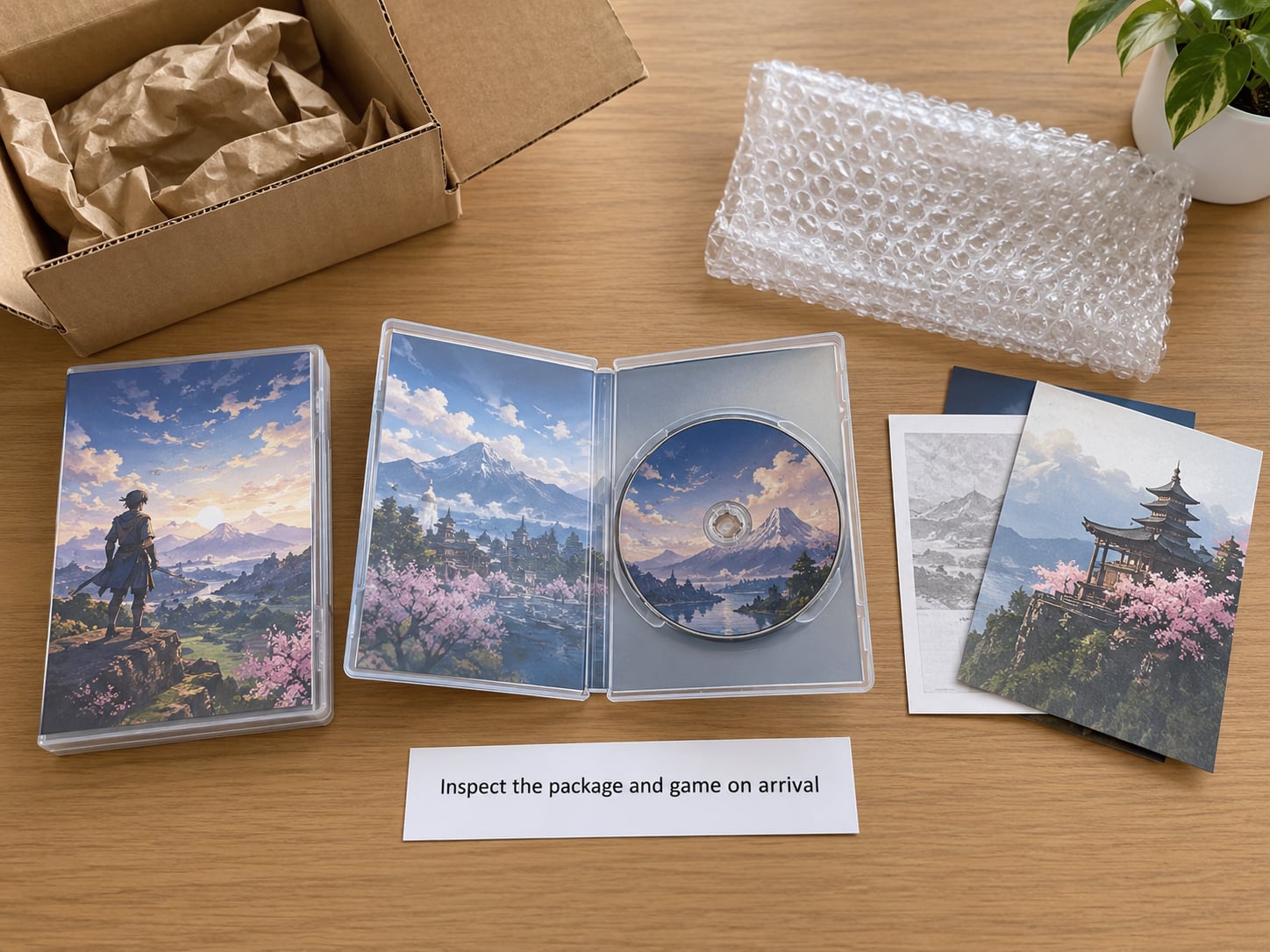
Open imported parcels the day they arrive, not the next week. Photograph the shipping box before you cut anything, because the carrier will not act on a claim you cannot evidence, and insurance claims usually require photos of the outer packaging.
Work through this checklist.
- Crushed corners, punctures, or a box that arrived with visible water damage or a soaking mark.
- A tampered shipping label, a reattached barcode, or tape over the original seal.
- The correct game, the correct edition, and the exact bonus items listed in the order.
- Missing inserts: manual, obi strip, warranty card, download code, art book, or the numbered seal for a limited edition.
- Disc condition under good light, checking for radial scratches near the hub and for any haze or rainbow banding.
- Cartridge pins under a loupe, looking for bent or green corroded contacts and for a cracked shell.
- Cartridge battery corrosion on Game Boy, Game Boy Advance and older handheld carts, where a leaking battery can destroy the board.
- Box art and spine condition, if the game is a CIB or sealed collectible rather than a loose cart.
Most problems show up as missing items rather than broken ones, and the cure is the same: photograph everything, then message the seller or forwarder the same day with the photos and the order number. Prompt reports get resolved; reports filed a month later usually do not.
Test the game and preserve the package
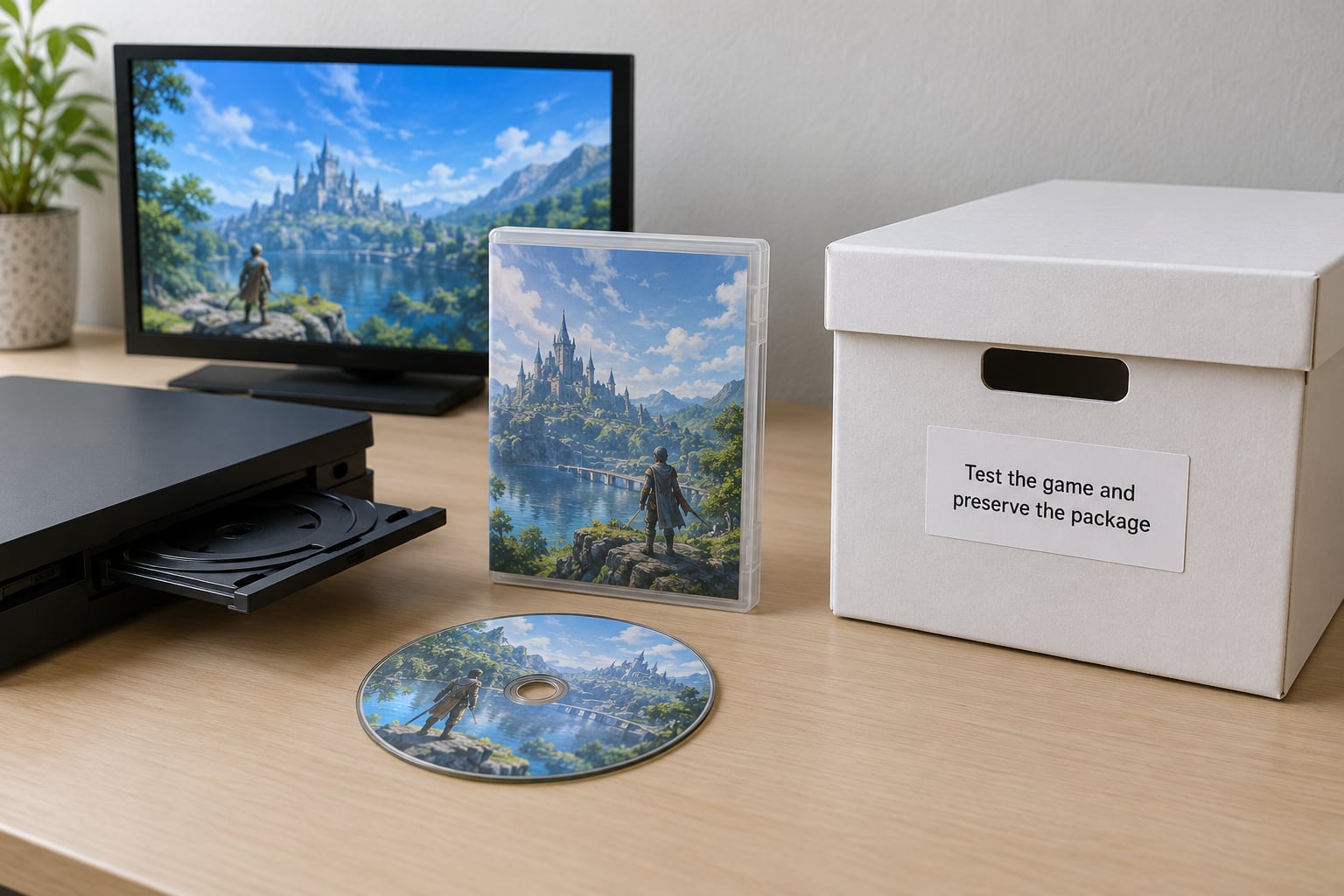
Test before you consider the purchase finished, and test in a way that cannot make things worse.
For discs, wipe in small circles from the centre outward with a dry microfibre cloth, then load it. Avoid household cleaners and avoid wet cleaning entirely. Confirm the audio track you expect, because a Japanese release with a Japanese voice track and no English option is not a defect.
For cartridges, test in the correct console, then open the shell and clean the pins with a cotton swab and a dab of 99 percent isopropyl alcohol if the picture is striped or the console does not detect it at all. For Game Boy and Game Boy Advance carts, check for a battery leak first and remove any battery with fresh tape on the contacts before applying power.
Document anything that fails while it is still in your hands. Unedited video of the failed attempt is far stronger evidence than a written description, and it costs nothing.
Then preserve the record. Keep the invoice, the customs receipt and the seller’s listing screenshot in the same folder as the game. Store discs upright in a jewel case sleeve away from direct sun, carts in a labelled archival box with a silica pack, and keep anything sealed in the bag it arrived in, because the bag is part of the value for serious collectors.
Common Mistakes
Almost every avoidable loss traces back to one of these.
- Buying the wrong region. You check the console brand and skip the model. Fix: confirm the exact model number before you look at a single listing, then use the table above.
- Ignoring language. The cart is right and the game is unreadable to you. Fix: read the language notes on the listing and check whether a translation patch exists before paying.
- Choosing untracked postage. Cheaper by a few hundred yen and worthless when the parcel disappears. Fix: tracked service on everything above replacement value.
- Not recording the order. A customs query or a damage claim needs the order number, tracking number and declared value. Fix: note all three the day you order.
- Opening the package roughly. Slice along a seam instead of the tape, or force a swollen jewel case and crack the disc hub. Fix: cut on a hard surface, tape down, open slowly.
- Declaring a low value to dodge duty. It occasionally works and sometimes costs you the game entirely. Fix: declare truthfully and budget the duty as part of the landed cost.
- Paying without photos. Sealed cart, cheap price, no recourse. Fix: ask for same-day photos of the actual unit and of the pins.
One habit prevents most of these at once: do not pay for anything until you can state the region, the language, the edition, the full landed cost and the return terms out loud. If any one of those takes more than a minute to work out, you are not ready to check out.
Frequently Asked Questions
Do I need to pay customs if I buy games from Japan?
It depends on your destination country and the value of the parcel. Most countries waive duty on low-value shipments below a de minimis threshold, and the United States has historically applied that exemption below 800 US dollars. Above the threshold you may owe import tax plus a handling fee. Declare the true value either way, because a parcel held at customs costs you far more than the duty would have.
Is it legal to import Japanese video games for personal use?
For your own collection, yes, and it is ordinary collector activity rather than anything restricted. Video games are normal consumer goods with no special import category. What changes the picture is intent: importing stock to resale turns it into a commercial act with its own licensing, customs and tax rules. Keep the receipt and the listing screenshot with the game so you can show ownership if a carrier ever asks.
Are used or sealed Japanese games safe to buy?
Used carts are the normal case in Japan and buying them is routine, but sealed copies carry real risk. Resealed boxes and clocked cartridges are the two most common frauds in this hobby, and a sealed copy priced far below the going rate is the classic signal. Ask for same-day photos of the actual unit, the label side and the connector pins, then check the serial and CERO sticker before paying.
What should I do if my Japanese package arrives damaged?
Photograph the outer box before you cut anything, then photograph the contents as you unpack. Message the seller or forwarder the same day with the photos, the order number and the tracking number, because claims filed a month later are rarely honoured. Unedited video of a disc or cart that fails to run is stronger evidence than a written description, and it costs nothing while the item is still in your hands.
Is the Japanese PS5 or PS4 region locked?
No. PS5 and PS4 discs are region-free, so a Japanese game runs on any disc console anywhere in the world. The real differences sit on the digital side. A Japanese PlayStation Network account only buys from the Japanese store, and a game bought on that account will not appear on a North American account, so plan which account owns your purchases before you commit to buying digitally.
Is it cheaper to buy games in Japan after all the fees?
For a single common cartridge, usually not once proxy fees, domestic postage, international shipping and any duty are added. For a box of used carts from one seller, or for a collector edition that never had a Western release, importing often wins clearly. The break-even point moves toward importing as the order size grows, because the fixed proxy and shipping charges get spread across more items.
Conclusion
If you do six things, almost nothing goes wrong. Know your exact console model before you look at listings, confirm the edition and language with the JAN code, add up the full landed cost including duty, ship tracked and insured, open the parcel the day it arrives and photograph everything, then keep the records with the game.
Start small. One cart through a proxy tells you how the fees, the transit time and the customs handling actually behave for your country, and that knowledge is worth more than any guide before you place a larger order.