If you have wondered why arcades are still popular in Japan, the answer is cheap, immediate, social play that a phone or a home console cannot easily copy: games built only for arcade hardware, cabinets you share with whoever is standing beside you, and venues a short walk or one train ride away. Seven factors explain that, and nostalgia is only one of them.
The short version: arcades in Japan are less a relic of the 1980s than a working retail business with regular customers, updated hardware on a multi-year cycle, and formats that simply do not exist anywhere else. What looks nostalgic from the outside is, for many regulars, an ordinary Tuesday evening.
Table of Contents
- 1Are Japanese Arcades Really Still Popular?
- 2Why Arcades Are Still Popular in Japan
- 3Why arcades are still popular in Japan: affordable play
- 4Why arcades are still popular in Japan: built for socializing
- 5Why arcades are still popular in Japan: dense locations
- 6Why arcades are still popular in Japan: distinctive arcade formats
- 7Why arcades are still popular in Japan: a steady stream of new games
- 8Why arcades are still popular in Japan: technology mobile games cannot easily copy
- 9Why arcades are still popular in Japan: communities, competition and nostalgia
- 10How Do Japanese Arcades Make Money?
- 11How Has the Arcade Business Changed?
- 12Which Arcade Types Are Most Popular?
- 13What Should Visitors Know About Japanese Arcades?
- 14Frequently Asked Questions
- 15Are arcades in Japan really declining?
- 16Why do Japanese players still visit arcades when they have mobile and console games?
- 17Can tourists easily visit a Japanese arcade?
- 18Are Japanese arcades mainly for children?
- 19Is nostalgia the main reason arcades remain popular?
- 20The Key Takeaway
Are Japanese Arcades Really Still Popular?
Yes, though the honest answer includes a shrinking headline number. National arcade counts compiled in a police white paper put Japan at 26,573 arcades in 1986 and 4,022 in 2019, and COVID-19 pushed closures further. That decline is real. What it describes is the collapse of the 1980s coin-op bubble, not the disappearance of the arcade.
The venues that remain are frequently newer, larger and more specialised than the ones that closed, and the big chains keep opening multipurpose floors in transit-linked districts such as Akihabara, Shinjuku, Ikebukuro and Osaka’s Dotonbori. Competition inside those buildings is intense, which is a sign of a live market rather than a dying one.
| Indicator | Figure | Date | Source | What it does and does not show |
|---|---|---|---|---|
| Total arcade venues | 26,573 | 1986 | Police white paper arcade count | Peak-era baseline for the coin-op bubble; not comparable to today’s venue mix |
| Total arcade venues | 4,022 | 2019 | Police white paper arcade count | Shows a large long-run drop; counts all sizes, including very small operators |
| Typical cost per play | roughly 100 to 200 yen | current | Operator pricing across chains | Entry-level games cluster low; specialty cabinets cost more |
| Operating chains | Taito Station, GiGo, Round1, plus specialists such as HEY and Mikado | current | Chain footprints | Chain and independent venues target different neighbourhoods and audiences |
| Post-2020 venue design | e-money and contactless payment at many urban locations | current | Operator policy | Confirms venues modernising; adoption varies by chain and location |
Two caveats matter when reading any arcade statistic. First, the count treats a two-machine neighbourhood parlour the same as a ten-floor entertainment complex, so the fall in numbers overstates the fall in capacity. Second, game arcades are only part of Japanese gēsen culture: crane floors, medal halls, private-game booths and rhythm-only rooms have different economics and different survival patterns.
Why Arcades Are Still Popular in Japan
The seven factors below split into structural advantages — what the building, the pricing and the hardware do — and cultural ones — who shows up and why. That split matters because nostalgia explains why someone returns once. It does not explain why a business still turns a profit.
Why arcades are still popular in Japan: affordable play
A single play on a standard cabinet commonly costs 100 to 200 yen, and premium formats sit above that. The important part is not the absolute figure but what it buys: an entertainment session measured in tens of minutes for roughly the price of a drink, with no console purchase, no download, no subscription and no monthly commitment.
Pricing is also unusually transparent. Most venues display per-game costs at the machine or on a posted chart, and machines accept coins directly or deduct from a stored-value card. When a session goes badly, the loss is bounded and small, which is exactly the calculation teenagers, office workers and groups splitting a birthday outing are making.
Contrast that with the alternatives. A home console or a current mobile title represents a much larger one-off or recurring outlay, and both compete with a phone that is already in your pocket. Arcades sell small, frequent, low-stakes entertainment, and the economics of a train ride and a few hundred yen fit inside a school afternoon.
Why arcades are still popular in Japan: built for socializing
Arcades function as a third place between home and work. Seating is communal, machines sit side by side rather than in separate rooms, and the loudest thing in the room is usually someone else having a good time. A visit can be entirely solo, but nobody designs the floor that way.
Formats make that social use concrete. Rhythm titles such as Dance Dance Revolution, Beatmania IIDX, Sound Voltex and Taiko no Tatsujin are played in pairs or in rotating groups where people watch each other and talk about routes. Fighting games at specialist venues run on a scene rhythm: you arrive, find people at the same level, and play for a few hours.
Crane and prize floors add a different kind of group activity, because chasing a plush or a figure is a shared pursuit with a visible scoreboard. The result is that an arcade visit has a length and a shape that a solo gaming session at home does not.
Why arcades are still popular in Japan: dense locations
Most Japanese arcades sit within walking distance of a major station, often on upper floors of buildings that also hold restaurants, karaoke, retail and offices. Commuters pass them daily. That means the decision to play costs almost nothing beyond the fare already being paid, and a group can assemble at a fixed time without booking anything.
Density also concentrates competition. Several venues within a short walk means regulars can specialise, and it means chains refresh floor layouts and hardware faster than they would in a town with one operator. Convenience is doing more work here than nostalgia, and it is the factor least visible from outside Japan.
Why arcades are still popular in Japan: distinctive arcade formats
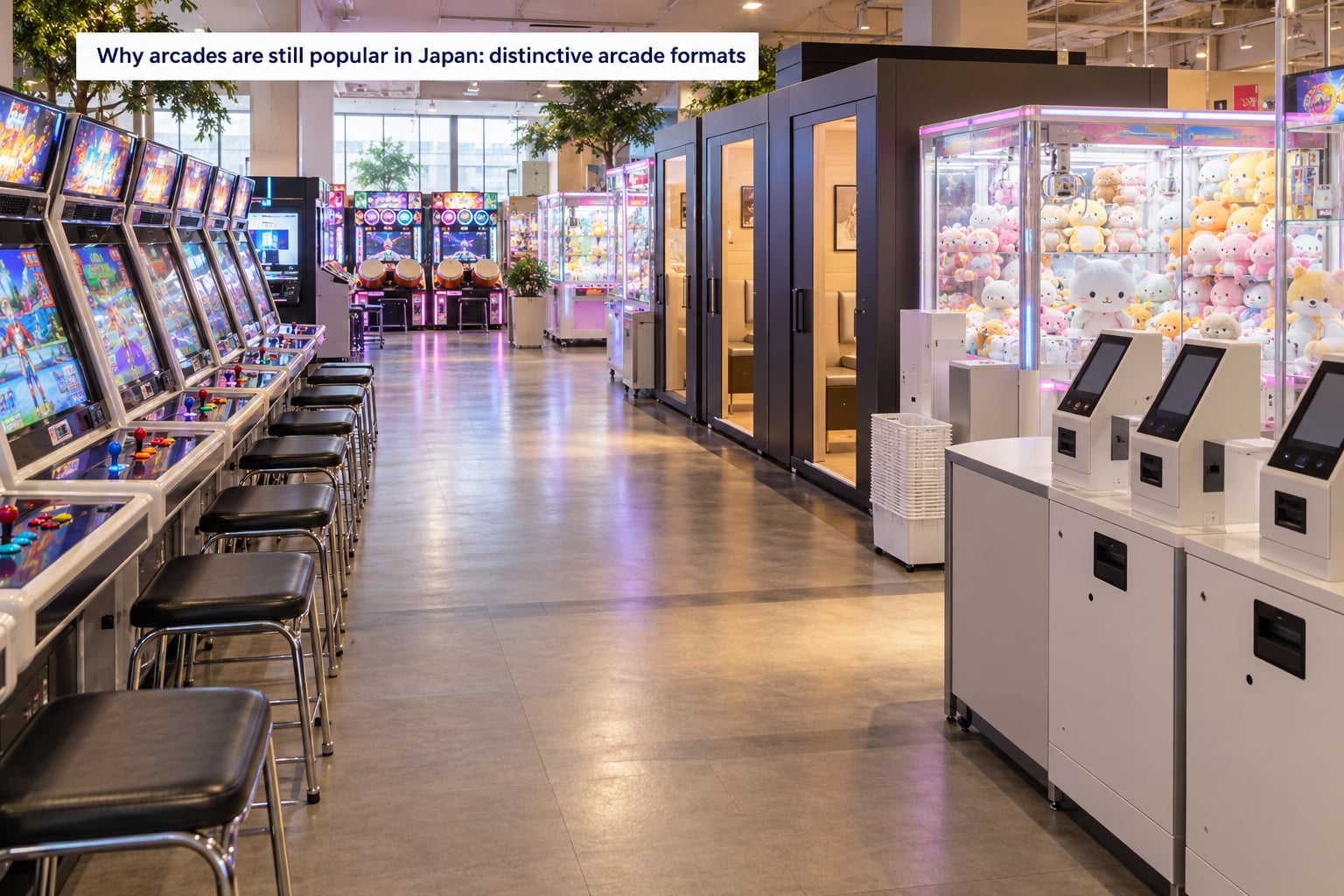
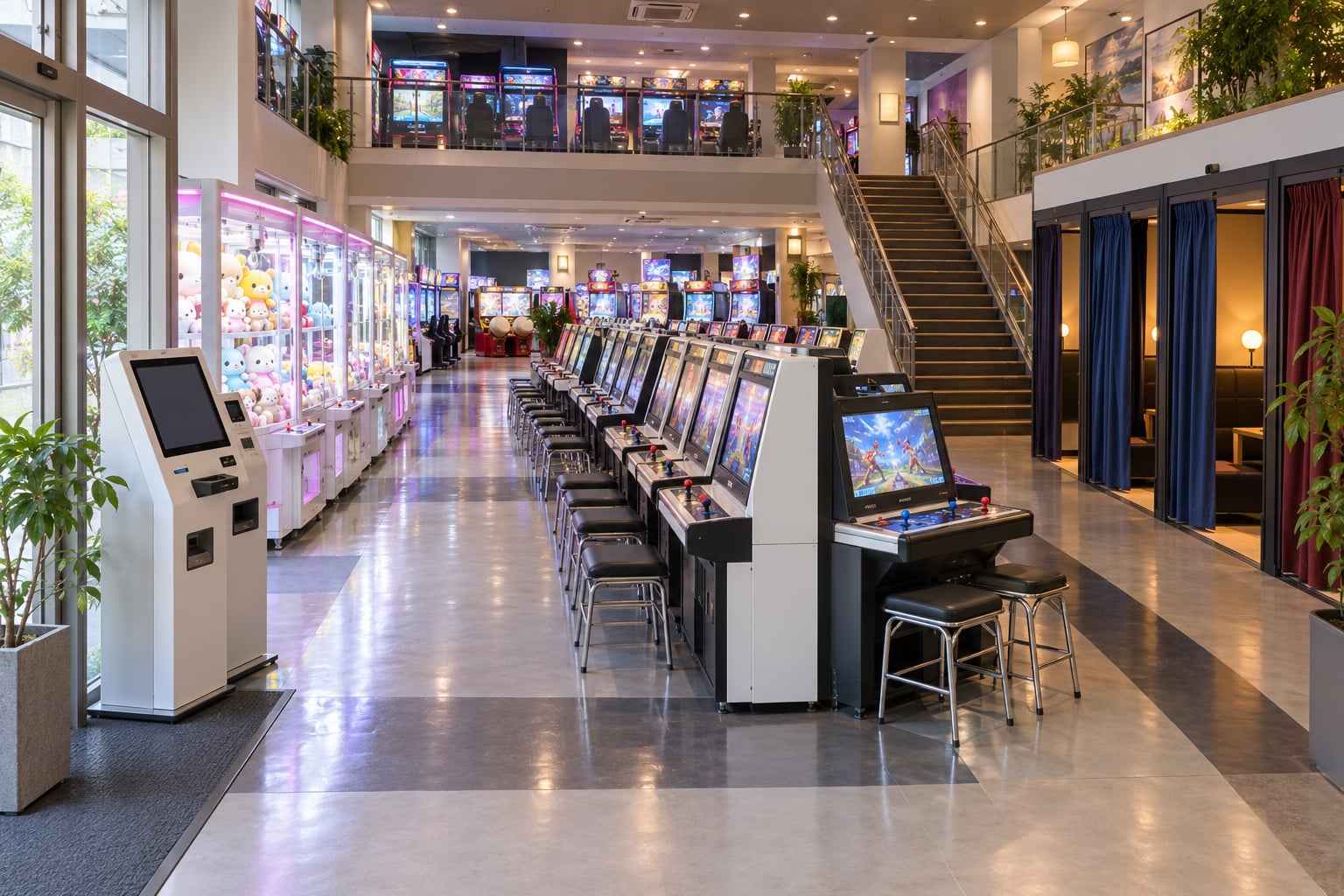
Many Japanese arcades are not one thing. A large venue might stack a rhythm floor, a general game floor, a crane floor with hundreds of machines, a purikura booth area, a sports hall with batting cages and bowling, and a private-room wing where a group rents its own space by the hour.
Other formats stand alone. Medal games operate on metal tokens with redeemable prizes, following different rules from standard play. Rhythm-only rooms run on a different atmosphere again, closer to a practice hall than a family attraction. Specialist retro halls preserve older cabinets and dedicated hardware that chains have already retired.
That variety matters for survival. A venue with a weak cabinet floor can still earn from prize machines, and a specialist hall can survive on a small, fiercely loyal audience. Chain operations and independent halls serve different neighbourhoods and different budgets, so the national average tells you very little about the building you walk into.
Why arcades are still popular in Japan: a steady stream of new games
Arcades are where Japanese publishers test live-service and competitive formats. Fighting game seasons, rhythm game updates and new arcade-only titles appear on a regular release rhythm, and major franchises frequently appear in arcades before or alongside console and mobile versions.
New software matters even when old machines stay popular. The rhythm and fighting scenes would collapse if the content pipeline stopped, because the reason to return is improving at something other people can see. It is also why dedicated venues invest in current hardware platforms from manufacturers such as Taito, Namco and Sega rather than clearing the floor for older stock.
Realistic expectations matter here. A flagship release draws a crowd for weeks, and the ordinary operating day is a mix of current titles, long-running series and machines that have been in place for years. Nobody disputes that arcades get new games; the debate is only about how much of the floor is new on any given week.
Why arcades are still popular in Japan: technology mobile games cannot easily copy
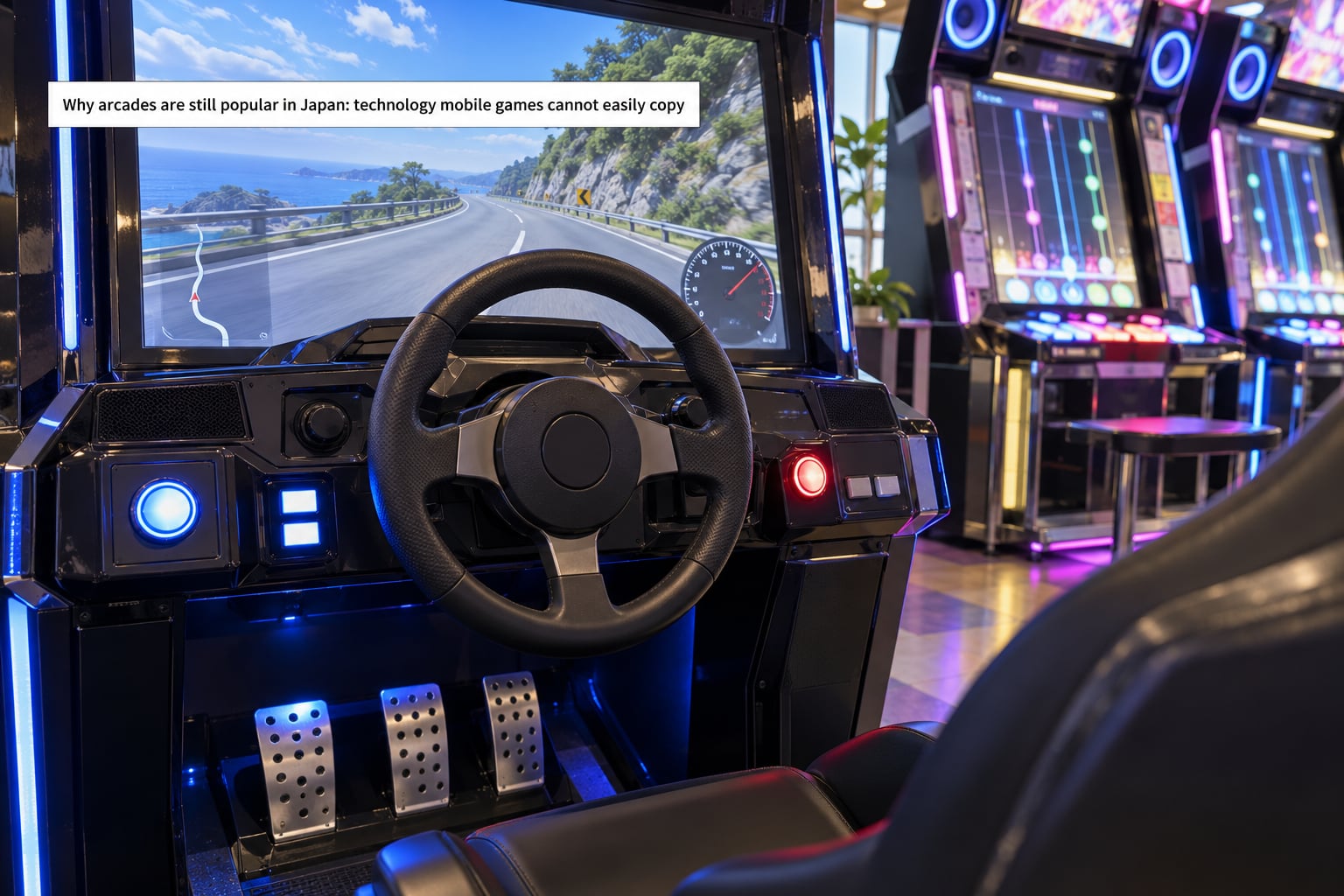
A racing simulator with a full-size wheel, force feedback and a pedal set cannot be flattened onto a touchscreen. The same holds for a turntable-and-keys rhythm setup, a motion-riding motorcycle cabinet, a dancing platform, a full-size gun rig or a mecha cockpit. The hardware is the game, and no phone reproduces the feel of a deliberate, calibrated pull on a wheel bolted to a cabinet.
The public screen changes the experience too. A player is not alone with a private display, which means progress is visible, technique is copied from the person next to you, and a good run draws an audience. Mobile gaming is more portable and often cheaper per hour. It is not the same activity, and most regulars treat them as separate hobbies rather than substitutes.
Worth saying plainly: arcade hardware is not automatically more advanced than what sits at home. It optimises a different combination — accessibility, spectacle and social presence — using PC-based multi-game boards alongside dedicated cabinets. Both approaches ship titles. Only one puts a stranger’s shoulder next to yours.
Why arcades are still popular in Japan: communities, competition and nostalgia
Regulars are the reason floors stay busy on a Tuesday. Fighting game communities cluster around specific halls such as HEY and Mikado, where tournaments, meetups and long practice sessions are the point. Rhythm players turn up in sportswear for multi-hour runs. Crane players track which floor has the best odds this month.
Nostalgia plays a real part in that. Familiar franchises from someone’s childhood pull in older visitors, and the arcade is one of the few places where those machines still exist at full size. But nostalgia alone would produce a museum, not a business, and it explains visits rather than frequency.
The frequency explanation is the community. Skill is visible, shared and improving in public, and a venue where people recognise you is worth returning to. Some of the most loyal venues have survived on community support campaigns, which is a decent indicator of how much of the value is in the crowd rather than the machines.
How Do Japanese Arcades Make Money?
Most venues run several income streams at once, and which one dominates depends heavily on format. A rhythm-only room and a crane hall look like the same business from the street and are not.
| Revenue stream | Why the customer pays | Operating pressure it creates | Sign a reader will notice |
|---|---|---|---|
| Per-play machine revenue | Access to cabinets you cannot own | Hardware refresh cycles and power and floor costs | Long rows of popular cabinets on a weekend afternoon |
| Prize and crane machines | Winning a plush or figure at retail prices | Prize inventory and per-machine setting | Stacks of prize displays near the entrance |
| Medal games | Token play with redeemable prizes | Separate rules and payout exposure | A medal counter at the entrance of a dedicated hall |
| Food, drink and private rooms | Staying longer without leaving the building | Staffing and cleaning | A cafe counter on the main floor, hourly room bookings |
| Stored-value card sales | Convenience and promotional top-ups | Unspent balances and card servicing | Charge and top-up machines by the entrance |
| Events and tournaments | Entry fees and repeat attendance | Staff time for events, prize budgets | A posted tournament schedule near the front |
Two habits keep money moving. Private rooms let a group pay by the hour for a space of its own, which converts a walk-in visitor into a booked one. And the promotional calendar — seasonal events, limited prize runs, new cabinet releases — pulls in occasional visitors who would otherwise never make the trip.
How Has the Arcade Business Changed?
The long arc runs from home-centred gaming to location-based entertainment. Arcades stopped competing with consoles on console terms and started competing on things consoles cannot offer: shared physical hardware, prize mechanics, and an excuse to leave the house.
Payment is the clearest change most visitors notice. Coins still work in many places, but e-money and contactless top-ups are now standard at large urban chains, which removes the token queue and makes small repeat purchases painless. Vending-style card dispensing and floor staff have also become routine at bigger venues.
COVID-19 pushed the industry in both directions. It accelerated closures among small operators, and it raised expectations around cleaning, spacing and indoor ventilation at the ones that stayed. Meanwhile demand for at-home entertainment pulled some audiences away, and hybrid formats with mobile links and account systems softened the blow for venues that could update their software.
The pressures that remain are ordinary ones: rent in a dense city, staffing costs, and hardware investment against an audience split into specialists and casual visitors. Survival now tends to mean specialising. A general floor with no identity struggles; a hall that commits to fighting games, rhythm games or prize machines can build a following that a floor trying to please everyone cannot.
Which Arcade Types Are Most Popular?
There is no reliable national ranking of arcade types by popularity, and patterns shift by city, district and chain. What you can do is match venue type to the kind of session you want.
| Arcade type | Typical audience | Main attraction | Session length | Main revenue source |
|---|---|---|---|---|
| Large multipurpose complex | Everyone, including first-time visitors | Crane floors, prize displays, variety, convenience | 30 to 120 minutes | Prize machines plus per-play games |
| Game-focused hall | Regular players and enthusiasts | Fighting games, rhythm titles, current releases | 1 to 4 hours | Per-play revenue |
| Crane and prize centre | Collectors, couples, families, tourists | Winning prizes rather than scoring points | 20 to 90 minutes | Prize machines |
| Rhythm or dance room | Dedicated players, often in pairs | Full-size cabinets, practice and community | 1 to 5 hours | Per-play revenue |
| Racing and sports venue | Groups, dates, casual visitors | Simulators, batting cages, bowling, sports challenges | 45 to 120 minutes | Mixed play, food and drink, room hire |
| Specialist retro hall | Older players and preservation-minded visitors | Older cabinets and dedicated hardware | 1 to 3 hours | Per-play revenue, often higher per play |
The pattern behind the table: venues that reward repeat skill attract long sessions, and venues that sell prizes attract short ones. That difference shows up in everything from staffing to floor design.
What Should Visitors Know About Japanese Arcades?
Entry is usually free, with payment happening at a change machine or on your card or stored-value card. Coins are still accepted widely, but e-money and contactless top-ups are common at large urban chains. Check the entrance signage for what that specific building accepts.
Per-play costs vary by format. Standard cabinets cluster in the low hundreds of yen, premium simulators cost more, and private rooms are billed by the hour. Posted prices at the venue are the only accurate reference, because every chain and location sets its own.
IC-style stored-value cards split into several incompatible systems, such as e-Amusement Pass, Banapassport, Aime and Nesica. Each works with its own operator’s machines, and a card bought for one chain will usually not load a game at a competitor’s floor. If you plan to play seriously, buy the card for the chain you will use most.
On etiquette: put in your coin only when the machine is free, keep the play area clear during a match, and do not touch another player’s cabinet mid-game. In rhythm rooms, watch the local rotation pattern before joining a machine. Photography rules vary by chain, and many venues restrict photography of players, so ask staff rather than assuming.
Age restrictions exist for prize machines and medal areas, and every venue sets its own entry conditions for minors at particular times. If you are travelling with children, check the chain’s current policy before you go, because hours and rules differ between buildings.
Frequently Asked Questions
Are arcades in Japan really declining?
The number of venues has fallen sharply, from 26,573 in 1986 to 4,022 in 2019 by police white paper counts, and COVID-19 accelerated closures. But the venues that remain are often larger, newer and more specialised, with chains continuing to open multipurpose floors in major stations. The decline describes the collapse of the coin-op bubble, not the end of the arcade.
Why do Japanese players still visit arcades when they have mobile and console games?
Because the two are not substitutes. Arcade cabinets offer shared physical hardware, a public screen, a live scene and prize mechanics that a phone or a living-room console cannot reproduce. Pricing also matters: a play commonly costs 100 to 200 yen, so an evening of entertainment needs no purchase commitment at all. Most regulars simply treat arcade play as a separate hobby from solo gaming.
Can tourists easily visit a Japanese arcade?
Yes. Entry is usually free and major chains such as Taito Station and GiGo operate in central districts including Akihabara, Shinjuku, Ikebukuro and Osaka. Coins work widely, and e-money or contactless top-ups are common at large urban venues. Buy the stored-value card for the chain you plan to use, since card systems are not interchangeable, and check age and photography rules for that specific building.
Are Japanese arcades mainly for children?
No. Families with young children make up one visible group, but adults make up much of the regular audience: office workers on evenings, couples on dates, and committed players who stay for hours on rhythm and fighting games. Women frequently report feeling comfortable in Japanese arcades. Visitor reports also note that the crowd is mostly local rather than tourist, which changes the atmosphere completely.
Is nostalgia the main reason arcades remain popular?
Nostalgia explains the first visit, not the habit. Familiar franchises pull in older players who remember them at full size, and specialist halls keep older cabinets alive because of that attachment. Frequency comes from somewhere else: visible skill, a community that recognises you, new releases, affordable repeat play and a location you pass every day. That habit, not memory, is why arcades are still popular in Japan.
The Key Takeaway
Affordability, social use, walkable locations, specialist formats, regular new releases, hardware a phone cannot copy and communities that make repeat visits worthwhile. Each one alone would be a footnote; together they are a working business that survives every competitor consoles and phones have thrown at it.
If you are planning a first visit, pick one well-reviewed urban multipurpose arcade near a major station, then check that building’s current payment methods, age rules and posted per-play prices before you travel. Everything else on this list you can work out once you are standing on the floor.