English AI models struggle with Japanese because almost every layer of the system was built for English first: the tokenizer was trained mostly on English text, the pretraining corpus is dominated by English, and the post-training data that teaches politeness and tone comes overwhelmingly from English speakers. The result is Japanese output that often reads as fluent to a non-speaker but slightly off to a native reader.
If you have searched why English AI models struggle with Japanese, you will usually find the same answer repeated: tokenization, data imbalance, and language structure. That is mostly right, but it leaves out the failure Japanese users actually complain about most, which is register. A model can produce perfectly grammatical sentences at the wrong level of politeness for a business email, which is a failure no English user would notice because English has no keigo.
This guide breaks the problem into the parts you can actually act on: how text gets split up, what the training data looks like, why benchmarks miss the issue, and what to do about it in your own workflow. It is written for developers, founders, marketers and Japan-based teams shipping Japanese-language features.
As of 2026, the gap has narrowed considerably from where it was two or three years ago, and some of what you remember as a Japanese failure was really a tokenizer failure that has since been patched.
Table of Contents
- 1Why English AI Models Struggle With Japanese
- 2Why English AI models struggle with Japanese even when the grammar is correct
- 3How tokenization makes Japanese harder to process
- 4Why Japanese grammar and writing systems stay difficult
- 5How English-centered training data limits Japanese performance
- 6Why mixed Japanese and English prompts cause failures
- 7How benchmarks can hide weak Japanese ability
- 8What model providers can improve
- 9What users and Japanese teams should do
- 10Prompt patterns that fix the most common failures
- 11Run your own tokenization check in under a minute
- 12A selection checklist for Japanese-language AI features
- 13When these models actually perform well in Japanese
- 14Frequently Asked Questions
- 15Can English AI models handle Japanese reliably?
- 16Is Japanese tokenization worse than English tokenization?
- 17Do AI models need Japanese prompts to answer in Japanese?
- 18How can I tell whether a model understands Japanese or is only translating?
- 19Are Japanese benchmarks enough to measure practical AI performance?
- 20Should Japanese companies use an English AI model without native-speaker review?
- 21Is Japanese a low-resource language for AI models?
- 22Conclusion
Why English AI Models Struggle With Japanese
The short answer is five causes stacked on top of each other: inefficient tokenization, a smaller share of high-quality training data, three writing systems loaded into one sentence, weak modelling of politeness register, and evaluation that never tests the tasks you care about. Remove any one of them and the model would be noticeably better in Japanese. That is also why single-cause explanations, like “the tokenizer is bad at Japanese,” satisfy nobody.
It helps to separate two different complaints that get bundled together. One is bad Japanese: wrong particles, stiff phrasing, repeated high-frequency words. The other is bad work: the model ignores your instruction, invents facts, mistranslates a contract clause, or answers a business question in a tone that would cause offense. The first is a language problem. The second is a reliability problem that happens to be more visible in Japanese.
Why English AI models struggle with Japanese even when the grammar is correct
Grammar is the easy part. A model asked to write a paragraph of Japanese can usually satisfy the syntax, because Japanese syntax is regular and heavily repeated in its training data. What it struggles with is everything layered on top: which words to choose, how formal to be, what to leave unsaid, and whether the answer is grounded in anything.
So when someone says a model understands Japanese, ask what they measured. Reading and generating Japanese prose? Following an instruction written in Japanese? Translating in both directions with the right tone? Answering questions about a Japanese company from a Japanese document? Calling an API with a Japanese argument and using the return value correctly? Producing copy that a Tokyo marketing team would send to a customer?
These are different capabilities with different training requirements, and one does not imply the others. A model can translate into Japanese but fail to follow a Japanese instruction, or hold a long Japanese conversation but produce something unusable for a regulated Japanese workflow.
How tokenization makes Japanese harder to process
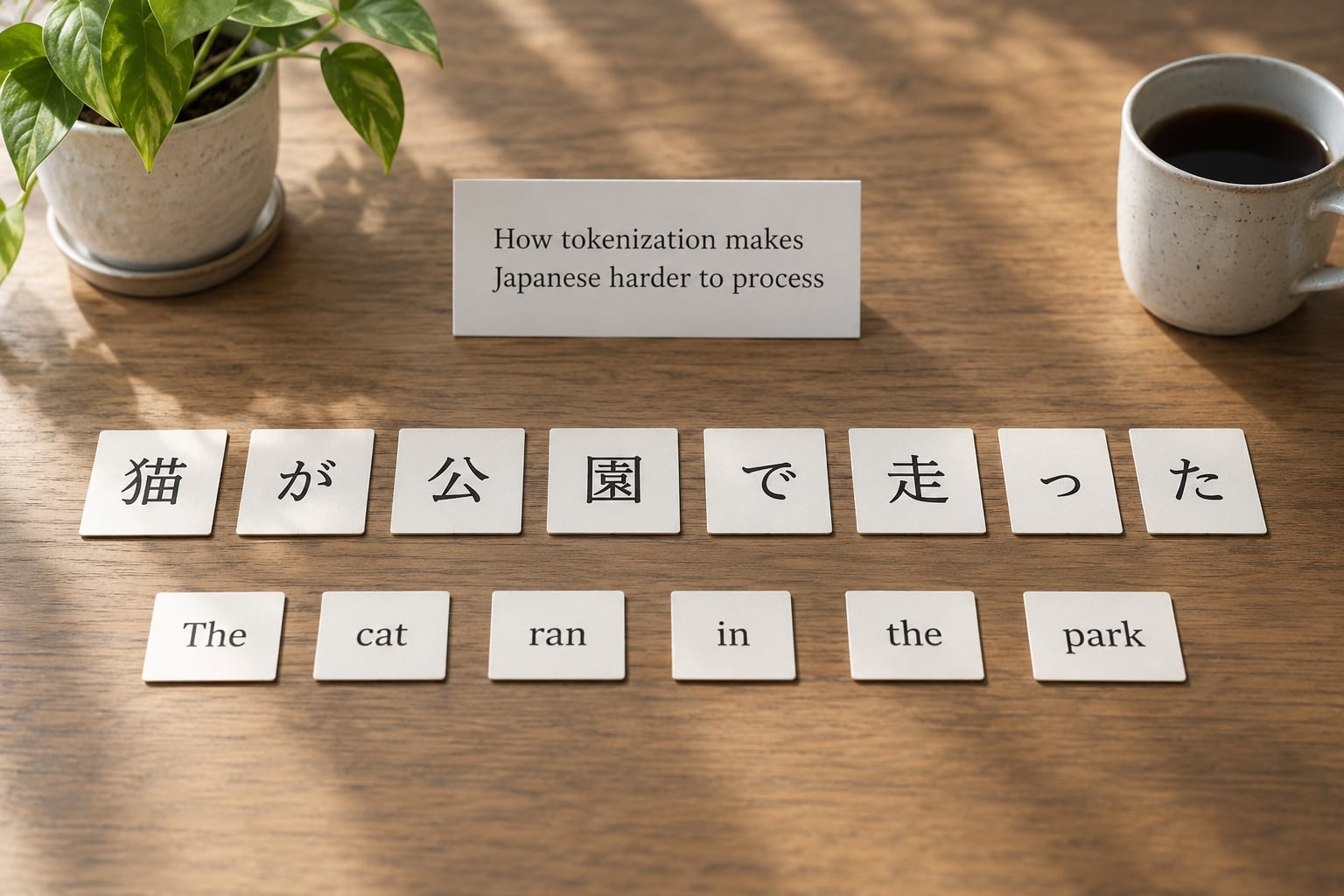
Before any model reads your text, a tokenizer splits it into tokens, which are the units the model actually processes. Modern tokenizers, including byte pair encoding and SentencePiece variants, learn merges from text and build a fixed vocabulary. Whitespace is a gift in English because it marks word boundaries for free, so the vocabulary fills up with whole words like “translation” or “because”.
Japanese has no spaces, so the tokenizer has to guess where words start and stop, and it often falls back on single characters and small fragments. The same meaning costs more tokens, and more tokens means more computation, a smaller effective context window, higher cost, and thinner learned representations for that language.
A widely cited example comes from a Zenn analysis of open models: the term 大規模言語モデル, meaning large language model, splits into eight tokens in a Llama-family tokenizer, while the equivalent English phrase takes three. The same analysis puts Japanese at up to 2.3 times the token cost of English for equivalent content. Those figures are model-specific, not universal, which is exactly the point.
The tokenizer story got measurably better in the GPT-4o generation. The arXiv cultural-fidelity work reports the new tokenizer cutting Hindi text from 90 tokens to 31, a 2.9 times improvement, with smaller gains for German and Vietnamese. That is the shape of the fix: fewer, larger multilingual tokens built into the vocabulary from the start rather than bolted on later.
| Same idea, written four ways | What the model has to work with | Effect on token cost |
|---|---|---|
| Japanese written mainly in kanji and kana | Mixed blocks of a few characters each, boundary guesses at every run | Noticeably higher than English for the same meaning |
| Japanese written mainly in kana | Small grammatical units that merge poorly, since kana words are short and irregular | The worst common case for Japanese text |
| Japanese typed in romaji | ASCII letters, but every word is split into syllables with no real word forms | Highest token cost of all, and the weakest output quality |
| The English equivalent | Whole words, boundary marked by a space | The baseline every other row is compared against |
Beyond cost, fragmentation hurts meaning. Japanese leans on wordplay, puns and fixed expressions that read as one idea but split into unrelated fragments. Learners on Bunpro and similar communities describe the effect plainly: models repeat the same handful of high-frequency words because those are the fragments the tokenizer and the data give them most often.
Why Japanese grammar and writing systems stay difficult
Japanese mixes three scripts in a single sentence: kanji for nouns and content words, hiragana for grammar, and katakana for loanwords, product names and technical terms. Romaji and full-width Latin show up too. A model has to infer the script boundary and the word boundary at the same time, with no whitespace help.
On top of that, subjects and objects are routinely dropped because context supplies them, and what is dropped changes with the relationship between speaker and listener. Particles mark case and topic, and the difference between は and が is a difference in meaning, not grammar tutoring. Verbs inflect, and the choice of plain, polite or honorific form changes who the sentence is addressed to.
None of this is unusual to a Japanese speaker, and none of it is inferable from the surface characters. That is why character-by-character substitution and literal word-order translation produce sentences that are readable and wrong.
How English-centered training data limits Japanese performance
Tokenizer design is only half the story. What a model knows comes from what it read, and English dominates at every stage of the pipeline: pretraining crawls, instruction and preference data, and human feedback used for alignment.
There is a real nuance here that most explainers skip. Japanese is not a low-resource language. It sits at roughly 4.5 percent of websites in the cultural-fidelity research, which is a large slice of the multilingual web, and it has more native speakers than Russian or Arabic. So the usual “low-resource language” explanation does not apply cleanly, and the frustration you see in Japanese communities is exactly this: the language is everywhere online, and the tools still feel subtly off.
The arXiv analysis quantifies the version of this that does hold up. For GPT-4o, 44 percent of the variance in how well the model reflects a language’s societal values correlates with how much digital material exists in that language, rising to 72 percent for GPT-4-turbo. The gap in error rates between high-resource and low-resource languages exceeded five times.
Volume is only part of it, though. Quality matters more. A large share of Japanese text online is machine-translated, scraped low-quality forum content, or translated from English in the first place, so the model learns to imitate translationese. The arXiv paper used native-speaker verification on World Values Survey answers for exactly this reason: fluent output with imported cultural assumptions is still wrong.
Domain gaps compound it. Business email, HR documents and Japanese legal text are a thin slice of any corpus, even in English. In Japanese they are thinner, and the register rules inside them are strict enough that a model trained mostly on casual web text will get the tone wrong even when the vocabulary is fine.
Outdated references hurt too. A model answering a question about Japanese companies, prices or services will happily produce confident details that no longer exist, because fluency is not the same as freshness and the model has no built-in sense of which facts have decayed.
Why mixed Japanese and English prompts cause failures
Ask a model a question in Japanese that involves English technical material, and it has to switch languages mid-sentence. In practice it does this badly.
Terminology drifts, so a product name from your prompt turns into a translated description by the end of the answer. Politeness level drifts too, and it often drifts downward into casual です・ます tone once the answer gets technical, which is the opposite of what a Japanese business context needs. Participants on Japanese forums describe the common pattern: the model answers the first paragraph properly, then slides into casual or English when the topic gets specific.
The reverse also happens. Japanese prompts with English system instructions produce answers in whichever language the longer context seems to pull toward, which is another reason Japanese developers are told to write their prompts fully in Japanese and avoid machine-translated boilerplate.
Voice input adds its own layer. Japanese speech recognition frequently confuses homophones and long vowel marks, and then transcribes them into the wrong kanji, which hands the model garbage it cannot recover from. That is why a voice-typed request can produce a confident answer to a question you never asked.
How benchmarks can hide weak Japanese ability
Japanese scores on general multilingual benchmarks look better than Japanese output quality in practice, and the gap comes from how those tests are built.
Contamination is the first problem. If a benchmark item is a translation of a familiar passage that also appears in the training corpus, the score measures recall rather than ability. Translation-based evaluation is the second problem, because a test built by translating an English set rewards matching the English wording, which is the opposite of what a Japanese user needs.
Multiple-choice formats are the third. Picking the correct option does not require producing natural prose, holding a register across 500 characters, or getting a particle right inside a business email. Benchmarks saturate, meaning everyone scores near the ceiling, while the underlying weaknesses move somewhere the benchmark does not look.
The practical test is whether the model can do your specific Japanese work: read a Japanese contract and answer questions about it, write a customer reply in the correct register, or extract structured data from a Japanese PDF without mangling the labels.
What model providers can improve
Providers have four levers, and all four matter more than model size.
- Better Japanese pretraining data. More native Japanese text, with aggressive filtering of machine-translated and low-quality scraped content.
- Tokenizer design built for multilingual text. More merge budget for CJK and other scripts, so a common Japanese term lands on one token instead of eight. This is the fastest fix in terms of cost and context.
- Evaluation by fluent speakers. Native-speaker review of Japanese output and of cultural fidelity, not just automated accuracy scoring against reference translations.
- Domain-specific grounding. Retrieval over the actual Japanese documents you care about, plus post-training with data reviewed by fluent Japanese speakers rather than translated from English material.
Reasoning models add a specific problem worth watching. Long chains of thought are typically generated in English or Chinese, then converted into the answer language. That conversion step is where register mistakes appear, and it is why some models answer a Japanese question fluently but with a translated, flattened tone.
DeepSeek’s language consistency reward, reported in the Zenn analysis, is one attempt at this, trading some reasoning quality for answers that stay in the requested language. It shows the tradeoff is real rather than imaginary.
What users and Japanese teams should do
You cannot fix the pretraining data, but you can control the workflow around it. The framework that works best is: test the exact task, state the language and audience explicitly, give the model context and examples, verify names and numbers, ask for source text, and escalate anything culturally sensitive or high-stakes to a fluent reviewer.
Prompt patterns that fix the most common failures
Naming the register is the single most effective change. Instead of asking for a business email, specify the speech level and the audience.
For a customer-facing message: “Write a reply to a Japanese customer who has complained about a delayed delivery. Use 敬語 (keigo) appropriate for business correspondence with a first-time external contact, keep sentences short, and do not use casual です・ます forms.”
For an internal update: “Summarise this for a Japanese-speaking internal team. Use plain です・ます form, no honorifics, and keep any technical terms in English with a Japanese gloss on first use.”
When you need both, ask for both and compare, which is a fast way to catch an unwanted register shift: “Give me two versions, one casual for peers and one business keigo for an external client, and tell me what changed between them.”
Ask for grounding when facts matter: “Quote the Japanese source text for every number and company name you use. If something is not in the source, say so instead of filling it in.”
Run your own tokenization check in under a minute
You do not need to trust anyone else’s numbers. Paste the same message twice into a tokenizer tool, once in natural Japanese and once in English, and compare the counts. Free tokenizer pages are linked from most tokenizer explainers, and the platform’s own tokenizer tool is the one to use if you are already paying an API bill.
Then repeat with a romaji version of the same Japanese sentence. That row is where the cost gap becomes obvious, and it is also the strongest practical argument for typing Japanese prompts in Japanese rather than in romaji.
A selection checklist for Japanese-language AI features
| What to check | English baseline | What weak Japanese support looks like |
|---|---|---|
| Training data share | Dominant language, native-scale instruction and feedback data | Present but partly machine-translated, with gaps in business and legal domains |
| Tokenizer efficiency | Whole words per unit of meaning | Character-level fragmentation, inflated token count per sentence |
| Register modelling | Politeness carried by tone and word choice | Keigo handled inconsistently, casual tone leaking into business answers |
| Cultural fidelity | Values align with source-language expectations | Answers import English-first assumptions that read as foreign |
If a vendor will not tell you how they evaluate Japanese, test them instead. Give three real Japanese tasks from your own workflow, score the output with a fluent reviewer, and compare at least one general model against one tuned for Japanese use.
When these models actually perform well in Japanese
This is not a story of total failure, and overstating it helps nobody.
Current multilingual models handle simple and medium translation between English and Japanese, summarization of pasted Japanese text, brainstorming Japanese taglines, first-draft Japanese support macros, extraction of structured fields from Japanese documents, and casual conversation with a native speaker who is willing to correct it. Where the input is clean, the task is short, and a fluent reviewer reads the output, the quality is genuinely usable.
Verification stays necessary when the audience is external, the register is formal, the content is regulated, or the facts are numbers, names and dates. Those four conditions cover most of what a Japanese-language product actually does, which is why the honest answer is that the models are good enough to draft and not good enough to send unreviewed.
Frequently Asked Questions
Can English AI models handle Japanese reliably?
For short, low-risk tasks, yes. Drafting, summarising pasted text, brainstorming and simple translation are usually usable today. Reliability drops when the audience is external, the register is formal, or the output contains numbers, names and dates. Treat Japanese output as a strong first draft that a fluent reviewer signs off on before a customer sees it.
Is Japanese tokenization worse than English tokenization?
Yes, for most tokenizers. English has whitespace boundaries, so the vocabulary stores whole words. Japanese has no spaces and mixes kanji, hiragana and katakana, so the tokenizer falls back on small fragments. Reports put Japanese at up to 2.3 times the English token cost for equivalent content, though the exact figure depends on the model and improved tokenizers have narrowed the gap.
Do AI models need Japanese prompts to answer in Japanese?
You can answer in Japanese from an English prompt, but quality usually drops, especially on tone. The model then translates rather than composing, which flattens register and register mistakes slip through. For business or formal Japanese, write the prompt in Japanese and state the speech level you want. Typing the request in romaji is the worst option of the three.
How can I tell whether a model understands Japanese or is only translating?
Give it a task that cannot be translated into English, such as rewriting the same message at two different politeness levels for two different audiences. A translating model produces near-identical sentences with synonyms swapped. A model that genuinely handles Japanese changes honorifics, sentence-final forms and vocabulary, and can explain what it changed and why.
Are Japanese benchmarks enough to measure practical AI performance?
No. Most multilingual benchmarks are translation-based or multiple-choice, both of which skip register, particle accuracy and long-form coherence. Scores also saturate while real weaknesses persist. The useful test is your own workflow: real Japanese documents, real audiences, and a fluent reviewer scoring the output against what a person would have sent.
Should Japanese companies use an English AI model without native-speaker review?
Not for anything customer-facing. General models handle Japanese drafting well enough to save time, but they mishandle politeness register, particle choices and cultural assumptions in ways only a fluent reviewer reliably catches. In regulated industries the review is a compliance requirement, not a quality nicety. Automate the drafting, keep the human sign-off.
Is Japanese a low-resource language for AI models?
Not by volume. Japanese accounts for roughly 4.5 percent of websites in published research, and it has more native speakers than Russian or Arabic. The problem is quality and distribution, not raw quantity. Research found 44 percent of the variance in GPT-4o value representation correlates with digital material in that language, so abundance helps without guaranteeing good output.
Conclusion
English AI models struggle with Japanese for a stack of reasons, not one: tokenizers trained on English fragment Japanese text into too many pieces, English dominates the training data at every stage, Japanese grammar hides meaning that no character-level translation can recover, politeness register is under-modelled, and the benchmarks used to measure progress rarely test real Japanese work.
So test before you deploy. Run your own Japanese tasks through two or three models, score the output with a fluent reviewer, and name the register you need in every prompt. That first hour of testing will tell you more than any benchmark chart.