How to sell software to Japanese companies comes down to four things: localize well past translation, work through a buying committee that reaches consensus before anything is signed, plan for a sales cycle that runs six to eighteen months, and have Japanese-language security, contract and support material ready before your first serious conversation. Skip any one of those and deals stall quietly rather than collapse loudly. That is the honest version of the playbook, and the rest of this guide walks through it step by step.
This guide is written for a founder, sales lead or GTM manager at a non-Japanese software company that wants Japanese enterprise or SME customers. It assumes you have a working product and no local presence yet.
Table of Contents
- 1What You Need
- 2Step-by-Step: How to Sell Software to Japanese Companies
- 3Step 1: Research the Japanese market and choose the right problem
- 4Step 2: Localize the product and sales materials for Japan
- 5Step 3: Build a list of qualified Japanese prospects
- 6Step 4: Find a local partner or sales representative
- 7Step 5: Reach out with a relevant business proposal
- 8Step 6: Present a pilot or proof of concept
- 9Step 7: Build trust through security, governance and support
- 10Step 8: Negotiate and close the commercial agreement
- 11Common Mistakes
- 12Frequently Asked Questions
- 13Is English enough to sell software in Japan?
- 14How long does it take to sell software to Japanese companies?
- 15Do I need a Japanese company or entity to sell software there?
- 16What documents do Japanese companies require from software vendors?
- 17Should I sell direct or through a Japanese partner?
- 18How do Japanese companies choose a software vendor?
- 19Conclusion
What You Need

Selling software to Japanese companies means localizing beyond translation, because Japanese enterprise purchases are consensus-driven across a multi-department buying committee, usually run through a partner, and take six to eighteen months from first meeting to signature. Everything else in this guide hangs off that.
Before you contact anyone in Japan, you need five things in place.
A localized product. The interface, the error messages and the empty states should all read naturally in Japanese, not like a word-for-word translation of English. Machine-translated menus are the fastest way to signal that nobody in your company speaks to customers here.
Japanese-language materials that go past the homepage. You need a Japanese site, Japanese documentation, a Japanese security page and a Japanese support presence. Buyers check the support page before they check the features.
A route to market. Decide whether you are selling direct, through a Japanese system integrator, or through a reseller. Trying all three at once confuses buyers and wastes your first year.
Market knowledge. JETRO publishes free material on the Japanese SME market, and METI publishes digital transformation policy that tells you which industries are being pushed to modernize. Read both before you build a target list.
A written ideal customer profile. Industry, employee band, which team owns the problem, and roughly what annual budget they carry for software. If you cannot write that page, outbound will not work.
A physical Japanese address helps, though a coworking space and a local phone number will do at the start. Buyers list trust signals they value, and a named Japanese contact with a local number is one of the strongest.
A few Japanese terms come up constantly in this market, and using them accurately is itself a credibility signal.
- Ringi, the formal circulation of a proposal through an organization for internal sign-off.
- Nemawashi, the pre-meeting alignment where objections get settled before anyone enters the room.
- Honne, the real opinion held privately, against tatemae, the agreeable answer given out loud.
- Omotenashi, anticipatory hospitality, which shapes how buyers expect support to behave.
- SIer, a system integrator, the Japanese IT services firm that resells and implements third-party software.
- APPI, Japan’s Act on the Protection of Personal Information.
- Hanko, the corporate seal that validates Japanese documents and contracts.
Step-by-Step: How to Sell Software to Japanese Companies
Step 1: Research the Japanese market and choose the right problem
Start by naming one industry and one operational problem inside it. Global demand curves tell you almost nothing here, because the buying trigger in Japan is usually a policy deadline, a labor shortage or a compliance requirement rather than a trend.
Look at industries where Japanese buyers already spend on software: manufacturing, logistics, retail operations, finance, and mid-sized manufacturing suppliers. Then map the roles involved. A mid-market company of 300 employees might have a director of operations, an IT manager who reports to them, and a procurement officer who handles the paperwork. Write those names down.
You know this worked when you can name the department that owns the budget without guessing. If two different teams could plausibly claim ownership, narrow it further.
Step 2: Localize the product and sales materials for Japan
Localization for Japan is a commitment signal, not a feature update. Buyers read a fully Japanese product as evidence that you intend to stay in the market for years. Getting this wrong is the most common reason teams stall when they try to sell software to Japanese companies without a local partner.
Work through this checklist in order of impact.
- Japanese user interface including date formats, currency display, name fields and error messages.
- Japanese documentation covering setup, integration and troubleshooting. Technical teams read this line by line.
- Japanese support in business hours, which means coverage across the Japan Standard Time working day, not a chatbot in Japanese.
- A Japanese security and privacy page describing where data is stored and how it is deleted.
- Bilingual contracts and order forms so legal review does not stall on translation.
- JPY pricing displayed in yen, with local payment options.
- Japanese-language sales material including a one-page company profile with a corporate seal, or hanko, on official documents.
You do not need a full translation of everything before day one. You do need every artifact a security reviewer or a procurement officer will actually touch, in Japanese.
Step 3: Build a list of qualified Japanese prospects
From outside Japan, target account research is the least pleasant part of the job. There is no free directory of Japanese companies with clean contact data, so build the list from a few sources at once.
Use industry association member lists, which tell you who is actually operating in your sector. Use company career pages, because an open engineering or digital transformation role often hints at a project about to start. Use conference exhibitor lists from events like Slush Tokyo. Use ITmedia and Nikkei BP coverage to spot companies investing in a specific area.
Then check the prospect’s site for signs of readiness: a security page, a careers page, a Japanese-language investor or company profile. Companies without a security page usually cannot pass your own procurement questionnaire later, so they are not ready buyers.
Your first target list should be small. Twenty well-researched accounts beat two thousand scraped ones, because a research note on a named company carries far more weight than another cold email.
Step 4: Find a local partner or sales representative
Three routes work in Japan, and the right one depends on your average deal size and how much control you want to keep. Anyone working out how to sell software to Japanese companies starts here, because this choice sets your margin, your cycle length and how much of the relationship you keep.
Direct sales keep the full margin and full control of the customer relationship, but they require Japanese-speaking account managers, local support hours and patience through long cycles. This route suits companies selling to large enterprises with their own procurement teams.
SIer or channel partner means working with a Japanese system integrator such as NTT Data, Fujitsu or NEC, or a smaller specialist. They already sit inside your target accounts, they carry implementation capability, and they take a margin of maybe ten to thirty percent. The trade is control: they often want approval rights over pricing and positioning.
Reseller or referral partner costs little and closes faster, but hands you thin margins and no direct customer relationship. Best used for a first logo, not for a long-term base.
Before signing anyone, ask five questions: which named accounts will they actually introduce, what is the commission or margin structure, do they hold approval rights over pricing, who owns the customer record after renewal, and what happens to the relationship if you part ways.
Also ask what they will not do. A partner who promises thirty introductions and delivers two is the most common regret foreign vendors report.
While you are mapping the route to market, map the people inside the customer too. A Japanese enterprise purchase usually involves six or seven roles, and each one needs something different from you.
- The champion, usually an IT manager or operations lead, needs an internal story they can repeat. What stalls them: no Japanese case study to quote.
- The department manager needs hours saved or headcount avoided, expressed as a number. What stalls them: no cost justification in yen.
- The IT or infrastructure team needs API documentation, integration options with Japanese systems, and deployment detail. What stalls them: an unsupported environment.
- The security team needs the questionnaire answered in Japanese. What stalls them: an English-only document.
- Procurement needs JPY pricing, payment terms and a supplier registration packet. What stalls them: invoicing they cannot process.
- Legal needs a bilingual contract, a data processing agreement and a subcontractor list. What stalls them: translation disputes over liability terms.
- The final approver, often a director or above, needs the risk addressed rather than the features restated. What stalls them: a deal that arrives without consensus behind it.
Serve all seven and the deal moves. Serve one and you have a stalled pipeline, however good the product is.
Step 5: Reach out with a relevant business proposal
Japanese B2B outreach fails when it sounds like a generic announcement. Aggressive pushy messaging gets ignored; patient, specific, slightly formal contact gets read.
Write the first message around one thing: a named operational problem at their company, the evidence you have that it costs them something, and a low-risk next step. Ten sentences maximum. Japanese business email favors polite register, so have the message reviewed by a native speaker before it goes out.
Follow up in keigo, honorific Japanese, at a measured interval. Three follow-ups is normal; ten is not. Send the minutes after any meeting within twenty-four hours, in Japanese, listing decisions and open items. That single habit does more for trust than a polished demo deck.
You know it is working when they accept a second meeting. In Japan, the second meeting is where real evaluation starts, so treat the first one as permission to continue, not as a win.
Step 6: Present a pilot or proof of concept
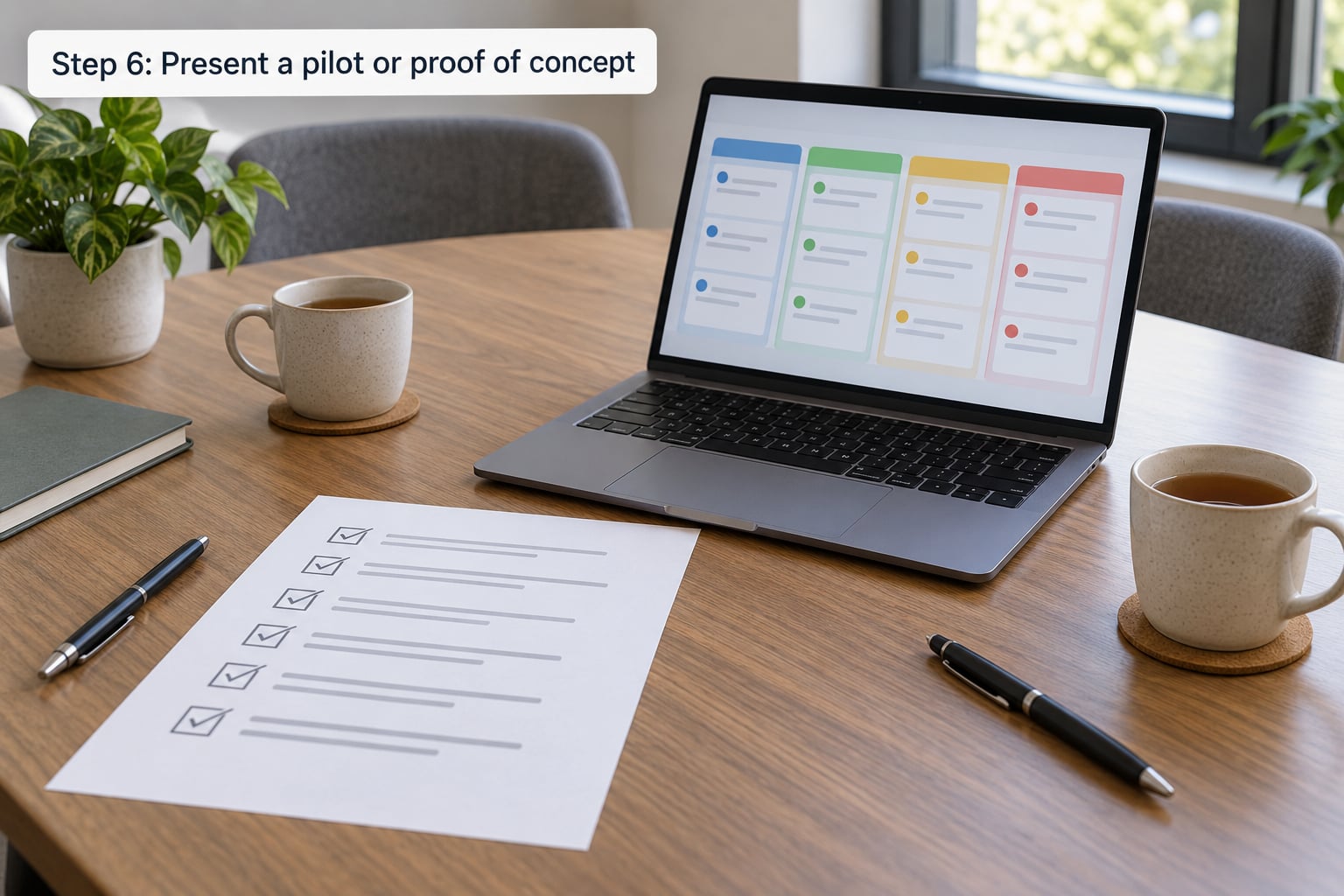
A small, fixed-fee pilot converts better in Japan than a free open-ended trial. Fixed-fee signals you believe in the product, and it gives the buyer an internal budget line they can actually approve.
Write down three things before the kickoff: the success criteria, the timeline, and who owns each side. Success criteria should be measurable and agreed in writing, such as processing a defined volume of records within an agreed error rate, or cutting a named workflow step from a stated duration.
Bring the operational stakeholders into the pilot early, not just IT. Japanese decisions made through nemawashi, the quiet pre-meeting alignment where objections get settled before the room, go better when the people who will live with the tool have already voiced concerns privately.
Protect the data properly. Use a sandbox dataset or a scoped subset, document what leaves the environment, and sign a short data handling agreement before the first byte moves. Japanese security reviewers will ask about this regardless, so getting ahead of it saves weeks.
Underneath every step sits a fixed sequence, and knowing where you are in it tells you what to prepare next.
- Awareness, weeks to months, when a Japanese buyer finds you through search, an event or a partner.
- Deep research, one to three months, spent reading your documentation and comparing you against incumbents.
- Social proof, overlapping with research, when they look for a Japanese customer in a similar industry.
- Trust validation, one to three months, covering references, security materials and a site visit or call with your team.
- Internal alignment, two to four months, where nemawashi and ringi decide whether the deal is real.
- Security and legal review, one to four months, the stage that stalls most deals when materials are English-only.
- Procurement and purchase, one to three months, ending in a signed order form and a bank transfer confirmation.
Six to eighteen months in total is normal. Each stage has a deliverable, and you should never ask a buyer to move forward without giving them the artifact that stage needs.
Step 7: Build trust through security, governance and support
Deals stall most often at internal review, which usually means a security questionnaire arrived and nobody could answer it. Prepare this material in Japanese before the first pilot rather than after it.
Japanese enterprise buyers typically ask for an APPI compliance statement, Japan’s Act on the Protection of Personal Information, plus your SOC 2 report or an ISMS certification if you serve regulated sectors. They want a data-flow diagram showing where personal data is processed and stored, and whether it stays on infrastructure inside Japan. Many will ask for an uptime SLA, breach notification terms, and your subcontractor list.
They will also want to speak to a reference customer in Japan, and to your implementation team. Put both in the plan early, because a missing reference is a late-stage killer.
Watch for the gap between honne, the real opinion held privately, and tatemae, the agreeable answer said out loud. A stakeholder saying it is fine is not the same as it being fine. Ask what concerns the team has not raised yet, and wait for the pause.
Do not follow the deal with a hard push. Japanese buyers notice pressure more than they notice persistence, and a contract they feel rushed into can stall at the final seal.
Step 8: Negotiate and close the commercial agreement
Budget conversations in Japan have a rhythm you should plan around. The fiscal year runs from April to March, and departmental budgets for the next year are usually locked months before it starts. A deal that arrives in the wrong window can sit for half a year with no objection at all.
That means you should ask about the budget cycle during the pilot, not at signature. If the customer’s renewal window matters more than your fiscal year, align your term to theirs.
Expect resistance to per-seat pricing when headcount is the metric. Alternative framings that land well: pricing per department, per transaction volume, or a platform fee with an included user band. JPY invoicing with furikomi bank transfer is the norm, and net-30 or net-60 payment terms are standard; some larger buyers will push toward net-90 at renewal.
Watch how the approval actually happens. Ringi, the formal circulation of a proposal for internal sign-off, can add months after verbal agreement. Ask the champion to walk the paper through the process themselves, and offer to support the process with documents in Japanese.
You know it is closed when the hanko is on the document and the furikomi details are confirmed. After that, the priority shifts: get the deployment live fast, ask for a Japanese case study, and turn the first customer into your most persuasive asset in market.
Common Mistakes
Most failed Japan entries share a handful of avoidable causes. Here are the ones that come up again, each with the correction.
Running an English-first motion. English demos work for exceptional developer tools in small teams, and rarely work beyond that. Fix: localize the interface, docs, support and security material before you scale outbound.
Treating localization as translation. Literal strings that read oddly tell a Japanese reviewer you did not care. Fix: have a native speaker review the interface and onboarding copy, not just the marketing site.
Coming in with aggressive outbound. Pushy tone and hard-sell messaging get filtered out. Fix: patient cadence, one idea per message, and a low-risk ask.
Launching marketing before the product is Japanese-ready. A localized landing page with English support behind it reads worse than no localization at all. Fix: build the support layer first, then drive traffic.
Ignoring the budget calendar. A deal that arrives after budgets are locked dies quietly. Fix: ask about the budget window during the pilot.
Offering unclear payment terms. No local invoicing means your finance contact cannot pay you easily, and slow payment creates friction with the business sponsor. Fix: JPY invoicing with furikomi and net-30 or net-60 from the start.
Partnering without checking references. A partner’s enthusiasm tells you nothing about their follow-through. Fix: ask for two named references and a concrete list of first-quarter target accounts.
Pushing at the wrong moment. Deals stall at internal review because nobody owns the paperwork. Fix: ask the champion to walk your documents through ringi themselves.
Setting an impossible timeline. Anything under a year assumes you got lucky. Fix: budget six to eighteen months from first meeting to signature, and plan your pipeline accordingly.
A few habits help across all of it. Be respectful of titles and surnames. Follow up after every meeting with minutes in Japanese. Show up to the same events twice a year, because repeat presence matters more than a single big announcement. And treat every English-only artifact in your pipeline as an open risk, not a minor detail.
Frequently Asked Questions
Is English enough to sell software in Japan?
English works for a narrow slice of the market. Small engineering teams and developer-focused tools will sometimes buy English software, especially when a Japanese engineer champions it internally. It stops working the moment you need legal, procurement or security review to move, because those teams do their work in Japanese. Plan on Japanese materials for the interface, documentation, security page, contracts and support from the start.
How long does it take to sell software to Japanese companies?
Plan on six to eighteen months from first meeting to signed contract for enterprise deals. The range depends less on your product than on the number of departments involved and where you sit in their budget calendar. Deals with a clear budget line and a named champion at the front usually land toward the fast end. Deals that enter after departmental budgets are locked can wait six months without any objection being raised.
Do I need a Japanese company or entity to sell software there?
Not to sign a contract. Most foreign vendors start by contracting directly with Japanese customers from an overseas entity. You will still need a Japanese-language support presence, a local contact, and a way to invoice in yen. Many companies add a Japanese branch or sole distributor later, usually once enterprise volume justifies the accounting and hiring effort.
What documents do Japanese companies require from software vendors?
Most enterprise buyers want a vendor security questionnaire completed in Japanese, an APPI compliance statement, a SOC 2 report or ISMS certification for regulated sectors, and a data-flow diagram showing where personal data is processed. They also expect a service level agreement covering uptime and breach notification, a subcontractor list, and a reference customer in Japan. Bilingual order forms speed up the legal stage considerably.
Should I sell direct or through a Japanese partner?
Sell direct when you sell to large enterprises with their own procurement function and want full margin and customer control. Use a system integrator when your deals need implementation capability or an introduction inside an account you cannot reach alone. Resellers are useful for closing a first logo quickly but thin your margin and cost you the direct relationship. Whichever you pick, write down who owns the customer record at renewal before signing.
How do Japanese companies choose a software vendor?
They choose through consensus across a buying committee rather than a single decision. A champion builds the case internally, IT and security validate it, procurement handles commercials, and a senior approver signs off through ringi, the formal circulation of the proposal for agreement. Aligning that group takes months. Vendors who understand this sequence and serve each role tend to close faster than vendors with better products but no internal plan.
Conclusion
If you take one action from this guide, do these three things this month. Pick a single buyer segment inside one industry and write the profile. Then build a Japanese-language proof of value: a localized pilot with written success criteria and a data handling agreement attached. Finally, start one careful conversation with a local partner or Japanese contact who can introduce you into an account you cannot reach alone.
Japanese software deals are won by companies that look committed, prepared and patient before the first meeting. Start from there, and how to sell software to Japanese companies stops being a question of translation and becomes a question of execution.