The Japanese government funds tech research through four main channels: MEXT, which distributes the bulk of the national science budget and manages KAKENHI Grants-in-Aid for Scientific Research; JST, which runs mission-oriented programmes from early-stage science through to commercialization; the Cabinet Office, which handles cross-ministerial innovation, economic security and talent programmes; and METI through NEDO, which backs industrial technology, semiconductor and compute infrastructure. Money flows from a Diet appropriation down to a specific lab, startup or company over one to five years.
If you’re trying to work out where to aim an application, the useful question isn’t which ministry is “responsible for innovation.” It’s which channel matches your stage. A university lab chasing curiosity-driven work lives or dies on KAKENHI. A startup scaling a prototype looks at SBIR and NEDO. A foreign company realistically enters through a Japanese partner.
Table of Contents
- 1What Does the Japanese Government Fund?
- 2How Japanese Government Funds Tech Research
- 3How the money moves, step by step
- 4Competitive Grants and Research Programs
- 5Commissioned R&D and Corporate Consortia
- 6Subsidies, Infrastructure and Demonstration Projects
- 7The main funding schemes at a glance
- 8Which Government Bodies Are Involved?
- 9Who Can Apply for Japanese Research Funding?
- 10What Costs Can a Funded Project Cover?
- 11How Do Companies and Universities Apply?
- 12How Does the Selection Process Work?
- 13Why Does Japan Use Public Funding for Technology?
- 14What Are the Main Challenges for Applicants?
- 15Frequently Asked Questions
- 16Does Japan’s government give research funding directly to foreign companies?
- 17Is a Japanese government research grant the same as a startup subsidy?
- 18How much funding can a Japanese technology project receive?
- 19Can international researchers publish the results of publicly funded research?
- 20What research gets the most funding in Japan?
- 21How does government funding affect the direction of Japanese research?
- 22Where to Start
What Does the Japanese Government Fund?
Japanese public funding covers more than laboratory science, and the distinction matters when you’re writing a proposal. Six broad categories do most of the work.
- Basic science — curiosity-driven research into natural phenomena, with no commercial target attached.
- Applied research and development — engineering work aimed at a working device, process or service.
- Industrial technology development — bringing a proven technology toward a production line, including plant and process investment.
- Public-interest technology — disaster response, energy, agriculture, healthcare and other areas where the market will not pay for the full cost.
- Infrastructure and compute — supercomputers, testbeds, research facilities and shared demonstration environments.
- Demonstration and early deployment — proving a technology works in a real setting, usually with matching funds from industry or local government.
None of that is the same as a commercial contract. A company that builds a product and sells it needs customers, not a grant. Public money is for work that does not have a paying customer yet, or where the benefit goes to society rather than to one balance sheet.
Procurement sits outside this system. When a ministry buys equipment from a vendor, that’s a purchase, not research funding, and the vendor isn’t applying for a grant. Many people blur these two and it costs them months.
How Japanese Government Funds Tech Research
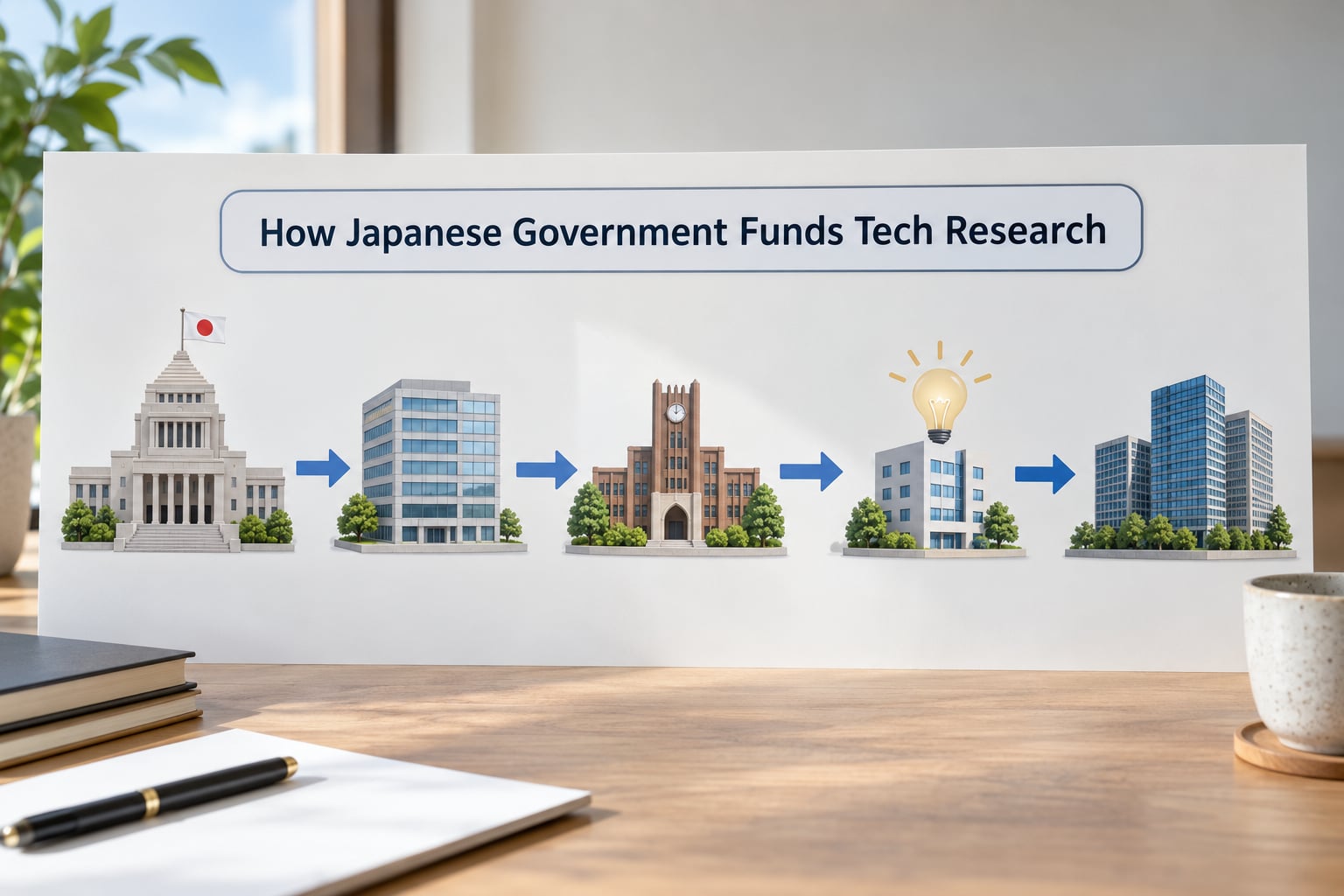
The mechanism is a funnel. A ministry requests a budget, the Diet appropriates it, the funding agency issues a call, applicants submit, reviewers rank, and the agency awards multi-year grants that pay out against annual plans.
How the money moves, step by step
- Appropriation. Each ministry asks for a science and technology budget for the coming fiscal year. The Diet approves it in late autumn.
- Allocation. MEXT splits its allocation between Grants-in-Aid, national university subsidies and large strategic programmes. METI and MIC control their own lines.
- Call for proposals. An agency publishes a call with a theme, an eligibility rule, a budget cap per project and a deadline. Nothing is funded that was not called for.
- Internal approval. The applicant institution checks departmental rules, ethics, conflict of interest and budget structure before anything is submitted.
- Submission. The principal investigator files through the agency’s system, usually with a research plan, budget justification and a list of the team.
- Review. External experts score proposals on criteria the call publishes, then rank them. Some calls use two-stage review; mission-oriented programmes often use external experts plus programme officers.
- Award and payment. Successful applicants get a formal decision and a multi-year budget, disbursed in instalments against annual reports and expenditure.
The gap between a headline figure and what lands in a lab is usually steps four through seven. A large announced programme funds several dozen projects, not thousands, and a meaningful share goes to administration, infrastructure and evaluation rather than to principal investigators.
Competitive Grants and Research Programs
KAKENHI Grants-in-Aid for Scientific Research is the backbone of academic funding in Japan, administered by MEXT through JSPS. Categories are roughly shaped by career stage: research funding for established investigators, a young-scientist category for researchers early in their careers, and a start-up category reserved for people who have just taken an academic position.
Individual awards are modest compared with a large national programme. The common framing is several million yen a year per investigator over one to three years, sometimes extended to five, with additional years available after a mid-term review. That sounds small against a corporate lab budget, and it is — but it is non-cost-share money attached to the investigator’s name, which is what makes a career.
JSPS also runs the KAKENHI Hi-Young and research-in-a-venture tracks, and the Leading Initiative for Excellent Young Researchers, aimed specifically at researchers who have a PhD and few publications. Eligibility usually requires Japanese research affiliation, and for a position-holding grant typically a domestic doctoral degree, which is the single most common reason a foreign researcher cannot apply directly.
On the JST side, competitive programmes run under mission-oriented and area-specific budgets, often requiring a co-funding contribution from industry or from overseas partners. Grants here are larger and shorter, typically two to three years, and come with deliverables and reporting attached.
Commissioned R&D and Corporate Consortia
The second channel is commissioned development. A ministry or agency defines a policy or industry problem, then contracts organizations — often a consortium of companies, universities and public research institutes — to solve it.
These projects are structured around a shared goal: a national semiconductor supply chain, an AI compute environment, a next-generation medical platform. Companies in a consortium commit their own engineers and often part of the cost, and the public side funds the part that no single firm would justify alone, such as shared test facilities or a common pre-competitive standard.
Subsidies, Infrastructure and Demonstration Projects
A third route pays for deployment rather than discovery. METI and NEDO run industrial technology development and commercialization support, frequently requiring companies to cover part of the eligible expenditure themselves. MIC and NICT run programmes tied to communications, cybersecurity and information infrastructure.
Some of the most valuable support in this category is not cash. Shared testbeds, demonstration environments, access to national compute facilities and trial deployments with public users give a company something a subsidy cannot: a place to prove the technology works outside its own lab.
The main funding schemes at a glance
| Scheme | Administering body | Typical scale | Duration | Who can apply | Primary purpose |
|---|---|---|---|---|---|
| KAKENHI Grants-in-Aid | MEXT via JSPS | Several million yen per year per investigator | 1–3 years, extendable to 5 | Researchers at eligible Japanese institutions | Academic, researcher-initiated research |
| Young scientist and start-up grants | MEXT via JSPS | Several million yen per year | 2–5 years | Early-career researchers, new PIs | Reduce the bottleneck at the bottom of the academic ladder |
| Mission-oriented programmes | JST | Larger block grants, industry co-funding common | 2–3 years | Universities, research institutes, companies | Technology development toward a national goal |
| Early commercialization and SME support | NEDO (METI) | Project-based, matching funds usually required | 1–3 years | Companies, SMEs, startups | Prototype to product, industrial process development |
| Semiconductor, compute and digital infrastructure | METI, MIC, NEDO, NICT | Very large, project-specific | Multi-year | Large companies and consortia | Industrial capacity and national infrastructure |
| Innovation, economic security and talent programmes | Cabinet Office | Programme-specific | Varies | Universities, institutes, companies, foreign researchers | Cross-ministerial coordination, attracting global talent |
| National university subsidies | MEXT | Institutional block allocations | Annual, multi-year agreements | National universities as institutions | Baseline operating support and facilities |
Read this table as orientation, not as a promise. Every scheme changes its terms between fiscal years, and the figures above are the general scale rather than a published ceiling.
Which Government Bodies Are Involved?
Five bodies do nearly all of the work, and confusing them is the most common early mistake.
MEXT, the Ministry of Education, Culture, Sports, Science and Technology, controls the largest share of Japan’s public research budget. It funds universities, runs the Grants-in-Aid system through JSPS, and pays for large national infrastructure including supercomputing.
JSPS, the Japan Society for the Promotion of Science, is MEXT’s grant-making body. It reviews applications, runs peer review panels and handles disbursement for KAKENHI.
JST, the Japan Science and Technology Agency, runs mission-oriented programmes that target specific national goals and span the whole path from early research to business development. It also operates several national facilities and runs the J-RISE initiative, a Cabinet Office programme for attracting international research talent.
METI and NEDO handle the industrial side: semiconductor and display investment, compute infrastructure, supply chain resilience, and support for companies bringing technology to market. NEDO is the delivery vehicle that most companies actually apply through.
MIC and NICT cover communications, broadcasting, cybersecurity and information infrastructure, which affects anything telecom-adjacent or security-adjacent.
The Cabinet Office sits above all of them and coordinates cross-cutting policy. Its innovation and economic security programmes can direct money through MEXT, METI or JST, so a programme announced by the Cabinet Office may still be applied for through another agency. Read the call carefully to see who is actually the awarding body.
Who Can Apply for Japanese Research Funding?
Eligibility is where most foreign applicants hit a wall, and the wall is usually institutional rather than personal.
University researchers with a Japanese affiliation can apply for KAKENHI. A researcher based overseas generally cannot apply as a principal investigator for the standard categories, though some programmes allow overseas co-investigators, and some carry specific rules on nationality or degree origin that differ by category. JSPS fellowships, postdoc positions and exchange programmes are separate routes with their own eligibility, and they are often the realistic first step into the system.
Startups and SMEs reach the system through SBIR-type phases, where proof-of-concept work is funded at the feasibility stage and scaling is funded at a later stage, and through NEDO programmes that require Japanese registration and usually a share of self-funded expenditure.
Large companies apply for commissioned research and co-fund mission-oriented programmes. Many such calls expect a consortium rather than a single firm, and expect the other members to be universities or public institutes.
Foreign companies face the sharpest constraint. Most commercial programmes assume a Japanese entity, and even where an overseas firm is technically eligible, the practical route is a joint application with a Japanese university or partner, a Japanese R&D subsidiary, or participation in a consortium led by a Japanese institution. Budget ownership and IP terms also sit more comfortably with a domestic lead.
| Applicant type | Realistic entry route | What you need first |
|---|---|---|
| University researcher in Japan | KAKENHI, JST mission programmes | Domestic affiliation and eligibility under the specific category |
| Overseas-based researcher | Exchange programmes, fellowships, co-investigator roles | A Japanese host institution and a bilateral agreement between countries |
| Japanese startup or SME | SBIR phases, NEDO commercialization programmes | Japanese registration and readiness to co-fund |
| Large Japanese company | Commissioned R&D, consortia, NEDO industrial programmes | Consortium partners and a defined work package |
| Foreign company | Joint application with a Japanese partner | A Japanese lead applicant who can hold and administer the grant |
What Costs Can a Funded Project Cover?
Grants generally cover direct project costs and an institutional share for administration. Typical direct categories are human costs for researchers and technical staff, equipment, materials and consumables, testing and analysis fees, travel including conference attendance, and subcontracting to partners who cannot be paid as project staff.
Most agencies separate direct costs from indirect costs, which are the overhead an institution is allowed to charge for space, utilities and research administration. The ratio is set by agency rules and the institution’s own policy, and it is one of the more important numbers to read before agreeing to a project.
There are rules that catch newcomers out. Equipment purchases usually require prior approval and often competitive quotation. Budgets are annual: money left unspent generally does not roll forward, so an underspend one year becomes a reduction the next. Subcontracting is capped in some programmes. And funds cannot be spent on things outside the approved purpose — including, in some calls, preparing materials for a later commercial phase.
Successful applicants treat the budget as a compliance document as much as a plan. Clearances that look bureaucratic at proposal stage routinely delay payment later.
How Do Companies and Universities Apply?
The mechanics look different depending on whether you are a researcher or a company, but the sequence is similar.
Monitor the calls. Agencies publish calls on their own sites and through the research administration office of your institution. Deadlines are fixed by the fiscal calendar, so a call usually opens weeks or months before a known application window.
Check eligibility first. Confirm your status, your host institution’s eligibility, the funding category, the required budget structure and any nationality or degree conditions. This step alone eliminates most wasted proposals.
Prepare internally. Universities route applications through a research administration office, which enforces internal deadlines well before the agency’s. Companies need board or management approval, a finance sign-off and a plan for the co-funding share if the programme requires one.
Write the proposal. Most calls ask for a research plan, expected outcomes, a budget justification, the team and past achievements. The plan should match the call’s stated aims closely; reviewers score against the published criteria, not against your broader vision.
Submit, then negotiate. If selected, applicants often go through a discussion stage before a formal award. Feedback at this point is often about scope and budget realism, and trimming the project to fit the funding is a legitimate and common response.
Exact documents and dates come from each official call. Anyone who gives you a fixed generic deadline for Japanese research grants is guessing.
How Does the Selection Process Work?
Peer review is the core of the competitive system. External experts assess proposals against criteria the call publishes, typically relevance to the programme’s aims, originality or technical feasibility, the capability of the team, expected impact, and whether the budget is proportionate to the work.
Mission-oriented programmes weight delivery risk more heavily. A proposal promising a working prototype in three years is judged partly on whether the team has done something comparable before. In commercial programmes run through NEDO, the assessment looks more like an investment decision: market, competitive position, cost structure and the firm’s own commitment.
What reviewers rarely write down still matters. A proposal that maps neatly onto the call’s language tends to score better than a more original one that sits beside it. And a team that has already worked with the agency, or demonstrated results in a related programme, carries information the reviewer can’t otherwise verify from the form.
Acceptance rates vary enormously by scheme. Broad calls with many eligible applicants are brutal; targeted mission programmes are also competitive but weigh track record more heavily.
Why Does Japan Use Public Funding for Technology?
Public money is doing work private capital structurally won’t do in Japan.
Spillovers. Basic research produces knowledge that other firms can use, but the firm that paid for it can’t capture all of the value. Private investors underfund that, so the state does.
Capability that takes decades. Materials science, photonics, fusion-adjacent engineering and semiconductor process research produce results slowly. A firm’s ten-year horizon is shorter than the science needs.
Coordination. When a national goal needs a common standard, shared test facility or coordinated supply chain, no single company will organize it.
Strategic sectors. Semiconductors, AI compute, quantum, space, cybersecurity, advanced materials and life sciences are treated as national priorities, and funding follows that framing rather than short-term market demand.
That’s the theory. The debate in Japan is over the balance: whether funnelling public money toward named priority technologies at the expense of open basic research produces more science or less. Both sides can point to real results, which is why the argument never settles.
What Are the Main Challenges for Applicants?
Language and administration. Calls, guidelines and reviews are published in Japanese. Translations exist for major programmes but lag behind, and reviewers often work in Japanese even when submission is permitted in English.
Eligibility walls. Institutional eligibility and degree requirements catch many foreign applicants before their proposal is read.
Long cycles. A typical competitive call runs across a fiscal year, which means budgets reflect the political calendar rather than your project’s needs.
Matching funds. Industrial and commercialization programmes usually require the company to co-finance a share of eligible expenditure, which filters out applicants who need the money most.
Reporting load. Progress reports, expenditure reports, ethical compliance and final evaluation all consume time that was not in the original plan.
Confidentiality conflicts. A company with a product to sell wants control of results; an academic wants to publish. Programmes designed for collaboration rather than product development often resolve this in the university’s favour.
Finding the right program. The scheme that fits can sit under an agency you weren’t watching. This is the most common avoidable failure.
The last mile. Public research produces strong prototypes and weak products. Manufacturing, sales channels and regulatory work sit outside what research funding pays for.
Frequently Asked Questions
Does Japan’s government give research funding directly to foreign companies?
Some programmes permit overseas organizations or researchers, but eligibility varies sharply between calls. Foreign companies most often participate through a Japanese university, eligible startup or a Japanese R and D subsidiary acting as lead applicant, because grant agreements, budget ownership and IP terms are simpler when a domestic body holds the funds. A few international schemes accept overseas applicants directly, usually with a co-funding requirement from the Japanese side.
Is a Japanese government research grant the same as a startup subsidy?
No. A research grant generally supports defined scientific or technical work, with reporting, publication and intellectual property conditions attached, and it does not require the applicant to be a business. A startup subsidy supports company activity such as equipment purchase, hiring or demonstration, and often requires Japanese registration and matching funds. Applying for the wrong one wastes months of internal approval before anyone reads the proposal.
How much funding can a Japanese technology project receive?
There is no single standard amount, and it depends on the call, research area, duration, team structure and approved budget. Individual KAKENHI awards are usually described as several million yen a year per investigator over one to three years, sometimes extended to five. Mission-oriented JST programmes and METI or NEDO industrial programmes are larger and project-specific. Published ceilings and current conditions always come from the individual call.
Can international researchers publish the results of publicly funded research?
Publication and intellectual property terms depend on the programme and the contract, not on the researcher’s nationality. Many programmes expect publication and allow prior review of manuscripts for confidentiality and IP protection. Researchers may also have to notify the funding body before filing patents, and some security-linked programmes restrict disclosure of technical detail. Check the specific agreement rather than assuming either freedom or restriction.
What research gets the most funding in Japan?
The largest public commitments go to strategic areas named in national policy: semiconductors and advanced display, AI compute infrastructure, quantum technology, space, cybersecurity, advanced materials and regenerative medicine. Large national university subsidies and supercomputing programmes form a second major block. Researcher-initiated KAKENHI grants remain numerous and broad but individually modest. Announced multi-year totals describe programme envelopes, not amounts available to any single applicant.
How does government funding affect the direction of Japanese research?
It shapes it heavily. Bottom-up KAKENHI grants let researchers choose their own questions, while mission-oriented programmes are written by policymakers and targeted at national goals, which concentrates money quickly but rewards delivery over curiosity. Critics argue that tying more funding to strategic priorities hollows out basic research and narrows what gets studied. Supporters point to capabilities in quantum, materials and semiconductors that private capital alone would not have funded.
Where to Start
If you want to move on this, the first action is narrow: pick one programme and read its call and guidelines end to end, including the eligibility section. Everything else depends on that.
Before you do, work through five things.
- Define the technology in one paragraph. If you cannot state the problem, the approach and why public funding fits better than private investment, no call will say yes.
- Identify the responsible agency. University science usually means MEXT and JSPS. Industrial development usually means METI and NEDO. Communications and security usually mean MIC and NICT. Cross-cutting programmes come through the Cabinet Office.
- Find a Japanese partner. For a foreign company or overseas researcher this is not optional in practice. It determines whether an application is possible at all.
- Monitor official calls. Check the agency sites and your institution’s research administration office on a schedule tied to the Japanese fiscal calendar.
- Verify before you write. Current eligibility, budget caps, deadlines, matching-funds requirements and co-funding expectations come from each official call, and they change between fiscal years.
Understanding how Japanese government funds tech research takes about an afternoon of reading. The hard part, six months later, is a clean budget and a schedule that survives internal approval.