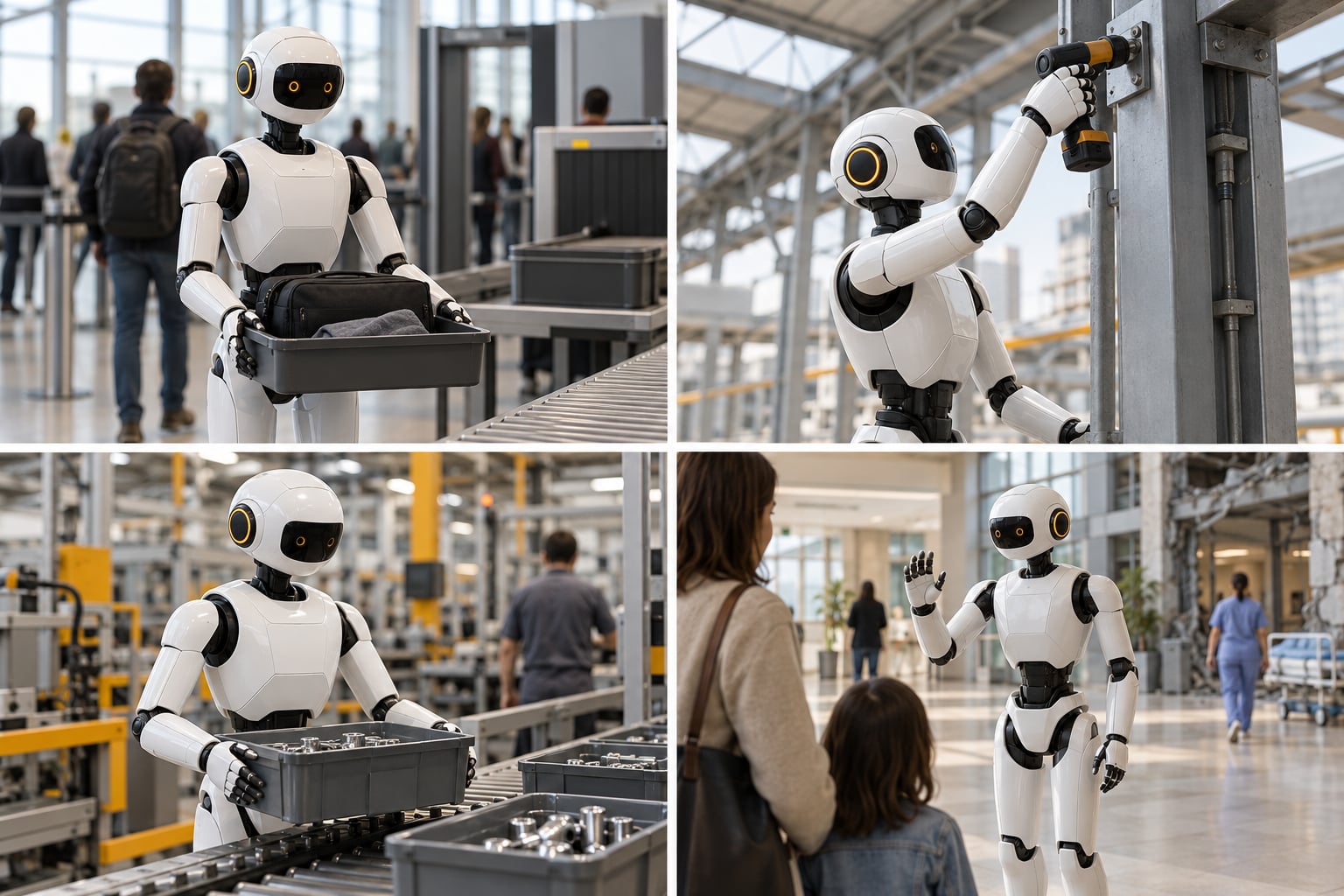
How humanoid robots are used in Japan right now: they handle baggage and cargo at Tokyo’s Haneda Airport, do overhead railway maintenance for West Japan Railway Company, assist with lifting and repositioning in care facilities, move parts in factories and warehouses, and are trialled for disaster response and nuclear decommissioning. Most of these machines are remotely piloted rather than fully autonomous, and most are still in trials rather than routine daily service.
- Airports: baggage, cargo and cabin work at Haneda, piloted from a remote cockpit
- Railways: overhead cable and structure maintenance for West Japan Railway Company
- Eldercare: lifting, repositioning and simple demonstrations in care facilities
- Factories and warehouses: parts handling, machine tending and line-side delivery
- Disaster response: inspection, debris handling and hazardous-area assessment
- Nuclear decommissioning: remote inspection inside damaged reactor buildings
- Retail and transport hubs: station information desks and store floor service
The phrase “Japan and robots” pulls in a lot of anime and toy imagery, so it is worth saying plainly what is on sale, working, or being tested. Almost all of it is unglamorous industrial work: the kind of job where a machine has to fit through a door, use a power tool, and stand on uneven ground.
That constraint is exactly why the humanoid form factor is being tried at all. A fixed robot arm is faster and cheaper for a fixed task in a purpose-built cell. It also cannot move a box from a conveyor to a shelf, climb onto a rail gantry, or carry a tray through a hospital corridor.
Table of Contents
- 1How Humanoid Robots Are Used in Japan at a Glance
- 2A dated timeline of the deployments people actually cite
- 3What Are Humanoid Robots Doing in Japanese Factories?
- 4Which tasks genuinely need a humanlike body
- 5Research, university programmes and the national push
- 6How Are Humanoid Robots Used in Care and Service Settings?
- 7How humanoid robots are used in care settings today
- 8Retail, hospitality and the station concourse
- 9How Do Humanoid Robots Help in Disaster Response and Extreme Environments?
- 10Why Is Japan Investing in Humanoid Robotics?
- 11The other reasons, which are less discussed
- 12What Limits the Current Use of Humanoid Robots in Japan?
- 13How to Tell Whether a Japanese Humanoid Robot Use Case Is Real
- 141. Is there a named site and a named operator?
- 152. How long has it run, and how many units?
- 163. What is the task scope?
- 174. Is a human operating it?
- 185. Is safety management kept with humans?
- 196. Is it purchasable or only demonstrable?
- 20Frequently Asked Questions
- 21Are humanoid robots widely used in Japan?
- 22What jobs are humanoid robots doing in Japan?
- 23Are Japanese factories using humanoid robots in everyday production?
- 24Can humanoid robots work in hospitals and elder care in Japan?
- 25How are Japanese humanoid robots different from industrial robot arms?
- 26Conclusion
How Humanoid Robots Are Used in Japan at a Glance
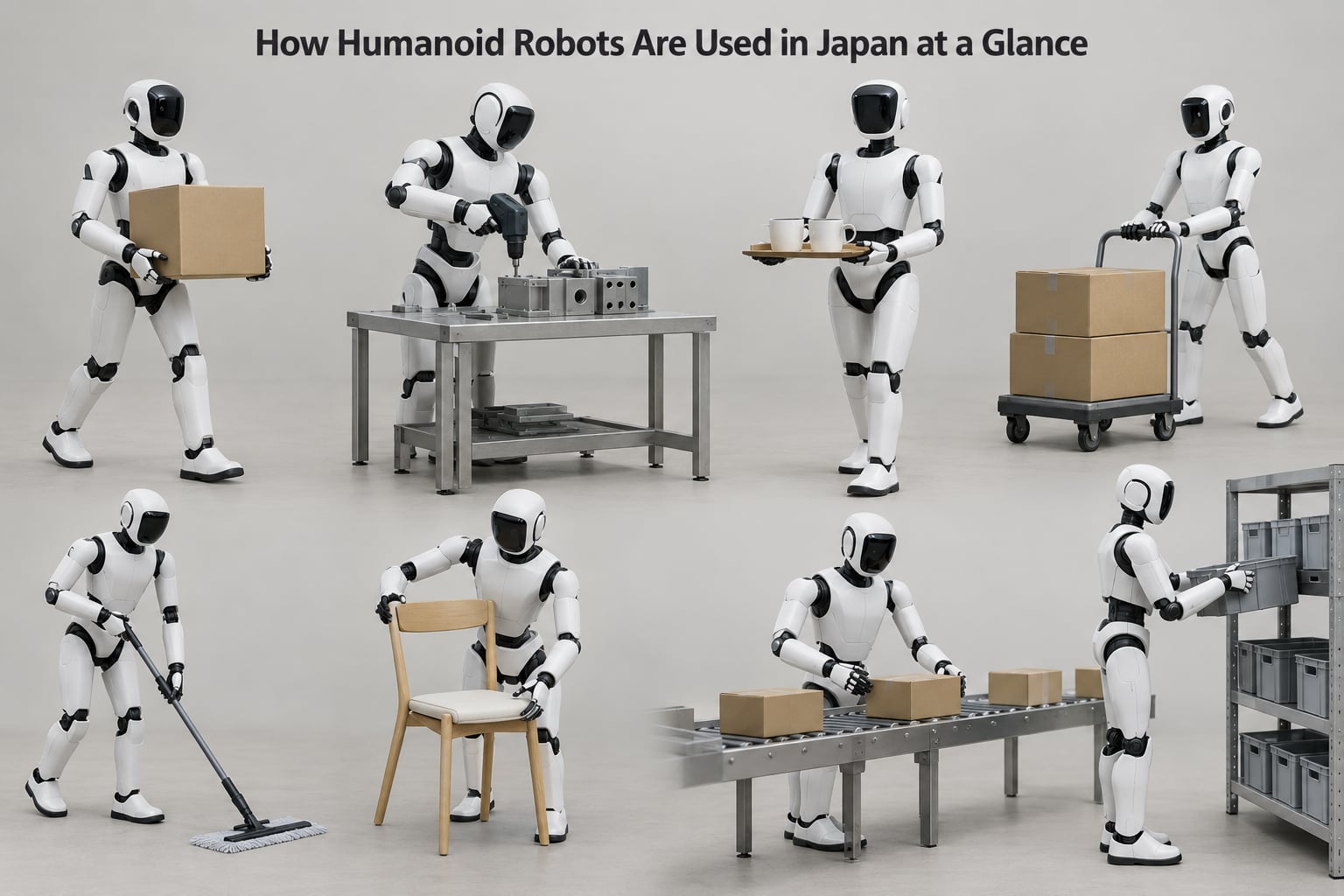
Humanoid robots in Japan are used mainly where the work is repetitive, physically demanding and awkward to automate, and where the surrounding building was designed for people. The table below maps the main application areas to the tasks, users, benefits and limitations, and gives an honest read on how far each has progressed.
| Application area | Typical tasks | Who uses it | Main benefit | Main limitation | Status |
|---|---|---|---|---|---|
| Airports | Baggage and cargo handling, cabin cleaning, towing | Airline ground handlers | Fills short-staffed ramp and back-office shifts | Battery runtime and payload limits | Pilot, phased from 2026 |
| Railways | Overhead maintenance, painting, cutting, inspection | Railway operators | Takes technicians off ladders and live track | Remote operation required | Field trials since 2024 |
| Manufacturing | Line-side delivery, machine tending, kitting | Manufacturers and research institutes | Flexibility without rebuilding the line | Slower and dearer per cycle than a fixed arm | Pilot and research |
| Warehousing and logistics | Picking, case handling, pallet work | Logistics operators | One machine, many pick locations | Throughput and grasp reliability | Limited pilots |
| Eldercare and hospitals | Repositioning support, fetching, engagement, monitoring | Care facilities and hospitals | Reduces strain on care workers | Direct physical contact with residents is unresolved | Prototype and demonstration |
| Retail and transport hubs | Station information, wayfinding, greetings | Rail operators, store chains | Multilingual help at low volume | Novelty value outlasts task value | Short trials |
| Disaster and nuclear decommissioning | Inspection, survey, debris handling | Utilities, emergency agencies, contractors | Works where people cannot safely go | Balance, comms and rubble navigation | Experimental |
| Defence research | Logistics studies under government programmes | Government and industry | Tests physical AI for logistics roles | Under study, not deployed | Research only |
Read the status column carefully rather than the hype in press coverage. “Pilot” means a named operator runs it for a defined period and publishes what happened. “Experimental” means a research team or a short public demonstration, with no claim of routine work.
A dated timeline of the deployments people actually cite
These are the named programmes that recur in trade coverage and industry reporting, with the date each began and the status reported for it.
| Date | Operator or institution | System | Task | Status |
|---|---|---|---|---|
| 2024 | West Japan Railway Company | Rail-mounted maintenance humanoid | Overhead structure work with brush and cutting attachments | Field trial, cockpit-operated |
| 2024 | JR West and partner firms | ARCHAX, roughly 4.5 m tall, piloted | High-level overhead maintenance demonstration | Demonstration platform |
| 2025 | Waseda University | AIREC, roughly 150 kg caregiver prototype | Physical assistance in care settings | Laboratory prototype |
| 2026 | Japan Airlines ground handling operations with GMO AI & Robotics | Humanoid ground support unit | Baggage and cargo transfer, cabin work | Multi-year phased trial from May |
| 2026 | Osaka Metro | Station service humanoid | Transfer guidance and tourist information | Short operational test |
| 2026 | Government study on defence logistics | AI-equipped humanoid platforms | Feasibility research for physical AI | Study phase |
Almost every entry has the same two words attached to it: trial and phased. That is not a failure of the technology so much as an honest description of where it sits on the learning curve.
What Are Humanoid Robots Doing in Japanese Factories?
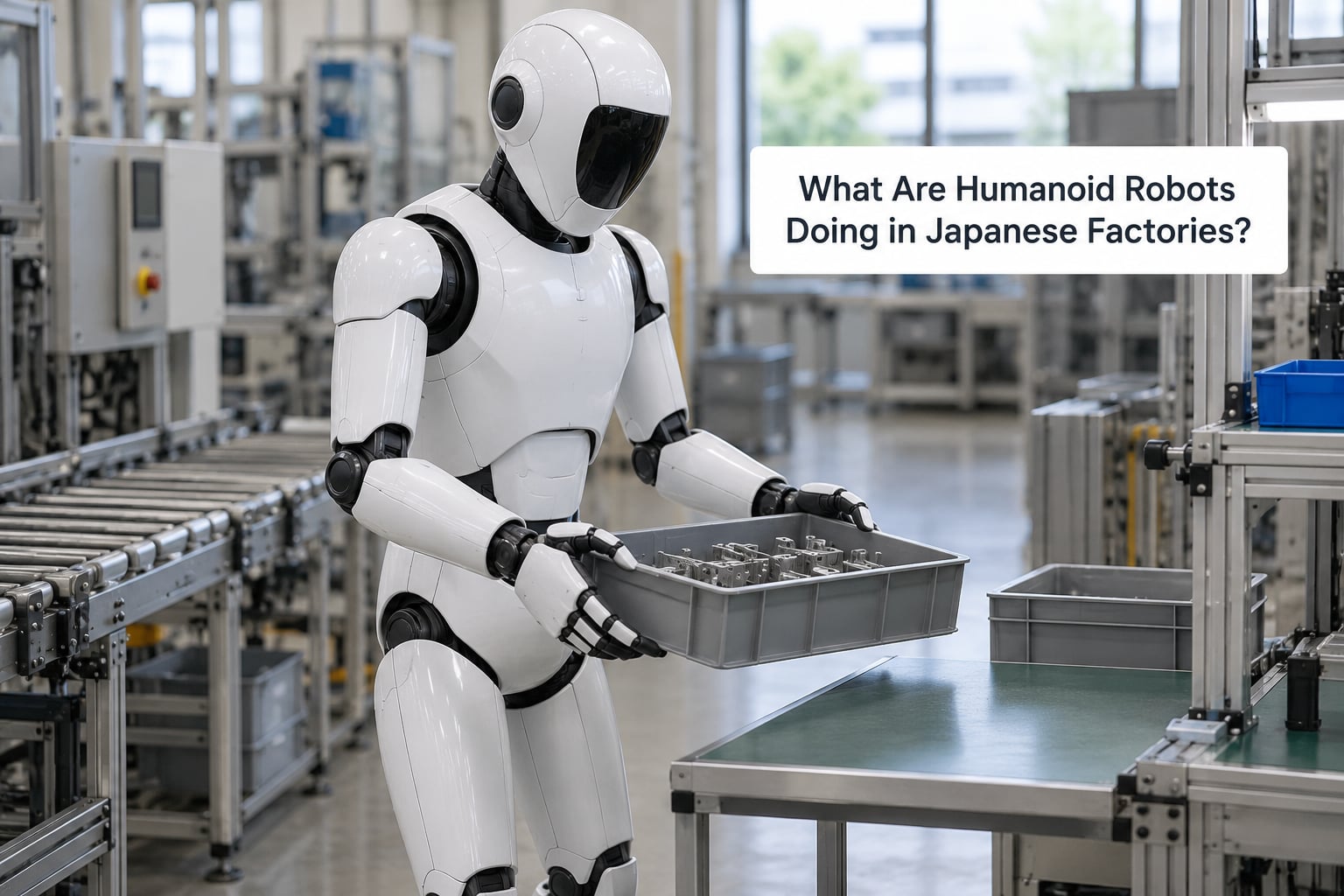
Japanese factories have used fixed industrial robot arms for decades, so the honest question is not whether humanoids work but what they add. The answer is flexibility: a humanoid can walk to the machine that needs attention, use either hand, and then move to the next task without a fixture or a guarded cell being rebuilt.
The tasks appearing most often in trials are line-side delivery of parts trays, kitting and kitting-adjacent material handling, machine tending where a human would open a door and swap a part, and simple inspection with a camera. Food manufacturing and food service appear too, partly because the work is repetitive and partly because kitchens and production lines are already full of standard equipment a robot arm can be trained around.
Warehousing is the other concentrated area. In a distribution centre, a fixed arm is faster for a fixed pick face, but the layout changes often and the pick locations are spread out. Humanoids are being tested where one machine can serve many locations and where a fixed conveyor or automated storage system would be too expensive to install.
Which tasks genuinely need a humanlike body
A few tasks keep coming back because they need hands, mobility and adaptation at once. Climbing a ladder or stepping onto a gantry needs legs. Carrying a tray while walking needs balance. Using an existing hand tool needs a gripper that matches a human grip. Opening a door, dragging a hose, or handing an object to a person who is not standing exactly where the robot expects are the kinds of thing fixed automation handles badly.
Everything else on a production line is still better served by conventional automation. Repeat cycles at high speed, welding, spraying and heavy pallet moves all favour fixed arms with dedicated tooling, because they are faster, cheaper per unit and easier to fence off safely.
Research, university programmes and the national push
Japanese research groups have been building humanoids as testbeds for decades, including the HRP series from the National Institute of Advanced Industrial Science and Technology, which was used for heavy labour experiments such as ceiling work and drywall handling long before current commercial platforms existed. Those programmes matter less for the labour they do than for the data they produce.
Policy is now funnelling money into the same layer. The Ministry of Economy, Trade and Industry has set a target of roughly 10 million humanoid robots in service across 18 job sectors by 2040, and a joint venture called Noetra, formed by SoftBank, NEC, Sony Group and Honda, is intended to develop core components and the supporting data. Regional AI robotics core centres are being set up to share compute, data and test facilities with smaller manufacturers that could not afford them alone.
Construction is worth watching as well. Major contractors including Obayashi and Kawada have shown humanoid and semi-humanoid prototypes for finishing and inspection work, where the environment changes on every site and the alternative is manual labour at height.
How Are Humanoid Robots Used in Care and Service Settings?
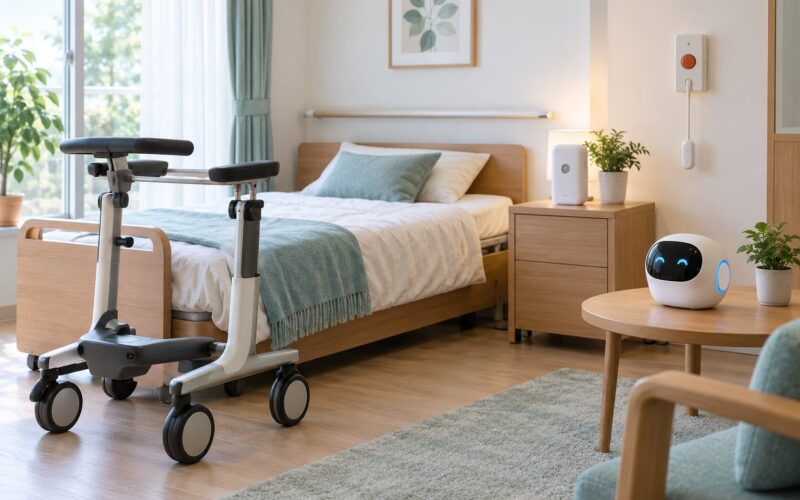
Care is the sector most often claimed and least often deployed. Japan’s care workforce is shrinking, and the gap is projected in the hundreds of thousands, which is why care robots attract so much attention. What is actually running in facilities today is mostly not humanoid: sleep and movement sensors, transfer aids, communication robots, and entertainment devices that play music and lead a stretch class.
Humanoid prototypes appear in a smaller number of settings. AIREC, developed at Waseda University and weighing roughly 150 kg, was designed to provide physical assistance in care, including lifting and repositioning a care recipient. It is a laboratory prototype, and researchers have pointed to around 2030 as an early availability target rather than a product launch date.
How humanoid robots are used in care settings today
The realistic near-term roles are support roles rather than replacement roles: fetching and delivering items, supporting light exercises, greeting and engaging residents, monitoring falls, and taking on repetitive indoor movement. Hospitals have run trials for logistics inside wards and for assisting staff with equipment carts.
The barrier is direct physical contact. Supporting a person’s weight requires predicting how that person will move, and a mistake here is a fall or an injury rather than a dropped box. Shigeki Sugano, president of the Robotics Society of Japan, has been among the clearest voices on this point: robots struggle to understand the full context of care work, which is why care staff tend to talk about collaboration instead of replacement.
Care workers themselves are cautious rather than dismissive. Takaki Ito, who works at a facility run by Zenkoukai, has said what would be genuinely useful is a robot that can grasp each resident’s individual condition and traits. In other words, the demand is for a machine that reads the person, not one that replaces the person.
Retail, hospitality and the station concourse
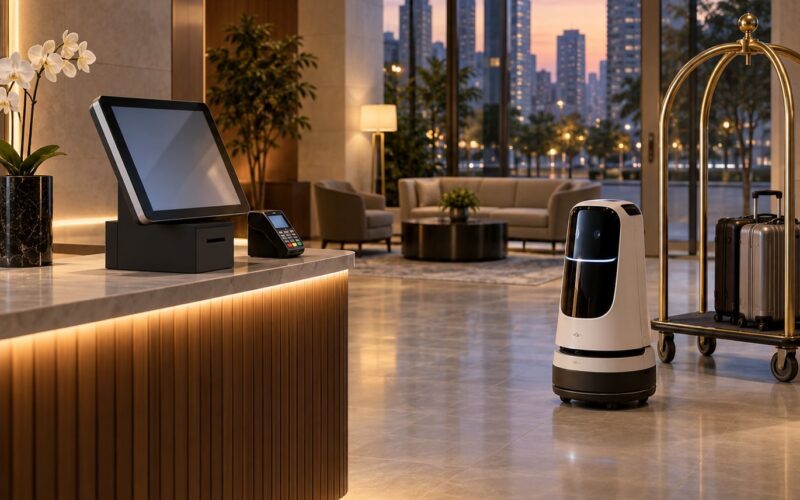
Service settings are easier to trial because the bar is lower. A humanoid at a station concourse does not need to lift anything; it needs to give directions, answer where the platform is, and handle the questions international visitors actually ask in a language they may not read. Osaka Metro has run a humanoid in exactly that role, providing transfer guidance and tourist information.
Retail chains have used service robots for store floor greetings, shelf tidying and simple demonstrations, often during a promotion rather than as a permanent installation. Restaurants use them for ordering, greeting and food presentation in a few pilot sites.
It is worth being clear about why this exists at all. A mobile robot on wheels can do most of it for less money and with fewer headaches. The humanoid version is adopted partly for visibility, and visitors do react to them. That is a real effect, but it is a marketing effect rather than a productivity one.
How Do Humanoid Robots Help in Disaster Response and Extreme Environments?
Disaster response and nuclear decommissioning are the two areas where the humanoid form factor has the strongest technical argument behind it. The work is dangerous for people, the buildings were never designed for machines, and the ideal robot is one that can open doors, carry equipment and work in whatever light there is.
Post-earthquake and post-flood use cases include structural inspection, gas leak detection, debris handling and mapping of standing structures before anyone enters. Emergency agencies and utility operators have run trials with tracked and wheeled vehicles for some of this, and humanoids are the next step up where stairs and rubble are involved.
At Fukushima Daiichi, the argument is the same one scaled up. Decommissioning work happens inside reactor buildings that were damaged by an accident, where radiation and heat limit human time. Robots already do parts of this work. Humanoids are being studied for survey, inspection and handling tasks where two hands, mobility and a humanlike reach would replace a lot of crane and fixture engineering.
The constraints are honest ones. Balance suffers on rubble. Wheeled and tracked robots beat humanoids on rough ground by a wide margin. Radio links drop where concrete and steel are in the way, which is why autonomy matters more in these settings than anywhere else. Batteries still run a few hours at most, so a machine in a hot, radiation-limited environment is on a clock.
Why Is Japan Investing in Humanoid Robotics?
The usual answer is demographics, and it is not wrong. Japan’s working-age population is shrinking, the country is the fastest ageing in the world, and care demand rises while the number of carers falls. Inbound tourism has run at record volumes, and the Japan National Tourism Organisation has counted tens of millions of annual visitors, which adds service workload on the same small workforce.
Projections commonly used in this debate include a foreign worker expansion to a multi-million workforce by 2040 and a care workforce gap in the millions. Those numbers explain why the government cares. They also explain why the announcements are loud.
The other reasons, which are less discussed
Japan has a manufacturing base that already knows how to build reliable actuators, reducers, sensors and controllers at volume. It has a deep robotics research community. And it has a domestic market small and slow enough that exporting is not optional, which pushes firms toward platforms that work anywhere rather than systems tuned to one country’s factory.
There is a strategic argument too. If general-purpose robots handle physical work, the value moves from hardware to software, data and models, and Japan wants a position in that layer rather than only in the components. Government announcements lean on the phrase physical AI for exactly this reason.
Read the demographic argument with care. Automation helps with task shortages, not population decline, and many of the hardest jobs in care and construction are hard because they need judgement, trust and improvisation. The honest version is that humanoids could remove a meaningful slice of strenuous, low-variety work, and that slice happens to sit exactly where Japan has the biggest gap.
What Limits the Current Use of Humanoid Robots in Japan?
Any honest assessment has to start with the gap between the demo and the shift. Here is where humanoids, industrial arms and purpose-built service robots actually stand against each other.
| Criterion | Humanoid robot | Industrial arm | Purpose-built service robot |
|---|---|---|---|
| Dexterity | Improving; two hands, limited force control | Very high and repeatable in one task | Single purpose, very reliable |
| Battery life | Typically a few hours per charge | Mains powered, effectively unlimited | Usually a full shift |
| Speed | Slower than purpose-built equipment | Highest throughput available | Matched to the task |
| Working environment | Human buildings, stairs, uneven ground | Guarded, fixed cell | Flat floors, marked routes |
| Flexibility | High; many tasks from one platform | Low; needs refixturing for a new task | Very low |
| Setup cost | High, still falling | Moderate to high | Low to moderate |
| Safety around people | Unproven in contact | High, fenced and predictable | High, predictable motion |
| Autonomy level | Often remote-operated today | Fully programmable, self-contained | Usually programmed or supervised |
| Best fit | Awkward, changing, human-built spaces | High-volume fixed production | One clear job, low risk |
Dexterity is the first limit. Hands that can handle a power tool well enough for a maintenance crew are still being demonstrated rather than sold in volume, and every task that needs fine manipulation inherits that limit.
Battery life is the second. Units in airport trials run a few hours on a charge, which is shorter than a ground handler’s shift and means charging or swapping has to be scheduled like any other equipment break.
Speed is the third, and it is an economic limit rather than a technical one. A humanoid that takes twice as long as a fixed arm turns a two-shift day into a longer day, and the business case has to be made on flexibility and labour saved rather than on cost per cycle.
Then there is reliability and software. Industrial robots run the same program for years. General-purpose humanoids do perception, planning and manipulation in an unstructured scene, which means the failure modes are harder to characterise and harder to certify.
Finally, performance degrades outside controlled conditions. A robot that works on a clean factory floor behaves differently on wet concrete, in dust, or in a building with unfamiliar lighting. Most of the announced Japanese deployments are in controlled or semi-controlled environments for that reason.
How to Tell Whether a Japanese Humanoid Robot Use Case Is Real
Japanese humanoid news is heavily pilot-shaped, and the gap between a headline and a production deployment is easy to overstate. Six questions sort most cases cleanly.
1. Is there a named site and a named operator?
“Japan Airlines begins humanoid trials at Haneda with GMO AI & Robotics” is a deployment. “A major Japanese airport introduces robots” is a press release. A site, an operator and a date are the minimum.
2. How long has it run, and how many units?
Multi-year trials with a handful of units are the realistic scale today. Claims about thousands of units in a specific sector deserve a date and an operator.
3. What is the task scope?
“Baggage and cargo transfer” is a defined task. “Helping people” is not. Watch for how much of the described job is one repetitive motion rather than the whole job.
4. Is a human operating it?
Several flagship Japanese deployments are piloted from a cockpit, including the West Japan Railway Company maintenance robot and the large piloted ARCHAX platform. That is not a flaw; it is a labour-saving tool where one operator drives one machine. It does mean labour savings scale slowly, one machine at a time.
5. Is safety management kept with humans?
Ground handling operators are explicit that safety management stays with staff even where robots do the physical work. That is a healthy line to check for.
6. Is it purchasable or only demonstrable?
Research platforms with no order book, no service network and no date are demonstrations. Anything with fleet support, a maintenance contract and a named customer is closer to a product.
A rough tiering helps: research demonstration, public showcase, subsidised or funded pilot, limited operational deployment, and scaled commercial deployment. As of 2026, most Japanese humanoids sit in the first three tiers, with airport ground handling and railway maintenance the furthest along.
Frequently Asked Questions
Are humanoid robots widely used in Japan?
Not in the way a headline suggests. Japan runs more humanoid robots in organised trials than most countries, concentrated in factories, airports, railways and research institutes, but almost none are in routine, unsupervised daily service. The furthest-along cases are airport ground handling and overhead railway maintenance, and even those run as multi-year phased trials with human operators and human safety managers.
What jobs are humanoid robots doing in Japan?
The recurring tasks are physically demanding and awkward to automate: moving baggage and cargo, delivering parts to production lines, working at height on overhead rail structures, inspecting hazardous buildings, and assisting with lifting in care settings. Stations and shops use them for directions and greetings. Most involve repetitive motion in a built environment rather than judgement, conversation or care work.
Are Japanese factories using humanoid robots in everyday production?
Mostly in trials rather than on production lines. Japanese factories already run fixed industrial robot arms at very high volume, and those stay faster and cheaper for repeat cycles. Humanoids are being tested for line-side delivery, machine tending and kitting, where flexibility matters and a fixed cell would be expensive to install. Standard assembly, welding and pallet handling still belong to conventional automation.
Can humanoid robots work in hospitals and elder care in Japan?
In a limited way, and mostly not yet in routine care. Today’s care facilities rely on transfer aids, sensors and communication robots rather than humanoids. Humanoid prototypes such as Waseda University’s AIREC are being developed for physical assistance, with early availability discussed around 2030. The open difficulty is safe physical contact with a person, which care workers and researchers both treat as unsolved.
How are Japanese humanoid robots different from industrial robot arms?
An industrial arm is fixed, fast, extremely repeatable and usually fenced off inside a purpose-built cell. A humanoid has a humanlike body, so it can walk, use two hands and existing tools, and work in stairs, corridors and buildings designed for people without rebuilding them. The trade-off is speed, battery life, reliability outside controlled spaces and cost per cycle, which is why humanoids are being aimed at awkward, changing tasks.
Conclusion
Japan’s strongest humanoid cases are controlled industrial, infrastructure and research environments rather than autonomous everyday service work. Airports, rail structures, factories and care prototypes are real programmes with named operators, dates and tasks attached. Very few are yet routine.
When you read the next deployment announcement, check five things: what the actual task is, what environment it works in, how much is teleoperated, what the safety record looks like, and how many units are actually running. That filter separates genuine deployment from a very good demonstration, and right now there is a large gap between the two.