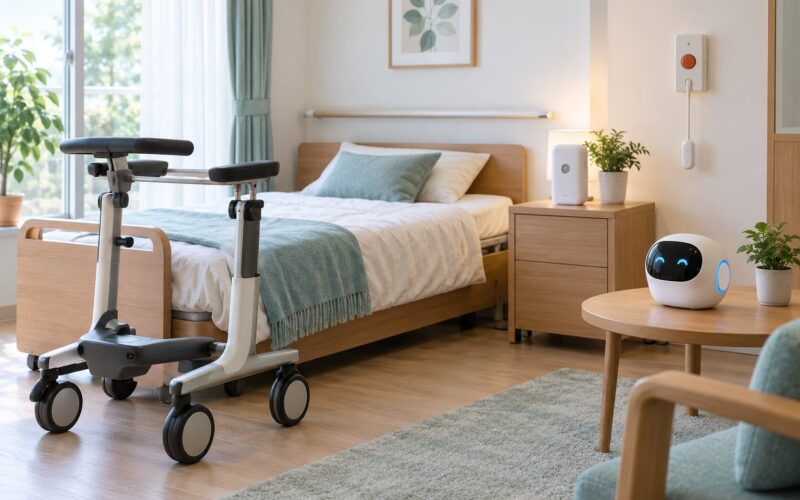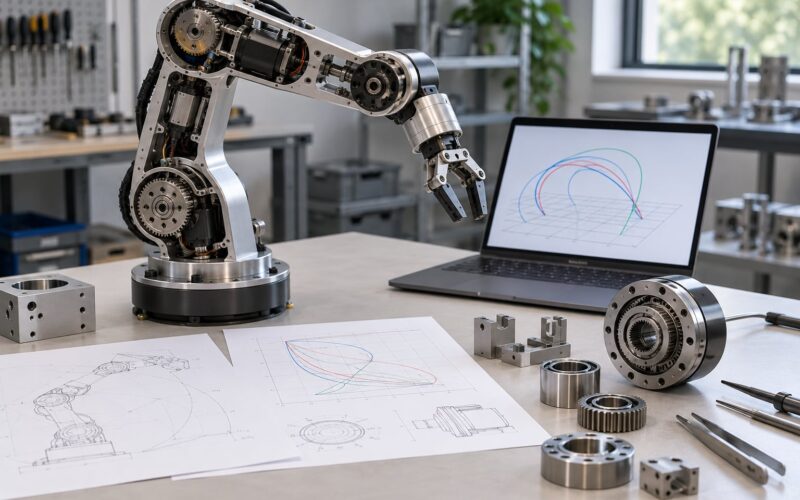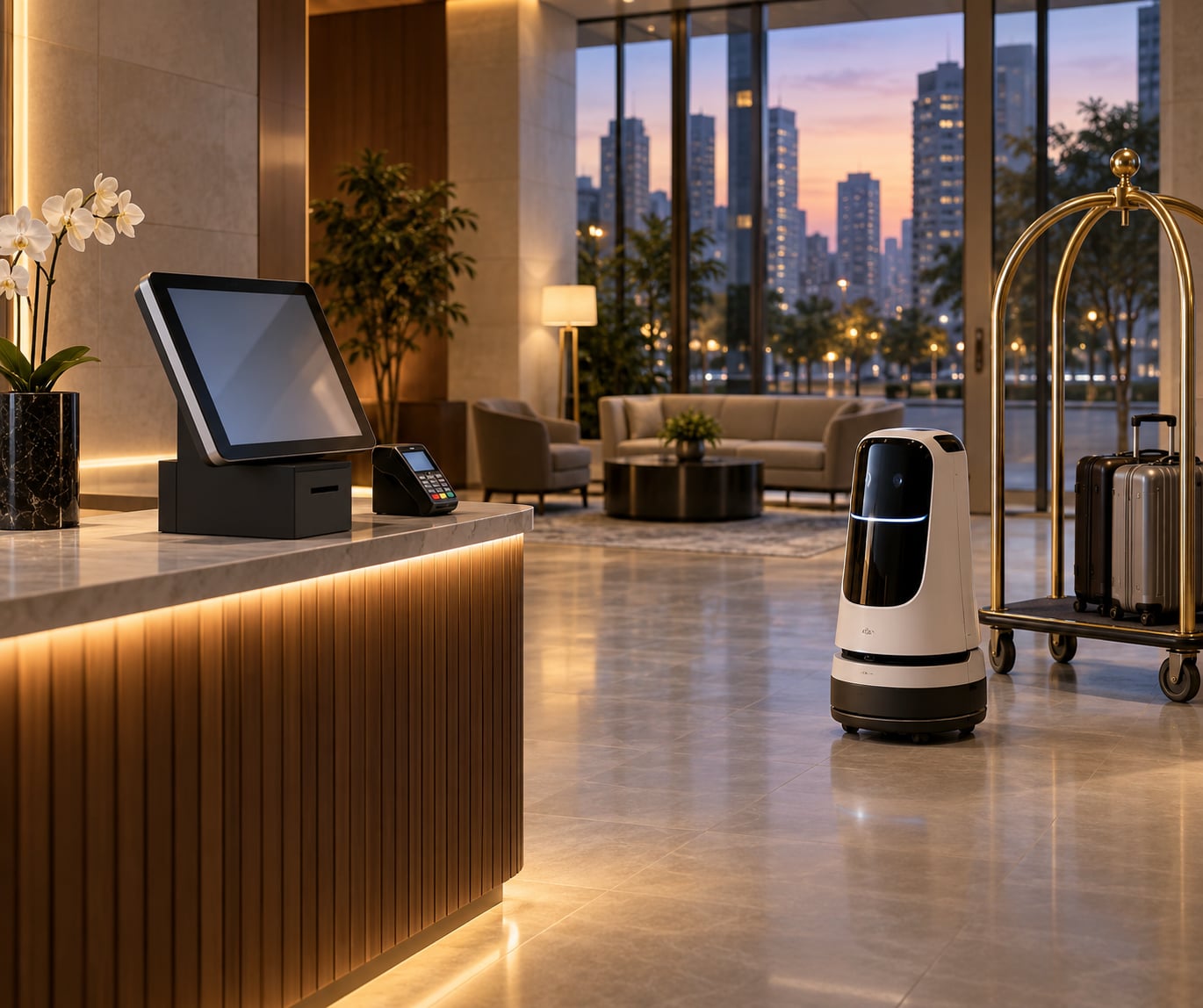
A robot hotel automates the guest journey: you check yourself in at a touchscreen kiosk, a facial image becomes your room key, robots carry your bags and answer questions by voice, and cleaning happens on a schedule instead of on request. Behind all of it, real staff still handle security, maintenance and emergencies.
That last part is the one most write-ups skip. The phrase robot hotel usually means highly automated hospitality, not a property staffed entirely by humanoid machines. The reference point is Henn na Hotel, which opened in 2015 at Huis Ten Bosch in Nagasaki and now runs roughly 20 locations across Japan.
Henn na (へんな) translates roughly as strange hotel or weird hotel, and the owner named it that on purpose. The chain holds a Guinness World Record for first robot-staffed hotel, and for a while it marketed itself on the idea that robots would run close to 90% of the service work. By 2019 it had retired more than half of its 243 robots, which tells you more about the limits of the model than any brochure.
Table of Contents
- 1How Robot Hotels Actually Work from Check-In to Checkout
- 2What Technology Runs a Robot Hotel?
- 3How Does Automated Check-In Work?
- 4How robot hotels actually work for late arrivals
- 5How Do Robot Hotels Manage Rooms and Housekeeping?
- 6What Happens When Something Goes Wrong?
- 7Are Robot Hotels Fully Automated?
- 8What Are the Benefits and Drawbacks?
- 9How Much Do Robot Hotels Cost?
- 10Frequently Asked Questions
- 11Are robot hotels staffed entirely by robots?
- 12Do robot hotels use facial recognition at check-in?
- 13What happens if the check-in kiosk or room lock fails?
- 14Do robots clean hotel rooms?
- 15Are robot hotels cheaper than regular hotels?
- 16Can guests use a robot hotel without a smartphone?
- 17Conclusion
How Robot Hotels Actually Work from Check-In to Checkout
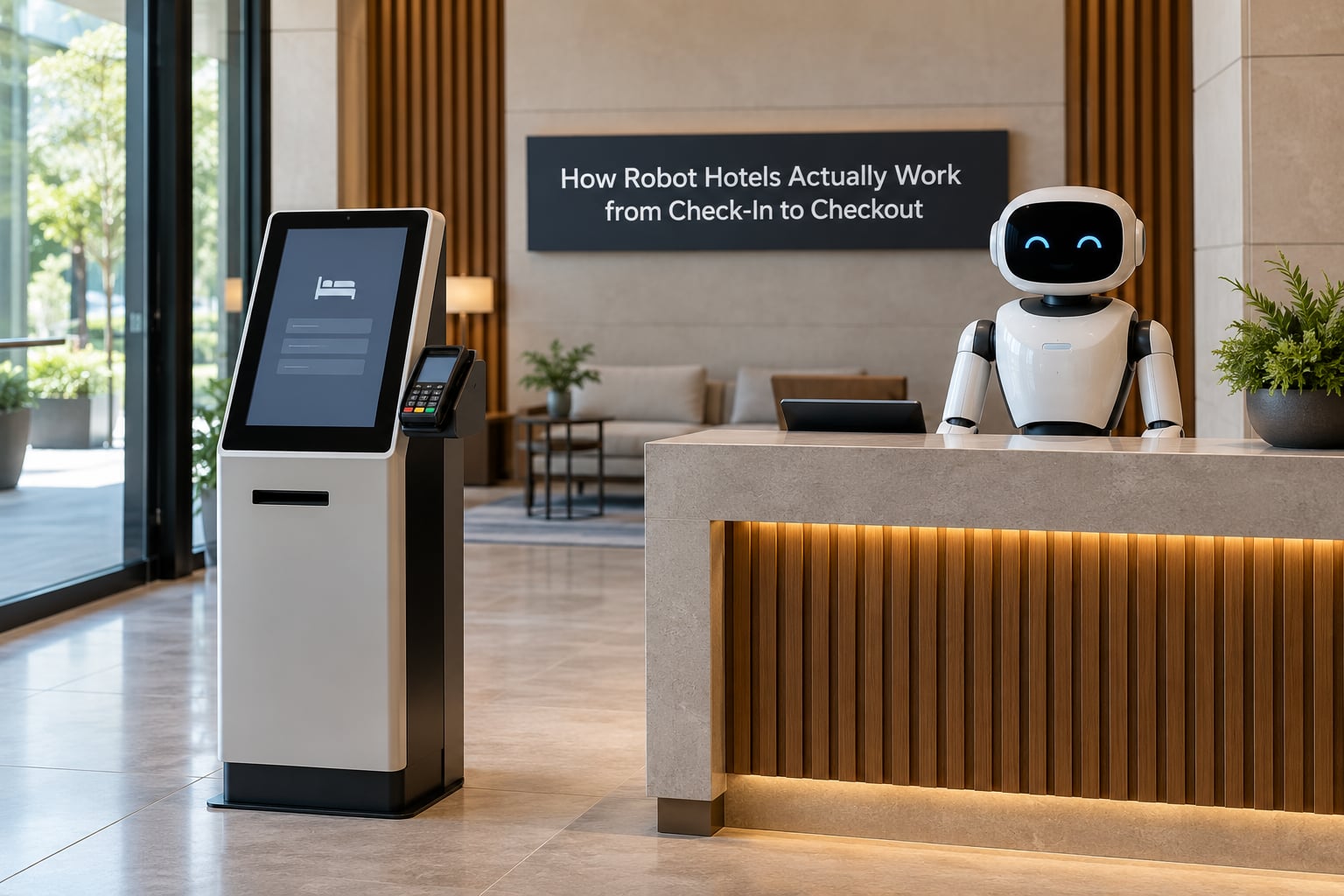
Stripped to essentials, a robot hotel runs the same four stages in a different order to a traditional property. You prove who you are and pay, the system assigns a room and converts your face or phone into a key, robots handle the carrying and the cleaning, and staff stay out of sight for anything that breaks. The rest of this guide takes each stage in turn, then looks at what it costs the operator and where it goes wrong.
That sequence is why the label sticks even when very little of the building is robotic. The visible part is a kiosk, a lock and a trolley with wheels. The invisible part is the software tying them to a reservation, and the people on the other end of a phone when the software misbehaves.
What Technology Runs a Robot Hotel?
Most of what looks like artificial intelligence is a handful of ordinary systems wired together. Each one does a narrow job, and the guest experience is just those jobs passing data back and forth.
| System | Its job | What the guest gets |
|---|---|---|
| Property management and booking software | Holds reservations, room inventory and rate rules | A booking that the check-in screen can read instantly |
| Self check-in kiosk or tablet | Collects identity details, takes payment, issues a room assignment | No queue at the desk |
| Identity verification or facial recognition | Confirms who is at the door and ties them to the reservation | No physical key card to lose |
| Electronic door locks tied to a central server | Unlocks the specific room for that verified guest | Keyless room entry |
| Room control platform | Runs lighting, temperature, alarms and blinds, often with no wall switches at all | Control from a tablet or by voice |
| Service robots | Carry luggage, deliver amenities, clean common areas | Porter and delivery help without a person |
| Sensors and cameras | Navigate the building, detect occupancy, monitor public areas | Safer corridors and faster response |
| Staff monitoring console | Watches the property and escalates failures | A human who can step in when something breaks |
The word to watch for is narrow. Most of these robots navigate a mapped route with sensors and follow scripted prompts. They are good at repeatable tasks in controlled spaces, which is exactly why hotels are a workable environment for them.
How Does Automated Check-In Work?
Automated check-in usually runs as a fixed sequence, and knowing it in advance removes most of the surprise. Procedures differ by property, and not every automated hotel uses biometrics, so read the property’s own instructions before you fly.
- Booking confirmation. You receive a confirmation that the front desk system can read, sometimes with a QR code for the mobile check-in flow.
- Arrival at the kiosk. A touch panel asks for your reservation number, passport or ID, and a payment card. Some properties skip the card if you prepaid in full.
- Identity capture. The kiosk photographs your face and matches it to the booking record. Some properties use a passport scan instead, and others accept a printed key.
- Key issuance. Instead of a plastic card, your face template or your phone becomes the credential. The hotel’s server now knows your face opens one specific room.
- Elevator and floor authorization. Connected lifts restrict which floors an unregistered guest can select, so the room number stays out of reach until check-in is complete.
- Baggage handoff. A porter robot takes your suitcase, or you store it in a locker that the room’s guest can retrieve later.
- Room access. You stand in front of the door reader, it recognizes you, and the lock opens. In the original Henn na design this replaced physical keys specifically because a robot cannot dig a lost key card out of a guest’s pocket.
- Checkout. The same screen or app settles the final amount and releases the room. Some properties ask you to confirm a photo of the room first, since nobody is walking in to inspect it.
How robot hotels actually work for late arrivals
Late check-in is where automation either shines or breaks. A lobby that closes at 10pm with a live staff member is a different product from one where the only option after hours is a kiosk in an empty room. The best properties publish their after-hours process and keep a phone number that a person actually answers, and the ones worth booking are the ones that do.
How Do Robot Hotels Manage Rooms and Housekeeping?
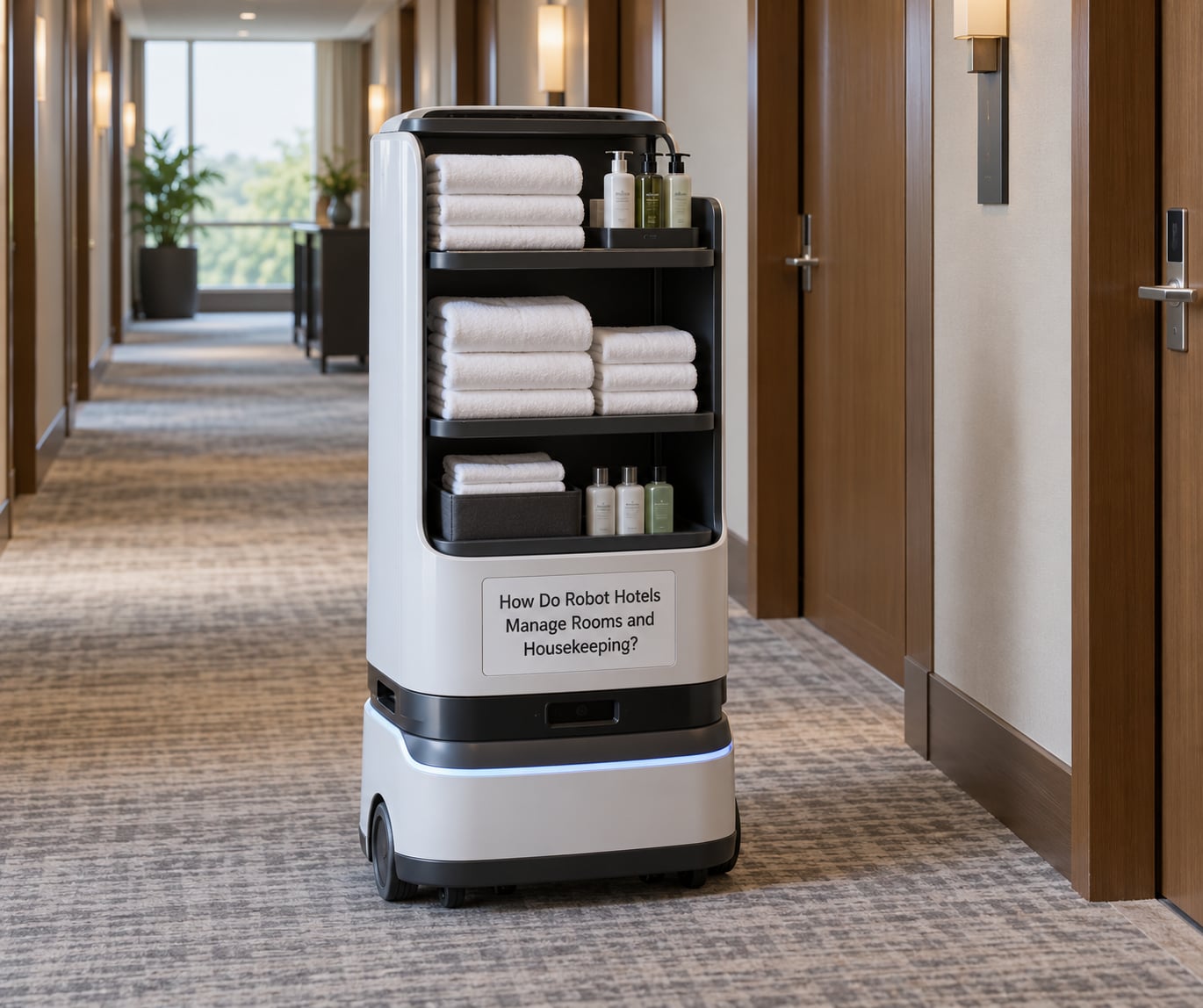
Housekeeping in an automated hotel is a logistics problem first. Sensors report which rooms are occupied, the booking system knows who is arriving, and the schedule gets built against that picture rather than against a housekeeper walking the floor.
Three different things get called cleaning, and it helps to keep them apart. Carry robots move linens, towels and amenity bottles between a store room and a guest room, sometimes opening the door at the end of the run. Cleaning robots work on common areas, primarily floors and large public spaces, because those are flat, wide and predictable. Inspections stay human: someone checks a room for safety, restocking and maintenance faults before the next arrival, which is exactly the judgment a machine struggles with.
Guests can also drive the schedule from their phone or in-room panel. Requesting extra towels at 9pm sends a task into the system instead of ringing a bell, and a lost remote arrives the same way.
What Happens When Something Goes Wrong?
Every credible automated hotel keeps a manual path, because the alternative is a guest locked out of a room at 2am. The usual fallback stack runs from the cheapest fix to the most expensive.
- Retry and reset. Most check-in kiosk and lock failures are a stuck reader or a network hiccup, and a restart solves them.
- Alternative credential. A staff member can issue a physical card or push a remote unlock to the door reader from the monitoring console.
- Phone escalation. A staffed line or an on-call number, which is the single detail that converts most sceptics.
- On-site response. Security and maintenance teams are physically present in every one of these properties, even when nobody is standing behind a desk.
The pattern is consistent across the industry: robots handle volume, humans handle exceptions. Anyone telling you a hotel runs with no staff on the premises is describing a demo, not a working property.
Are Robot Hotels Fully Automated?
No. The 2015 claim that robots would run close to 90% of the work measured a specific set of service tasks, not the whole hotel, and it never meant the property was unstaffed. Launch coverage described a crew of more than ten people in plain black clothes monitoring cameras and stepping in when machines faltered.
The 2019 reversal made the distinction obvious. Henn na retired more than half of its 243 robots after guests said they missed human contact, and the roles that survived were the ones doing something a machine handles badly: making a bed, opening a jammed window, calming a guest, or handling a spill.
What survives today is a hybrid model. Robots carry, deliver and answer repetitive questions. People do anything with judgment or consequence attached. If you book a robot hotel expecting to be alone, you will be disappointed; if you book one expecting faster check-in and no queue, you will get what you paid for.
What Are the Benefits and Drawbacks?
Both sides are real, and the balance changes a lot depending on the property and how much you value being greeted by a person.
| Factor | Upside | Downside |
|---|---|---|
| Speed | Check-in takes minutes at any hour | No fix when something fails, so a small fault costs more time |
| Consistency | The same procedure at 3pm and 3am | Impersonal at the moments guests most want warmth |
| Labor cost | Fewer hours spent on repetitive service tasks | Capital and integration costs land on the operator |
| Privacy | Some properties use a card or phone instead of biometrics | Facial templates are sensitive data with unclear retention |
| Accessibility | Multilingual prompts and no language barrier | A voice or touch-only flow can exclude some guests |
| Service quality | Reliable answers to simple questions | Nothing replaces a human for a complaint or an exception |
| Technical failure | Rare once the systems are integrated properly | Lockouts and reader errors travel straight to the guest |
| Learning curve | One flow, reused on every screen | Guests unfamiliar with kiosks need a human nearby early on |
That table is also why the model fits some properties and not others. It works best where rooms are standardized, routes are predictable and demand is steady. It struggles in small boutique hotels, properties with complex room service, and anywhere the guest experience is the product itself.
How Much Do Robot Hotels Cost?
The room rate you see on a booking site tells you almost nothing about the operator’s technology spend, and room rates at automated properties move with the same season, location and demand rules as any other hotel. What matters more is what drives the bill on the owner’s side, because that is what keeps the model running.
The major cost drivers are check-in kiosks and touch panels, electronic locks and the wiring to tie them to one server, integrations between the booking system, the payment processor and the lock controller, service robots, network and sensor coverage, preventive maintenance, and staff training on the systems and the manual fallbacks.
Few operators buy robots outright. Most use a robot-as-a-service model where a vendor supplies the unit, maintains it and swaps it out when it fails, for a monthly fee. That spreads the cost and removes the worst part of ownership, which is a robot sitting idle for a year and then breaking during a busy weekend. Vendors also increasingly price by task, per delivery or per interaction, which moves the risk onto them.
The saving on the other side of the ledger is labor hours on tasks that repeat hundreds of times a day. It is real, and it is also smaller than the launch headlines implied, because the human jobs associated with the property do not disappear. Checking that balance honestly is the difference between a robot hotel that works and one that quietly loses its staff.
Worth asking any property before you book: whether check-in is fully self-serve or staffed, whether biometrics are used or a card, whether a phone line reaches a person overnight, whether the room has wall switches, and what the accessibility arrangements are.
Frequently Asked Questions
Are robot hotels staffed entirely by robots?
No. Automated hotels automate specific service tasks such as check-in, luggage delivery and simple concierge questions. Real staff remain on the property for security, maintenance, emergencies and anything requiring judgment. Henn na once marketed a roughly 90% robot claim, but retired more than half of its 243 robots in 2019 and runs a hybrid model today.
Do robot hotels use facial recognition at check-in?
Many do, because a face works as a room key that cannot be lost or stolen from a pocket. The kiosk captures an image at check-in and matches it to your reservation. It is not universal: some properties use a passport scan, a mobile QR code or a physical card instead, and you can usually find which one applies in the property’s own arrival instructions.
What happens if the check-in kiosk or room lock fails?
There is always a manual path, and this is worth confirming before you book. A staff member can issue a physical card or send a remote unlock to the door reader, and most properties keep a phone line or on-call number that reaches a person overnight. Any property that cannot explain its after-hours failure process is one to avoid.
Do robots clean hotel rooms?
Partly. Robots carry linens, towels and amenities to rooms and increasingly clean common areas such as floors and lobbies. Actual room inspections, bed-making, restocking and fault checks stay with human housekeeping staff, because those tasks need judgment and accountability. In-room you usually trigger requests from a panel or phone rather than waiting for a knock.
Are robot hotels cheaper than regular hotels?
Room rates at automated properties follow the same seasonal and location rules as any hotel, and they are not automatically cheaper. Operators save on labor hours for repetitive tasks, and some pass part of that saving to guests. The real value for many travelers is speed and queue avoidance at check-in, not the nightly rate.
Can guests use a robot hotel without a smartphone?
Usually, yes. Every automated property keeps a kiosk or staffed desk for guests without a phone, and card or passport check-in is the normal path. A few rooms use a phone app as the only room control, so ask for a room with a physical panel or a wall-mounted controller if you plan to travel without one.
Conclusion
Robot hotels work by stacking narrow, reliable systems: self-service software that handles the volume, connected devices that carry a guest from the door to the room, targeted automation for repetitive tasks, and human backup for everything with consequences attached. The Henn na experiment is the honest version of the story. It opened in 2015 promising near-total automation, lost most of its robots by 2019 because guests missed people, and now runs a hybrid model that works better than the original pitch ever did.
Before you book, check five things: how check-in runs and whether it is staffed, whether the property uses biometrics or a card, whether a person answers the phone overnight, whether your room has physical controls as well as app ones, and what the accessibility setup is. Ask how robot hotels actually work where you are staying, and if the answers are vague, book somewhere that explains them properly.