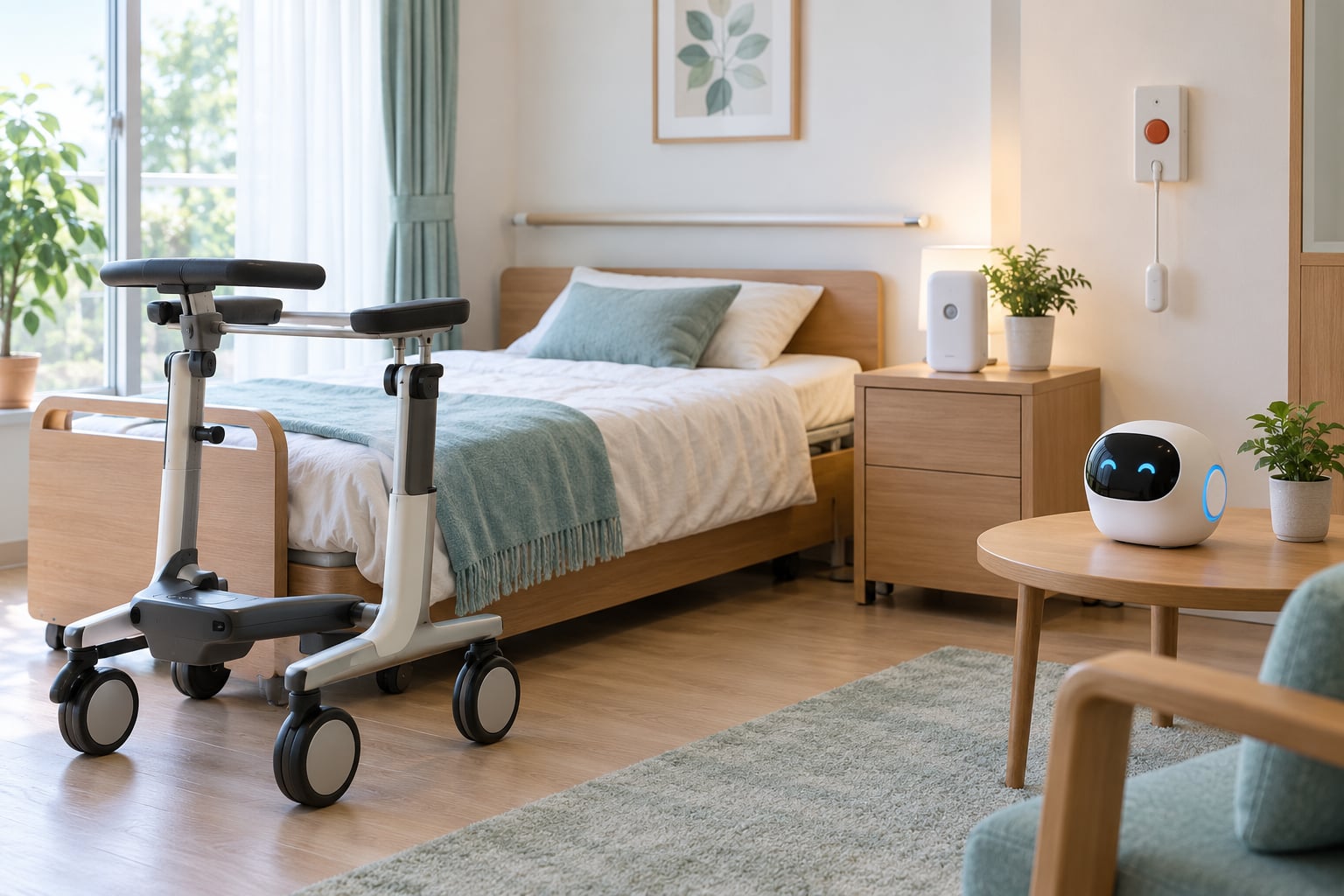
Elder care robots in Japan are machines that help people aged 65 and over with daily tasks, health monitoring, mobility and companionship, and that alert caregivers when something is wrong. Most of them work alongside care staff rather than replacing them. Japan became the main testing ground for this technology because it has one of the oldest populations on earth and one of the fastest-shrinking workforces.
The interesting part is how unexciting the reality turned out to be. The famous humanoids get the headlines, but the machines actually deployed most often are sensors, carts and lifting devices. Here is what the category looks like, where it is used, and where it falls short.
Table of Contents
- 1Elder care robots in Japan: What Are They?
- 2How Are Elder Care Robots in Japan Used?
- 3In the home
- 4In assisted living and nursing facilities
- 5In hospitals
- 6In public spaces and care workplaces
- 7What Can Elder Care Robots Do, and What Can They Not Do?
- 8Why is Japan developing elder care robots?
- 9How Much Do Elder Care Robots in Japan Cost?
- 10The four cost tiers
- 11What drives the price of elder care robots in Japan
- 12Are Elder Care Robots in Japan Widely Used?
- 13The barriers that remain
- 14What should families and businesses consider before using one?
- 15The evaluation checklist
- 16Frequently Asked Questions
- 17Does Japan use elder care robots to replace caregivers?
- 18Are elder care robots in Japan available to individual families?
- 19What privacy concerns come with elder care robots?
- 20How do I tell whether an elder care robot is genuinely useful?
- 21What is the biggest downside of elder care robots in Japan?
- 22How much does a humanoid elder care robot cost?
- 23Conclusion
Elder care robots in Japan: What Are They?
Elder care robots in Japan are any machine used in a home, care facility or hospital to support an older adult or the person caring for them. That includes robots that lift and transfer people, sensors that watch for falls, companion devices that stimulate conversation, and carts that move meals, medicine and linens around a ward. Most support care work rather than performing it. None of them diagnose, prescribe or make clinical decisions, and none replace a registered nurse or care worker.
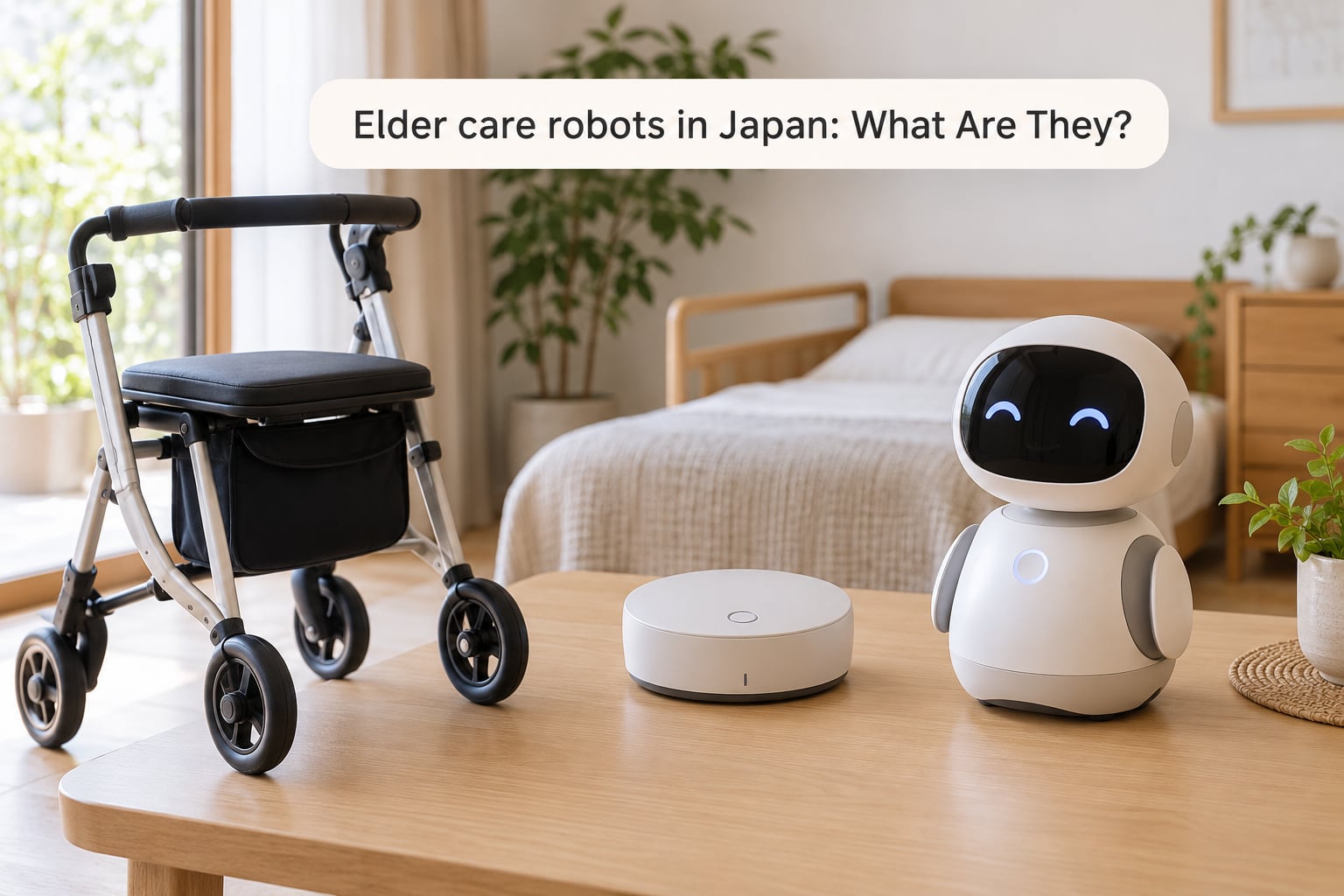
The term covers a wide range of hardware, and the table below sorts it into the five groups that come up most often. The distinction matters because the categories differ wildly in price, in setting and in how much judgment they can actually replace.
| Type | What it does | Who uses it | What it cannot do |
|---|---|---|---|
| Mobility and transfer | Assists standing, sitting, walking and lifting a person between bed and chair | Care staff and the older adult, with a carer operating the device | Judge whether it is safe to move someone, or handle a person who panics mid-lift |
| Monitoring and sensors | Tracks movement, door and toilet use, breathing and heart rate, then sends alerts | Care staff, family members living far away | Explain why an alert fired, or replace a person who checks in |
| Companion and cognitive | Talks, recalls details, plays music, leads simple games and reminiscence prompts | Older adults, particularly those with dementia | Give medical reassurance, or provide genuine emotional care |
| Logistics and delivery | Carries meals, medicine, samples and laundry between rooms, wards and kitchens | Facility and hospital staff | Hand over anything that requires bedside judgement |
| Care-work support | Records nursing notes, schedules shifts, handles reception and simple telepresence visits | Care home administrators and nurses | Make staffing decisions or reduce the number of staff a facility needs |
One useful piece of Japanese terminology: long-term care insurance, or kaigo hoken, is the public scheme that pays a share of an older person’s care costs based on an assessed need level. It is the mechanism through which much institutional equipment reaches facilities, and it is covered in more detail in the cost section below.
How Are Elder Care Robots in Japan Used?
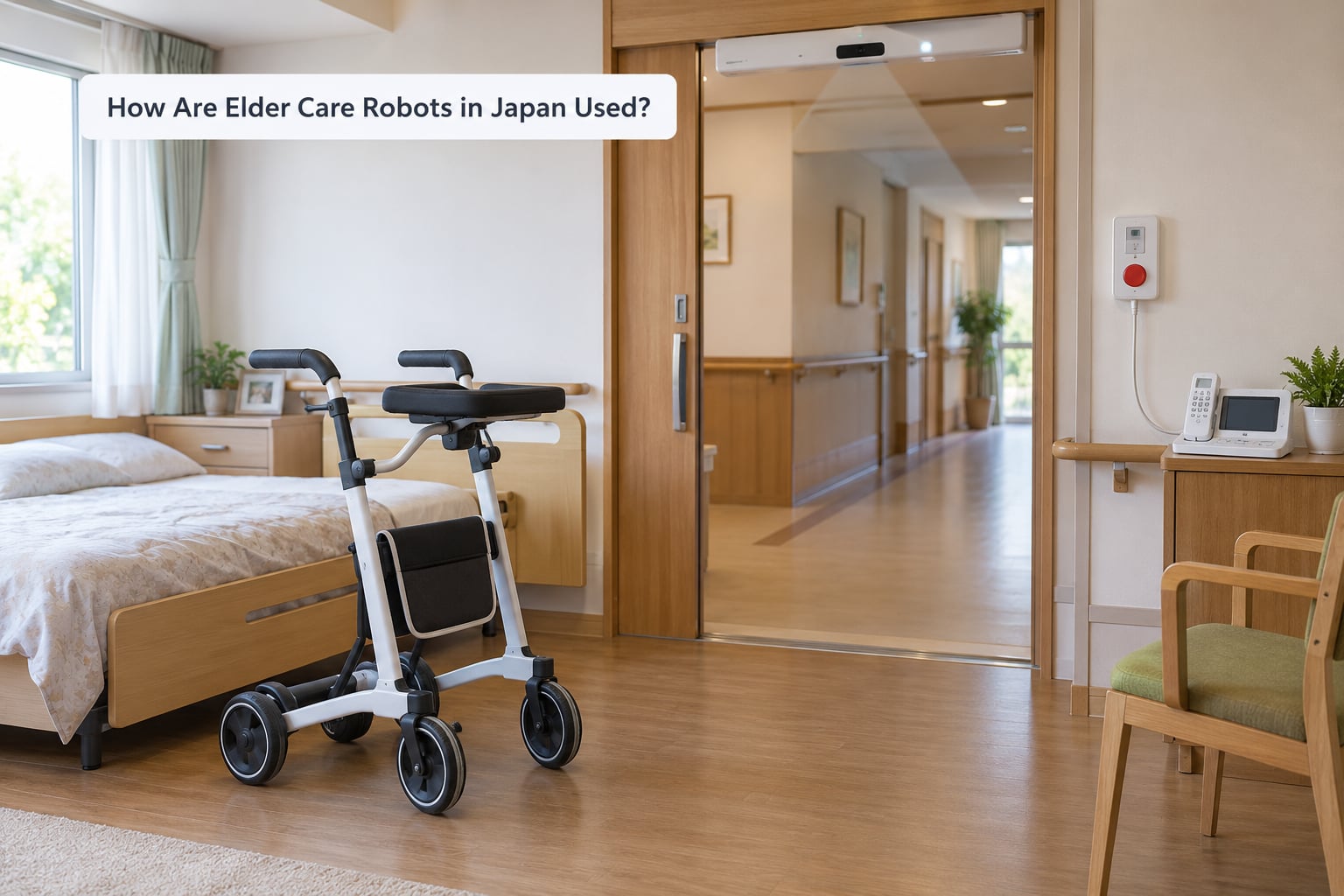
In Japan, elder care robots are used in five main settings: private homes, assisted-living and nursing facilities, hospitals, public spaces and care workplaces. What they do changes completely between them, and so does how much a human has to be nearby.
In the home
Home deployments lean on monitoring rather than robotics. Ceiling, doorway and toilet sensors map daily routine; when patterns break, a family member or care manager gets a notification. Walking-assist frames with small powered wheels and exoskeleton-type supports for sit-to-stand are used with a human present. A companion unit may sit on a table and initiate conversation, because an older person living alone will not start the interaction alone.
In assisted living and nursing facilities
This is where transfer robots and delivery carts earn their place. A powered assist can take much of a person’s weight through the lift, which matters because care workers lifting residents is the single biggest source of staff injury. Mobile carts move meal trays and linen so staff spend less of a shift walking. Recording robots draft nursing notes so a carer can spend the time at the bedside instead of typing. Companion devices sit in common rooms and are especially common in dementia wards.
In hospitals
Hospital robots mostly handle logistics and sterile work: delivering specimens, meals and linens, and in some rooms running UV-based disinfection cycles after a patient leaves. Transporting medicines is the exception, and even there a human confirms the handover. None of this is treatment. A robot that delivers a meal is not a nurse, and facilities describe it that way.
In public spaces and care workplaces
Stations, malls and municipal buildings use reception and guidance robots to direct visitors to the right counter, particularly where staffing is thin. Training backdrops in care colleges and company training rooms let new staff practise patient conversations and physical-transfer technique against a simulator. Simulators are among the more defensible uses, because the failure happens during training rather than during somebody’s actual care.
What Can Elder Care Robots Do, and What Can They Not Do?
Elder care robots in Japan are good at repeatable, physical and record-keeping tasks, and poor at anything requiring judgement, empathy or improvisation. The line is not about how advanced the machine is. It is about whether the task has a correct answer that can be written down in advance.
| Task | Where robots are genuinely useful | Where they stop short |
|---|---|---|
| Reminders and routine | Medication timing, hydration prompts, meal and appointment reminders | Persuading someone who refuses, or noticing that the reminder did not work |
| Fall detection and alerts | Detecting a fall or an unusual gap in bathroom visits and paging a human | Getting to the person quickly, or deciding whether an alert is an emergency |
| Communication support | Telepresence carts that bring a doctor or a distant relative into a room | Reading the emotional subtext of a conversation that matters |
| Mobility assistance | Reducing the load on a carer during a planned transfer | Rescuing someone who has already fallen, or lifting an unpredictable patient |
| Household tasks | Carrying items, sorting, simple cleaning routines | Bathing, dressing, feeding, continence care and anything needing touch sensitivity |
| Social interaction | Conversation prompts, music, reminiscence games, structured activity | Being a substitute for a relationship, or for the staff member who notices distress |
| Caregiver workload | Note-taking, inventory, tray delivery, cleaning support | Recruiting staff, making rota calls, or covering an entire shift |
The pattern in the research is consistent: robots redistribute tasks between machines and care staff, they do not remove staff. That distinction gets blurred constantly in media coverage, and it is the one worth holding on to.
Why is Japan developing elder care robots?
Japan is developing elder care robots because its population is ageing faster than its care workforce is growing. Around 36 million people are now over 65, and the share of the population above that age keeps climbing while the number of working-age people shrinks. Japan’s long-term care insurance already funds care for millions, and demand for that care rises faster than the budget comfortably absorbs.
Policy has actively pushed the technology. The Ministry of Economy, Trade and Industry has funded care-robot development and subsidised adoption, and an earlier industry target was robotic support for four in five care recipients by 2020. Government projections for the 2040s have ranged from tens of millions of robots in use to far larger headline figures. Treat those as directional ambition rather than forecast.
The technology is generally framed as one component of a care system that still depends on human workers. Japan is not trying to automate away its caregivers; it is trying to reduce back injuries, free up minutes per shift and cover tasks nobody wants to do at three in the morning.
How Much Do Elder Care Robots in Japan Cost?
The honest answer is that there is no single price, because the range spans from a consumer device you can carry in one hand to an institutional system with installation, software and a service contract. What follows describes the tiers rather than fixed amounts, and how much you pay varies by model, vendor, installation, service plan and exchange rate.
These are indicative Japanese market ranges for each tier, not universal prices.
The four cost tiers
- Consumer companion devices. Small tabletop and mobile companions, programmable robots and smart speakers with health add-ons. Bought outright, sometimes through retailer instalment plans.
- Smart sensor systems for the home. Motion, doorway, toilet and mattress sensors plus a hub, often sold as a monthly monitoring subscription with a caregiver app.
- Institutional equipment. Transfer and walking-assist devices, care recorders and mobile carts. Sold to facilities, sometimes covered in part through long-term care insurance depending on the assessed need level and the equipment category.
- Rental and shared deployment. Robots owned by a vendor or municipality and leased to a facility, which spreads cost and moves maintenance to the supplier. Municipal and prefecture-backed programmes have been used to lower the barrier for smaller care providers.
What drives the price of elder care robots in Japan
Hardware is rarely the biggest line. Integration costs dominate: connecting a device to a facility’s record system, its call system and its alerting chain takes engineering time and often custom work. Compliance documentation and safety certification add fixed cost per model. Service and maintenance matter because a transfer robot out of service is a shift problem, not a gadget problem.
Scale helps a lot. The same device costs far less per unit when a facility buys forty rather than two, which is why multi-site operators and municipalities push adoption harder than individual households do. Small apartments are another constraint: a large transfer unit may physically not fit in a typical Japanese flat, which pushes families toward sensors and small assist frames instead.
Who pays is as important as how much. Long-term care insurance covers a share of assessed care costs, but coverage of any specific device depends on the assessment and the category. Families should get a written determination for the exact product before assuming it will be covered.
Are Elder Care Robots in Japan Widely Used?
Widely used depends on which part of the stack you mean. In nursing homes and hospitals, deployment is real but concentrated in a few categories: transfer assistance, delivery, disinfection and note-taking. Monitoring sensors are the most widespread residential technology. Mobile humanoids that walk, talk and help around the house are largely at the pilot or research stage, and remain pilot-stage today.
That gap between announcement and deployment is worth stating plainly, because the 2020-era targets were repeated for years without anyone checking them. The honest summary as of 2026 is that the well-defined, physically grounded tasks got commercialised, and the general-purpose humanoid did not.
The barriers that remain
- Cost and unclear reimbursement. Families cannot easily tell what insurance covers, and facilities hesitate on capital budgets.
- Small-space living. Apartments limit which devices can physically work.
- Reliability. A transfer robot that faults mid-lift is a safety event, and one well-publicised research robot was left immobile by a circuit fault during a demo. Devices must be designed so a failure stops the motion rather than dropping someone.
- Usability for staff. A tool that needs an engineer to operate will not survive a busy shift.
- Privacy. Cameras and microphones in bedrooms and bathrooms are a real concern, which is why non-camera vital-sign sensing is a growing category.
- Acceptance. Some older adults refuse devices outright, and consent from the person being monitored is a genuine requirement, not a checkbox.
- Proving benefit. Operators need evidence that a device reduces injury or saves staff time. A robot that looks impressive in a demo does not clear that bar.
There is also a darker reading. If a robot appears during a shift when staffing is short, it can read as a substitute for a person rather than a support for one. Staff who feel replaced stop reporting problems with the equipment, and the facility loses its most useful safety signal.
What should families and businesses consider before using one?
Start from a specific problem rather than a device. Write down the thing that actually goes wrong, the hours it costs, and who is affected, then look for technology that addresses that. A facility with a back-injury problem is served by a transfer assist. A family worried about a fall at 2am is served by sensors. Buying a general-purpose humanoid because it is interesting solves nothing.
The evaluation checklist
- Define the purpose and the success measure. A reduction in transfer injuries, fewer unanswered call alerts, or minutes returned to staff per shift.
- Test with the actual users. Older adults and care workers, in the real room, with real corridors and real door widths. Watch for refusal.
- Check safety failure modes. Ask what happens on power loss, network failure and obstruction. Stops, brakes and manual release paths should be documented.
- Keep a human in the loop. Every alert needs a named responder, an escalation path and a defined response time. If nobody is accountable, the device is decoration.
- Handle data deliberately. Ask exactly what is recorded, where it is stored, how long it is kept, who can see it, and how to delete it. Prefer non-camera sensing where it will do the job.
- Confirm consent. The older person should know what is monitoring them and be able to refuse without losing care.
- Budget for maintenance and downtime. Include servicing, spare parts, consumables, cleaning, training time and what happens while a unit is out of service.
- Confirm language and support. Check that the interface works for users with reduced vision or hearing, and that vendor support is reachable in Japanese during your operating hours.
- Get the funding answer in writing. Long-term care insurance, municipal subsidy or facility budget, with the assessment level that applies.
One boundary matters here. Robots and sensors are supports, not clinicians. Anything touching health, medication, a fall injury or a change in a person’s condition belongs with a doctor, nurse or qualified care professional. A fall-detection alert is a reason to call someone, not a diagnosis.
Frequently Asked Questions
Does Japan use elder care robots to replace caregivers?
No. The pattern in Japanese care settings is task redistribution rather than replacement. Robots take on lifting assistance, delivery, disinfection, note-taking and monitoring alerts, while care workers keep the bedside tasks that need judgement and touch. Providers describe devices as reducing back injuries and returning minutes to a shift, not as filling staff vacancies.
Are elder care robots in Japan available to individual families?
Yes, but the practical options are narrower than in facilities. Most households start with sensor-based monitoring sold as a subscription, plus small companion devices and portable walking-assist frames. Large transfer and lifting units are aimed at care providers rather than homes, partly because apartments are small and partly because setup and training need a professional.
What privacy concerns come with elder care robots?
The main concern is monitoring inside private space. Cameras and microphones in bedrooms or bathrooms capture intimate activity, which is why non-camera vital-sign sensing is a growing category. Buyers should ask what is recorded, where it is stored, how long it is kept, who can view it and how to delete it, and should get the older person’s explicit consent to be monitored.
How do I tell whether an elder care robot is genuinely useful?
Look for evidence from a real deployment rather than a demonstration. Ask what task the device removes, what the measured result was, how it performed over months rather than weeks, and who responds when it raises an alert. A useful device has a named owner, a documented failure mode and a support contract. A demo has none of those.
What is the biggest downside of elder care robots in Japan?
The strongest single concern is reliability in work where failure has physical consequences. A transfer assist that faults mid-lift, or a fall-detection sensor that stays silent, turns a support into a hazard. That is why devices must stop safely on fault, and why every alert needs a named human responder and a defined response time.
How much does a humanoid elder care robot cost?
Humanoid research and general-purpose care robots remain the most expensive category, and most are not sold as finished household products at all. Comparable commercial devices vary enormously, from small consumer companions to institutional transfer systems sold with installation and service. Treat any specific figure as indicative, and confirm the funding route in writing before buying.
Conclusion
Japan’s elder care robots in practice are less dramatic and more useful than the headlines suggest. The technology that reached real deployments does the heavy, repeatable, boring work: lifting, carrying, recording and watching. The technology that promised to be a robotic carer is still mostly a research project.
So start with one problem. Name what goes wrong, test a solution with the older person and the care staff who will use it, and check safety failure modes, data handling, maintenance and total cost before anyone signs anything. Get the funding answer for the specific product in writing, and keep a named human accountable for every alert the device sends.
And where health, medication or an injury is involved, the robot’s job is to tell a qualified care professional faster. Not to answer instead of them.