
Japan has fewer unicorns than the United States because four pressures push the same way: less risk-tolerant growth capital at the late stage, an IPO market that pulls founders public below the billion-dollar mark, an employment system that keeps ambitious people inside large firms, and a corporate sector that absorbs venture-shaped work instead of spinning it out. Multiply those together and the count stays low.
That is the honest answer, and it is more useful than the usual one-liner about a risk-averse culture. Japan is not short of engineers, money or technology. It is short of the specific conditions that turn a domestic leader into a globally valued private company.
Last updated: October 2026
Table of Contents
- 1Why Japan Has Fewer Unicorns: The Short Answer
- 2The four causes at a glance
- 3How Is a Startup Unicorn Defined?
- 4How Many Unicorns Does Japan Have Compared With the US?
- 5Why Japan Has Fewer Unicorns: The Main Structural Reasons
- 6How Does Japan’s Funding Market Limit Unicorn Growth?
- 7Why the late stage is the worst place to be short of money
- 8What about non-venture financing?
- 9How Does Japan’s Domestic Market Affect Startup Valuation?
- 10Why Are There Fewer Big Exits in Japan?
- 11Acquisitions: active, but inside Japan
- 12The stay-private counter-argument
- 13Why Does Japan Produce Fewer Large Startups at the Beginning?
- 14Culture as a system of incentives
- 15What Changed as Japan’s Startup Ecosystem Matured?
- 16Can Japan Produce More Unicorns in the Future?
- 17Frequently Asked Questions
- 18How many unicorn companies are there in Japan?
- 19Why do most Japanese startups not become unicorns?
- 20Does Japan have a lower startup success rate than the United States?
- 21Are Japanese startups harder to scale internationally?
- 22Why are there few Japanese technology IPOs?
- 23What could help Japan create more unicorn companies?
- 24Conclusion
Why Japan Has Fewer Unicorns: The Short Answer
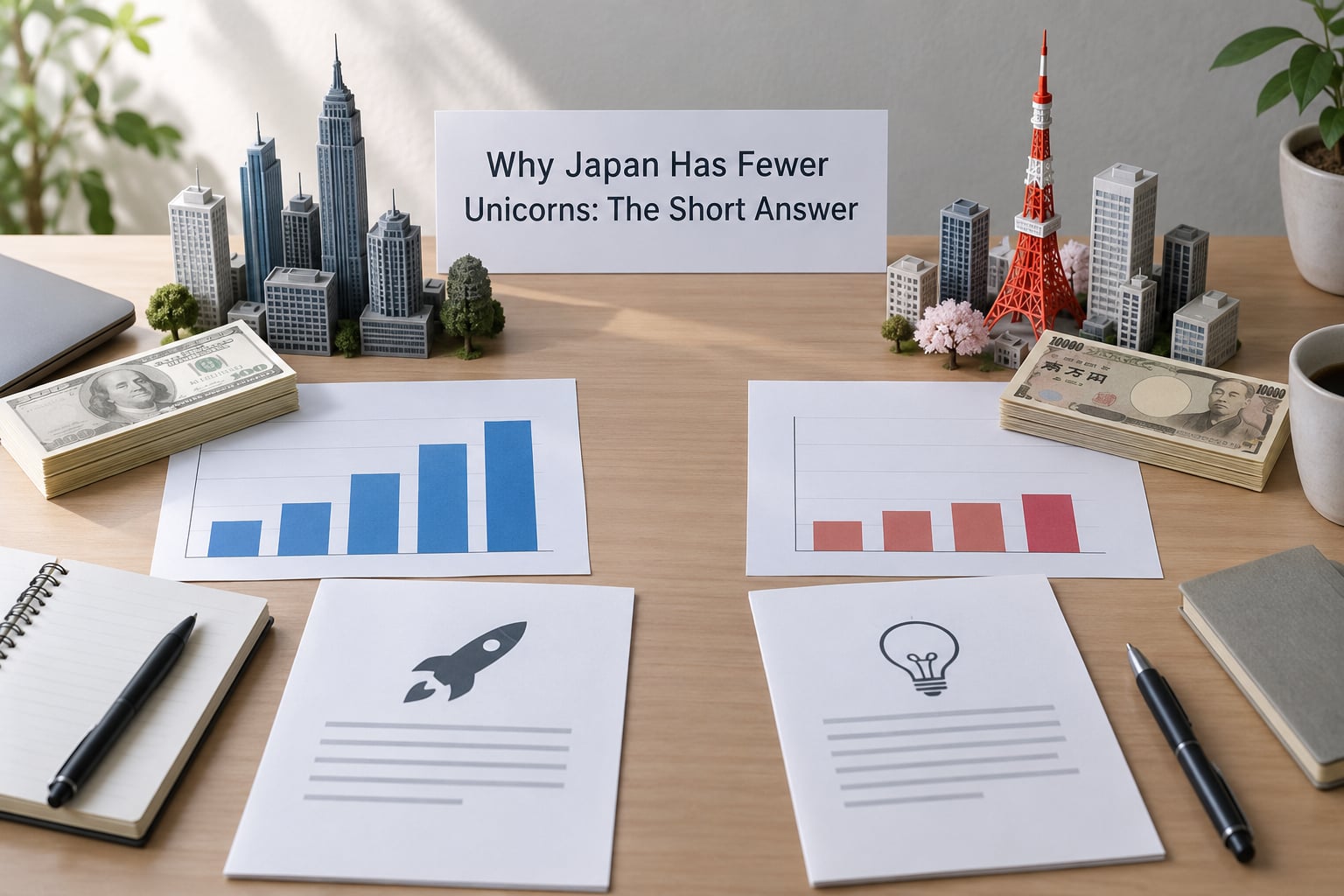
The gap is not one problem. It is a capital problem, an exit problem, a labour-market problem and an industrial-organisation problem that reinforce each other. Japan has fixed parts of the first and is still working on the others, which is why the count has moved slowly.
The four causes at a glance
- Thin growth capital. The Japanese startup funding market is small relative to the size of the economy, and most of what exists is seed-stage or comes from corporate venture programmes rather than independent funds.
- An exit that arrives too early. Japan has a functioning listing market, so founders can go public at a fraction of the valuation a private round would imply, which caps how many companies stay private long enough to cross one billion dollars.
- A talent system that rewards staying put. Lifelong employment norms, low labour mobility and a weak social safety net for failure make quitting a secure job unusually expensive for a Japanese founder.
- A corporate sector that absorbs rather than spawns. Large Japanese firms buy or build venture-shaped businesses and keep them inside, so the startup never appears in the count as an independent company.
| Condition | Japan | United States |
|---|---|---|
| Risk capital at the growth stage | Small relative to the size of the economy; heavy corporate venture participation | Deep, specialised late-stage pools plus a large private-equity market |
| Exit liquidity | Listing market available and used early; acquisition market thinner | Large IPO and acquisition markets that reward staying private longer |
| Willingness to leave secure employment | Low; career risk is personal and financial | High; failed founders are re-hired and valued for the attempt |
| Corporate entrepreneurship | Ventures usually stay inside the parent company | Corporate carve-outs and spin-outs are a recognised exit for the parent and the founders |
| Addressable home market | Large in absolute terms, narrow in per-customer revenue outside Japan | Very large with high revenue per customer |
One caveat worth stating up front: any unicorn total depends on the database, the date and the definition. Different trackers publish different numbers for the same country, and a list that counts only privately held companies will never include the listed companies trading above the same threshold.
How Is a Startup Unicorn Defined?
A unicorn is a privately held company valued at more than one billion US dollars. The word describes private companies only, which is why headline counts shift when a well-known startup lists and drops out of the category.
The label came from a 2013 book term that stuck, and it is now a shorthand for one scale milestone rather than a quality judgement. A decacorn is the same idea one order of magnitude higher, at ten billion dollars. Japan’s Nikkei NEXT Unicorn Survey uses a different bar again, around ten billion dollars, which is why the two most-cited Japanese figures rarely match.
| Label | Threshold | Notes |
|---|---|---|
| Startup | Any private company | No valuation floor; counts vary wildly by tracker |
| Unicorn | Over one billion US dollars | Private companies only; most databases add a recency filter for new valuations |
| Decacorn | Over ten billion US dollars | Used more in the US than in Japan |
| NEXT Unicorn (Japan) | Around ten billion US dollars | A Nikkei survey category, not the global unicorn definition |
Three practical consequences follow. A company that lists at three billion dollars stops appearing on unicorn lists without losing a single yen of value. A company valued by an internal round rather than a priced round can be counted or skipped at the tracker’s discretion. And deep-tech companies that raise at more conservative valuations can sit just under the line for years.
How Many Unicorns Does Japan Have Compared With the US?
Japan is usually counted in the low tens; the United States is counted in the low hundreds. The exact gap depends on when you look and what the tracker counts, which matters more than the precise number.
Tracked unicorn lists in recent years have put Japan at roughly a dozen to around thirty names depending on the vintage and the inclusion rule, while the United States total has sat in the region of two hundred or more. Chinese and Korean totals are counted separately and have moved sharply year to year as new rounds are recorded.
| Country | Reported unicorns | Basis and caveat |
|---|---|---|
| United States | Roughly 200+ | Tracked privately held companies above one billion dollars; total rises with new rounds and falls when companies list |
| Japan | Roughly a dozen to around thirty | Range reflects different database rules; counts drop when a Japanese unicorn lists publicly |
| China | Counted in the low hundreds | Historically high; sensitive to the reporting period chosen |
| Korea | Around 27 in a recent market-entry comparison | Single reported figure, useful as an order-of-magnitude comparison with Japan |
Two numbers in this table are worth treating as directional rather than exact. Market comparison figures age fast, and a Japanese company listing in Tokyo or New York removes itself from the private list on the day it trades. Read any total as a snapshot with a date attached, not as an annual statistic.
Japan’s own survey tradition uses the NEXT Unicorn list, which tracks companies aimed at much larger valuations and reports growth sectors rather than private-company counts. When a Japanese article quotes “unicorns” it may be quoting that survey, the global tracker, or the government target, and those three things are not the same measurement.
Why Japan Has Fewer Unicorns: The Main Structural Reasons
Each cause below has a direct mechanism that reduces the number of companies crossing one billion dollars, and the mechanisms compound rather than stack neatly. Fixing one does not leave the others untouched.
| Factor | Mechanism | Effect on the count |
|---|---|---|
| Growth-stage funding shortage | Late rounds are smaller and rarer | Fewer companies financed long enough to reach the threshold |
| Corporate venture dominance | Investors want a strategic return, not a venture return | Companies get shaped to suit an acquirer rather than to grow big independently |
| Early listing culture | Founders treat the IPO as the finish line | Companies leave the private pool below the threshold |
| Limited labour mobility | Founder supply is small and self-selecting | The pipeline of first-time founders narrows |
| Internal corporate ventures | New businesses are funded as divisions | Standalone companies never appear in the count |
| Domestic revenue ceiling | Local revenue per customer is lower outside Japan | International expansion is mandatory earlier, which is harder |
How Does Japan’s Funding Market Limit Unicorn Growth?
Japan’s funding problem is one of scale and shape, not of availability. The money that exists is concentrated in seed and early stages and in corporate programmes, with very little independent capital for a company priced at several hundred million dollars and growing.
The most quotable benchmark is funding as a share of economic output. Japanese startup funding has been reported at roughly 0.13 percent of GDP, against about 1.02 percent for the United States and around 0.99 percent for the United Kingdom, on 2022 figures cited by the Japan Investment Corporation and market analysts. Those dates matter: the 2022 numbers were measured during a global funding contraction, and Japan rose slightly while the US and Europe fell, which is a sign of an underdeveloped market rather than a strong one.
Shape matters as much as size. Independent Japanese funds tend to be small, often sized for a seed or Series A, and there are fewer of the specialist growth-stage vehicles that write ten-million-dollar cheques in the US and Europe. That is the formal gap the Japan Investment Corporation calls the equity gap issue, and its own Venture Growth Investments programme exists to fill it, with cumulative commitments reported at roughly 433 billion yen.
Corporate venture capital fills part of the hole with mixed results. Corporate programmes write cheques quickly and open doors into large Japanese customers, which is genuinely valuable. The problem is the objective: a corporate investor usually wants a technology it can deploy or an acquisition target, so the company is built to fit inside one parent rather than to grow into an independent leader.
Why the late stage is the worst place to be short of money
Series D and later financing is where independent growth really happens, because that is the stage where a company stops fitting a strategic buyer and starts fitting an international market. The NEXT Unicorn Survey has repeatedly reported reduced investment at Series D and above in Japan, with the same squeeze reported in the AI and enterprise software categories where market sizing has been modest by global standards.
When a company cannot raise that round domestically, it has three bad options: sell early, accept a strategic investor’s terms, or move. Japanese founders who have taken the third route are a visible part of the current ecosystem, and their existence is a form of leakage that never shows up in any national statistic.
What about non-venture financing?
Bank lending, public grants and the government’s investment programmes all play a role, but they are calibrated for a different goal. Debt and subsidies suit companies with predictable revenue and long payback periods, which describes infrastructure and deep tech more than consumer software. The government plan’s target of a 10 trillion yen funding market by 2027 is a deliberate attempt to widen this base.
How Does Japan’s Domestic Market Affect Startup Valuation?
A one-billion-dollar private valuation on a recent round implies a revenue base the Japanese market often cannot supply on its own, so most Japanese venture-scale companies are global companies from early on. That is a harder business than selling domestically first.
Population is the starting point. Japan’s market is large in absolute terms and among the largest in the world, which makes the raw comparison with the US misleading. The relevant comparison is revenue available per customer in each category, and in many Japanese categories the local willingness to pay sits below what a US or European customer accepts.
Language and distribution add friction. Enterprise sales cycles are relationship-driven and long, procurement is conservative, and marketing a self-serve product in Japanese to a shrinking, ageing population is a narrow addressable base. A company that clears its initial revenue hurdle domestically usually has to export almost immediately.
Fragmentation cuts both ways. Japan has many specialised niches that a single American company would serve with one product, and a well-run niche business can be a good company. It is just very hard to build a one-billion-dollar company out of a niche that cannot widen without a new product and a new market.
Why Are There Fewer Big Exits in Japan?
The most commonly missed reason is not a shortage of exits but an exit that arrives too soon. Japan has a real listing market, and founders use it at valuations well below the private threshold, which removes the company from the unicorn count without removing the business.
Listing early is not irrational. Public companies in Japan face disclosure obligations, governance requirements and quarterly reporting that private companies do not, and a founder who has spent ten years building a business is rewarded for getting to a liquidity event. The market’s appetite for a long growth story without visible profitability is also narrower than in the US, which makes staying private with no near-term listing harder to justify to employees and investors.
The cost is real, though it is easy to oversell. Listing earlier caps the founder’s upside before the highest-risk years, adds reporting overhead that pulls management attention away from product and expansion, and can end growth spending when a share price needs supporting. It also removes the company from the set of companies the world’s investors watch for private-market opportunities.
Acquisitions: active, but inside Japan
Corporate acquisition activity in Japan is high. Japanese firms buy foreign startups at a scale that surprises outsiders, and they buy to solve a specific problem inside a large business rather than to build a portfolio company. A company acquired at three hundred million dollars was never going to be a unicorn, and no database will ever show it.
The stay-private counter-argument
There is a serious objection here, and it deserves more than a footnote. Some of Japan’s most valuable private companies have no plans to list and no interest in foreign capital. A founder running a profitable, cash-generative domestic business with no need for a billion-dollar valuation is not a failure of the ecosystem; it is a different and perfectly rational outcome. On that reading, the low count measures a preference for control and stability, not an inability to grow.
That reading is partly true, and it does not explain the whole gap. It would have to account for why the same preference does not produce a comparable set of very large private companies in Japan, and it does not explain why so many Japanese founders who do aim high end up building those companies elsewhere.
Why Does Japan Produce Fewer Large Startups at the Beginning?
The supply of founders is a numbers problem before it is a culture problem. In the United States, large pools of people arrive with the skills, the network and the personal tolerance for risk that a first company requires. In Japan that pool is much smaller, and most of the difference is explained by incentives rather than by temperament.
Employment norms do most of the work. Lifelong employment still shapes how people read a job offer, how they treat a company that restructures, and how a family reacts to a son who has quit something stable. A founder in Japan carries personal financial risk for a decision that an American founder would describe as a career bet funded by an unemployment system, an equity history or a spouse’s income.
Failure carries a social cost. The common claim that Japanese society punishes failed entrepreneurs more than American society does is difficult to measure, and it should be treated as an incentive rather than a personality trait. What is measurable is the structure around it: little social insurance for a failed founder, fewer second chances, and hiring processes that treat a short stint at a collapsed startup as a signal rather than as experience.
Education and selection matter less often than people assume. Japanese universities produce capable engineers, but the pathway from research to a funded company is narrow, and the dominant destination for a good graduate remains a large employer. Company formation and small-business counts are not low in absolute terms; what is low is the share of new businesses that intend to grow without bound.
Culture as a system of incentives
The word monozukuri, the craft of making things well, gets used as shorthand for Japanese caution. It is more useful as a description of where effort goes. That same orientation produces excellent incremental hardware and deep tech, and it is a poor fit for the fast, disposable product experiments that software unicorns are made of. The cultural explanation works best when it is stated as a mismatch between two kinds of innovation, not as a statement about a national character.
What Changed as Japan’s Startup Ecosystem Matured?
Japan’s ecosystem has genuinely improved since 2022, mainly in capital formation and market access. It has improved much less in the conditions that turn a company into a global one, which is why the unicorn count has moved less than the headlines suggest.
The main changes are these:
- The Five-Year Startup Development Plan. Announced in 2022, it targets a 10 trillion yen startup funding market, 100,000 startups and 100 new unicorns by 2027, with the Ministry of Economy, Trade and Industry coordinating.
- Public capital. The Japan Investment Corporation and its venture growth arm commit public money to fill the growth-stage gap that private funds avoid.
- Tax and investment reform. Changes to the small-company investor tax scheme and a growth-oriented stock market segment aimed at mid-sized companies have made it easier to hold and list smaller firms.
- Corporate entrepreneurship. Open innovation programmes and internal venture funds now exist at many large firms, and some are explicitly designed to invest in external startups rather than absorb them.
- Foreign participation. Overseas investors have taken larger positions in Japanese startups and tech, and the exit has partly shifted from domestic listing to foreign capital and global listings.
The AI wave of the mid-2020s is the most plausible source of new pressure on the old structures. Large Japanese language models need more capital than most Japanese startups have raised before, so companies are reaching for foreign money, foreign listing or corporate partners earlier than their predecessors did.
There is healthy scepticism about the target. A Nikkei survey reported that 52 percent of surveyed venture capitalists did not think the 100-unicorn goal would be met. Investors who allocate to Japan see the policy as necessary and the timeline as optimistic, which is a fair summary of the argument in one number.
Can Japan Produce More Unicorns in the Future?
Yes, and the conditions are identifiable rather than mysterious. Progress depends less on one big fund than on the following six changes happening together.
- Deeper late-stage pools. More independent growth funds, larger fund sizes and a reliable source of follow-on capital for companies priced above several hundred million dollars.
- Regional funds with national reach. Tokyo holds most of the capital, and the gap between the capital pool and regional talent is the easiest thing to fix deliberately.
- A listing market that tolerates long growth stories. A deeper mid-cap market lets a profitable or near-profitable company wait for the right moment instead of listing to satisfy investors.
- Real founder economics. A credible route back into employment after a failed company would widen the first-time founder pool more than any single funding programme.
- Genuine corporate carve-outs. Spin-outs with real independence and real economics for the founding team create companies that would otherwise stay invisible inside a large group.
- Support in the gap between validation and scale. Grants, debt and patient capital for companies with revenue but no venture round available, which is where many Japanese startups currently stall.
The honest forecast is a gradual rise rather than a sudden catch-up. Deep tech, AI and healthcare are the sectors where Japanese companies have the most defensible ground, and they take longer to scale because of how they are funded.
Frequently Asked Questions
How many unicorn companies are there in Japan?
Japan is usually counted in the low tens of privately held unicorns, with tracked lists placing it roughly between a dozen and thirty depending on the database and the year. The United States is counted in the low hundreds. Japanese totals move when a company lists publicly, because a unicorn is by definition private, so any figure should be read with its date attached.
Why do most Japanese startups not become unicorns?
Most Japanese startups do not become unicorns because the conditions for that specific milestone are missing: late-stage capital is scarce relative to the size of the economy, exits arrive early through listing, and large domestic companies often absorb venture-shaped businesses instead of letting them grow independently. Many reach a good, profitable, mid-sized outcome, which is a different plan rather than a failure.
Does Japan have a lower startup success rate than the United States?
Not in any meaningful statistical sense, because failure rates are measured inconsistently and startup survival data for Japan is not comparable with US figures. The more useful observation is that Japanese founders face a higher personal cost for trying and a lower personal reward for surviving a failure, which narrows the pipeline of people who start at all. The difference shows up in who starts, not only in how many succeed.
Are Japanese startups harder to scale internationally?
They often are, because the domestic market rarely produces enough revenue to fund a scale-up on its own, enterprise sales cycles are long and relationship-driven, and the local willingness to pay in many categories sits below US and European levels. That forces early export, which raises the cost of scaling rather than lowering it. Companies with genuine technology advantages, particularly in robotics, materials and deep tech, tend to handle it better.
Why are there few Japanese technology IPOs?
The number of Japanese technology listings is a function of how many large private technology companies there are to list, and that number is small for the reasons above. Demand plays a role too: the domestic market rewards profitable companies and is less patient with long growth stories that carry no visible earnings. Many Japanese technology companies now prefer foreign capital or an overseas listing instead of a domestic one.
What could help Japan create more unicorn companies?
Six things: deeper independent growth-stage funds, regional capital that can hire from outside Tokyo, a mid-cap listing market that tolerates long growth, employment protection that makes failure survivable, real corporate carve-outs with independent economics, and patient capital for companies between validation and scale. Government programmes such as the Japan Investment Corporation already target the funding gap, which is the most addressable of the six.
Conclusion
Japan has fewer unicorns than the United States because four constraints act together: growth-stage capital is thin relative to the economy, the exit arrives before the threshold is crossed, the employment system keeps founders inside large firms, and the corporate sector absorbs ventures instead of releasing them. Remove any one of them and the count would rise; that is why the number has moved slowly despite a decade of policy attention.
Two habits will keep you out of trouble. Check the date and the definition behind any unicorn total before quoting it, because the number moves when a company lists and because different trackers count differently. And treat the low count as a description of one specific milestone rather than a verdict on Japanese technology, which is deep in hardware, robotics and materials in ways the private software valuation definition barely registers.
For founders, the practical read is that a venture-scale ambition in Japan has to be a global plan from the start, with an exit strategy that assumes foreign capital. For investors, it means the late stage is where the real gap sits, and that is where the returns have been.