Japanese robot makers compete with Chinese firms by owning the hard-to-copy upstream parts, building factories inside China, and selling lifetime reliability instead of the lowest purchase price. On the other side, Chinese makers answer with per-unit cost, supply-chain speed and state-backed scale. Understanding how Japanese robot makers compete with Chinese firms means looking at two very different businesses wearing the same label.
Both sides build industrial arms that weld, machine and pack. Only one side has spent forty years building a service network that can reach a customer line at 2 a.m. That difference decides most purchasing decisions, and it is the reason Japanese makers still hold roughly 40-50% of global industrial robot production even as headlines announce Chinese dominance.
The tension between those two facts is the whole story. China installs more robots each year than the rest of the world combined, yet Japanese suppliers still ship the arms with the tightest repeatability and the parts that go into everyone else’s arms. Here is how each side plays the game.
Table of Contents
- 1How Japanese Robot Makers Compete With Chinese Firms
- 2Why Chinese Robot Companies Have Gained Ground
- 3Where Japanese Robot Makers Still Have an Advantage
- 4How Japanese Companies Compete on Product and Technology
- 5How Japanese robot makers compete with Chinese firms on hardware
- 6How Japanese Robot Makers Compete on Cost and Business Models
- 7How Japanese Robot Makers Compete Internationally
- 8Which Segments Create the Most Competition?
- 9What Risks and Trade-Offs Shape the Competition?
- 10What Should Readers Watch Next?
- 11Frequently Asked Questions
- 12What country is number 1 in robotics?
- 13Who are the big 4 in robotics?
- 14Whose technology is better, China or Japan?
- 15Why are Japanese robots so much more expensive than Chinese ones?
- 16Are Chinese humanoid robots reliable enough for factory use?
- 17Will China overtake Japan in robotics by 2030?
- 18Conclusion
How Japanese Robot Makers Compete With Chinese Firms
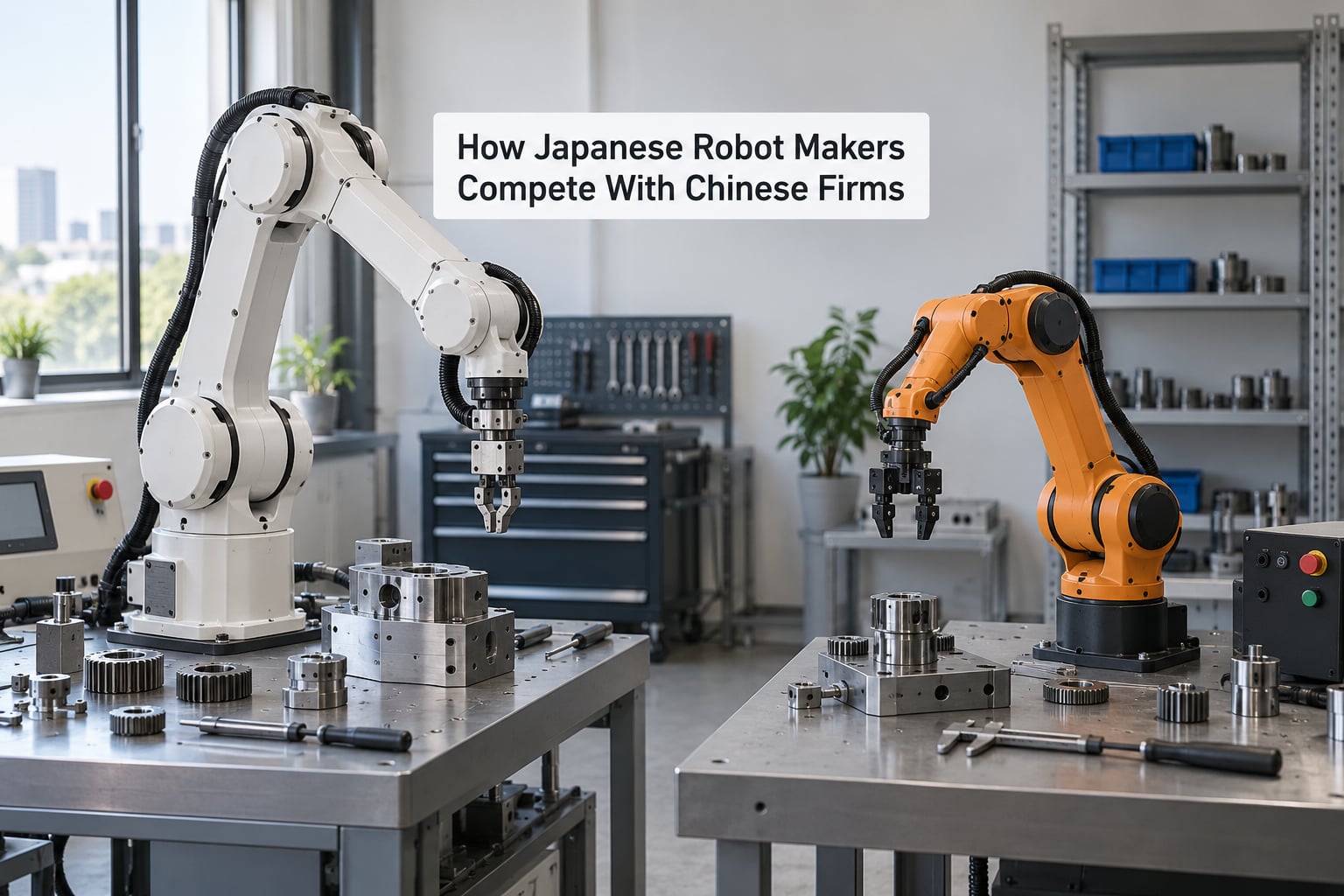
How Japanese robot makers compete with Chinese firms comes down to six levers, none of which is “make the arm cheaper.” They localize production, deepen the service network, protect the precision component supply chain, sell application engineering as a package, layer AI software onto decades of installed hardware, and target the segments where downtime costs more than the robot itself.
None of those levers is secret. What is new is how sharply they are being pulled in 2026, with NVIDIA announcing physical-AI partnerships with both FANUC and Yaskawa, and Chinese humanoid makers compressing release cycles that once took Japanese teams a decade.
The comparison below is the frame for everything that follows. Figures come from the International Federation of Robotics, Chinese ministry reporting and industry analysts rather than from company press releases.
| Dimension | Japanese makers | Chinese makers |
|---|---|---|
| Share of global industrial robot production | Roughly 40-50% | Largest domestic market; domestic output passed Japanese output in 2024 |
| Primary advantage | Repeatability, reliability, service coverage | Unit cost, supply-chain integration, delivery speed |
| Precision component self-sufficiency | Strong in reducers, roller screws, force-torque sensors | Improving fast; still dependent on imported high-end parts |
| Humanoid position | Behind, with limited commercial volume | Leading on cost and iteration speed |
| Funding model | Private capital and customer R&D | Private capital plus national industrial policy |
| Weakest point | Slow decisions, high fixed cost | Unproven field reliability, thin overseas service |
Why Chinese Robot Companies Have Gained Ground
China’s lead comes from being the biggest customer in the world. Domestic robot installations have run well ahead of Japan for years, which means Chinese makers learn on their own factories first and export second.
That volume creates three advantages at once. Component suppliers cluster near assembly plants, so a parts shortage resolves in days. Engineers are plentiful and increasingly well trained, so integration is cheap. And when a customer wants a custom axis or a Chinese-language controller, the turnaround is weeks rather than quarters.
Policy amplifies all of it. Chinese authorities have pushed domestic humanoid development through an action plan targeting world-class systems by 2027, and by the end of 2025 the ministry responsible counted more than 140 humanoid manufacturers and over 330 humanoid models. Most of those companies will not survive as independents, but the count matters because it proves how much capital is chasing the category.
Humanoid price points are where the gap stings most. Chinese units are being offered at a fraction of what Japanese and American humanoids cost, and researchers on r/robotics already treat Chinese quadrupeds from Unitree as genuinely useful workplace tools rather than demos. Whether humanoid parity arrives around 2030 is still an open argument, but the purchase-price gap is already real.
Where Japanese Robot Makers Still Have an Advantage
Japanese suppliers still win on the parts everyone else needs. Harmonic and RV reducers, planetary roller screws and force-torque sensors are the chokepoints of the entire industry, and Japanese firms make them at volumes and tolerances few others match. A Chinese arm maker that can source those parts domestically gains real independence; one that cannot is building on someone else’s chokepoint.
The second advantage is field reliability, which only shows up after years. A robot that runs eighteen hours a day for a decade with the same repeatability is worth a premium in automotive and electronics, because every recalibration and every jam costs a line. Chinese competitors have closed much of the gap on specification sheets and have not closed it on ten-year duty cycles.
Third is the service network. Japanese companies built local subsidiaries, distributors and field engineers for decades, and that infrastructure is the thing a new entrant cannot buy quickly. Fourth is the installed base: tens of thousands of Japanese arms running Japanese controllers, with a trained pool of integrators who already know the programming environment.
That installed base is also a ceiling. Japan’s automotive and electronics customers are shrinking, so the incumbent revenue that funds the moat is also the market that caps growth. That tension drives most of the strategy described next.
How Japanese Companies Compete on Product and Technology
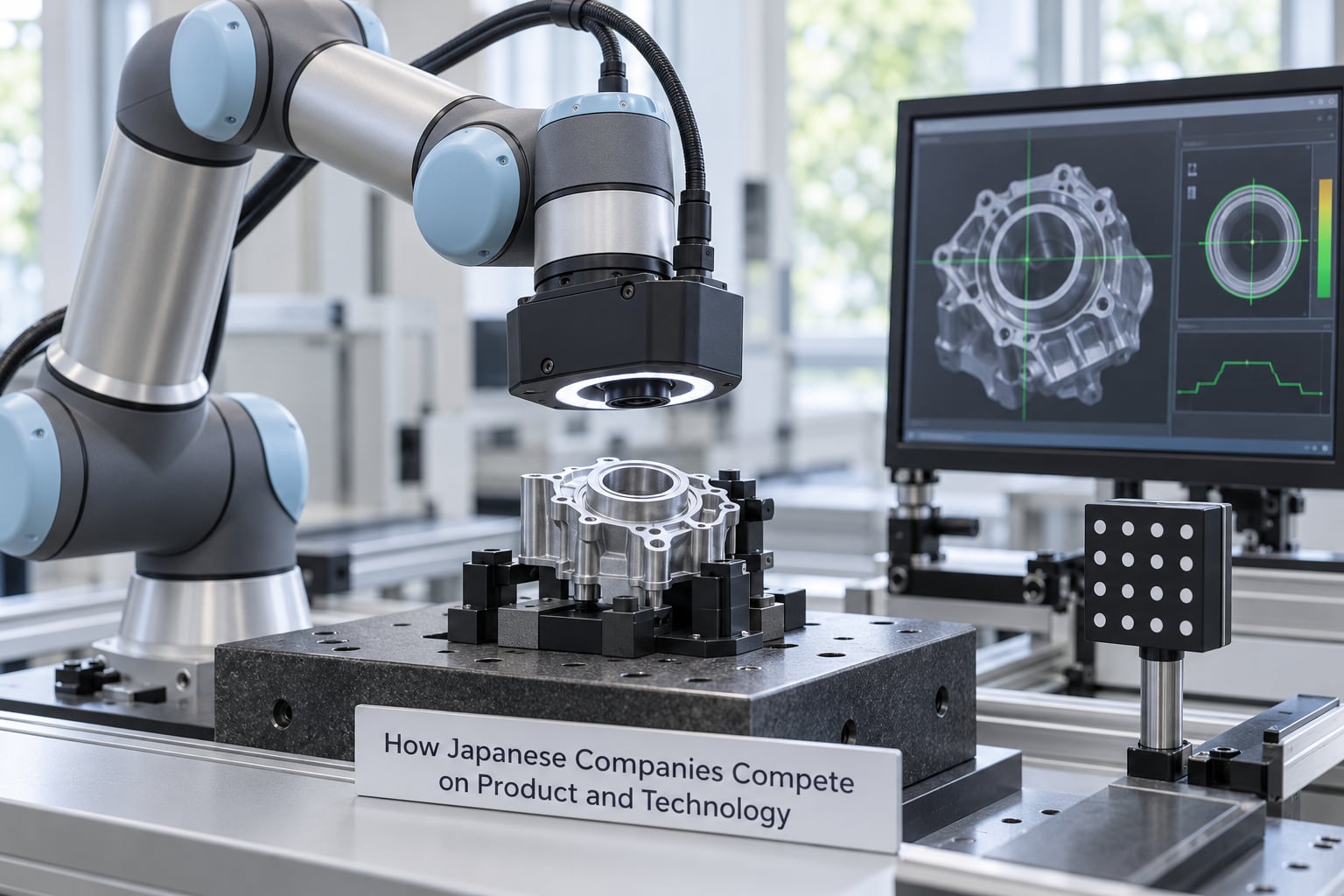
Product differentiation for Japanese makers now runs through sensors, software and application-specific engineering rather than through bigger motors. Three approaches matter most.
How Japanese robot makers compete with Chinese firms on hardware
The first is component control. Rather than only selling arms, Japanese groups invest in the reducers, screws, sensors and machine tools inside them, then sell that consistency as a measurable guarantee of repeatability. Chinese makers are moving in the same direction fast, which is why localization of high-end parts is now the metric to watch rather than arm count.
The second is machine vision and force control, the sensing layer that decides whether a robot can do useful work instead of moving to fixed points. Collaborative arms that work beside people without a cage, and vision systems that adapt to product variation rather than requiring perfect fixturing, are where Japanese engineering still earns its premium.
The third is software retrofit. Japanese companies are pushing AI functions onto controllers and simulators already installed in customer factories, including partnerships with NVIDIA around physical AI. It is a defensive move and a clever one: it turns a thirty-year-old installed base into a customer of tomorrow’s software.
How Japanese Robot Makers Compete on Cost and Business Models
Japanese companies cannot win on purchase price and have mostly stopped trying. A Chinese arm will often cost less than half a comparable Japanese unit, and that gap is structural rather than a mistake waiting to be corrected. Competing on it would mean abandoning the labor, materials and quality systems that produce the reliability advantage in the first place.
So the pitch shifts to lifetime cost. Buyers are asked to count integration hours, spare part lead time, engineering support and lost production from unplanned stops, not just the invoice. A robot that installs in two days and runs for a decade can be cheaper than a cheaper robot that needs a specialist for a week and a spare part from another continent.
Business models follow the same logic. Japanese suppliers bundle application engineering with the hardware, sell maintenance contracts and training, and increasingly sell the cell rather than the arm. Some are experimenting with outcome-based pricing tied to throughput, which moves the risk away from the plant manager and onto the supplier who actually understands the process.
Financing helps too, since a Japanese vendor that leases or structures a purchase removes a capital approval that a cheaper cash purchase still has to fight through.
How Japanese Robot Makers Compete Internationally
Localization is the quietest and most effective Japanese strategy. FANUC, Yaskawa, Kawasaki and others build and source inside China rather than exporting from Japan, which cuts logistics time, satisfies local content expectations and blunts any political argument about foreign dependence.
Joint ventures and partnerships cover the rest. Chinese makers have bought their way up the stack too, most visibly Midea’s acquisition of KUKA, which gave a German brand Chinese ownership and Chinese manufacturing economics. Both directions of that deal produced something: a Western premium name with Chinese cost structure.
Service localization follows the hardware. A field engineer within driving distance changes the conversation for a plant manager, and Japanese companies have been building that bench in North America and Europe as their home markets contract.
One practical complaint keeps surfacing from hobbyists and smaller integrators: Japanese robot hardware is genuinely hard to obtain outside Japan and priced well above Chinese alternatives, which narrows who can even evaluate it. Japanese groups have had to open smaller and entry-level lines, and cheaper distribution, to answer that.
Which Segments Create the Most Competition?
The contest splits cleanly by market, and the two sides are winning different fights.
High-volume factory automation such as automotive welding, electronics assembly and machine tending is where Japan’s installed base and reliability still decide contracts. Chinese makers approach hardest in standard machine tending and welding cells, where the tolerance for downtime is lower and cost matters more.
Warehouse logistics is the contested middle. Chinese makers move faster and price aggressively; Japanese vendors answer with fleet software and a service footprint that survives multi-site rollouts.
Humanoids are the least settled segment and the loudest. Most current humanoid buyers are research labs, not factories, and an independent teardown of the Unitree G1 produced a verdict worth remembering: a rough build, but a price nobody can ignore. Japanese companies have humanoid programs but almost no commercial volume, which leaves them defending a category they are not yet selling into.
Retail, elder care and general service robots are the opposite story, a place where Japanese experience with reliability and safety matters more than per-unit cost because a failing helper robot is a safety event rather than a lost production hour.
What Risks and Trade-Offs Shape the Competition?
The largest Japanese risk is pace. Japan’s strength is decision-making that outlasts a product cycle, which is exactly wrong in a segment that re-prices its expectations every twelve months. Chinese humanoid vendors can launch variants continuously, and Japanese firms structure decisions around committees that take longer.
Labor and component costs inside Japan keep rising, which squeezes the gross margin on every unit sold at a Japanese price. The second trade-off is software: Japanese companies have historically left the operating layer to someone else, and cloud and simulation layers are exactly where Chinese entrants are now investing.
Chinese risks mirror those. Field reliability over ten years is unproven, overseas service coverage is thin, and regulatory headwinds for Chinese hardware in the US and Europe can make the cheaper option illegal or politically awkward. Forum skeptics on r/Futurology also note that the capital flowing into Chinese robotics is small next to the sums going into US AI, which argues against an industry-wide bubble here even if individual companies fail.
Then there is the geopolitical ceiling. Export controls on advanced compute bind both sides, and a hardware category that becomes a national-security concern loses the one advantage it had, which was scale.
What Should Readers Watch Next?
Six signals tell you more than any press release. Track annual robot installation and domestic production figures from the International Federation of Robotics, since they settle the share argument faster than headlines do.
Watch Chinese localization rates for high-end reducers, screws and sensors. That is the number that tells you whether Chinese makers are genuinely independent or still dependent on imports for the hardest parts.
Then look at commercial humanoid orders from factories rather than laboratories, Japanese and Chinese service headcount in Europe and North America, and order backlog and margin trends at FANUC, Yaskawa and Kawasaki as a read on whether reliability still pays. Joint ventures and localization announcements matter less than they used to; factory hiring matters more.
Frequently Asked Questions
What country is number 1 in robotics?
It depends on the metric, and the two answers point in opposite directions. China installs and operates more industrial robots each year than the rest of the world combined, and its domestic output passed Japan’s in 2024. Japan still produces roughly 40-50% of the world’s industrial robots by value and owns much of the precision component supply chain. China leads on volume and demand; Japan leads on production share, precision parts and reliability.
Who are the big 4 in robotics?
The usual list is FANUC, Yaskawa Electric, Kawasaki Heavy Industries and ABB. The first three are Japanese, while ABB is a Swiss-Swedish group, and KUKA (owned by China’s Midea) often appears in the same tier. In Asia-specific coverage the fourth slot more often goes to Daifuku, the material handling specialist.
Whose technology is better, China or Japan?
Japan leads in industrial robot precision, component self-sufficiency, decade-long field reliability and service coverage. China leads in humanoid cost, iteration speed, production volume and the size of its domestic test market. Neither side is ahead everywhere: Japanese humanoids lag commercially, while Chinese arms still lack ten-year duty-cycle evidence.
Why are Japanese robots so much more expensive than Chinese ones?
The gap reflects labor, materials, quality systems and the cost of a service network spread across many markets. Japanese makers also sell a different bundle: tighter repeatability, longer support coverage and predictable spare part supply. Buyers who count only the invoice see a big gap; buyers who count integration time and downtime often see a much smaller one.
Are Chinese humanoid robots reliable enough for factory use?
Not yet for most production lines, mostly because the buyers are still research labs rather than factories. Chinese quadrupeds from Unitree are already treated as useful workplace tools by people who use them, and the same ecosystem covers cost well enough that teardowns conclude nobody can ignore the price. Humanoid reliability over continuous industrial duty cycles remains unproven.
Will China overtake Japan in robotics by 2030?
On volume and cost, Chinese makers are already ahead and will stay there. On industrial robot production share, precision components and factory-grade reliability, the gap is real but narrowing rather than closing. Most informed forecasts put humanoid parity somewhere around 2030. The more likely outcome by then is a split market: China leading humanoids and volume, Japan holding the high-reliability industrial base.
Conclusion
So how Japanese robot makers compete with Chinese firms is not a price war. They compete by staying upstream in precision components, building and staffing inside every market they sell to, and pricing the whole life of the robot rather than the box it ships in, while Chinese firms compete on cost, volume and speed into the fastest-growing market on earth.
If you are evaluating one for actual work, check four things first: where the precision components come from, how close a qualified service engineer is, what the repeatability claim looks like after a year rather than a datasheet, and how the total cost of ownership compares over the ten years you actually intend to run the cell. Those four answers usually tell you more than any nationality comparison will.