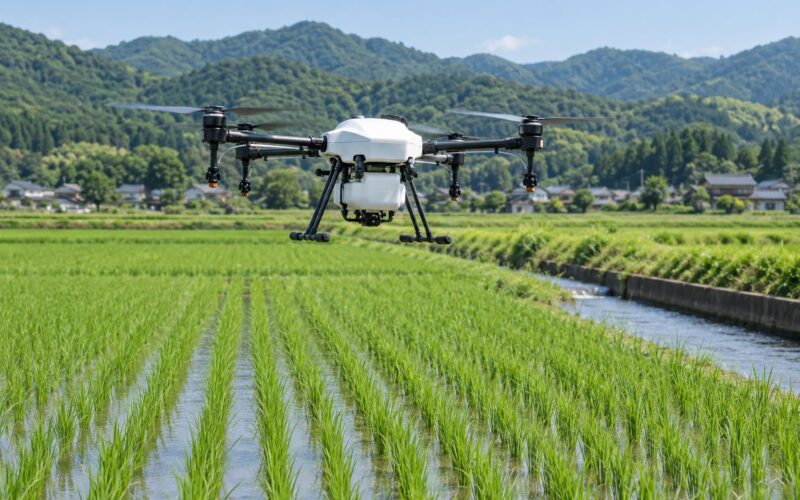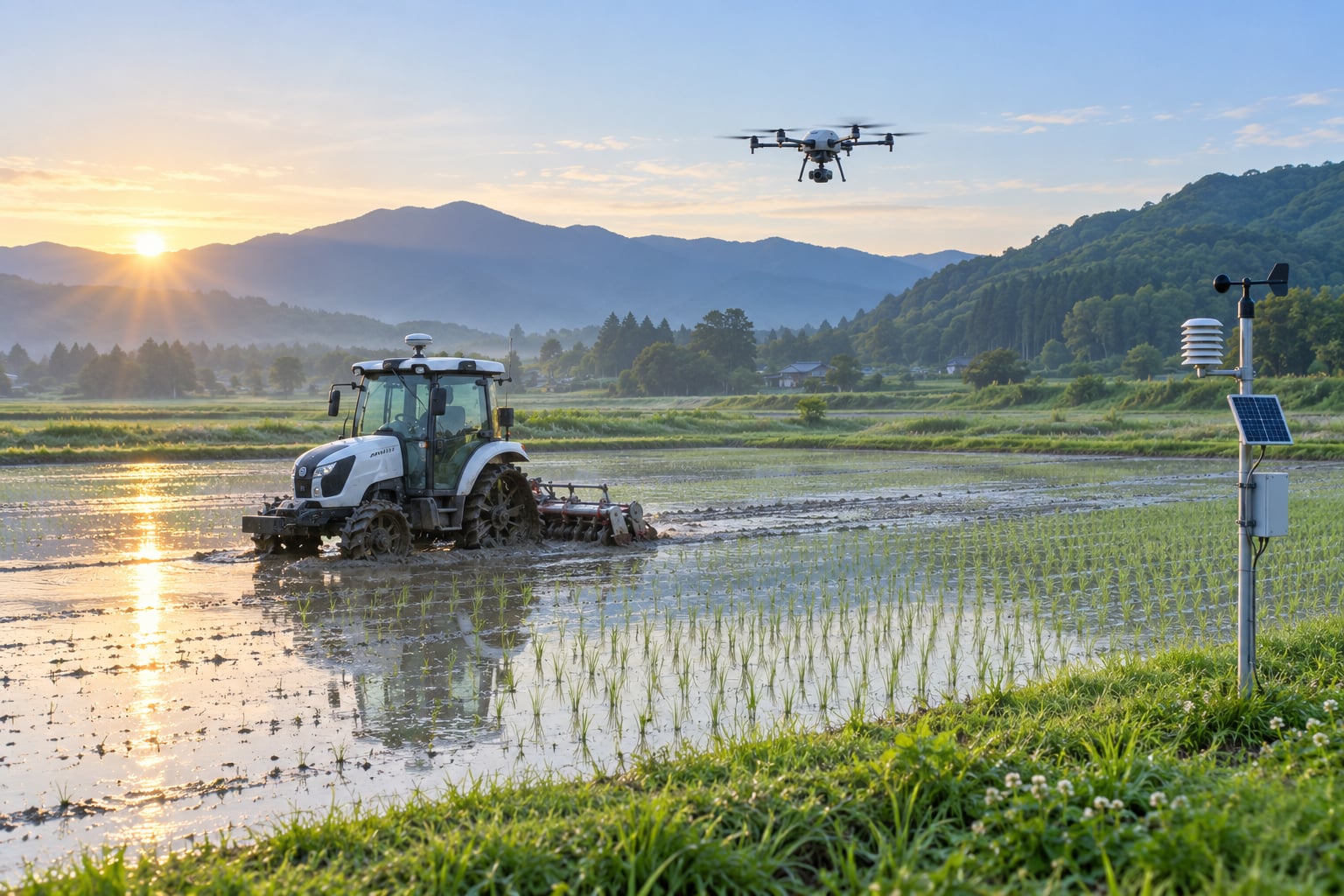
How Japanese smart farming works comes down to a loop: sensors and cameras measure what is happening in a field or greenhouse, the readings go to a cloud platform, software turns them into a recommendation, and a machine acts on it. A farmer reviews the result on a phone and adjusts the next round. The technology is commercially real and supported by the Ministry of Agriculture, Forestry and Fisheries, but adoption on ordinary farms is still modest.
Most English-language coverage of the topic flattens it into a list of shiny machines. That list misses the part people actually ask about, which is the sequence: what happens first, what data comes out of it, and which decision changes because of that data.
Table of Contents
- 1The short version
- 2What Is Japanese Smart Farming?
- 3Why Japan Uses Smart Farming Technology
- 4How Japanese Smart Farming Works From Field to Data
- 5How Japanese Smart Farming Works in Daily Practice
- 6The Main Technologies Used on Japanese Farms
- 7Smart Greenhouses and Vertical Farms
- 8What Japanese Smart Farming Can Improve
- 9Costs, Challenges, and Why Results Vary
- 10The Future of Smart Farming in Japan
- 11Frequently Asked Questions
- 12What is Japanese smart farming?
- 13Does smart farming in Japan replace farmers?
- 14Which technologies are used in Japanese smart farming?
- 15How much does smart farming cost in Japan?
- 16Is Japanese smart farming better for the environment?
- 17Can small Japanese farms use smart farming technology?
- 18Conclusion
The short version
- The loop: sense, transmit, analyse, decide, act, verify, then repeat with better data.
- The machines: GNSS and RTK-guided autonomous tractors, rice transplanters, drone sprayers, weeding robots, harvesters and grading lines.
- The data: soil moisture, temperature, humidity, nutrient and pH probes, plus multispectral drone imagery and machine vision on ripening fruit.
- The pay-off: fewer hours spent steering, less fertiliser and spray applied blindly, tighter control of irrigation, and a traceable record from field to packing line.
- The catch: an unmanned tractor commonly costs more than ten million yen, plots are small and scattered, and a machine that goes down in the planting window cannot wait for the parts van.
What Is Japanese Smart Farming?
Japan’s Ministry of Agriculture, Forestry and Fisheries describes smart agriculture as farming run through a smart integrated system: data gathered across the whole production process, used to support decisions so that even growers without long technical backgrounds can reach good results early in their careers. The emphasis is not on a single clever robot. It is on joining sensing, analysis and machinery into one process.
That is the difference from ordinary mechanisation. A tractor with a tilt-sensor is automation the farmer drives. Smart farming means the machine knows which plot it is in, what the soil and crop are doing, what happened last season there, and what it should do next. Take a tomato greenhouse in Kumamoto or Aichi. Probes in the substrate read moisture and nutrient concentration, while a camera above the row counts fruit and grades ripeness by colour. A cloud service compares those readings against the greenhouse’s own history and opens or closes the drip line, then tells the grower why it did that.
Terms overlap and get used loosely. Precision farming means applying inputs at the right place and rate, usually guided by GPS. Controlled environment agriculture means growing indoors where you control light, temperature, humidity, water and nutrients. A vertical farm is a building where crops stack upward on tiers under LEDs. Smart farming is the wider label: it covers field machinery, sensors, cloud platforms and greenhouses together.
Why Japan Uses Smart Farming Technology
Japan did not adopt this because farming was profitable or convenient. It adopted it because four constraints arrived at the same time.
The first is land. Roughly six-tenths of the country’s surface is mountainous or otherwise not cultivated, and what farmland exists is split into small, dispersed plots. Machinery that works beautifully on a wide flat field in Iowa or Brazil struggles to turn between narrow paddy edges.
The second is people. The farming population is fewer than two million and the average age sits above sixty-five. Foreign technical workers and family members fill part of the gap, but a generation is retiring out of physically demanding work, and the replacement question has no easy answer.
The third is food security. Japan imports a large share of what it eats, and a pandemic, a shipping disruption or a currency move turns that exposure into a political problem overnight. Raising output per worker matters more than adding acres, because the acres do not exist.
The fourth is resources. Irrigation water and electricity are limited and unevenly distributed by region, and fertiliser and pesticide use are politically sensitive after decades of overuse. Doing less, more precisely, is attractive on its own terms.
Government support follows from this. The Smart Agriculture Demonstration Project set up districts where the full stack is run together rather than one machine at a time, and subsidies offset part of the purchase cost. The Agricultural Technology Utilization Promotion Act is the legal frame underneath. Demonstration sites matter more than they sound: a tractor that works on one farm’s layout often needs re-fitting for the next one, and the projects are where that gets worked out.
How Japanese Smart Farming Works From Field to Data
The mechanism is the same whether the crop is rice, tomatoes or sweet potato. Six stages repeat through the season, and each one ends with a measurement that feeds the next.
| Stage | Tools | Decision or action | What gets measured |
|---|---|---|---|
| 1. Sense | Soil moisture, temperature and nutrient probes; field cameras; weather stations | Nothing yet, just continuous readings | Volumetric water content, pH, EC, air temperature and humidity |
| 2. Scout from above | Multispectral drones from firms such as Nikon or Topcon, NDVI and colour indices | Where to walk and look closely | Canopy cover, chlorophyll response, irrigation and pest stress patches |
| 3. Transmit | LoRa and cellular gateways, farm routers, 5G where coverage allows | Choose which readings are worth sending and how often | Signal quality, uptime, data cost |
| 4. Analyse | Cloud and edge farm platforms, decision models, weather forecasting feeds | Build a recommendation for the next operation | Predicted soil moisture, disease risk window, expected harvest date |
| 5. Act | Autonomous tractors, transplanters, drone sprayers, robotic weeders, actuators, harvesters | Till, transplant, spray, weed, irrigate, harvest on RTK-guided paths | Fuel and chemical used, area covered, pass accuracy, hours worked |
| 6. Verify and record | Scales, yield monitors, grading cameras, farm management apps | Compare actual result with the prediction | Yield per plot, grade distribution, input cost, traceability records |
Step six is the one that makes the loop worth running. A prediction that is never checked against the harvest becomes decoration. Recorded yield per plot feeds back into next season’s seeding rate and fertiliser plan, and that is how a farm’s own data becomes an asset that a machine cannot buy anywhere.
How Japanese Smart Farming Works in Daily Practice
Follow a rice cooperative through one season. Before transplanting, a GNSS and RTK-equipped tractor tills, puddles and levels the paddy on a stored path, which means it can repeat the same run on the same plot next year instead of reworking ground that was already fine. A transplanter places seedlings at fixed spacing and depth; Kubota, Yanmar and Iseki all build units for this work, with autonomy added at the factory.
Ten days after transplanting, a drone flies the plot. Multispectral imagery turns into an index map, and the map marks the low-drainage corner that always yellows. The platform then compares weather forecast, leaf wetness duration and yesterday’s readings, and raises a spray window rather than a blanket recommendation. Some cooperatives water by sensor threshold, opening and closing an inlet instead of flooding on a fixed schedule, which saves water in regions with summer water restrictions.
In a greenhouse block, the same pattern runs at hourly resolution. Climate data sets shade and ventilation, fertigation doses nutrients by substrate reading, and a camera counts trusses and grades colour at harvest, which feeds a picking list so pickers walk to plants that are actually ready. Farmers stay responsible throughout. Most Japanese systems run in an advisory mode where the machine suggests and the grower confirms, and fully unsupervised decision-making is still limited to specific operations such as irrigation and climate control.
The Main Technologies Used on Japanese Farms
Each layer solves one problem, and none of them is much use alone. How Japanese smart farming works in practice is really the story of how these pieces are joined.
- Sensors. Capacitive soil probes for water, ion-selective probes for nutrients, pH and EC probes, leaf-wetness sensors, air temperature and humidity, and cheap throwaway tensiometers. Accuracy and calibration intervals decide whether the reading is worth acting on.
- IoT gateways. Small solar or battery units from vendors including Zenrin Agri and Hitachi TraceAgri that collect readings from a field and forward them, buffering when the connection drops.
- Cloud and edge platforms. Farm management services such as Farmnote and Panasonic’s field systems hold the history for each plot. Edge processing handles the readings that must respond in seconds, such as valve control, because a round trip to a distant server is too slow.
- AI and machine vision. Models from companies including NEC, Nileworks and Agrist classify disease symptoms in leaf photographs, estimate yield from fruit counts, and turn drone imagery into stress maps. Vision systems from firms such as Yaskawa handle picking and grading tasks that tolerate imperfect object shapes.
- GNSS and RTK guidance. A base station sends correction data so a tractor holds its line to a few centimetres. This is what makes repeatable passes, accurate spacing and automatic headland turns possible on fragmented Japanese plots.
- Drones. Survey drones map fields; spray drones apply pesticide and foliar feeds at low volume, which suits the small, awkward shapes Japanese farmers work. SkyDrive builds industrial drones in Japan and has moved toward agricultural and logistics work.
- Autonomous machinery. Yanmar, Kubota and Iseki supply tractors with assisted steering, automated turns and supervised autonomy, plus rice transplanters and combines. Manufacturer-built autonomous kits generally cost more than the manual machine.
- Weeding and cultivation robots. Small machines with hoes, brushes or finger weeders work between rows, and some are steered by vision rather than buried cables.
- Harvest and post-harvest automation. Harvesters for cabbage, onions and other vegetables, picking robots under development for strawberry and tomato, and grading lines with cameras and weight stations that sort by size and colour.
- Controlled environment systems. Greenhouse climate computers, LED lighting, hydroponic and aeroponic benches, and fertigation skids, all tied to the same data platform as the field sensors.
- Connectivity. 4G and 5G cellular in settled areas, LPWAN and satellite links in remote ones. Japan has good coverage overall and patchy coverage in exactly the places with the largest plots.
Smart Greenhouses and Vertical Farms
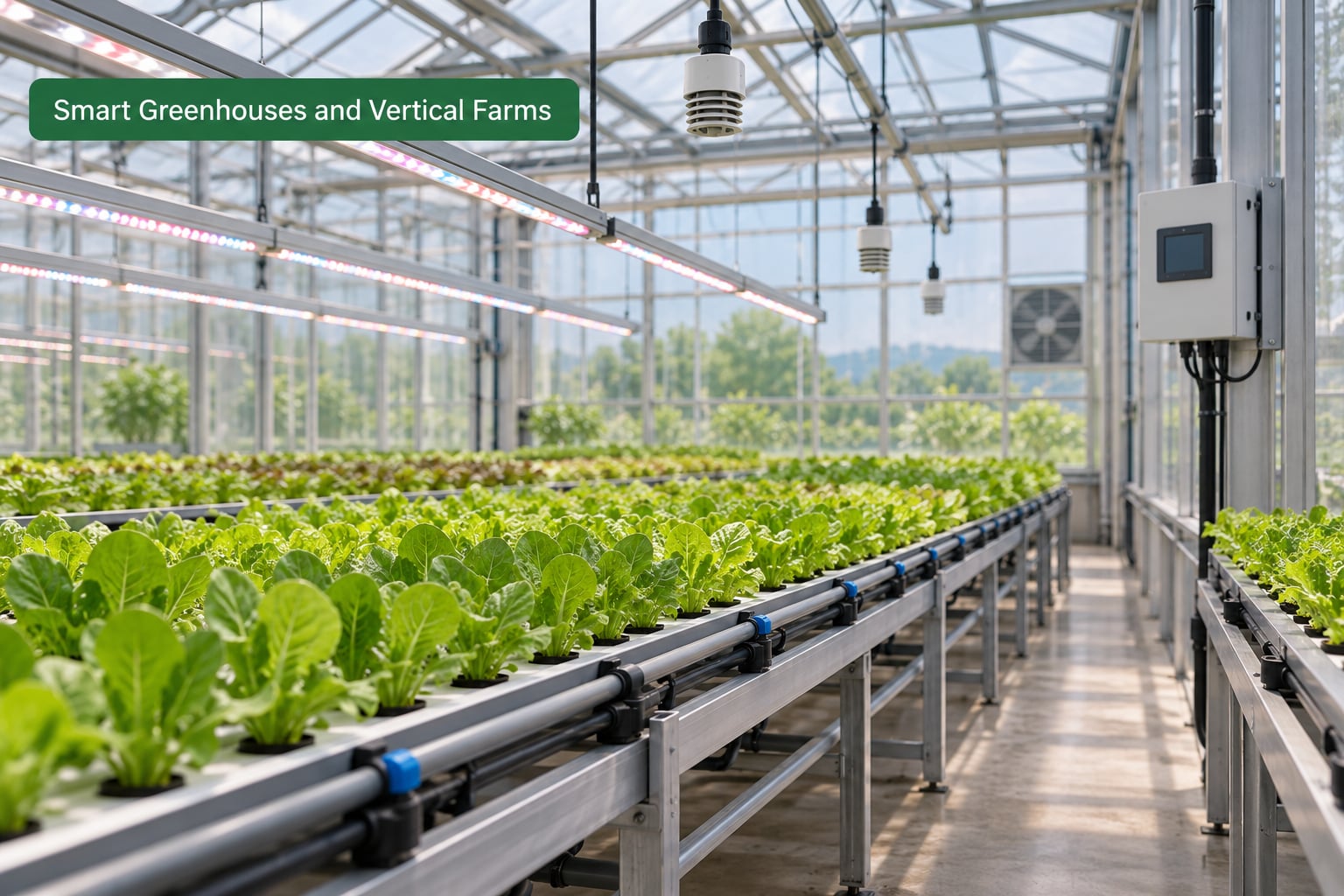
Japan’s greenhouse belt around Shizuoka, Kochi and Kumamoto is where automation and controlled environment overlap most. Large houses run climate computers, fertigation and machine vision together, and the appeal is predictability under a bad summer, not novelty.
Plant factories go further. A fully enclosed vertical farm such as those operated by Spread or Oishii Farm controls light, temperature, humidity, water and nutrients almost completely, so a crop is no longer exposed to weather at all. That control buys year-round supply of a small, high-value set of crops for city consumers.
| Production method | What the farmer controls | Strongest advantage | Common crop profile | Operating challenge | What the data changes |
|---|---|---|---|---|---|
| Open field with GNSS machinery | Passes, depth, spacing, spray rate | Lowest capital cost per hectare | Rice, wheat, soybeans, potatoes | Weather exposure and small fragmented plots | Repeatable passes and fewer overlaps cut fuel and inputs |
| Automated greenhouse | Temperature, humidity, irrigation, nutrients, some light | Extends season and tightens input use | Tomatoes, cucumbers, strawberries, sweet potato, melons | Heating cost and skilled operator time | Drip lines and vents respond to probes instead of a fixed schedule |
| Plant factory or vertical farm | Light spectrum and intensity, temperature, humidity, water, nutrients, CO2 | Weather-independent, year-round, close to buyers | Lettuce and leafy greens, herbs, strawberries | Electricity cost per kilogram and capital intensity | Recipes are tuned per crop stage from thousands of logged readings |
The honest comparison is that greenhouse automation improves an existing profitable crop, while vertical farming creates a new one and carries a harder energy bill. Electricity is the constraint that keeps large-scale vertical farming from displacing field production in Japan: plants need light around the clock, so the power bill per kilogram becomes the decisive number rather than the growing recipe.
What Japanese Smart Farming Can Improve
Some gains are well established in Japanese demonstration data, others depend heavily on the crop and the weather that year. It helps to sort them.
Well established. Labour hours on the mechanical operations fall, because guidance and autonomy remove steering, headland turns and monitoring time. Fertiliser and pesticide use drop when application is driven by a map or a threshold instead of a habit. Water use falls where irrigation is scheduled from soil readings rather than a calendar. Every operation generates a record, which makes GAP certification and export paperwork far easier to assemble.
Crop and climate dependent. Yield increases are real on greenhouses where climate is tightened, and much harder to promise in open field, where weather still dominates. Crop loss reduction from disease alerts depends on someone acting on the alert in time. Post-harvest grading gains come from camera sorting on uniform produce, which is why strawberry and tomato lines are further along than potato or onion lines.
Still early. Fully autonomous decision-making across an entire season, yield forecasting accurate enough to sell futures on, and inter-farm machinery sharing are all research topics rather than settled practice.
Costs, Challenges, and Why Results Vary
Survey figures reported for Japanese farms sit far below promotional claims, with roughly 11.6% using drones, 11.1% using robotics and around 9.0% using other smart-farming technology. Treat these as directional, but they are the best honest picture available, and they are nothing like the “half of all farms” figure that appears in vendor material.
Cost is the first constraint. An unmanned tractor commonly exceeds ten million yen before any attachments, and a full stack of drones, gateways, a harvester and a platform runs well beyond that. For a 1.5-hectare family farm, the payback calculation rarely works alone, which is why cooperative ownership, contractor services and subsidy programmes matter so much to how this spreads.
Fragmented plots come next. Autonomous guidance needs a margin it can drive along without clipping a neighbour’s field, and a paddy of half a hectare with three awkward corners is a different problem from the flat rectangles the manuals describe.
Connectivity and interoperability cause quieter failures. A gateway that drops out in a valley sends a gap in the record, and gaps undermine the yield comparison at the end of the season. Farm management apps from different vendors often do not share data cleanly, so a grower can end up re-entering the same field history twice.
Training and maintenance are the last pair. The intended user is a farmer over sixty-five who did not grow up with dashboards, and an adoption rate stays low if the interface assumes otherwise. Downtime is the fear operators mention most: Japanese rice planting and harvest windows are narrow, and a machine that fails in early May cannot be replaced before the transplanting deadline.
That is also why partial adoption is so common. A farm buys one piece, often a drone service rather than a machine, and gets the scouting benefit without the capex or the maintenance chain.
The Future of Smart Farming in Japan
In the near term, the changes already under way are the wider spread of supervised autonomy on tractors and combines, AI recommendations that reach farmers through apps they already use, and more low-cost contract services that let a small farm rent the capability by the hour rather than buy it.
Further out sit low-power and solar sensors that can be left in a field for a season without servicing, remote management of unattended greenhouses, and platforms that let several small farms pool their data and share equipment. Coordinating multiple machines over 5G, including swarm-style weeding or seeding, sits further out still because it needs reliable coverage at exactly the moment work happens.
The likely direction is a shared infrastructure rather than a fully automated farm. Smallholders keep the decisions, cooperatives and contractors supply the machines, and the data layer becomes the part that is genuinely common.
Frequently Asked Questions
What is Japanese smart farming?
It is farming run through a smart integrated system, the term the Ministry of Agriculture, Forestry and Fisheries uses. Sensors, drones, cloud software and machinery share data across one production cycle, so decisions about irrigation, spraying, fertiliser and harvesting are made on measurements rather than habit. The machinery mostly executes or suggests, and the grower still approves.
Does smart farming in Japan replace farmers?
No. Most Japanese systems run in an advisory mode where software proposes an action and the farmer confirms it. Full autonomy is limited to specific operations such as supervised tractor driving, climate control and irrigation valves. The policy goal is to let growers reach a good result earlier in their careers, not to remove the person making judgement calls about a specific field.
Which technologies are used in Japanese smart farming?
The main ones are GNSS and RTK-guided autonomous tractors from Yanmar, Kubota and Iseki, rice transplanters, survey and spray drones with multispectral cameras, soil and weather sensor networks, IoT gateways, cloud farm management apps such as Farmnote, machine vision for ripeness and grading, robotic weeders and harvesters, and fully controlled greenhouse and vertical farm systems with LED lighting and fertigation.
How much does smart farming cost in Japan?
An unmanned tractor commonly costs more than ten million yen, and a full stack of drones, gateways, a harvester and a platform costs well beyond that. Reported adoption sits near 9 to 12 percent depending on the technology, so most small farms do not buy a complete system. Contractors, cooperatives and MAFF demonstration projects spread the cost, and many farms start with drone services for scouting only.
Is Japanese smart farming better for the environment?
It reduces inputs rather than expanding the farm. Guidance and variable-rate application cut fertiliser, pesticide and fuel per hectare, and sensor-based irrigation lowers water draw. Vertical farms use no field land at all but consume a great deal of electricity for lighting, which is the main reason they have not replaced field production. Whether the balance is positive depends on the grid mix and the crop.
Can small Japanese farms use smart farming technology?
Yes, but usually one piece at a time rather than as a full stack. Drone scouting, subscription farm management apps and contract machinery services cost little and need no maintenance chain, which suits farms under two hectares. Capital-heavy items such as autonomous tractors are usually shared through cooperatives or run by contractors. The real barrier is training time, not the size of the farm alone.
Conclusion
Smart farming in Japan is a repeated loop rather than a single invention: measure the field, move the data somewhere useful, turn it into a decision, carry the decision out with a machine, then check the result against the prediction. That last step is what makes it farming rather than a gadget demo.
If you want to see how it works in practice, start small. Pick one measurable problem on a farm you know, such as water use on one plot or hours spent scouting, collect only the data that problem needs, run one intervention for a season, and compare it with an untreated plot. Almost nobody starts with a fleet, and the farms that keep going are the ones that got one measurable thing right first.