Short answer: the reason why Japanese automakers were slow on EVs is that hybrids were already a profitable, low-risk answer to Japan’s fuel costs, and a deliberate multi-pathway bet meant battery EVs were never urgent. Add thin charging infrastructure, a post-Fukushima grid, a decade of hydrogen policy, and a supplier base wired to combustion parts, and the delay starts to look less like a mistake than a stack of individually rational choices.
That framing is useful until you look at what those choices cost. In 2022 Japan sold roughly 59,000 battery EVs, under 2% of new cars, while China was near 20% and Western Europe near 15%. Two years of strategy reversal since then have not closed that gap.
Table of Contents
- 1Why Japanese Automakers Were Slow on EVs: The Short Answer
- 2How Japan’s Car Industry Entered the EV Era
- 3Why Hybrid Expertise Helped Delay the Battery-EV Pivot
- 4Why Japanese Automakers Were Slow on EVs: Business and Market Incentives
- 5How Government Policy and Industry Structure Shaped the Delay
- 6Why Battery Supply Chains and Technology Choices Mattered
- 7Why Japanese Automakers Were Slow on EVs: The Global Competitive Shift
- 8What Toyota and Other Japanese Brands Did Differently
- 9What Japan’s Slow EV Turn Means for Buyers and Investors
- 10What Lessons Japanese Automakers Learned About EVs
- 11Frequently Asked Questions
- 12Were Japanese automakers completely against electric cars?
- 13Why did Toyota favor hybrids over fully electric vehicles?
- 14Did Japan’s government cause domestic automakers to fall behind in EVs?
- 15Which Japanese automaker was earliest to sell a mass-market EV?
- 16How did Chinese EV makers affect Japan’s automotive industry?
- 17Can Japanese automakers catch up in the global EV market?
Why Japanese Automakers Were Slow on EVs: The Short Answer
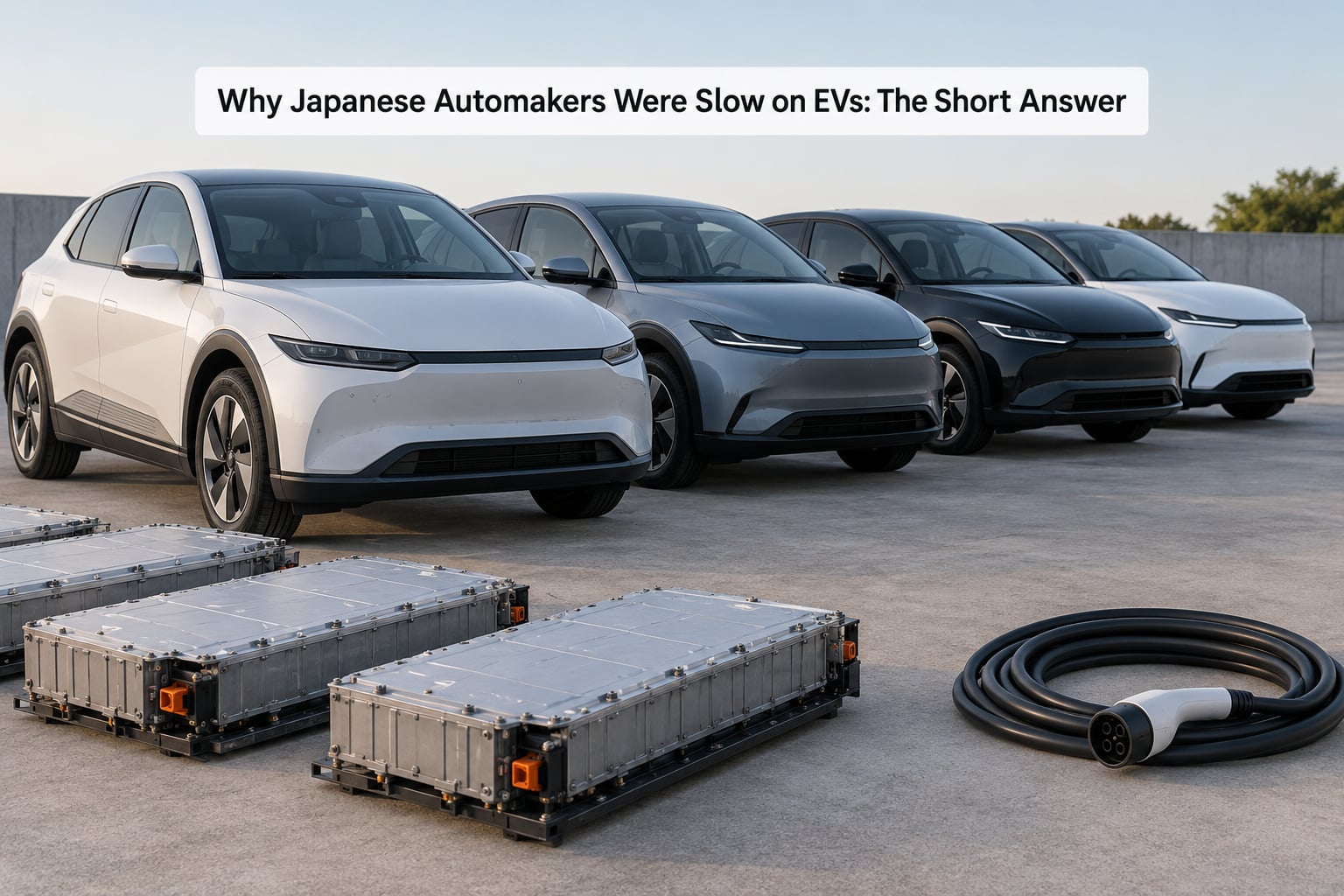
Seven forces did most of the work. Each one made sense on its own, and together they kept Japan’s battery EV share at a fraction of China’s.
| Cause | How it delayed electrification | Strategic disadvantage |
|---|---|---|
| Hybrid economics | Hybrid profit centres and mature engineering kept combustion alive | Revenue mix tilted toward high-margin combustion hardware |
| Multi-pathway strategy | Battery, plug-in hybrid and fuel cell pursued together, with no deadline | Battery-specific scale never accumulated |
| Charging access | Public charging stayed thin and apartment dwellers had little route to a charger | Domestic demand signal stayed small, so export bets looked speculative |
| Grid limits after Fukushima | Reduced nuclear output and land scarcity constrained cheap overnight power | Mass electrification looked politically and environmentally harder than elsewhere |
| Hydrogen policy | METI funding pushed fuel cells as the strategic lane | Sunk investment in a technology with thin demand |
| Keiretu suppliers | Tens of thousands of small firms build combustion components | Timing of a shift was a political question, not only a technical one |
| Service revenue | Periodic maintenance underwrites the economics of every car sold | BEVs weaken the model that pays back a decade of ownership |
The uncomfortable part is that the strongest critic of the delay, Toyota, has been one of the loudest. Chief executive Akio Toyoda has publicly questioned whether the pace of battery-only adoption was settled science, and even Toyota’s later language calls battery EVs the missing piece of a multi-path carbon neutral strategy rather than the whole of it.
How Japan’s Car Industry Entered the EV Era
Japan’s automotive strength came from narrow, disciplined engineering: small-displacement engines, front-wheel drive layouts tuned for tight city streets, kei cars sized to Japanese size-class rules, and manufacturing quality that turned a company’s badge into a resale-value claim.
Kei cars matter more here than anywhere else in the global market. The kei class is a regulatory category, not a styling choice, with strict length, width and engine-size limits that shape which vehicles Japanese manufacturers design first.
Japan was not absent from early electric cars. Mitsubishi’s i-MiEV arrived in 2009 and Nissan’s Leaf in 2010, both real production vehicles years before most Western brands shipped anything pluggable. What those cars lacked was a market behind them.
The brands that needed a battery EV to open a new segment had an incentive to ship one. The giants that dominated Japan, Toyota, Honda, Nissan and the rest, were defending profitable existing lines and did not face the same pressure. Early battery vehicles ended up looking like a niche product from a niche maker, and that reading stuck for a decade.
Why Hybrid Expertise Helped Delay the Battery-EV Pivot
Hybrids are the reason the delay happened at all. Toyota commercialised the Prius at volume in the late 1990s, and by the mid-2000s the approach was spread across nearly every Japanese brand as the technology matured into something ordinary and dependable.
The economics were attractive. A hybrid needed no charging infrastructure, no new grid capacity, no behaviour change from the driver, and no battery pack sized for long-distance range. It also cut fuel use by roughly a third to a half in normal driving while keeping the entire refuelling and servicing infrastructure intact.
For Japan’s driving pattern, that mix won. Most daily mileage is short urban commuting, which is exactly where a hybrid’s efficiency gains are largest and a battery EV’s charging inconvenience is most annoying. Short trips, short distances, dense cities, reliable rail for anything longer.
| Powertrain | Charging needed | Fit with Japanese daily driving | What it cost the battery EV |
|---|---|---|---|
| Conventional hybrid | None | Excellent for short commutes | Took the volume, and the margin |
| Plug-in hybrid | Overnight, partial | Good, with a small electric range | Gave drivers an electrified option without the commitment |
| Battery EV | Regular, planned | Fine urbanly, awkward on long trips | Faced with the harder adoption ask |
| Fuel cell | Hydrogen refuelling network | Technically suited, commercially thin | Absorbed policy money and engineering time |
It would be unfair to call this purely cynical. A plug-in hybrid running on electricity for most commutes is a real emissions reduction, sold at scale, in the 2010s. It just is not a zero-emission fleet, and it does not force the battery cost curve or the charging build-out that a battery EV market creates.
Hybrids also insulated the manufacturers. When a combustion platform could keep getting more efficient, there was no burning platform moment where a firm had to say everything before now goes electric.
Why Japanese Automakers Were Slow on EVs: Business and Market Incentives
The strategic contradiction sits in one sentence: fuel in Japan is expensive enough to make efficiency attractive, but a reliable combustion car was still the lower-risk purchase for almost every buyer. Nobody in Tokyo was deciding between a good car and a bad car. They were deciding between a familiar one and an unfamiliar one.
Several quieter incentives pointed the same way.
| Factor | Pulled toward combustion | Pulled toward battery EVs |
|---|---|---|
| Buyer demand | Resale value and fuel economy already solved | Running costs attractive, but only in a few segments |
| Dealer economics | Service bays scheduled for decades | Fewer routine visits to sell |
| Factory utilisation | Plants tuned for combustion components | Retooling cost with no volume to justify it |
| Battery cost | Not urgent while hybrids satisfied emissions rules | Scale only arrives with volume, and volume needs cheap batteries |
| Product cycle | Seven-year platform refreshes fit a slow market | Faster cycles needed to track battery price falls |
Range anxiety shows up here too. Forum discussion on this topic is consistent: many drivers want around 700 km of real-world range before they will consider a battery EV as a primary car, and quoted WLTC figures have not always earned trust.
A second, quieter concern sits under all of it. Japanese manufacturers make money twice, once on the car and again over a decade of scheduled maintenance. A vehicle that needs far less servicing does not fit that model cleanly. One widely repeated argument on enthusiast forums is that hydrogen was attractive partly because it keeps a service tail alive. Treat that as an argument from the debate rather than a documented plan, but it explains why the status quo had defenders.
How Government Policy and Industry Structure Shaped the Delay
Japan’s own policy framework did not push its automakers toward battery EVs the way Europe and parts of the US did. There was no purchase subsidy of the kind that created early demand in Norway, and Japan’s efficiency targets were worded to let hybrids and fuel cells count toward compliance.
The keiretsu structure matters too. Japanese assembly is built on tiered supplier groups, with a lead assembler and a deep network of smaller firms. One forum user claims METI pressed Toyota to slow electrification to protect employment across the component-supplier base. That specific claim is unverified, and it is better treated as a hypothesis than a fact. The structural point underneath it stands on its own: a very large number of small companies build combustion components, so the timing of a transition is partly an employment question, not purely an engineering one.
Geography adds friction that Europeans sometimes underestimate. Japan’s urban form means many households live in apartment blocks without a private parking space, which makes home charging difficult and public charging necessary. Post-Fukushima shutdowns cut nuclear generation, and Japan’s limited land makes new generation and large solar build-out slower than in countries with more space or more abundant gas.
Japan has roughly 30,000 public charging points against a target of 150,000 by 2030, set when chargers were far rarer. Contrast that with a market that subsidises purchases, mandates fleet electrification and funds chargers directly. Those three levers create demand, and demand is what forces a product.
For balance, Japan’s caution was not pure superstition. Analyst Christopher Richter of CLSA argued the industry still had to be EV-first because raw material supply chains carry real risk, and METI official Kuniharu Tanabe pointed to affordability and resource limits. That concern has aged worse than the charging one, but it was not unreasonable when it was made.
Why Battery Supply Chains and Technology Choices Mattered
Japan is excellent at batteries the size of a phone card and unproven at the ones the size of a car. That gap came from where each supply chain grew: consumer electronics demanded small, high-energy-density cells made in enormous volumes, while electric vehicles needed large-format cells at very low cost per kWh.
Japanese makers bought cells externally for most of the 2010s rather than building their own at scale. Every purchase therefore carried another company’s pricing and roadmap, while hybrid programs needed far smaller packs that Japan’s existing supply could serve comfortably. The dependency cut both ways: it kept costs low in the short run and left no internal cell capability when the strategic value of one became obvious.
Building packs was the second problem. A combustion platform is a mechanical machine, and swapping in a dedicated electric platform means new housings, new thermal management and new factory lines. Chinese manufacturers designed those architectures later, from the start, when their packs were cheap and their plants young.
Solid-state batteries get a lot of attention as the answer, and Toyota has tied its next battery programme to them. Treat that as a timeline with real engineering still in front of it rather than a solved problem. The chemistry that has actually moved cost fastest is simpler: LFP cells use widely available materials and forgo nickel and cobalt, which is a large part of why Chinese packs got cheap so quickly.
Why Japanese Automakers Were Slow on EVs: The Global Competitive Shift
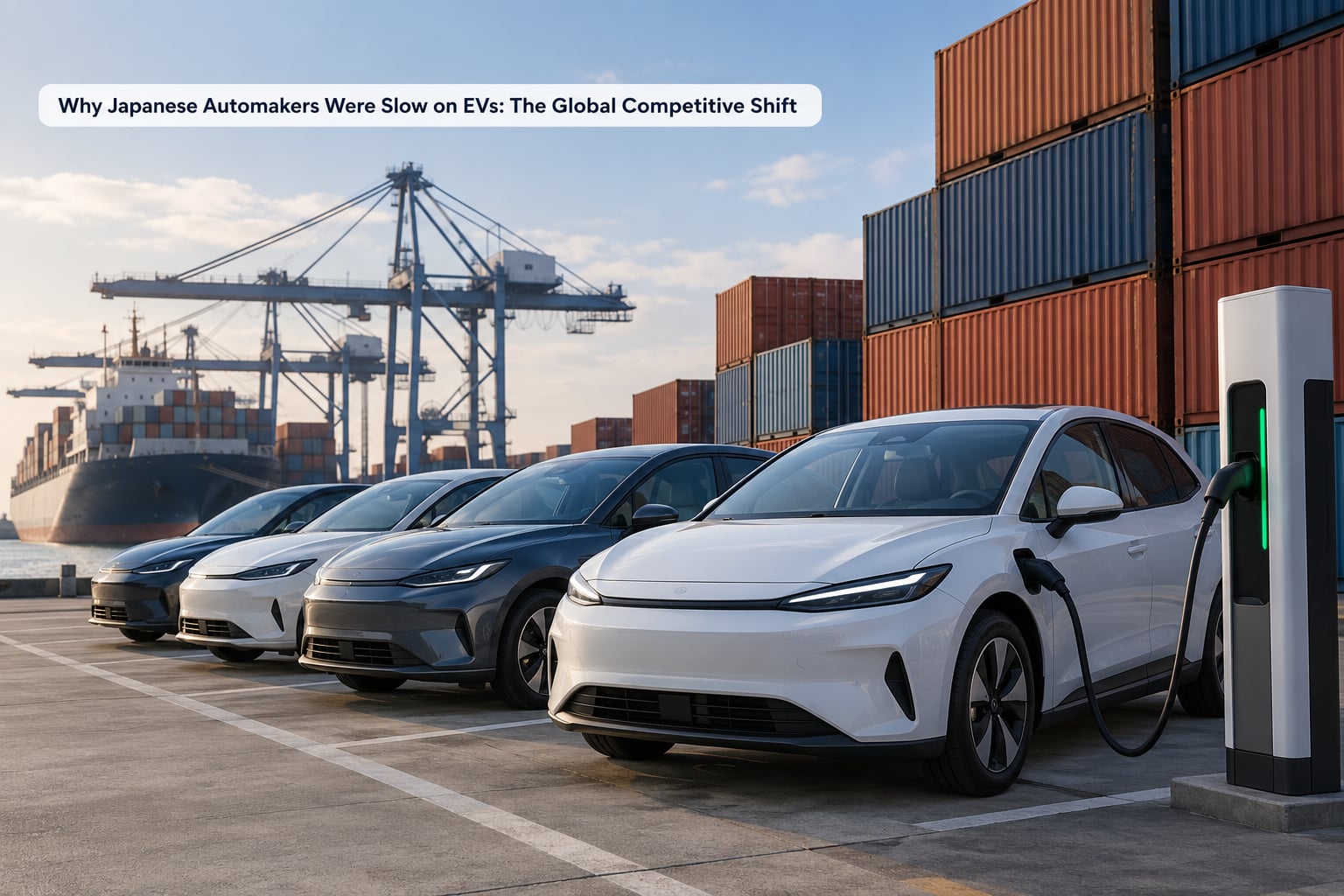
Two external shifts did more damage than any single misjudgement, and both changed what buyers expected a car to be.
The first was Tesla, which treated the car as a software product. Direct sales removed the dealer handoff, over-the-air updates made the vehicle improve after purchase, and long advertised range figures reset what shoppers compared against. Japanese manufacturers had deep engineering capability and thin software capability, and the gap showed up in how the car was sold rather than how it drove.
The second was China, which combined lower pack costs, faster model cycles and enormous export ambition. Chinese brands did not need to win a decade of brand building to compete; they arrived with pricing, features and product refreshes that Japanese exports found hard to match in Southeast Asia and increasingly in Europe.
| Market | Battery EV share of new car sales | Charging build-out | Policy direction |
|---|---|---|---|
| China | Around 20% | Fast, state and industry funded | NEV targets with industrial support |
| Western Europe | Around 15% | Growing steadily | Fleet CO2 rules, 2035 zero-emission target |
| United States | Around 5% | Patchy, mostly private networks | State-level rules, changing federal support |
| Japan | Under 2% | Thin public network | Multi-pathway targets counting hybrids and fuel cells |
Figures are the 2022 comparison reported by PwC and repeated widely since, and they are the clearest single picture of the gap. The strategic cost was not so much worse engineering. It was arriving late to the software-defined buyer and then meeting Chinese brands with the price and cadence Japanese exports could not match.
What Toyota and Other Japanese Brands Did Differently
The brands were not uniform. Their approaches read differently now that the dust has settled a little.
| Brand | Early battery EV | Stated approach | What the delay cost or saved |
|---|---|---|---|
| Toyota | No mass-market battery EV until the bZ series in the early 2020s | Multi-pathway: hybrid, plug-in hybrid, battery EV, fuel cell | Banked hybrid profit through a demand slowdown others panicked about, but ceded the battery software narrative |
| Nissan | Leaf, 2010, the first volume mass-market battery EV | Early BEV leader, later reset around a new EV programme | Proved the early product worked, then lost the volume advantage it created |
| Honda | Closer to a late start | Efficiency first, then a firm BEV commitment that has since been trimmed | Credible recent hybrids and a clean-slate platform, at the cost of years of scale |
| Mazda | Late entry | Modest BEV programme built around its own driving-focused approach | Kept engineering credibility, offered almost nothing on cost or volume |
| Subaru | Regional-market focus | Segment-specific hybrids and a limited BEV range | Performed well where it competed, small elsewhere |
| Mitsubishi Motors | i-MiEV, 2009, shared development with Nissan | Kei-car BEV led by the Sakura | Showed the kei class was Japan-specific EV opportunity, in a small niche |
Nissan is the sharpest lesson. Launching the Leaf first created something no rival had, a real position in battery EVs, and then a decade of incremental rather than aggressive follow-up gave it away. Toyota’s caution looked vindicated when Western EV demand cooled in 2023 to 2025, and Nissan executive Stephen Ma argued electrification would not grow in a straight line. The caution was right about timing and wrong about direction.
Mitsubishi took the opposite bet in miniature. The Sakura, a kei-class battery EV, accounted for a meaningful share of Japan’s 2022 battery EV sales, small cars in a category only Japan regulates this way.
What Japan’s Slow EV Turn Means for Buyers and Investors
For buyers, the practical effect of Japan’s delay is that the global EV market reached maturity before Japan’s best-known names got there. Japanese hybrid lineups remain the strongest part of these brands’ catalogues, and the range and charging figures on Japanese domestic EVs have historically lagged what Chinese and Korean brands offer at similar prices.
That gap is narrowing rather than closing. New dedicated battery platforms from Toyota, Honda and Nissan, wider use of LFP chemistry, and faster charging hardware are the reasons. Buyers outside Japan should read export availability rather than domestic lineups, since model rollouts differ by market.
For investors tracking the sector, the pattern that matters is a shift in where the risk sits. Supply chains for cells and materials now run through China more than through Japan’s supplier base, which weakens the old argument that a slow transition protects Japanese industrial employment. Emissions rules in Europe, the UK and US states remain the strongest external pressure, and each revision of those targets moves the Japanese capital plans.
Software and over-the-air capability are the harder gap to close. Tooling, chips and platform software are bought and built quickly compared with a factory, but the organizational habits take longer, and those habits are what a direct-sales, updateable vehicle model runs on.
None of this is investment advice, and vehicle economics vary by country, subsidy and electricity price. It is simply the direction the industry has taken since the strategy reversals began.
What Lessons Japanese Automakers Learned About EVs
Four lessons come out of this, and they apply well beyond Japan.
Demand moves faster than a seven-year plan. Every forecast that sized Japanese EV demand for the early 2020s assumed a market that did not arrive on schedule.
Component supply chains set the price floor. Battery cell economics did more to determine EV affordability than any automaker’s platform decision.
Software is part of the vehicle now. Engineering excellence does not substitute for updateable, direct-sold products, and that gap is organizational rather than mechanical.
Waiting for a perfect technology forfeits the standards. Charging standards, battery formats and software ecosystems get decided by whoever has volume, not by who has the better engineering argument.
The first step for anyone trying to judge a specific automaker is to run their decision through the seven causes above. Ask which of the seven actually applied to that company, which were assumptions, and which have now reversed.
Frequently Asked Questions
Were Japanese automakers completely against electric cars?
No. Mitsubishi sold the i-MiEV in 2009 and Nissan launched the Leaf in 2010, both real volume cars. Japanese brands simply treated battery EVs as one lane of a multi-pathway portfolio rather than the destination, and kept funding hybrids, plug-in hybrids and fuel cells alongside them.
Why did Toyota favor hybrids over fully electric vehicles?
Hybrids fitted Japan’s driving pattern and its existing infrastructure, needed no charging, and were profitable at a scale battery EVs had not reached. Toyota management also questioned whether battery-only timelines were settled. That caution protected cash flow through the 2023 to 2025 demand slowdown, while costing Toyota an early lead in software-defined vehicles.
Did Japan’s government cause domestic automakers to fall behind in EVs?
Policy contributed rather than dictated. Japan set efficiency targets that let hybrids and fuel cells count toward compliance and offered no purchase subsidy of the kind that created early demand in Europe. Some forum users claim METI pressed Toyota to protect supplier employment, though that claim is unverified and the keiretsu supplier structure is the more solid part of the argument.
Which Japanese automaker was earliest to sell a mass-market EV?
Nissan, with the Leaf in 2010, which was the first volume mass-market battery EV. Mitsubishi’s i-MiEV predates it slightly at 2009 but was a much smaller effort. The gap is telling: Japan’s early battery EV wins came from makers that needed the technology, not from the giants defending combustion lineups.
How did Chinese EV makers affect Japan’s automotive industry?
Chinese brands combined cheaper LFP-based packs, faster model cycles and aggressive exports, which turned a slow Japanese transition into a commercial loss in Southeast Asia and Europe. Chinese marques are also now a presence in Japan itself. The squeeze came from cost and refresh speed rather than from a purely technical gap.
Can Japanese automakers catch up in the global EV market?
Partly. Battery platforms, wider LFP use and faster charging are closing the product gap quickly, and Japan’s hybrids and reliability reputation still travels well. The harder gaps are software, direct sales and cell manufacturing scale, which are supply chain and organizational problems rather than engineering ones.
Start with the seven causes before you judge any one company. Japan’s slow turn on EVs came from hybrids that worked, a grid and charging network that lagged, policy that counted hybrids toward the goal, and suppliers with a decade of combustion business to protect. Check which of those actually applied to the automaker you are looking at, and when each of them stopped applying.
This analysis was last checked for 2026.