Japanese business card etiquette for tech meetings comes down to a fifteen-second ritual you either get right or you don’t: you carry cards in a proper case, exchange them at the start of the meeting in order of seniority with both hands and the text turned toward the recipient, and you read the card you receive before you put it anywhere. Done properly, it tells a Japanese counterpart that you understand how their company works before you say a word about your product.
The card is called a meishi (名刺) and the formal exchange is meishi koukan (名刺交換). For a founder or an account lead walking into a first meeting with a Japanese technology company, this is not ceremony for its own sake. The meishi is one of the earliest structured signals you get about who in the room holds seniority, what the company thinks of you, and whether this relationship will be quick or slow.
Most etiquette guides cover the general office context. This one is aimed at the version you will actually hit: a demo with a product team, a partnership conversation with an incumbent platform, a funding pitch with a Japanese investor, or an engineering review with eight people in the room.
The 60-second version: bring more cards than there are people, keep them in a card case rather than a wallet, hand them over with both hands and the text facing the reader, pause and read each card you receive, lay it on the table above your notebook instead of pocketing it, follow the host’s lead on who goes first, and send a short follow-up the same day.
Table of Contents
- 1What Is Japanese Business Card Etiquette for Tech Meetings?
- 2What makes the tech context different from a general office visit
- 3How Should You Prepare Before the Meeting?
- 4How Do You Exchange Business Cards Respectfully?
- 5What Should Your Business Card Include in a Tech Industry?
- 6How Should You Handle the Card After the Exchange?
- 7How Does Card Etiquette Fit Tech Talks, Demos and Follow-Up?
- 8What Common Mistakes Can Make a Bad Impression?
- 9Frequently Asked Questions
- 10Do you bow when handing over a business card in Japan?
- 11Can I write on a Japanese business card after the meeting?
- 12How many business cards should I bring to a meeting in Tokyo?
- 13Are digital business cards accepted instead of paper in Japan?
- 14What is the 5-minute rule in Japan?
- 15Do foreign founders need a Japanese-language business card?
- 16Conclusion: What to Do First
What Is Japanese Business Card Etiquette for Tech Meetings?
A meishi exchange is a short, structured introduction that establishes who you are, where you sit in your own organisation, and how much respect you are paying to the person in front of you. The information on the card is almost incidental; the way the card travels is the message.
Three things are being signalled at once. The first is jouge kankei (上下関係), the hierarchy between the people in the room, which is why the exchange happens in a fixed order and why everyone waits. The second is attention: reading the card you were given is not optional theatre, it is the moment the other person sees whether you actually noticed their name and title. The third is your own organisation’s standing, because the card is read as a sample of your company’s standards.
That third signal matters more in tech than in many other industries. Japanese engineering organisations tend to be explicit about rank in a way many Western teams are not, and the meishi is the fastest document that tells you who is a manager, who is a senior engineer, and who is probably going to sign. Engineers at large firms may carry cards with different colour bands or an employee number, which signals level without anyone having to say it out loud.
It also matters because business card etiquette in Japan runs on kuuki wo yomu (空気を読む), reading the air. The person who hands over cards most carefully is usually the one who has read the room correctly, and getting the exchange wrong signals that you will read other things wrongly too.
What makes the tech context different from a general office visit
The mechanics do not change. The surrounding norms do. A venture-backed startup with forty people in Shibuya may treat the exchange as a warm formality and move on within a minute. A twenty-year-old enterprise platform with procurement, legal and a formal ringi (稟議, the internal approval process) will notice every detail. As a visitor you cannot know which room you are in on arrival, so start with the formal version and let the host loosen things up.
How Should You Prepare Before the Meeting?
Preparation is where most of the etiquette actually lives, because the exchange itself is over before you have time to think. The checklist below is what I would work through the night before any first meeting in Japan.
| Step | What to do | Why it matters |
|---|---|---|
| Bring spares | Two cards per person you expect to meet, plus five or ten extra in the bag | Handing out your last card is an instant loss of control, and a repeated card with a crossed-out correction reads as an error |
| Use a card case | A slim leather or metal meishi case, not a back-pocket wallet | Bent, dog-eared or lint-covered cards carry into the exchange; a wallet forces one-handed handling |
| Make it bilingual | Japanese and English on one side, ideally katakana for your name | A card a Japanese colleague cannot read makes you harder to remember and harder to recommend internally |
| Check orientation | Decide which way up you will hold it before you walk in | Fumbling with the card while people watch is the most common avoidable awkwardness |
| Dress a notch up | Dark suit, plain shirt, minimal pattern, clean shoes | In many offices the suit is still expected even when the engineering culture is casual |
| Research the room | Company, product, the people you are meeting, and the person most senior among them | Nemawashi (根回し), the informal pre-consensus building that happens before decisions, usually means someone has already briefed internally |
| Plan your opening line | Decide whether you will greet the room in Japanese, in English, or both | A rehearsed haiken shimasu (拝見します) plus an English fallback lands better than improvising |
Card quantity deserves one more line because it is the thing people get anxious about. Group meetings with engineers are usually larger than expected: if four people are on the invite but eight show up, you want sixteen cards. A note in Japanese that says these are extra cards for anyone who did not get one is a small, generous touch that gets you invited back.
On the greeting side, learn three phrases and you are fine. Hajimenmashite (はじめまして) for hello, haiken shimasu (拝見します) for the respectful “I present this to you” during the exchange, and yoroshiku onegaishimasu (よろしくお願いします) for the close, which works as both a greeting and a thank-you. Pronunciation matters less than you fear. What matters is that you tried.
How Do You Exchange Business Cards Respectfully?
The exchange follows a fixed sequence that most people in a Japanese office could recite in their sleep. Knowing it in advance is the whole point, so you can think about the conversation instead of your hands.
- Wait for the cue. The exchange happens at the start of the meeting or as people arrive, usually before anyone sits down, and it is led by the most senior person present. Watch the host and follow their timing rather than starting early.
- Take your cards out before you need them. Pull them from the case and hold them in both hands, text side up, angled so you can read your own name at a glance.
- Stand and face the other person. Make eye contact first, then reach for the card. Sitting down and passing a card across a laptop is acceptable in a casual startup room, but standing is the default.
- Offer with both hands. Hold the card between your fingers and thumbs, text facing the recipient, at roughly chest height so they can take it without bending. One hand is sometimes tolerated when receiving, but two hands on both give and take is the safe default and looks correct everywhere.
- Say haiken shimasu or a simple “this is my card” as you offer it, with a small nod or shallow bow at the same moment.
- Receive with both hands. Take the card by its edges rather than the middle, and keep your fingers off the printed face.
- Read it. This is the step foreigners skip and it is the step Japanese colleagues watch for. Turn the card so you can see it, glance down, and pause long enough to visibly register the name and title. Ten seconds is normal. Rushing straight to a pocket undoes everything the exchange just built.
- Thank them. A quiet arigatou gozaimashita or an English thank you, then place the card on the table in front of you or in your case.
If the other person offers their card with one hand, match their formality loosely. If they use both hands and a bow, mirror it fully. Matching the person in front of you is more useful than following an abstract rule, which is also just good manners.
In a group, the order is seniority first, then everyone else, with the most senior person on each side exchanging first. Hand a card to kamiza (the seat of honour, furthest from the door) before shimoza (nearest the door). If you cannot tell who is most senior, the host will usually introduce them in order, and the person whose title came with the company name first is your cue.
What Should Your Business Card Include in a Tech Industry?
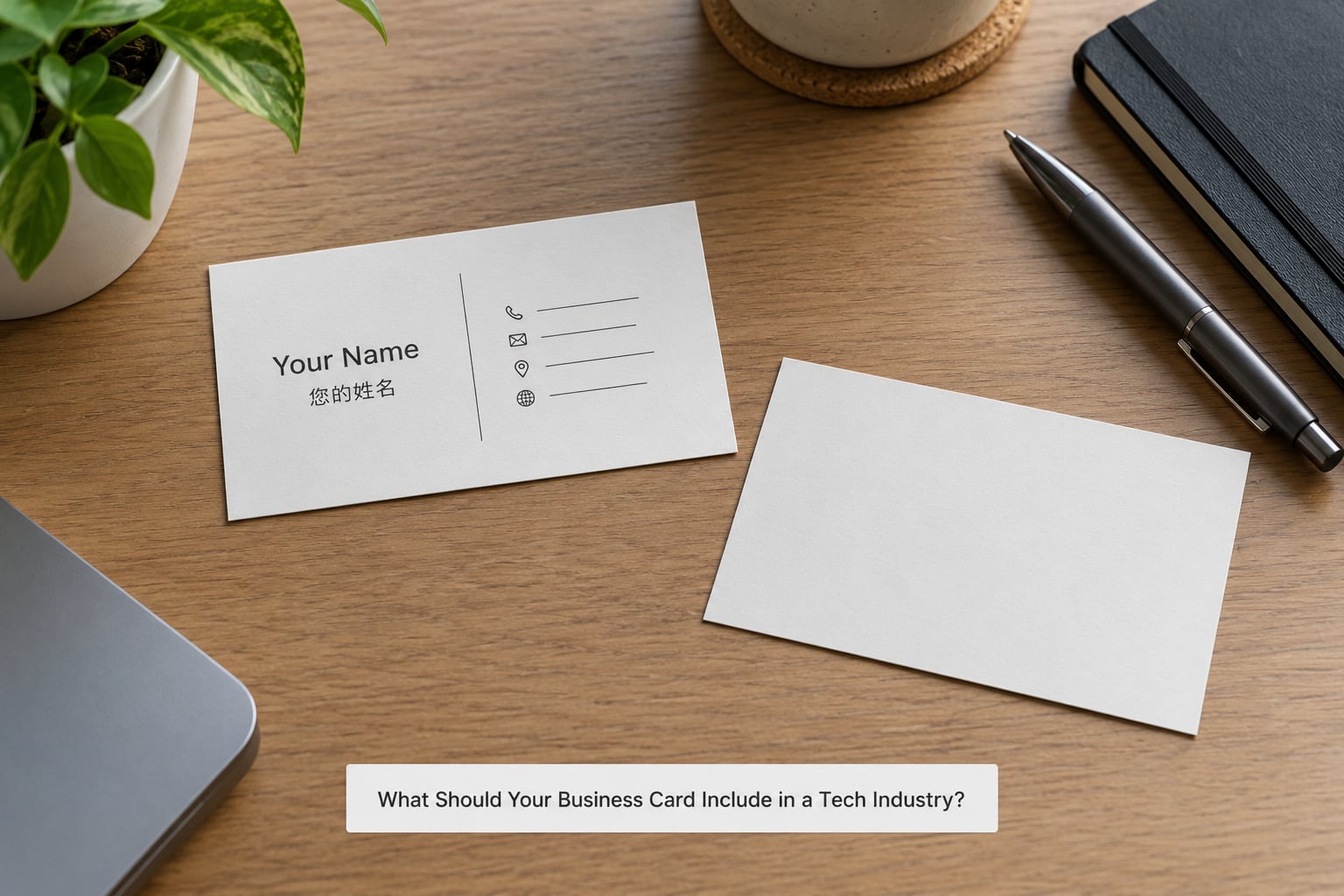
A meishi carries more required information than a Western card, because Japanese companies expect the card to function as an identifier inside the company rather than as a calling card. Standard Japanese card size is 91 by 55 millimetres, so a card designed for 89 by 51 millimetres in the US or Europe will look slightly small and slightly off-centre.
| Field | Include it because |
|---|---|
| Name in Japanese, with katakana | Katakana is how your name will be spoken aloud in the room and how Japanese systems and email tools will store it |
| Name in Latin script | So the person can match you to your LinkedIn or your website within seconds |
| Company name, official form | The registered Japanese entity name, not a brand name, if they have one that differs |
| Department and team | Tells people where to route you internally and hints at who your actual counterpart is |
| Job title in Japanese | The title is the part Japanese colleagues read first and often repeat back to you in conversation |
| Direct phone or mobile | Contact details are the whole job of the card; an email-only card feels incomplete |
| Email with country code | Use the full international format, for example +81 followed by the number without the leading zero |
| Website | Optional but useful, especially for a foreign company where nobody else can find you |
Keep it legible and quiet. Plain white or a single muted colour, a standard font, no gradients, no photo, and no slogan. The card should be easy to file in a case and easy to read across a table, which rules out most of what gets printed on Western cards. Card stock should feel substantial rather than thick and springy, and if you have a Japanese printer or stationer, ask them for meishi specifically.
One judgement call: your title. Translating Head of Product as Product Manager or Product Lead is normal and understood. Translating it as Director when you are not one creates a seniority mismatch that surfaces later in ringi and procurement. People notice that gap.
How Should You Handle the Card After the Exchange?
After the exchange, leave the card on the table in front of you, placed above your notebook or laptop rather than tucked under it or slid aside. It stays visible for the whole meeting, which is how a Japanese counterpart confirms your name and title at the moment they address you. Placing it below your notebook is a genuine breach, not a fine detail.
Never put it in a back pocket or a shirt pocket, and never fold, bend, write on it, or fold it to fit. When you have a moment, file the cards in your case in the order you received them, which means the most senior person’s card sits on top or is easily reachable. Some people keep a small card holder on the table for exactly this.
Use the card during the meeting. Refer to people by the title printed on their card, which also signals you read it, and write down the details you need. When you follow up, use the name exactly as it appeared on the card, which for a Japanese name means family name first as printed.
Afterwards, enter the details into your CRM the same day. Cards that sit in a case for six weeks and then get typed from memory are how contact records turn into three correct names and a row of guessing. The second half of Japanese business card etiquette for tech meetings is unglamorous: read, place, use, log.
How Does Card Etiquette Fit Tech Talks, Demos and Follow-Up?
Once you are seated, the card work is mostly done, but it shapes the meeting in quieter ways. The table placement keeps your name and title in front of the person addressing you. The exchange order told the room who leads. And in a decision-making culture built on wa (和, harmony), the fact that you did the small ritual properly lowers the temperature for the disagreement you are about to have about your product.
| Venture-backed startup | Established company | |
|---|---|---|
| Exchange | Warm formality, often quick, sometimes after the first joke lands | Full two-handed exchange with a bow, sometimes with an interpreter present |
| Card style | English-only or simple bilingual, sometimes a badge instead | Bilingual, possibly colour-banded by level or with an employee number |
| Seating | Informal, people sit near whoever they need from | Planned seating with kamiza and shimoza, introductions by the host |
| Decision path | Direct, fast, often a single founder or CTO | Nemawashi and ringi before anything is agreed, so a yes in the room is not a yes |
| Follow-up | Same day, informal, often Slack first | Same day or next morning, formal email, copied to the people in the room |
For a demo specifically, prepare the card exchange before the screen sharing starts rather than mid-presentation. For a group review with eight engineers, exchange in seniority order, then hand the remaining cards to a colleague to distribute discreetly, or do a short second round at the end. For a pitch, hand your card to the partner first and let them place it before you start talking.
Virtual meetings have their own adaptation. There is no card to hand over, so the exchange happens by email after, and people generally send a digital card or a short introduction message with their details attached. Keep the camera on, join early, and note that silence is normal here too. Japanese meetings are comfortable with chinmoku (沈黙), considered silence, and a room of engineers thinking about your architecture is often closer to agreement than it feels.
Follow-up is where the etiquette pays off. Send a short email the same day, addressed to the most senior person with the others copied, thanking them for the time and confirming the two or three things you actually agreed. Keep the subject line and your own name block identical to your card, in case someone searches your company for you later.
What Common Mistakes Can Make a Bad Impression?
Almost every mistake foreigners make with meishi is a Western habit that reads very differently in Japan. None of them is catastrophic on its own, but they add up fast.
| Mistake | Why it lands badly | Do this instead |
|---|---|---|
| Pocketing the card immediately | Says you did not care to read it, which reads as not caring about the person | Read it, then place it on the table above your notebook |
| Writing on the card | The card represents the person and their company; annotating it looks like a correction | Keep notes in your own notebook, or write on a separate slip |
| Handing over with one hand | One-handed giving is treated as casual or careless in a formal room | Both hands on give and receive, edges not fingertips |
| Covering the text with your fingers | The other person needs to read it as they take it | Hold it by the corners and keep the printed face clear |
| Running out of cards | It derails the flow and you end up explaining yourself mid-room | Two per attendee plus a handful of spares in the bag |
| Exchanging in the wrong order | Skipping a senior person signals you did not understand the hierarchy | Let the host start, follow seniority, mirror their pace |
| Using the wrong title | Getting a title wrong is a status error, not a typo | Repeat back the title printed on the card, including the san honorific in speech |
| A thin follow-up | An unconfirmed meeting reads like it did not happen | Same-day email, summary of next steps, copied to everyone in the room |
Two more worth naming. Do not hand a card to someone with a casual Western handshake attached, because the two gestures want different things from your hands. And do not treat the exchange as a formality to rush through so you can get to the demo; in a room where decisions move slowly through ringi, the fifteen seconds you spend here is the cheapest credibility you will buy all day.
Frequently Asked Questions
Do you bow when handing over a business card in Japan?
Usually yes, a small nod or shallow bow at the moment you offer the card. The bow is shallow in most office settings, around 30 degrees, and deeper contexts such as a first formal introduction or an apology call for it. The bow and the two-handed offer happen at the same time, which is what makes it look natural rather than choreographed.
Can I write on a Japanese business card after the meeting?
Avoid it, even to write a phone number or a note about where you met. The card stands for the person and their company, and annotating it reads as a correction or as a downgrade. If you need to attach something, hand over a separate slip of paper or a folder. If you already did it, apologise briefly the next time you meet and hand over a fresh card.
How many business cards should I bring to a meeting in Tokyo?
Two per person you expect to meet, plus five to ten spares. Japanese meetings grow: an invite for four often turns into eight once a colleague joins. Keep the spares in your bag rather than in the case so pulling one out does not look like you were counting. Bring more than you think you need; running out is the most common card mistake reported by newcomers.
Are digital business cards accepted instead of paper in Japan?
Yes, increasingly. Electronic cards known as 電子名刺 (denshi meishi), including services like dBiz, are common in Japanese tech companies and are usually accepted at tech events and with younger teams. Paper still wins in formal settings, at traditional firms, and in front of senior executives. The safest approach is to offer paper and let the other person choose their format.
What is the 5-minute rule in Japan?
It refers to the habit of arriving about five minutes early so you are never the person making others wait. Japanese business meetings start on time and end on time, so arriving early gives you a buffer rather than awkward silence. It also matches a broader comfort with pauses: allow roughly a minute of silence before prompting someone who may simply be thinking, and let the most senior person speak first.
Do foreign founders need a Japanese-language business card?
Yes, make it bilingual. Japanese on one side, English on the same side or the reverse, with your name in katakana so colleagues can pronounce it and Japanese systems can record it. A card only one side of which the local team can read makes you harder to remember and harder to recommend to people you never meet. Include your department, your Japanese job title, and a phone number with the full +81 country code.
Conclusion: What to Do First
Print a clean bilingual card with katakana and your department, and put it in a slim case rather than a wallet. Watch the host and let them set the timing of the exchange. Hand yours over with both hands, text facing the reader, and take a few seconds to read theirs. Put it on the table above your notebook and keep it there. Then send a short follow-up the same day, copying everyone who was in the room. Get Japanese business card etiquette for tech meetings right once and the same room treats the second meeting differently.