
A Japanese IPO is a domestic, relationship-driven listing: a narrower investor base, heavier pre-filing review, and ownership that often stays concentrated in a few strategic hands. A US IPO trades some of that certainty for a far deeper pool of global equity capital, heavier disclosure obligations, and a much noisier aftermarket. How Japanese IPOs differ from US IPOs comes down to those two trade-offs.
Below is a side-by-side look at exchanges, ownership, timelines, pricing, governance and exit routes. Rules change, and every company has exceptions, so treat this as a map rather than a verdict.
Table of Contents
- 1How Japanese IPOs Differ from US IPOs at a Glance
- 2Where Japanese and US IPOs Are Listed
- 3Investor Bases and Ownership
- 4How Japanese IPOs Differ from US IPOs in Regulation and Disclosure
- 5What the regulator difference means for your disclosure workload
- 6Why a US listing asks for more disclosure sooner
- 7IPO Process, Timelines, and Underwriting
- 8Pricing, Allocations, and Initial Trading
- 9Post-IPO Governance and Shareholder Culture
- 10Which Should You Choose?
- 11Frequently Asked Questions
- 12Are Japanese IPOs easier than US IPOs?
- 13Is a TSE Growth IPO suitable for an early-stage startup?
- 14Can a Japanese company list directly in the US?
- 15Can a US company pursue an IPO in Japan?
- 16Should an international technology company choose Tokyo, New York, or a dual listing?
How Japanese IPOs Differ from US IPOs at a Glance
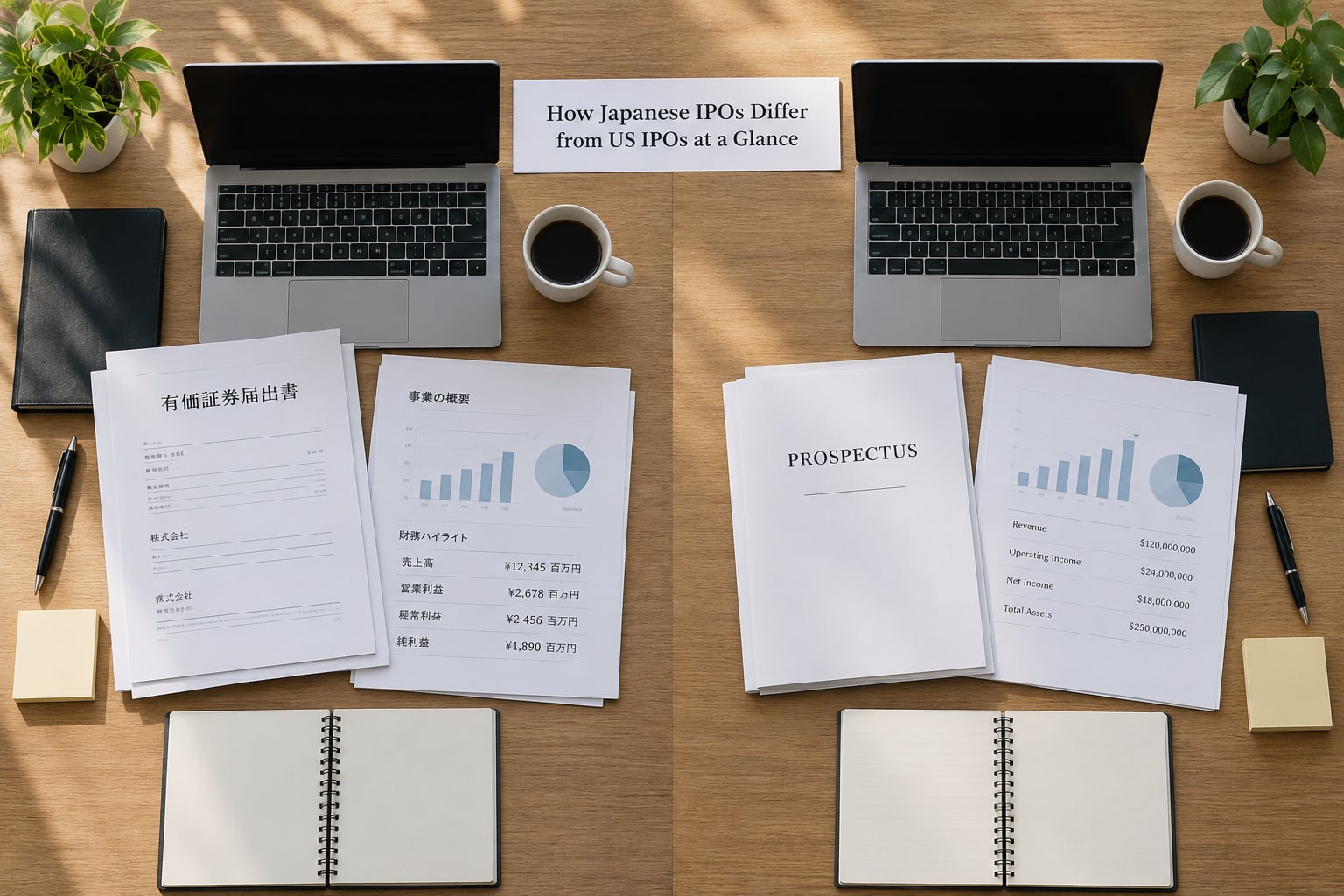
The fastest way to see the gap is to put the two markets next to each other. Every row below is a general pattern, not a rule — sector, market cap and listing route all shift the details.
| Criterion | Japan | United States |
|---|---|---|
| Primary exchanges | Tokyo (Prime, Standard, Growth), plus Nagoya, Sapporo and Osaka | NYSE and Nasdaq, with specialist venues for smaller issuers |
| Investor base | Heavily domestic, with a large retail participation habit | Deep global institutional and index-fund participation |
| Ownership after listing | Often concentrated; founding families and strategic holders keep control | Usually dispersed, though dual-class structures are common at the top |
| Regulator | Financial Services Agency plus exchange listing rules | Securities and Exchange Commission plus exchange listing standards |
| Accounting | Japan GAAP or IFRS | US GAAP, with IFRS accepted from foreign private issuers |
| Underwriter relationships | Domestic houses with long-standing ties to the issuer and its main holder | Global banks pitching to a wide institutional book |
| Offering formats | Classic new-share listing, sometimes with cornerstone allocation | Primary offering, secondary, mixed, and ADRs or dual listings |
| Pricing discovery | Bookbuilding guided by relationship demand, often with a narrow first-day band | Wide bookbuild, published allocations, heavy analyst coverage |
| Liquidity | Thinner outside mega-caps; domestic funds dominate daily turnover | Generally deeper, with more intraday volatility |
| Reporting rhythm | Quarterly reporting plus timely exchange disclosure | Quarterly and annual reporting, plus current reports on major events |
| Governance focus | Board independence, capital efficiency, and pressure to unwind cross-shareholdings | Board accountability, say-on-pay, and activist campaigns on cost of capital |
| Follow-on funding | Rights issues and shareholder-friendly structures common | Follow-on offerings, converts and at-the-market programmes |
| Typical strategic exit | Domestic takeover, sponsor-backed sale, or cross-list to a global venue | Global takeover, sponsor-backed sale, or continued independent path |
Where Japanese and US IPOs Are Listed
Japan’s route starts with the Tokyo Stock Exchange’s three tiers. Prime is the top market and is usually the destination for companies that already have scale, a clean reporting history and institutional visibility. Standard sits below it for established but less liquid issuers. Growth exists specifically for earlier-stage companies that do not yet meet Prime’s profitability and disclosure thresholds, and it comes with lighter ongoing requirements in exchange for a thinner pool of buyers.
Outside Tokyo, the Nagoya, Sapporo and Osaka exchanges cater mainly to regional companies, and a handful of boards serve international listings or research-oriented issuers. The tier you land in shapes everything downstream: which funds can hold the shares, how much disclosure is demanded, and how much a takeover premium the board can expect to defend against.
On the US side, the NYSE and Nasdaq carry the large majority of listings, each with its own set of initial listing standards, and both now operate board classes that differ in size and governance expectations. Smaller issuers often use smaller US venues or specialist boards where the listing bar is lower but liquidity is thinner still. Companies incorporated outside the US frequently list as foreign private issuers, a status that reduces some reporting frequency requirements in exchange for less frequent disclosure to US investors.
Investor Bases and Ownership
Here is the difference that shapes everything after listing. In a US IPO, the order book is built by global institutions, long-only funds, index trackers and fast-money. Foreign investors often hold a large share of the register, and ownership disperses quickly after the lockup expires. Retail participation exists but plays a smaller part in price discovery at the top end.
Japan’s book looks different. Domestic banks, insurers, trusts and corporate buyers dominate, alongside a famously active retail base — the share of individuals trading directly is far higher than in the US. Cornerstone investors are often given an allocation before pricing, and strategic shareholders frequently anchor the offering. One r/investing thread I read put it simply: in a Tokyo listing, you are selling to people who may already own your main shareholder, which changes how the book is built and who gets allocated.
Ownership concentration is the practical consequence. Founding families and strategic holders often retain enough shares to shape ordinary resolutions, board composition and any sale of the company. Cross-shareholding, historically common among large Japanese corporates, is under active pressure from exchanges and index providers, which pushes issuers toward cleaner capital structures. Free float matters for a different reason in each market: in Tokyo a thin float can widen the price band and quiet trading, while a US listing can shrink the effective float through lockups and insider holdings just as effectively.
How Japanese IPOs Differ from US IPOs in Regulation and Disclosure
Japan runs on Financial Services Agency supervision plus detailed exchange listing rules, and the exchange does a substantive review of the applicant’s business, governance and disclosure record before it will list. US listings run on SEC registration and disclosure obligations plus NYSE or Nasdaq listing standards, and the review model is different in character rather than simply heavier or lighter.
What the regulator difference means for your disclosure workload
Japanese domestic issuers typically file with the regulator under Japanese disclosure formats and can report under Japan GAAP or IFRS, with English disclosure obligations that vary by market tier and index inclusion. That can mean a lighter reporting cadence for a purely domestic audience. It also means your English-language investor materials are largely optional in a way they are not in New York.
Why a US listing asks for more disclosure sooner
A US listing front-loads work: the registration statement has to be thorough, the financial history longer, and the risk factors more candid. Accounting under US GAAP is the default, though foreign private issuers may report under IFRS. Being outside US domestic reporting forms does not make the process light — it changes the shape of it, and you still need to describe how your numbers are prepared and audited.
Two practical notes. Companies report on fiscal calendars that may not line up with US calendar quarters, and that alone can change how quickly information reaches investors. And in both countries, being outside the home regulator’s reporting regime creates real preparation cost. None of this is legal or tax advice — talk to counsel and auditors in both jurisdictions before you pick a route.
IPO Process, Timelines, and Underwriting
The stages look similar on paper: preparation, audit, due diligence, exchange review, investor education or roadshows, bookbuilding, pricing, allocation and stabilization. The differences are in the emphasis and the clock.
Japanese offerings typically run a longer preparation cycle. Companies bring a draft filing, receive exchange queries, revise, and go through a listing examination that looks closely at governance, internal controls and the track record of the main shareholder. Because domestic underwriters often have long-standing relationships with the issuer and its controlling holder, the process runs on trust as much as on process. Investor education through repeated domestic briefings matters a great deal here, and the roadshow is less of a pitch to institutions than a series of conversations with a known set of buyers.
US timetables are usually more compressed. A public filing, a short marketing period, an intensive institutional roadshow, and a book that closes fast. Underwriters are competing for mandates across a global client list, so the pitch is competitive in a way a Japanese book rarely is. After pricing, both markets have a stabilization period, though the mechanics and how visible it is differ.
Neither country offers a fixed timetable. A reporting problem discovered late, an audit adjustment, or a weak market can push a launch out by months. Reporting readiness, not ambition, decides the window.
Pricing, Allocations, and Initial Trading
Valuation methods are largely shared — a multiple of earnings or cash flow, or a discounted cash flow, benchmarked against comparable listings. Where the two markets split is in who sets the price and who gets the shares.
In the US, institutions receive published allocation data and will scrutinise it. Founders are used to being told they were under-allocated by a specific long-only fund, and that scrutiny is a fact of life for banks and their clients. Price discovery leans on the analyst coverage that follows, and the first trading session can move sharply in either direction.
Japanese allocation practices lean more on relationships and on cornerstone investors secured before pricing, with distribution through domestic channels that outsiders cannot see. Retail demand can be strong and sudden. Trading after listing tends to move within price bands rather than the open-ended swings many US listings produce, and the free float is often smaller, so the same order size moves the price further.
Lockups on existing holders exist in both markets, and their length and carve-outs vary by deal and by jurisdiction. None of this says anything about how any offering will trade after listing. Past performance in either market tells you very little about the next one.
Post-IPO Governance and Shareholder Culture
Japanese listed companies now face explicit pressure on capital efficiency. Exchanges and index providers have pushed boards toward disclosing cost of capital, setting and meeting targets, and returning cash. Independent directors are expected as a matter of course, and companies have spent years unwinding the cross-shareholdings that once insulated management from outside shareholders. Family-controlled companies have lost ground here, since concentrated control is hard to reconcile with the scrutiny a Prime listing attracts.
US shareholders organise differently. Institutional investors and proxy advisers run the board slate, say-on-pay is routine, and activists take positions specifically to argue that a company is overinvesting or sitting on too much cash. You will not have a Japanese takeover board defending a premium in quite the same way a US activist arrives with a letter and a demand.
Ownership style is the hinge. Concentrated control plus pressure for capital efficiency looks very different from dispersed ownership plus activist oversight, and each produces a different set of constraints on what management can do with the money. Expectations also vary by market tier and by company size — a Growth-market issuer is not judged like a Prime issuer, and a US listing’s requirements scale with size too.
Which Should You Choose?
Choose a US IPO when your growth case depends on global equity investors, when technology credibility or an acquisition currency matters, and when you genuinely intend to be a US strategic target one day. Accept the costs: heavier disclosure, higher running costs, a more demanding board, and quarterly scrutiny that never switches off.
Choose a Japanese IPO when demand is predominantly domestic, when your natural buyers are Japanese strategics or banks, and when you plan to build in Japan for a decade rather than exit next quarter. The investor base is the point, not the valuation.
And check the alternatives before you commit. TSE Growth suits an earlier company that needs a public currency and public visibility before it is ready for Prime. A Prime listing can wait. A cross-listing on an international board, or a dual listing, lets you hold both audiences at once but doubles the reporting and governance work. Staying private, with the right investors and a longer runway, remains a perfectly rational answer when the capital is not needed yet.
Frequently Asked Questions
Are Japanese IPOs easier than US IPOs?
Neither is objectively easier, and the difficulty sits in different places. A Japanese offering is slower and more dependent on exchange review and domestic relationships, while a US offering is faster to market and demands far more disclosure up front. Japanese issuers also face tighter listing examinations and heavier governance expectations once public. Neither route carries a guarantee of approval, pricing or aftermarket performance, so treat both as options to evaluate with counsel, not as certainties.
Is a TSE Growth IPO suitable for an early-stage startup?
Growth was designed for exactly that profile. It accepts companies that do not yet meet Prime’s earnings thresholds, with lighter ongoing disclosure requirements, which makes it a realistic public route for an earlier-stage issuer that needs a listed currency for recruitment, acquisitions or credibility. The trade-off is a thinner buyer base and less institutional attention, so you should model your future funding options carefully before assuming a Growth listing solves long-term capital needs. This is general information, not financial advice.
Can a Japanese company list directly in the US?
Yes. A company incorporated in Japan can list on NYSE or Nasdaq directly, usually as a foreign private issuer, which permits IFRS reporting and can reduce reporting frequency relative to a domestic US issuer. The practical hurdles are registration, US GAAP or IFRS reconciliation where required, English-language disclosure and a US audit process, plus the cost of maintaining a US-compliant reporting function afterwards. Many companies take a dual-listing or depositary-receipt structure instead. Speak with US counsel before assuming the route or the timetable.
Can a US company pursue an IPO in Japan?
Yes, and it is a normal route, particularly for companies whose revenue is mostly in Japan or Asia. A foreign issuer can list on Tokyo’s markets under the applicable listing standards, and demand from Japanese institutions, banks and strategic investors can be substantial. Expect a review process focused on governance, disclosure quality and shareholder structure, plus adaptation of reporting to Japanese requirements or an accepted alternative framework. Cross-listings from the US are common for companies that want both audiences, but they double the compliance work.
Should an international technology company choose Tokyo, New York, or a dual listing?
New York if your customers, investors and likely acquirers sit mostly in the US and you want technology credibility and acquisition currency. Tokyo if most of your market and your strategic partners are in Japan, and if you intend to build there for years. A dual listing, often as American depositary receipts alongside Tokyo shares, keeps both audiences but adds a second reporting framework, a second board relationship and roughly double the compliance cost. Decide on capital needs and reporting capacity first, then pick one venue or both.
Start with four questions before you choose anything: who is your target market, how much capital do you actually need and when, do you want to keep control or trade it for speed, and can your reporting function sustain the requirements of the venue you are targeting? Answer those honestly and the exchange question usually resolves itself.