Japanese hi-fi culture developed from three forces that fed each other for eighty years: postwar reconstruction, which handed a generation of engineers the chance to build precision electronics; a domestic audio boom that turned stereo separates into a normal part of an ordinary home; and a listening culture born in scarcity, where jazz kissa bars made careful playback a shared ritual. Engineering, market and manners, in that order.
The whole arc fits into eight dated moves:
- 1926-1929 — Dedicated jazz kissa listening bars appear in Tokyo, including Cafe Lion and the Blackbird Tea Room, where one record and one good system mattered more than a large collection.
- 1946 — Masaru Ibuka and Akio Morita found Tokyo Tsushin Kogyo, the company that became Sony, betting on the transistor before anyone else in Japan did.
- 1954 — A transistorised portable radio puts a speaker in young people’s hands and makes audio a personal thing rather than a household broadcast.
- 1950s-1960s — The audio boom: rising incomes, FM stereo broadcasting, procurement demand from the Korean and Vietnam wars, and a wave of new brands.
- 1965 — Sony’s TA-1120, the first fully transistorised hi-fi integrated amplifier, splits home audio into separate components.
- 1970s-1980s — The specification arms race, in which measured total harmonic distortion and signal-to-noise ratio became the industry’s headline numbers.
- 1980s — Export dominance in the United States, followed by trade friction and tariffs that the industry had brought on itself.
- 1990s-2020s — Bubble collapse, brand absorption, the disappearance of separates from ordinary homes, and then a vintage market plus a kissa revival that has now travelled abroad.
Table of Contents
- 1What Did Japanese HIFI Culture Mean?
- 2How Japanese HIFI Culture Developed After the War
- 3How Amplifiers, Turntables and Speaker Tests Became Obsessions
- 4How Specialty Magazines Built an Audio Community
- 5Why Japanese Audio Products Succeeded Overseas
- 6How Listening Rooms and Retail Experiences Shaped the Culture
- 7How Digital Audio and Luxury Changed Japanese HIFI
- 8What Remains from Japanese HIFI Culture Today
- 9Frequently Asked Questions
- 10When did Japanese HIFI culture begin?
- 11Why did Japanese consumers become so interested in technical audio specifications?
- 12Did Japanese HIFI equipment become popular because it was always cheap?
- 13How did Japanese specialty shops influence the global audio industry?
- 14Is Japanese HIFI culture still influential today?
- 15Conclusion
What Did Japanese HIFI Culture Mean?
Japanese hi-fi culture was never simply about owning expensive equipment. It was a set of habits: knowing what a specification means, arguing about it, arranging a system so the numbers and the listening matched, and treating a record as an event.
Five things defined it, and all five still describe the scene today.
- Knowledge. Owning a hi-fi system implied being able to read a spec sheet, argue about it, and be wrong. Distortion, noise floor, damping, sensitivity and tracking force were ordinary conversation.
- Ritual. Listeners adopted the manners of the jazz kissa: sit down, keep quiet, no phones, one record at a time, the room’s attention on the music.
- Specialist media. Magazines carried measured reviews, test records, circuit diagrams, letters and classified ads, and they were the reference for almost every purchase decision.
- Customisation. Because audio was sold as separate components, matching an amplifier, a deck, a cartridge and a pair of speakers into one system was a normal part of ownership rather than an enthusiast extra.
- Status. A serious system marked a young salaryman as someone with a hobby that required discipline. It was domestic, male, and competitive in the quietest possible way.
None of that requires a large budget. It requires attention, and a culture that rewards it.
How Japanese HIFI Culture Developed After the War
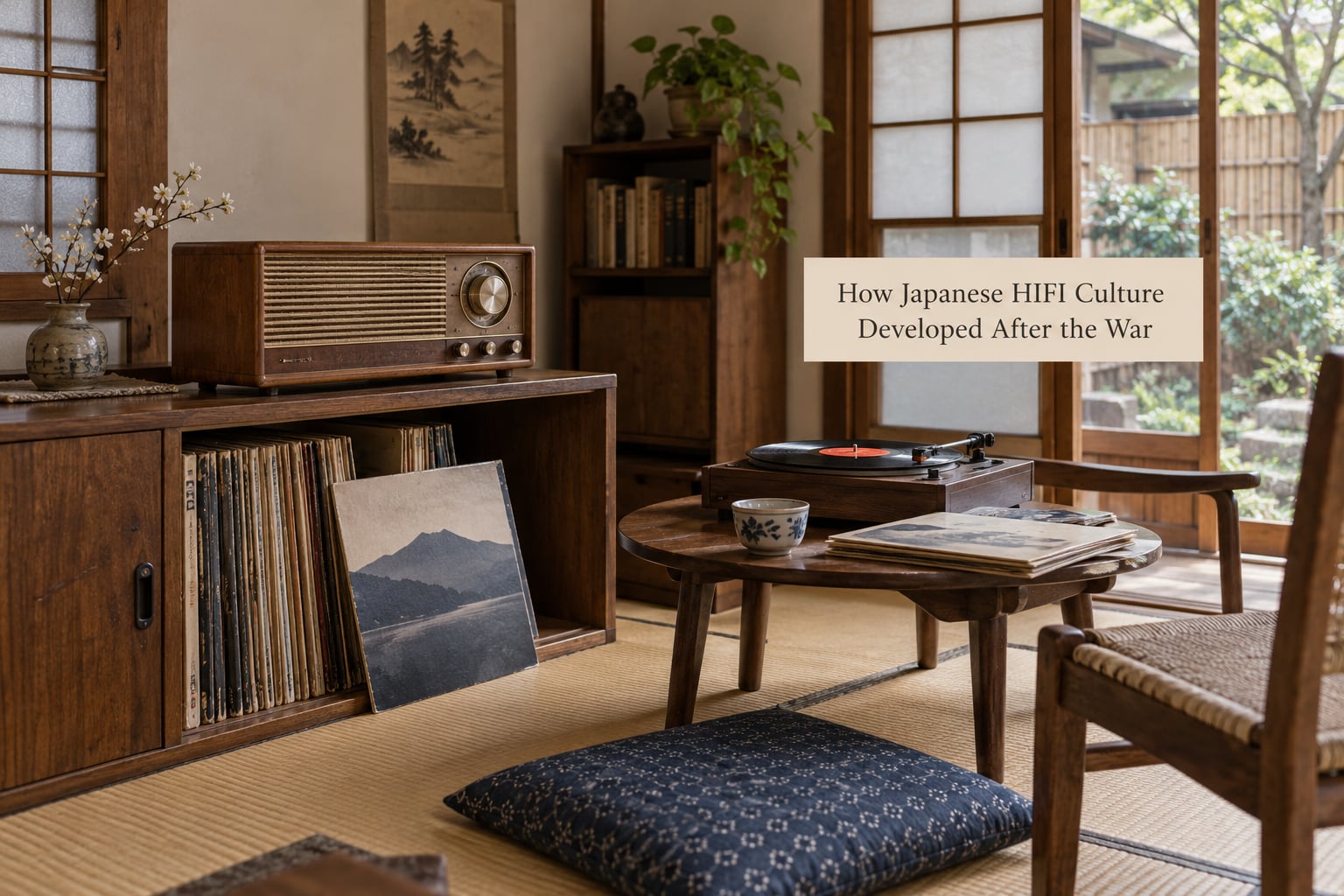
The custom of paying to listen started long before high fidelity had a name. Cafe Lion opened in Tokyo in 1926, followed by the Blackbird Tea Room in 1929, and these were jazz kissa: rooms built around a good system, a decent turntable, and imported records that most listeners could never afford to own at home.
That scarcity shaped everything after it. When records were rare and expensive, listening was communal and disciplined. You queued, you sat, you said nothing while the record played. The etiquette was not snobbery; it was the only way a shared room worked.
Then the war rewired the country. The 1946 founding of Tokyo Tsushin Kogyo by Masaru Ibuka and Akio Morita is the usual starting point, and their bet on the transistor was early and expensive. Magnetic tape gave Japan a recording medium it could manufacture at scale, and by the mid-1950s portable transistor radios had put a speaker and a headphone jack into the hands of people far outside the affluent classes.
Demand came from outside the home market too. Procurement for the Korean War and then the Vietnam War pulled enormous quantities of radios and tape equipment, and American servicemen bought Japanese electronics through PX stores at a time when almost nothing comparable came out of the United States. The large export surplus that followed fed directly into the trade friction of the 1980s.
Broadcasting did the rest. Regular radio and, later, FM stereo broadcasting gave listeners a reason to own a tuner, and NHK’s Science and Technology Research Laboratories supplied research to manufacturers who could not carry their own programme. With no manufacturing arm, NHK licensed technology out, which meant small firms could rent an achievement instead of funding a decade of work to reach it.
FM stereo broadcasting in 1968 and Sony’s TA-1120 in 1965, the first fully transistorised hi-fi integrated amplifier, are the two hinge points. The second is the one people remember: it turned the home system into separate parts that could be chosen, matched and upgraded one at a time.
How Amplifiers, Turntables and Speaker Tests Became Obsessions
That is how Japanese HIFI culture developed at the level of the individual system. Once the amplifier, the deck, the tuner and the speakers were sold apart, comparing them stopped being a shop decision and became a discipline.
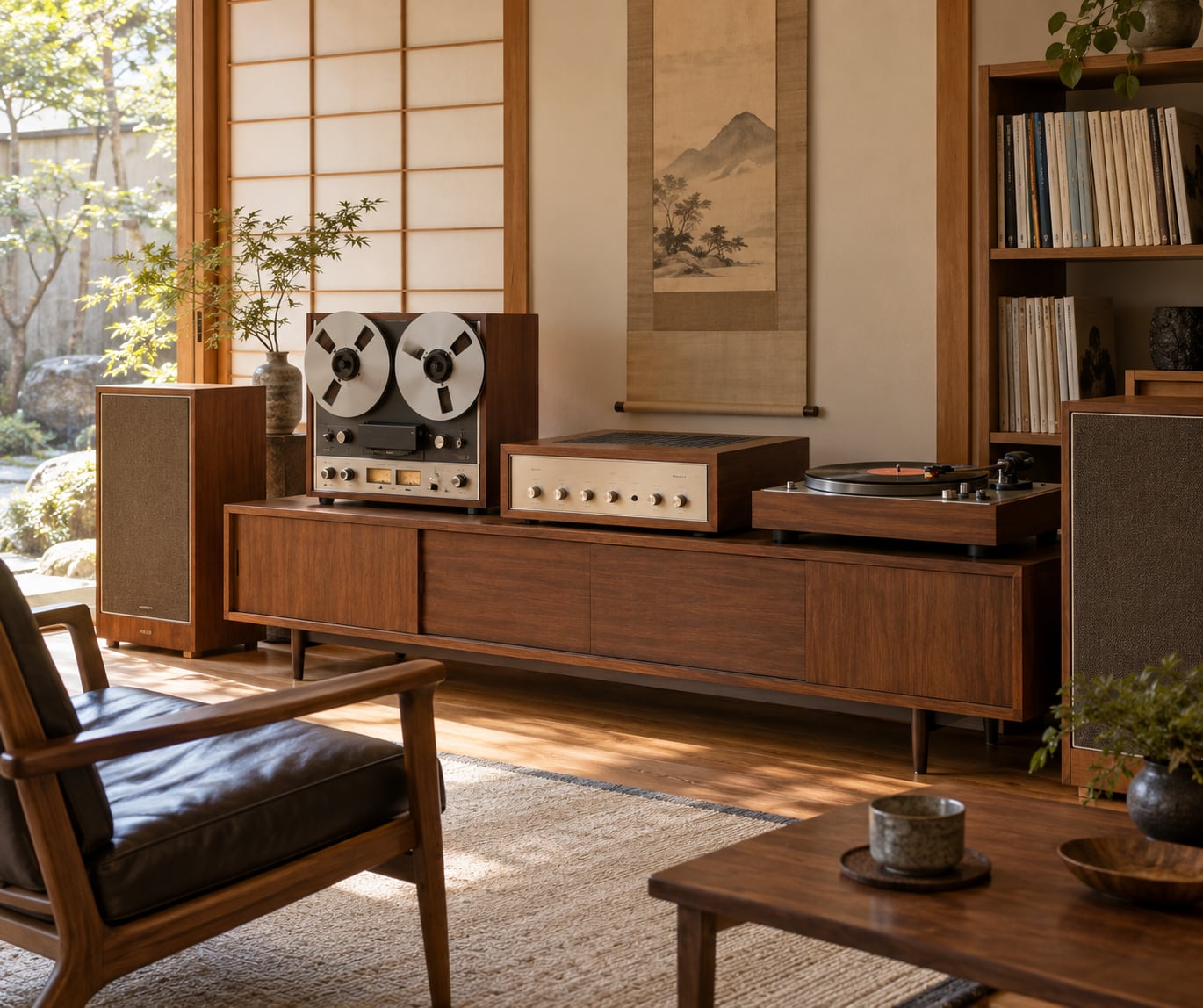
Direct-drive turntables removed the belt and the idler from the signal path, and the Technics SL-1200 of 1972 became the reference other decks were measured against. Cassette decks became the place where the engineering was most visible: Nakamichi, TEAC, Akai, Toshiba’s Aurex and Sharp’s Optonica competed on wow and flutter, head alignment and three-head recording, with measurement printouts that read like engineering papers.
Through the 1970s and into the 1980s the specification arms race became the industry’s public language. Total harmonic distortion was pushed into fractions of a percent, signal-to-noise ratios climbed past 100 dB, and marketing centred on figures an enthusiast could verify. Sansui, Trio and Pioneer grew into the big three, joined by a dense field including Kenwood, Yamaha, Onkyo, Denon, JVC, Victor, Marantz, Sanyo, NEC, Hitachi, Sharp and Toshiba.
The cost of that competition was a blind spot. Because Japan led in electronics, speaker design lagged behind British and American makers for decades; on an oscilloscope the amplifiers looked immaculate, while the speakers carrying the sound were often the weakest link. A forum poll of collectors still argues about which Japanese brand made the best acoustics of the era, and there is no settled answer, because the cabinets were chasing a harder problem with less engineering money behind them.
How Specialty Magazines Built an Audio Community
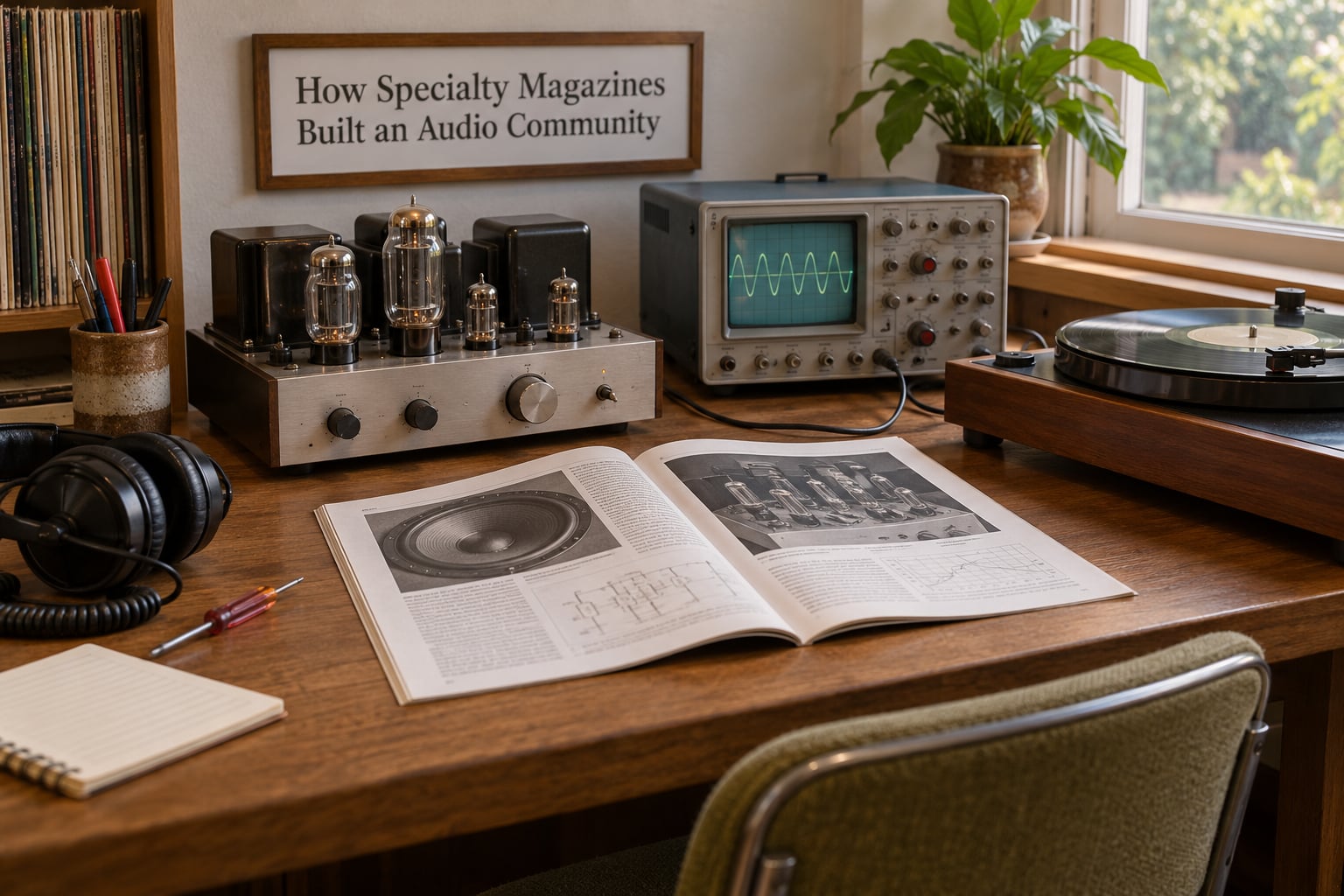
Hardware alone does not make a culture. What made Japan’s hi-fi world coherent was a press that treated readers as engineers rather than buyers.
Specialty magazines ran long measured reviews, published test record content so anyone could hear the same demonstration, and printed circuit diagrams for designs that readers were invited to build. Letters pages turned individual opinions into a visible argument, and classified sections did the commercial work, putting a used amplifier in front of a reader who lived four hundred kilometres away.
Reputations formed there before they formed in shops. A brand that performed well on a published test was discussed for years. Model hierarchies hardened into community knowledge: a 300 or 500 series designation still signals a class of seriousness to Japanese collectors, and people who finish a first system still regret not having afforded the flagship, as one longtime enthusiast forum thread records.
Magazines also amplified a problem that buyers still face. Because so many rebranded products carried Japanese-sounding names, enthusiasts learned to ask whether a company invented the design or licensed it. That scepticism is one reason a certain kind of audio forum reputation is considered worth having.
Why Japanese Audio Products Succeeded Overseas
Japanese audio succeeded abroad for a mix of reasons, and value was only one of them. It was the first, not the only.
Export demand from the PX channel created enormous production scale, and scale brought cost advantages. Japanese makers could offer a wide range of models within one product family, from a portable deck to a domestic flagship, in a way a smaller workshop could not. A buyer who liked one Japanese turntable could find the matching cartridge, the matching amplifier and the service manual in the same catalogue.
Quality came from the same concentration: the big three and their peers built dense product lines with a shared parts philosophy, so a new model often reused a motor, a dial mechanism or a power supply that was already proven. Buyers found that a mid-range Japanese deck was more reliable than an expensive one from elsewhere, and that reliability was easier to verify than sound quality.
Dealer networks did the rest. Specialty shops in the United States and Europe stocked Japanese separates densely, held demonstrations, and could service a unit decades later. That combination of range, dependability and a local face behind it is what turned a low-priced export line into a global reputation.
By the mid-1980s the success had turned into a political problem. Export volume drove American trade complaints, and tariffs landed on Japanese tape decks and consumer electronics. The same overproduction that had made the industry strong also handed competitors abroad a legal weapon, and volume stopped being treated purely as a good thing.
How Listening Rooms and Retail Experiences Shaped the Culture
Japanese hi-fi was sold in person, in rooms built for the argument. A specialty dealer would not hand you a box; they would let you switch between two amplifiers and two sets of speakers in the same afternoon.
That mattered because specification culture and listening culture are opposites in one respect. A specification claims to settle the question on paper. A switch demonstration does not. Enthusiasts learned that a dealer who let them A and B for an hour had nothing to hide, and that trust carried into how they read magazines and later which brands they would defend online.
Audio fairs amplified it. A hall of booths where a dozen makers play the same record at full volume sounds chaotic, but it is where brand character gets separated from spec sheet. It is also where the community met in person: club members, collectors, engineers, and the people who later opened shops of their own.
The jazz kissa carried the same idea forward into the 1970s and 1980s. Pay for the room, borrow the system, hear records you might never own. Today many have closed, but the etiquette survives as an expectation inside home systems too: one record, no talking, no phone.
How Digital Audio and Luxury Changed Japanese HIFI
Digital arrived in 1982 with the compact disc, and Japanese electronics companies were unusually well placed to industrialise it. Digital decks and CD players fit the culture’s strengths: repeatable measurement, error correction that could be counted, and a format that eliminated the hiss the specification war had spent fifteen years arguing about.
The consequences cut both ways. Digital made the medium cleaner and cheaper, and it removed one of the main reasons to own separate components. It also opened portable and car audio, two mass markets where Japanese companies held decisive positions, and pushed high-end domestic systems into a smaller, more expensive corner where a serious Japanese integrated amplifier began to cost more than a car in the previous decade.
That shift produced the luxury tier: heavier cases, machined faces, gold-plated inputs, and a presentation borrowed from watchmaking rather than radio. It also produced the recurring tension in Japanese hi-fi, between making audio technology at scale and treating it as a craft. The same factory that could build a portable player to a cost target would spend years on the same company’s flagship.
What Remains from Japanese HIFI Culture Today
Most of what remains is invisible unless you look for it. Headphones, portable players and car audio are now Japanese-led global categories, and their design language is recognisably the same: minimal, functional, quietly expensive.
The most visible legacy is the second-hand market. Vintage Japanese hi-fi is now the most common way for a beginner anywhere to own serious, well-built equipment, because a 1970s integrated amplifier or a Nakamichi or Technics deck costs a fraction of a new one and still works after careful servicing. That is a direct result of how the culture was built: dense ranges, long production runs, parts that stayed available.
The obstacles are equally direct. Servicing is the real barrier for newcomers. Many brands of that era have no remaining parts, no schematics and no authorised service network outside Japan, and decades-old capacitors, belts and lubrication are what fail first. Importing from inside Japan adds shipping weight, duty and a language barrier for documentation, and forum buyers regularly warn each other about exactly that combination. Restoration can cost more than the unit.
The jazz kissa is also returning, and the revival has travelled. New listening bars built on the same model have opened in Hong Kong and New York, aimed at the same experience that began in 1926: a good system, a quiet room, records you do not own, and no obligation to talk.
One honest caveat belongs here, because the culture produced plenty of folklore. The personal utility pole — a private power line installed to isolate a system from shared grid noise — is a real practice among a very small number of Japanese listeners, not a national trait, and there is no convincing published evidence that it improves what a recording sounds like. The most common response in enthusiast forums is a joke. Read the claims as culture rather than as engineering, and the rest of the story holds up.
Frequently Asked Questions
When did Japanese HIFI culture begin?
The roots sit in the 1920s, when jazz kissa listening bars such as Cafe Lion in 1926 and the Blackbird Tea Room in 1929 turned critical listening into a paid public ritual. The industrial half of the story starts after 1946, with the founding of Tokyo Tsushin Kogyo, later Sony, and the transistor radio boom of the 1950s. So the culture has two starting points: 1926 for the listening manners, and 1946 for the engineering.
Why did Japanese consumers become so interested in technical audio specifications?
Two reasons reinforced each other. Manufacturers competed on published measurements, so enthusiasts learned to read them, and a national broadcaster supplied research results that anyone could license, so the numbers were credible. Total harmonic distortion, signal-to-noise ratio and damping factor became the shared vocabulary of the market. That made consumers unusually informed buyers, and it also pushed firms to chase figures that mattered less in the room than on paper.
Did Japanese HIFI equipment become popular because it was always cheap?
Cheap was the opening, not the reason. Low export prices made Japanese gear an easy first hi-fi purchase, but what made it stick was dense product ranges, long production runs, parts availability and a dealer network that could service a unit decades later. By the late 1980s several Japanese brands had repositioned into premium and luxury products, and those high-end models are what the vintage market rewards most today.
How did Japanese specialty shops influence the global audio industry?
Shops turned comparison into an in-person event. A dealer who let buyers switch between two amplifiers and two speaker pairs for an hour removed the salesperson from the argument, and that habit of side-by-side demonstration spread worldwide. Audio fairs reinforced it by giving manufacturers a place to build a brand’s character rather than quote a spec sheet. Specialty media and shops together are why Japanese brand reputations were so widely trusted far from Japan.
Is Japanese HIFI culture still influential today?
Yes, in ways that are easy to miss. Japanese companies lead headphones, portable players and in-car audio, and the minimalist industrial design of the era still shapes how hardware is presented. The second-hand market now treats Japanese separates as the affordable entry point to serious hi-fi, while jazz kissa-inspired listening bars have opened in Hong Kong and New York. What has faded is the domestic audience for separate components, which collapsed in the 1990s.
Conclusion
Japanese hi-fi culture developed because three things reinforced each other for eight decades: an industrial push that put precision electronics within reach of small firms, a consumer boom that turned separate components into an ordinary home purchase, and a listening culture born from scarcity that made careful playback a social discipline. Add the PX export channel, NHK’s shared research and a retail habit of side-by-side demonstration, and the golden age follows fairly directly.
It then collapsed, and that collapse is the part most histories skip. The bubble burst, the domestic audience shrank, brands were absorbed, and separate components disappeared from ordinary homes. What is left is arguably the more interesting half: vintage gear as the cheapest route into serious listening, Japanese leadership in headphones, portable and automotive audio, and a quiet revival of the listening bar in cities far from the original ones.
If you want to explore one tradition first, start with the jazz kissa, including its new branches in Hong Kong and New York. Every other habit in this story, the silence, the single record, the refusal to be sold to, started in those rooms. Updated for 2026.