Here is how Japanese tech media works in practice: it is the layered network of newspapers, IT trade publications, specialist verticals and creator channels that reports on the country’s technology industry. It runs differently from the Western tech press mainly because it is funded by large corporate and technology advertisers rather than reader subscriptions, and because speed comes from tight beat relationships with manufacturers rather than from leaks and scoops.
Last updated: October 2026
Table of Contents
- 1What Is Japanese Tech Media?
- 2Why the Japanese Tech Industry Is Hard to Cover
- 3How Japanese Tech Media Finds and Checks News
- 4How Translation and Local Context Change a Story
- 5How Startups, Platforms, and Gadgets Get Covered
- 6How Events and Industry Trends Are Reported
- 7What English-Language Tech Media Adds
- 8How to Judge a Reliable Japanese Tech Report
- 9Frequently Asked Questions
- 10Is Japanese tech media independent?
- 11Why are Japanese technology headlines difficult to translate?
- 12What is a kisha club in Japan?
- 13How do Japanese reporters cover startup funding announcements?
- 14Why does English-language coverage of Japanese tech news appear late?
- 15Can English-language blogs provide useful coverage of Japanese technology?
- 16Conclusion: Start With Context, Not Just a Headline
What Is Japanese Tech Media?
Japanese tech media is not one thing. It is a stack of layers that overlap, compete and feed each other, and each layer has a different owner, a different audience and a different reason for existing.
The bottom layer is the national dailies and business press. Nikkei, Asahi, Yomiuri and Mainichi carry technology reporting when it becomes an industrial or economic story: semiconductor capacity, corporate results, supply chains, government policy. Nikkei also publishes a Latin-script edition of its business title, which is why serious industry news often reaches English readers as a Nikkei item first.
Above that sits the IT trade press, which is where most product news lives. Outlets such as ITmedia, Impress (PC Watch), ASCII and ITlife cover launches, software, devices and enterprise IT for working readers. The trade press is vertically split in a way few Western markets match: enterprise IT, consumer electronics, mobile, photography, gaming and developer tooling are separate newsrooms with separate editors.
Then there are the platform layer and the social layer. Yahoo! Japan News, run by SoftBank Group alongside LINE, aggregates and rewrites a large share of what trade outlets publish. Individual journalists, engineers and commentators post faster than any outlet can, on X (Twitter), YouTube and 5ch. In practice, a story often exists publicly before it exists as journalism.
A quick reference to the main outlets:
| Outlet | Owner or publisher | Language | Core beat |
|---|---|---|---|
| Nikkei | Nikkei Inc. | Japanese, with a Latin-script business edition | Business, chips, industrial policy |
| ITmedia | ITmedia Inc. (SoftBank group) | Japanese | Enterprise IT, products, workplace tech |
| PC Watch / Impress Watch | Impress Inc. | Japanese | Consumer electronics, gadgets, pricing |
| ASCII | ASCII Corporation | Japanese | Developer tools, hardware, publishing |
| ITlife | ITlife | Japanese | Consumer IT culture and how-to coverage |
| 4Gamer | Kadokawa and Webmedia | Japanese | Games, hardware, events |
| Yahoo! Japan News | SoftBank Group | Japanese | Aggregation of trade and wire coverage |
| The Japan Times | Japan Times Publications | English | Japan business, policy and industry |
Domestic reporting and English-language coverage are different businesses with different incentives. The domestic press serves Japanese readers, advertisers and a Japanese search ecosystem where Yahoo! Japan matters as much as Google. English-language coverage serves outsiders, mostly inherits its facts from domestic reporting, and adds translation and explanation rather than original reporting.
Why the Japanese Tech Industry Is Hard to Cover
Five structural features make Japanese technology reporting harder to enter from outside than it looks.
Language is a working barrier, not a translation problem. Product terminology, model numbering and corporate names do not map cleanly into English. A single launch often has a different name, a different spec sheet and a different price depending on the channel.
The advertising market is concentrated. A handful of large technology and telecom companies spend a large share of the digital advertising budget. Outlets that want those budgets have a reason to keep the relationship friendly, which shapes how much criticism a story can carry.
Corporate relationships are formal. Manufacturers do not simply send a PDF to a distribution list. They host press tours, briefings and club events, and reporters covering the beat are regular guests. That access produces fast, accurate reporting about launches and slow, cautious reporting about anything else.
The startup ecosystem is locally financed. Funding stories often run through domestic investors, business journals and government programmes tied to METI, so the internationally visible announcement is rarely the whole story.
Domestic significance does not travel. A product can be a national event in Japan and a footnote elsewhere. English outlets covering Japanese technology tend to pick up stories that touch US or European business, which systematically filters out the domestic beats that matter most to Japanese readers.
How Japanese Tech Media Finds and Checks News
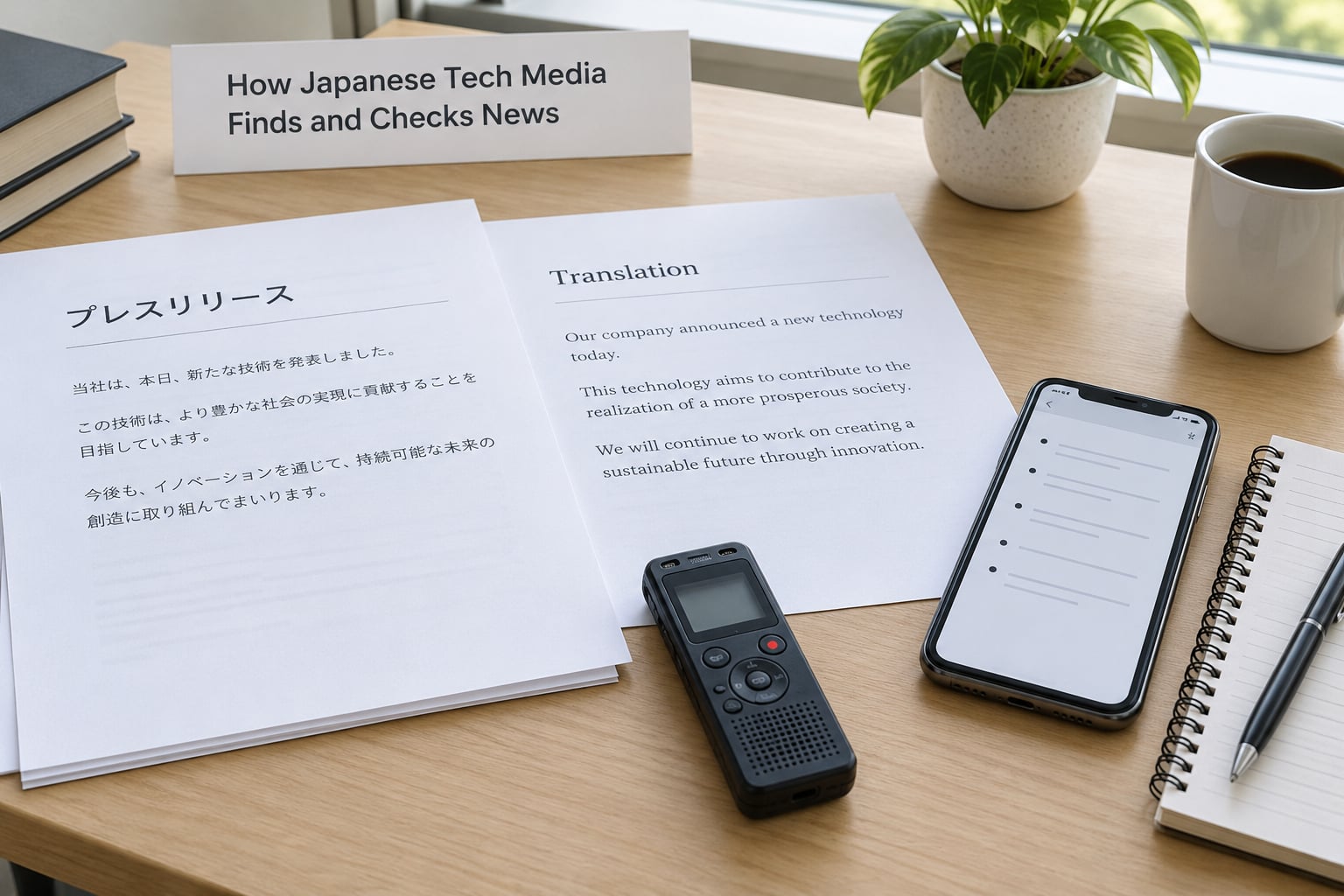
A typical story moves through the same path whether it comes from a hardware launch, a funding round or a policy announcement.
- The company prepares Japanese-language materials: a press release, a spec sheet, a price and release date, and often a briefing invitation.
- A small number of beat reporters receive the material first, under embargo, usually with an interview slot attached.
- Outlets split the story by beat, so the same launch appears at the electronics desk, the enterprise desk and the gaming desk simultaneously, each with its own angle.
- Reporters confirm the numbers that matter: the teika list price, the actual sale date, model suffixes and regional variants.
- Trade outlets publish first, usually on the Japanese site. Aggregators such as Yahoo! Japan News pick the piece up and rewrite it.
- Social channels and video creators react within minutes, often before the written coverage is complete.
- English-language outlets pick it up days or weeks later, usually by translating the Japanese write-up rather than by reporting independently.
The checking step is where the system differs most from what outsiders expect. Japanese tech articles frequently restate the supplied material. Readers looking for original reporting often find the same specifications and the same superlatives in five outlets, because all five received the same document. That is normal for launch news and a poor sign when you see it applied to analysis.
What journalists do check reliably: pricing terms, release dates, availability by region and the exact product name. What they check less often: performance claims, benchmark numbers and anything about a company’s finances. If you are verifying a claim, those are the distinctions to draw.
How Translation and Local Context Change a Story
Translation is where meaning is most often lost. Japanese tech headlines compress aggressively, drop the subject because it is obvious to a domestic reader, and lean on promotional corporate register that inflates when rendered into English.
- Omitted subjects. A Japanese headline can name the product and the feature without naming the company. Translated literally, the claim appears to come from the journalist.
- Register inflation. Corporate Japanese stacks polite intensifiers and evaluative words. Straight translation can turn a neutral product line into a superlative claim.
- Specification density. Japanese spec sheets use abbreviations and model codes that lose meaning character by character.
- Pricing vocabulary. Teika (the manufacturer’s list price) and jitsunyō kakaku (the price a shop actually charges) are different numbers, and English coverage routinely reports the first as if it were the second.
- Release wording. The terms for announcement date, reservation start, pre-order and on-sale are distinct, and machines often blur them together.
Politeness level matters too. Japanese business writing marks distance and hierarchy in ways that carry implication. A phrase that sounds neutral in English may signal deference to a partner company, which changes how a reader should treat the surrounding claim.
How Startups, Platforms, and Gadgets Get Covered
Each category raises a different editorial question, and the answers are uneven in quality.
Startup funding. The announcement states an amount. The useful reporting asks who invested, at what valuation, what the company shipped before, and how the round compares with earlier rounds. Domestic business coverage often has the registration and investor detail that the release omits; international coverage frequently has only the headline number.
Consumer platforms. Changes to LINE, Yahoo! Japan or a major retail platform are treated as business stories as much as technology stories, and coverage leans on the company’s own framing of user numbers. Ad targeting, ranking changes and policy shifts get the least scrutiny precisely because they matter least politically inside Japan.
Connected devices and gadgets. This is where Japanese coverage is strongest and where hands-on testing is most likely to be original. Release-day hands-on coverage, thermals, battery behaviour and repairability are genuinely useful, and readers generally trust Japanese sources for pricing, availability and dates more than for verdicts.
Product launches generally. Expect specification accuracy and promotional framing at the same time. That combination is normal in the launch window and a reason to wait two weeks before deciding anything.
How Events and Industry Trends Are Reported
Japan’s trade calendar concentrates a lot of the year’s news into a few fixed weeks. CEATEC, Tokyo Game Show and the annual CEATEC-adjacent product shows draw the trade press into the same halls, and the coverage that results is unusually hands-on because reporters attend with pre-written questions and press assets provided.
What makes event coverage valuable is not the booth description. It is the comparison: what competitors were showing in the next hall, which claims were repeated across every vendor, and which demos failed. Those observations rarely make it into English summaries, which is why event coverage from Japan reads as thin when you only see the English version.
Trend coverage is where sources get thinner rather than thicker. Policy stories around AI and semiconductors are heavily government-linked, and the ministries involved have their own priorities, which shapes which developments get treated as newsworthy. Corporate and regulatory stories move slowly, and when they do move, they often break first on a company’s own channel or on social media rather than in an outlet.
Regional imbalance shows up here too. Tokyo dominates the schedule, and coverage outside it is uneven, with a small number of writers filing across several publications on the same beat. That concentrates authority and narrows the range of voices.
What English-Language Tech Media Adds
English-language coverage of Japanese technology does three things well: translation, international context and selection.
Translation is the service. Titles such as The Japan Times, plus a small set of specialist outlets and newsletters, make Japanese announcements readable to outsiders who have no time budget for Japanese-language sources. For a reader who wants to know that something launched, what it costs and when it ships, that is genuinely sufficient.
Context is the second contribution. Explaining that a launch matters because of a supply chain, a policy target or a market structure nobody outside Japan knows is work English outlets can do and domestic coverage usually does not bother with.
Selection is the third. Western tech media covers Japanese companies when the story touches Western business. The filtering is rational and it distorts the picture, because the beats that dominate Japanese coverage are largely excluded by it.
What English coverage rarely does is original reporting inside Japan. It is a downstream layer. Treat it as a translation and framing service with an editorial voice, not as an independent check on the domestic press.
How to Judge a Reliable Japanese Tech Report
Six checks will tell you most of what you need to know about any single article.
- Check the byline. A named reporter with a visible beat and a track record is a better signal than a staff byline on a newswire rewrite.
- Check the sourcing. Does the article attribute quotes to people, or does it simply restate a company document? Both are legitimate for a launch; only one is legitimate for analysis.
- Check whether photography is the outlet’s own. Vendor-supplied images are the clearest sign that the piece came off a press kit.
- Check the pricing terms. List price and street price are not the same number, and Japanese shop prices often sit below the list price.
- Check the release date wording. Reservation start, pre-order and on-sale dates are different things and are frequently collapsed into one by translation.
- Check the independence signals. Sponsored content, paid travel and advertorial should be labelled. Unlabelled advertorial is the single most common failure in the sector.
One practical habit helps more than any other: read the same story in two places. If a Japanese trade outlet and an English outlet reporting on the same announcement contain identical wording, you are reading one source twice, and the consensus is thinner than it looks.
People following the sector tend to trust Japanese tech coverage for facts and pricing and to be cautious about verdicts. That split is a fair summary of the whole system.
Frequently Asked Questions
Is Japanese tech media independent?
Japanese tech media includes independent publications, newspaper and broadcast desks, specialist outlets, company blogs, newsletters and event organisers. Editorial independence varies by outlet and by beat. Launch coverage is the most promotional part of the sector because companies fund the advertising that pays for the sites. Corporate, regulatory and financial stories are covered more cautiously, partly because advertisers and government-linked institutions matter to the same outlets.
Why are Japanese technology headlines difficult to translate?
Japanese headlines compress claims, drop the subject when it is obvious locally, and use promotional corporate language that inflates when rendered into English. Machine translation also blurs specification terms and release terminology. Accurate coverage often needs the full article rather than the headline, and a reader who knows whether a list price or a shop price is being quoted will catch most of the rest.
What is a kisha club in Japan?
A kisha club, or press club, is an organised group of reporters who cover one institution or industry and are hosted by it. Companies use them for briefings, factory tours and advance product access. The arrangement gives reporters reliable early information and gives the host a venue for shaping coverage. Most large Japanese firms and many government agencies maintain one.
How do Japanese reporters cover startup funding announcements?
Reporters compare the announcement with registration records, investor statements, previous funding rounds and commentary from founders and investors. They also examine what the amount actually means, whether the valuation is disclosed, and whether the company shipped a product before raising. Domestic business coverage often carries that detail; the international announcement usually carries only the headline number.
Why does English-language coverage of Japanese tech news appear late?
Because the pipeline runs downstream. Manufacturers brief Japanese-language outlets first, trade outlets publish in Japanese, aggregators rewrite them, and English desks pick the story up through translation afterwards. Add embargo timing and the fact that English outlets filter for stories affecting Western business, and a two to four week delay is normal. Community channels move much faster and sometimes break a story before any outlet does.
Can English-language blogs provide useful coverage of Japanese technology?
Yes, especially for readers who need translated reporting, international context and access to Japanese-language announcements. Their value depends on whether they verify claims, identify sources, distinguish announced prices from shop prices, and note when a piece is a rewrite of a press release. Blogs run by named former journalists or working engineers are usually more useful than anonymous aggregation accounts.
Conclusion: Start With Context, Not Just a Headline
Japanese tech media runs on advertiser funding, beat access and vertical specialisation, which is why launch news is fast and accurate on facts while analysis stays thin and promotional. Before you rely on any Japan technology story, check the original Japanese source, the pricing terms, the byline and whether the reporting adds anything beyond the press release. Start with the original, not the summary.