Japanese press releases look different because Japan’s media system is different. Releases are written for reporters who work through press clubs (記者クラブ), in a high-context register that favours restraint, dense factual detail and company background over punchy claims and calls to action. That single cause explains nearly every difference an English reader notices.
It is not a translation problem. A Japanese release often reads long and formal, with a long descriptive headline and a block of company information at the bottom, and none of that signals sloppy work. It signals a different job: giving a journalist verifiable material that they will rewrite into their own voice.
The rest of this guide walks through the structure, the language, the distribution system and the details worth checking. I have written it for people who have to read a Japanese release quickly and decide whether the news behind it is real.
Table of Contents
- 1Why Japanese Press Releases Look Different: Language and Format
- 2Why Japanese Press Releases Look Different, in Five Parts
- 3How Formal Japanese Business Language Changes the Tone
- 4Why Headlines Often Lead With the Product or Service
- 5How Media Distribution Differs in Japan
- 6How Company and Product Details Are Presented
- 7Japanese and Western Release Conventions Side by Side
- 8What to Watch For When Reading a Japanese Release
- 9Frequently Asked Questions
- 10Are Japanese press releases difficult for English readers because they are badly translated?
- 11Why do Japanese press releases use more formal language?
- 12Do Japanese companies distribute press releases differently from Western companies?
- 13Are company claims in a Japanese press release independently verified?
- 14Should a foreign company publish its press release in Japanese or English?
- 15Conclusion
Why Japanese Press Releases Look Different: Language and Format
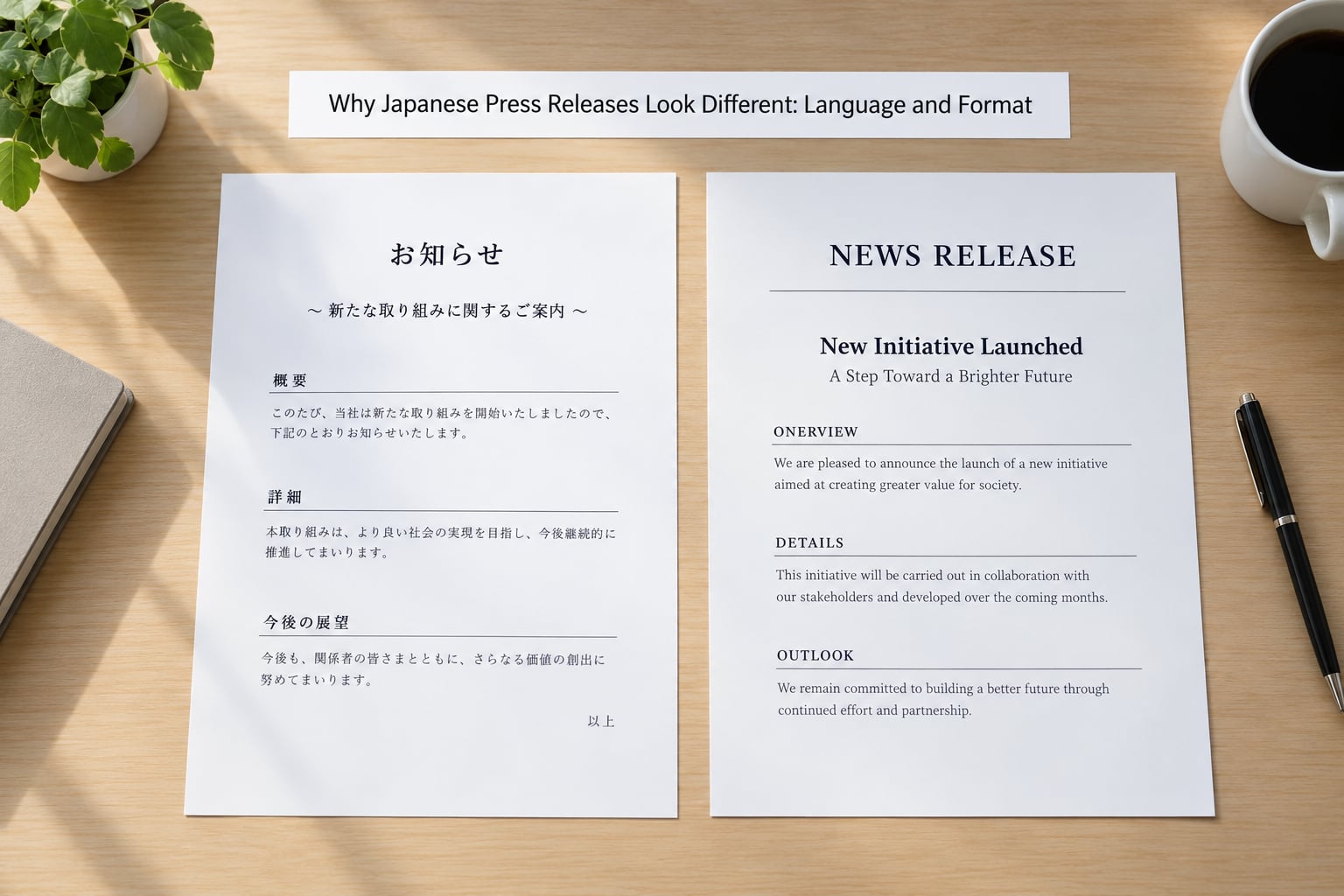
Four things drive almost all of it: business etiquette, the conventions individual outlets expect, how releases are actually distributed, and the working relationship between a company and a reporter. Each one pushes the document in the same direction, so they reinforce each other rather than competing.
Read the differences as tendencies, not rules. Large listed firms with an in-house communications department produce a different document from a ten-person startup pitching its first product, and a trade publication accepts things a general newspaper ignores.
Two cultural forces sit underneath all four. The first is high-context communication: the reader is expected to fill in meaning from shared background rather than from explicit argument. The second is nemawashi (根回し), the pre-alignment that happens before anything is announced publicly, which means a release often arrives after the important decisions have already been settled behind closed doors.
Why Japanese Press Releases Look Different, in Five Parts
Open any Japanese release and you will find the same five parts in the same general order, regardless of company or sector.
- Headline. A long descriptive sentence that names the company, the offering and the date, often 25 to 40 characters.
- Lead paragraph. One dense paragraph that is the whole summary. There is usually no separate sub-headline beneath it.
- Body. Specification, pricing structure where relevant, and quotes from named executives with their full titles.
- Company profile (会社概要). A boilerplate block covering founding date, capital, headcount, business lines and address.
- Contact block. A named person, department, phone number and email address at the end, not a generic press inbox.
The company profile trips up every newcomer. Western releases treat it as an afterthought to be trimmed. In Japan it is standard boilerplate that appears in a large share of corporate announcements, and its absence can make a document look incomplete to a local editor.
How Formal Japanese Business Language Changes the Tone
Japanese business writing uses keigo (敬語), a set of polite and honorific forms that mark distance and respect. Applied to a release, it produces a sentence that sounds ceremonial to an English ear while being perfectly ordinary to a Japanese reader.
Claims get restrained. Instead of announcing a breakthrough, a release typically says a service has begun, or that a company has started providing something, and then lets the specifications do the persuading. The reason is credibility: Japanese reporters treat unverifiable superlatives as a sign that the company is inexperienced, or worse, that it is padding a thin result.
Concrete numbers carry the weight instead. A precise count of users, stores, pre-orders or survey respondents does more work than any adjective, and any figure a company cannot substantiate later is one it should leave out entirely.
Deference also shapes the prose. A company rarely presents itself as the hero of its own announcement. The subject is usually framed as the market, the customer, the industry or society, and the company appears as the party responding to that shift. This is the difference between asking for coverage and supplying material to someone who intends to write a story.
Why Headlines Often Lead With the Product or Service
Japanese headlines tend to name the offering first, then the company, then the event. A Western headline often leads with the news and leaves the product name for the sub-head.
The practical reason is truncation. On news portals and aggregator apps, headlines are cut at a fairly short length, so anything important has to appear in the first stretch of characters. The commonly cited guidance is roughly 30 characters for the headline itself, and around 13 characters of that survive in a Yahoo! NEWS listing, which means the company and product name come first.
Headlines also avoid clickbait and superlatives entirely. You will not find a Japanese headline promising a revolutionary or world-leading solution, because the journalist is judging the source and the claim simultaneously, and a headline that oversells damages both.
Worth noting: a headline that makes complete sense on its own, without opening the body, is treated as the mark of a competent release. If the reader needs the article to understand the title, the release is considered badly written.
How Media Distribution Differs in Japan
Distribution is the biggest practical difference, and the one most foreign teams get wrong. Releases rarely go onto a single global newswire and call it done.
The press club (記者クラブ) system is the foundation. Reporters hold scheduled briefings, often repeating weekly, at which a company’s designated representative supplies information and access. Major dailies such as the Nikkei, the Yomiuri Shimbun, the Mainichi Shimbun and the Asahi Shimbun each maintain clubs. Because the company is physically present and the reporter owns the final voice, the release is a supporting document rather than the story itself.
On top of that sit commercial distribution services, and they differ in ways that matter. PR Times is aimed at companies and draws heavily on affiliated media that republish submissions. PR Newswire Japan, BizPR and Dream News operate in the same space with different emphases and different editorial filters. A release submitted through a service may be accepted for republication without ever being read by a staff writer, which is publication but not coverage.
Direct outreach still works, and for many announcements it works better: department-level pitches to a specific reporter or bureau, briefings with trade and vertical publications, and pitches to television programme producers, who look for visual and demonstrable material rather than text.
One more expectation to set straight. Links inside distributed releases are typically nofollow, so treat distribution as publicity and relationship-building rather than a link acquisition tactic. If backlinks are the goal, the announcement is the wrong instrument.
How Company and Product Details Are Presented
Japanese releases give background information more room than Western ones do. Corporate history, capital, employee count and business lines appear as a standard block rather than an optional extra.
Consider a fictional example. A Tokyo software company launches an inventory tool for small retailers. The headline names the service and the company and the date. The lead paragraph states what the service does, who it is for and when it becomes available, in about four lines. The body follows with supported hardware, system requirements, the pricing structure, a short quote from the chief executive with the full title attached, and a note on existing partner integrations.
What is absent tells you as much. There is no buy button, no urgency, no discount language, no customer count inflated past what the company can defend, and no claim that competitors cannot do the same thing. The release ends with the company profile and a named contact with a direct phone number.
Executive titles matter more here than they do in English-language copy. 代表取締役社長 means representative director, the top executive role, and it appears attached to a person’s name with near mechanical consistency. Dropping titles makes a release look machine-translated even when the Japanese itself is clean.
Japanese and Western Release Conventions Side by Side
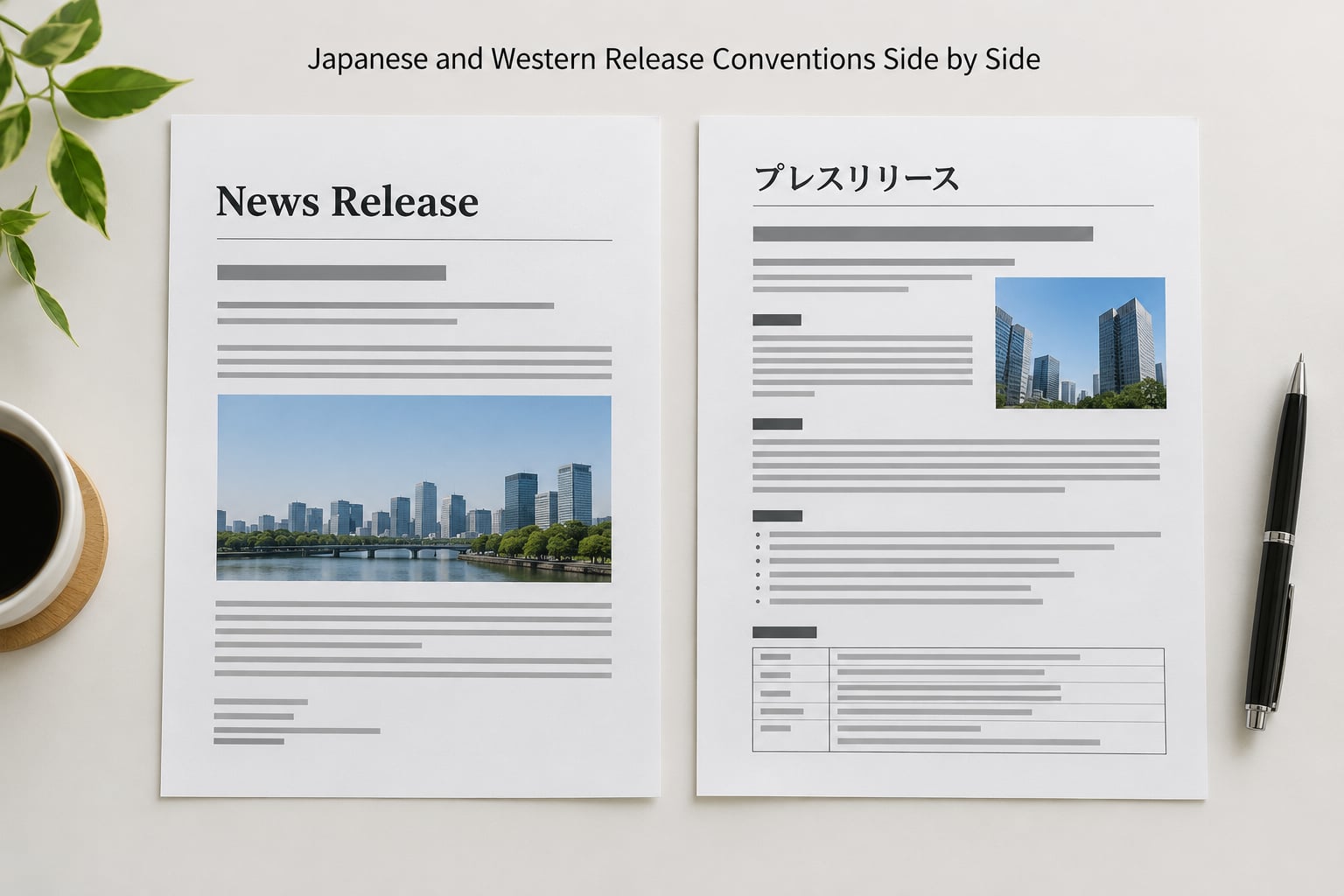
The table below shows common patterns on both sides. It describes tendencies that a careful writer will find most of the time, not a rulebook, and plenty of hybrid releases sit between the two columns.
| Element | Common Western pattern | Common Japanese pattern |
|---|---|---|
| Headline | Short, benefit-led, superlatives welcome | Long descriptive line naming company, offering and date |
| Opening | Hook plus the single most important news | One dense summary paragraph, no separate sub-headline |
| Claim tone | Assertive, competitive, comparative | Restrained, hedged, socially framed |
| Proof | Customer quotes and user counts | Specifications, dates, named figures |
| Body length | Sparse, scannable, bulleted | Dense, continuous prose, header-heavy |
| Call to action | Buy, sign up, register, contact us | None; a named contact block instead |
| Company block | One-line boilerplate, often omitted | Full 会社概要 profile with capital and headcount |
| Distribution | Newswire syndication, media list emailing | Press club briefings plus domestic distribution services |
What to Watch For When Reading a Japanese Release
Now the practical half. Reading a Japanese release well comes down to separating what is verifiable from what is framing, and being honest about which one you are looking at.
Check the date and the release type. Japanese announcements carry a specific publication date and often a scheduled launch or registration date. The two are not the same, and the distinction matters when you are judging whether news is fresh.
Find the named subject. If the release names a person, department or company, you can go and check that entity. A release with no named subject and no figures is usually an opinion piece wearing business clothing.
Read the numbers literally. Specific figures such as a count of participating stores, a pre-order total or a survey sample size are the most reliable content in the document, because they are the parts a company can be held to.
Treat the framing as framing. Statements about social significance, contribution to the industry or a shift in the market are the company’s positioning, not a finding. Nothing in the release verifies them.
Distinguish republication from coverage. A release appearing on a distribution service or a partner site means the company distributed it. It does not mean a reporter investigated it or wrote about it independently.
Watch for missing context. Very long releases often leave out the comparison that a Western reader expects. There is no direct equivalent of a section telling you how this differs from what already exists, so you have to supply that comparison yourself from independent sources.
Translate carefully. A release that arrived in English and reads awkwardly was almost certainly translated rather than rewritten. Native Japanese releases are never this stiff, and the awkwardness is a signal about the original source rather than the translation.
Frequently Asked Questions
Are Japanese press releases difficult for English readers because they are badly translated?
Usually the opposite. A native Japanese release is written in a high-context, understated register that assumes shared background, so it can feel slow or vague to an English reader without any translation being involved. The genuinely stiff documents tend to be translated from English without rewriting, which is why word order and emphasis feel off. If the Japanese reads naturally but the English summary feels padded, that is convention, not translation failure.
Why do Japanese press releases use more formal language?
Because formal register is the default for Japanese business writing. Keigo, the polite and honorific form set, marks respect and distance between the company and the reader, and it is used in internal documents too, not only public ones. In a release the formality also serves a strategic purpose: a restrained voice signals that a company is confident in its facts rather than trying to win attention with adjectives.
Do Japanese companies distribute press releases differently from Western companies?
Yes. Japan runs on scheduled press club briefings where company representatives supply information directly to reporters at major dailies, and on domestic distribution services such as PR Times, PR Newswire Japan, BizPR and Dream News. Western practice leans more heavily on a single newswire syndication model. Because links on distribution services are usually nofollow, teams that expect coverage to translate into search visibility are often disappointed.
Are company claims in a Japanese press release independently verified?
Not by the release itself. Specifications, dates and named figures are usually reliable because a company can be held to them, but statements about market leadership, industry contribution or social significance are positioning written by the company. A distribution service republishing a submission is also not verification, since acceptance often means automatic syndication rather than editorial review. Treat every claim as company-sourced unless a separate outlet reports it.
Should a foreign company publish its press release in Japanese or English?
Publish in Japanese if you are targeting the domestic market, and rewrite rather than translate. Running English text through a translator produces obviously foreign phrasing and ignores the structure local reporters expect. An English version is fine as a supplementary document for international trade publications and for investors, but Japanese coverage generally comes from a Japanese release distributed through Japanese channels.
Conclusion
Why Japanese press releases look different comes down to a media system built on press clubs and a writing culture built on high-context restraint. Nothing about the format suggests careless work or a bad translation, and reading it that way leads to the wrong conclusion about the company behind it.
When you open one, start in a fixed order: read the headline to see what is actually being claimed, check the date, look for the named subject, then find the figures. Everything else in the document is framing built around those facts. Updated for October 2026, since these conventions shift slowly and it helps to know how old your reference point is.