Japanese warranties usually stop at the border. A Japanese warranty is a service promise administered by the manufacturer’s Japanese subsidiary or domestic distributor, so it only covers products bought through that channel and repaired inside Japan. Take the device abroad and there is no local service network, no spare-parts stock and no technician trained on your model to honour it.
That is the short answer. The useful answer is why it works that way, and what you can still do about it. Below I break down the five structural reasons, the categories where the restriction bites hardest, a pre-purchase checklist you can run in the shop, and a plan for the day the thing actually breaks.
One warning before we start: brand policies change, often more than once a year. Everything here describes how these warranties generally work, so treat the brand’s own written policy page as the final word.
Table of Contents
- 1What Japanese Warranty Actually Means
- 2Why Warranties Are Tied to a Sales Region
- 3Why Japanese Warranties Do Not Cover Overseas Use?
- 4Which Products Are Most Likely to Have Territorial Limits?
- 5What to Check Before Buying in Japan
- 6What to Do When a Product Fails Outside Japan
- 7Exceptions for Short Trips, Relocation, and Shipping
- 8Frequently Asked Questions
- 9Can I use a Japanese warranty when temporarily visiting another country?
- 10Does the warranty start when I leave Japan or when the product is imported?
- 11Can I return an electrical product to Japan if it is not working?
- 12Does using another country’s voltage automatically void the warranty?
- 13Is an international warranty from a store or insurer the same as manufacturer coverage?
- 14Conclusion
What Japanese Warranty Actually Means
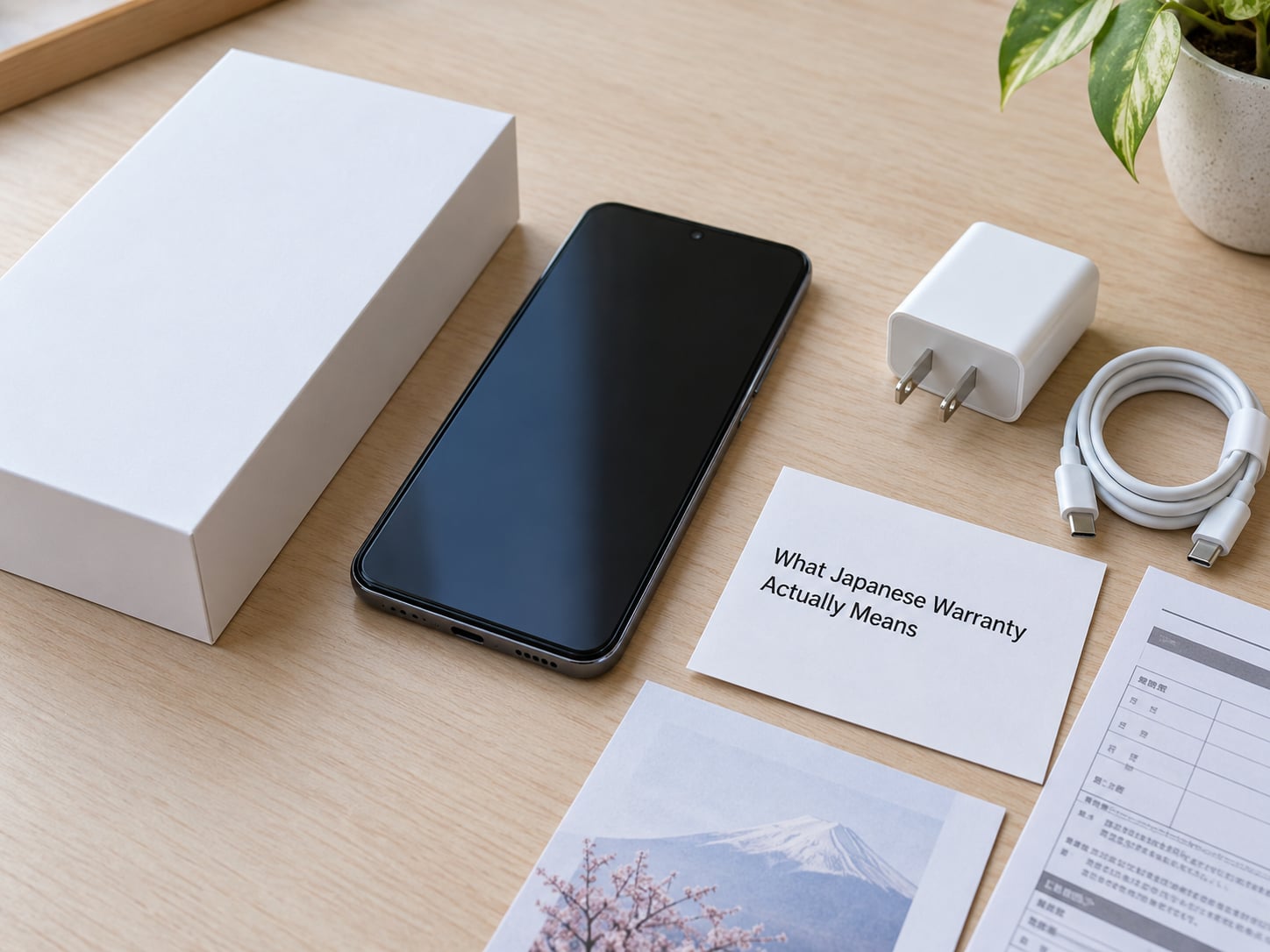
There are three different things people call a warranty, and mixing them up causes most of the confusion in Japan electronics forums.
A manufacturer’s limited warranty is the promise printed on the box or in the paperwork. It covers defects in materials and workmanship for a fixed period, usually one year, and it comes with conditions about where the product must be serviced.
A retailer or dealer warranty comes from the shop that sold you the thing. It is the store’s own promise and it evaporates the moment you leave the country, because the store has no way to service you from thousands of kilometres away.
A statutory guarantee is what the law of the country gives you regardless of any brand policy. In Japan that means the Product Liability Act and consumer contract rules, which hold a manufacturer responsible for defective products. Outside Japan, the statutory protection you get is the law of wherever you live.
The mistake people make is reading “Made in Japan” as a warranty jurisdiction. Manufacturing country and service country are unrelated. A camera body assembled in Japan and sold through a European distributor is a European warranty, and the assembly line location changes nothing.
Why Warranties Are Tied to a Sales Region
Region-locking is not a scheme to trap tourists. It falls out of how a manufacturer actually budgets for repairs, and it comes down to five things.
1. The money comes from domestic margin. The repair reserve for every unit sold in Japan is built out of the profit on units sold in Japan. A Japanese-market phone is cheaper than its European equivalent precisely because it carries no cost of servicing customers on three other continents. Hand that unit to a service centre abroad and someone is paying for parts and labour out of a budget that never received your money.
2. The contract is with a local legal entity. Your warranty is usually issued by Sony Corporation, Canon Inc. or whatever the Japanese entity is called. That company has no retail presence in your country, no relationship with its local distributor, and no legal obligation to a customer who is not its customer. The warranty is a contract with a Japanese company, and that contract has a territory.
3. Service centres hold the parts and the knowledge. A repair shop is only fast if it has the replacement board, the panel and the firmware image on the shelf. Japanese authorised service centres stock for the Japanese model range sold in Japan. A Japanese-market variant can use a different screen, a different charging flex or a different radio module than the model with the same name sold elsewhere, so the part sitting in a Berlin or Toronto warehouse may simply not fit.
4. Technicians are certified for specific models. The person opening your laptop has been trained on the configuration their market received. Ask for a Japan-only variant and you are asking them to work on hardware they have never seen, with a manual in a language they may not read.
5. The claim needs local proof of purchase. The claim process expects a receipt issued by a domestic authorised seller, a Japanese-language warranty card, and a serial number registered in the domestic system. A tax-free shopper’s paperwork is thin by design. If the serial number does not appear in the destination country’s regional database, the local support line has no record that your product exists.
That last point is the one people hit hardest. The most common complaint on forums is not a refused repair, it is a support agent telling them the serial number is unknown, because from the destination market’s side the product was never sold.
Why Japanese Warranties Do Not Cover Overseas Use?
Because the warranty is valid only in designated sales territories, and Japanese domestic coverage normally ends the moment a product is used, purchased or returned outside Japan unless the manufacturer has written an international service clause into the terms. The standard exclusion says, in plain English, that service may be refused if the product has been used outside the country in which it was sold, or if the serial number has been altered, removed or found to belong to another region.
Some manufacturers soften that with a named international programme rather than a general promise. Sony’s VAIO Overseas Service, for instance, is a paid extension that has to be bought within 30 days of purchase and needs a dated sticker, with repair handled free of charge only in designated countries. Canon runs a separate Canon International Warranty for certain markets. Those exist by exception, and they are narrow.
Which Products Are Most Likely to Have Territorial Limits?
The table below is a general pattern, not a verdict on any model. Coverage always comes down to the exact model number, the serial number, the market designation and the manufacturer’s written policy for that combination.
| Product category | Typical Japanese coverage | What usually goes wrong abroad |
|---|---|---|
| Smartphones | One year, Japan only, through the carrier or the manufacturer’s Japanese channels | Serial number absent from the destination carrier database; no overseas screen or battery stock |
| Cameras and lenses | One to two years depending on the body | Regional model differences, sensor and LCD variants, sensor cleaning treated as a service item |
| Gaming handhelds and consoles | One year, domestic service centres | Region-locked firmware and region-locked game media; joystick and shell parts are market-specific |
| Laptops and tablets | Typically one year, tied to the selling country’s service entity | Apple restricts service by country of sale; other brands route you to their local subsidiary, which may decline an imported machine |
| Home appliances | One year on-site repair inside Japan | No on-site repair abroad at all, plus a voltage mismatch that is a safety problem before it is a warranty problem |
| Headphones and audio gear | One year, often distributor-run | Replacement earpads and headbands are stocked for the domestic SKU only |
| Drones and action cameras | One year, region-locked firmware on many models | Radio bands differ by region, so firmware updates for the wrong market are simply not released |
| Smartwatches and wearables | One year, paired to a domestic phone app | Region-locked companion apps and band frequencies |
Note the pattern. Categories with high failure cost and thin margins get the strictest territorial limits. A cheap USB cable fails and nobody minds. A handheld that will not boot in month fourteen is an expensive problem with no local fix.
What to Check Before Buying in Japan
Run this list in the shop or on the manufacturer’s site before you pay. It takes five minutes and it is the only point at which you still have leverage.
1. Find the model number, not the marketing name. Look for the model string on the box, on the device and in the settings menu. Retailers often carry several regional variants of the same product under one name, and only the model number reveals which one you are getting.
2. Ask for international coverage in writing. Ask the store to look it up on the manufacturer’s site with you there, or accept that verbal reassurance is not policy. Forum consensus is that in-store staff give inconsistent answers on this question, sometimes because they genuinely do not know.
3. Read the warranty card. Look for the country or countries listed as service locations. If the card names only Japan, you have your answer. Japanese warranty cards are often printed in Japanese, so the same page usually has an English or multilingual version online.
4. Check where the serial number is registered. Some brands let you register a product on their site before purchase or immediately after. Registering while you are still abroad gives you a timestamped record with the destination country attached.
5. Find the nearest authorised service centre in your destination country. Not in Japan. Search the brand’s own service locator for the country you are going home to, and check that the exact model appears.
6. Keep every document. Receipt, warranty card, box with serial stickers, and a photo of the serial number on the device. If you buy tax-free, the receipt is often your only proof of purchase.
7. Confirm the power supply. Japan runs at 100V with two flat pins. Most modern electronics accept 100-240V, but plenty of kettles, rice cookers, hair dryers and older vacuum cleaners do not. This is a safety issue first.
8. Red flags that mean walk away. A seller-only warranty with no brand involvement. An online-only seller with no physical service point. A store employee who cannot name the policy page. A price so far below the market that nobody downstream is making money on your support.
Here is what the trade-off looks like in plain terms.
| Factor | Bought in Japan | Bought in your home country |
|---|---|---|
| Warranty provider | Japanese subsidiary or distributor | Local subsidiary with in-country service |
| Spare parts | May not match the regional variant | Guaranteed fit for the local SKU |
| Firmware and updates | Region-locked on some models | Full update stream for your region |
| Technician access | On-site repair in Japan only | Walk-in or next-day repair |
| Resale value | Harder to sell abroad, buyer will discount it | Normal local resale market |
On legal recourse, the same purchase gives you completely different options depending on where you stand. Japan’s consumer framework holds manufacturers responsible for defective products, US buyers fall under the Magnuson-Moss Warranty Act for written warranties on consumer goods, and EU and UK buyers get a two-year conformity guarantee against the seller that no manufacturer policy can shorten. Buying in Japan and living in Berlin means the German conformity guarantee no longer protects you, and you are left with a contractual claim against a Japanese company.
What to Do When a Product Fails Outside Japan
Work through this in order. Skipping step one is how people end up voiding a warranty that would still have covered them.
1. Stop using it if it is unsafe. A battery that has swollen, a charger that smells burnt, a cable that is warm to the touch or an appliance that trips a breaker gets unplugged and left alone. Do not charge a swollen battery and do not open a power supply.
2. Record everything before you touch it. Serial number, error messages, a short video of the failure, and the date. Screenshots of any error text. If you have the original box and receipt, put them with the device rather than in a different bag.
3. Contact the brand in your country of residence, not Japan. Give them the serial number and ask specifically whether the serial number is registered in their system. The answer tells you whether you have a claim or a courtesy case.
4. Ask about the international programme before assuming there is none. Canon International Warranty, Apple service by country of sale, and regional ASUS international coverage all have published conditions. Ask for the policy document, not a summary.
5. Do not let an unauthorised party open the device. Third-party repair shops and independent technicians routinely void remaining coverage, and once a warranty is gone it does not come back.
6. If nobody will service it, price the mail-back option. Sending a device back to Japan can cost more than the device and takes weeks, and customs may treat a returned repair as a fresh import with duties due. Get the written estimate before you commit, and ask the brand whether they support that route.
7. Check your other cover. Credit card purchase protection, travel insurance that covers electronics, home contents cover, and airline or retailer programmes all sometimes extend to equipment bought on the card. These are separate from manufacturer coverage and usually time-limited, so check soon after the failure rather than later.
Whatever the outcome, this is a good moment to note what you would buy differently. For most people buying in Japan for overseas use, it is a locally sold unit with a local warranty, unless the international coverage is written down on the brand’s own site before the purchase.
Exceptions for Short Trips, Relocation, and Shipping
Temporary use and permanent relocation are treated very differently by brands, and the distinction matters.
Short trips. Most warranties do not define “warranty starts when the product leaves the country”, but plenty of them do define service territory. A two-week holiday in Thailand does not usually trigger a claim, so the risk is mostly theoretical until something fails on day three of the trip.
Temporary work abroad. Same as a long trip, except the clock runs longer. Several months with a Japan-bought phone is exactly the scenario support lines refuse, because it looks like relocation.
Importing a device. Importing is not the same as buying abroad, but it produces the same outcome. The importer is not the authorised seller in your country, so the local subsidiary treats the device as unregistered. Grey market or parallel imports are described the same way by manufacturers: no local warranty, no firmware updates for your region, and no guarantee the radio module is even legal where you live.
Relocating permanently. This is the clearest case. The warranty attaches to the sales channel in your country of residence, and possession of the device in Japan does not extend it.
Some brands run paid overseas service plans, and these are the exception worth knowing about. Sony’s VAIO Overseas Service is the clearest published example: it has to be bought within about 30 days of purchase, requires a dated sticker on the unit, and covers repair free of charge only in designated countries, with exclusions covering things like requesting a repair outside the region of the request itself.
Frequently Asked Questions
Can I use a Japanese warranty when temporarily visiting another country?
Possibly, but do not count on it. Most Japanese limited warranties restrict service to designated territories rather than tying themselves to your passport or your length of stay. A two-week holiday rarely triggers a claim, so the practical risk is small. Extended stays, contract work abroad and relocation are where local service centres routinely decline a Japan-bought device. Ask the manufacturer for the written service territory before you leave, and photograph the policy page while you still have Wi-Fi.
Does the warranty start when I leave Japan or when the product is imported?
Neither, exactly. The warranty period normally starts on the purchase date recorded on the receipt, and running it does not depend on travel. What changes when you import or relocate is where service may be performed, not when coverage begins. That is why a device can still be inside its one-year window and still be unserviceable in your country. Check both the remaining coverage period and the service territory, because they are two separate questions with two separate answers.
Can I return an electrical product to Japan if it is not working?
You can send it, but do not assume it is cheap or quick. Return shipping, customs handling, possible import duty on a returned device, and a multi-week repair cycle can easily exceed what the unit is worth. A brand whose Japanese entity has no relationship with you may simply refuse the return. Before mailing anything, get a written estimate and confirmation from the manufacturer that they will accept the repair. For anything bought tax-free, expect the original receipt to be the deciding document.
Does using another country’s voltage automatically void the warranty?
Not automatically, but it is a strong reason a claim can be refused. Japan runs at 100V, so an appliance rated only for 100V used on a 220-240V supply can destroy itself. The manufacturer will usually point at incorrect operating voltage as misuse, and misuse voids coverage. Many modern electronics accept 100-240V, so check the rating plate on the device before you leave the shop rather than after it fails.
Is an international warranty from a store or insurer the same as manufacturer coverage?
No, and the difference is often decisive. Manufacturer coverage is administered by the company that built the product, using its own parts and technicians. A store or insurer plan is a separate contract with a different company, may cover different failure types, may carry a claim form and a time limit, and may require you to pay first and claim later. Some store plans are only as good as the store’s continued existence. Treat them as separate products and compare them separately.
Conclusion
Japanese warranties do not travel because they were never built to. They are domestic service contracts funded by domestic margin, staffed by local technicians and backed by local parts stock.
So before you buy in Japan, do three things: write down the exact model number, find the brand’s written policy for your country of residence, and keep the receipt and warranty card. If international coverage is not on the manufacturer’s own page, treat the Japanese warranty as what it is: a promise that only works while you are in Japan.