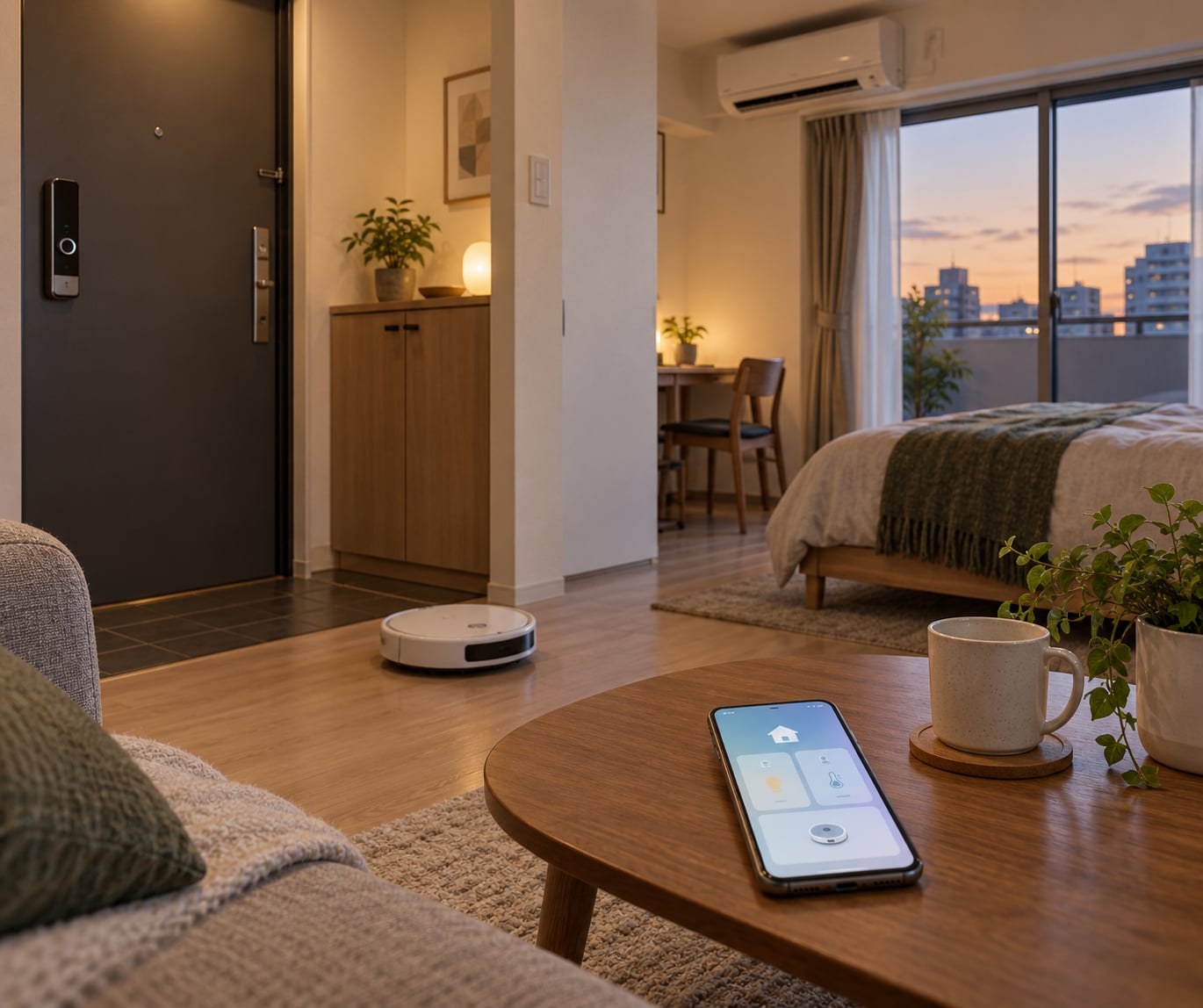
Japanese smart home adoption is the rate at which households in Japan install connected devices — smart locks, cameras, lighting, appliances and energy controls — that can be monitored and automated, increasingly through the Matter standard rather than single-brand ecosystems. It is advancing, but unevenly: strong in apartment-heavy metro areas, held back in rental housing and in older homes with limited wiring.
Here is the honest version. The market is growing at roughly 8.6% a year and most buyers assemble their own systems rather than buying a packaged whole-home install. That difference from North America and South Korea explains most of what looks contradictory about Japan’s numbers.
Table of Contents
- 1What Is Japanese Smart Home Adoption?
- 2Japanese Smart Home Adoption at a Glance
- 3Why Are Smart Homes Becoming More Popular in Japan?
- 4Ageing in place is the strongest long-run driver
- 5Energy policy pays part of the bill
- 6Security is the fastest-growing device category
- 7AI and Japanese-language voice control matured
- 8Compact housing rewards devices that do more with less
- 9Telecom bundles make the entry price lower
- 10How Do Japanese Apartments Make Connected Living Easier?
- 11Which Smart-Home Devices Have the Best Adoption Potential?
- 12How Do Japanese Smart-Home Platforms Fit Together?
- 13What Is Slowing Japanese Smart Home Adoption?
- 14How Much Does a Japanese Smart Home Cost?
- 15Who Is Adopting Smart-Home Technology in Japan?
- 16How Is Japanese Smart Home Adoption Different From the United States and South Korea?
- 17What Trends Will Shape Japanese Smart Homes Next?
- 18Frequently Asked Questions
- 19What is the most common smart-home device in Japan?
- 20Can I install smart-home technology in a Japanese rental apartment?
- 21Are Japanese smart homes safe from hacking and privacy risks?
- 22Do smart homes in Japan reduce electricity bills?
- 23Are smart homes useful for older adults living alone?
- 24Will Japanese smart-home adoption grow significantly in the near future?
- 25Conclusion
What Is Japanese Smart Home Adoption?
A smart home in Japan is a home where devices share a network and can be controlled or automated, rather than a single appliance with an app. A washing machine you start from your phone is connectivity. A washing machine that runs when solar generation peaks, notifies a family member on completion and pauses the dryer until you are home is a smart home.
Japanese smart home adoption covers three layers that people often blur together:
- Connectivity — the network that carries the devices, usually home Wi-Fi and increasingly a Thread mesh.
- Devices — locks, cameras, blinds, sensors, robot vacuums, air conditioners, monitors.
- Control layer — the hub, app, voice assistant or HEMS controller that ties them into routines.
Statista’s market taxonomy for Japan splits consumer smart home spending into six segments: Control & Connectivity, Comfort & Lighting, Energy Management, Security, Home Entertainment, and Smart Appliances. That framework is useful because it makes clear where revenue actually sits — in appliances and comfort systems, not in the robot-helper category most people picture first.
Mordor Intelligence, in a January 2026 update, sized the Japan smart home market at USD 11.77 billion in 2026 and forecast USD 17.77 billion by 2031, an 8.58% compound annual growth rate. Treat that as one firm’s estimate rather than a census: Grand View Research and other houses publish materially smaller numbers for the same period, which tells you the definition of “smart home revenue” is doing a lot of work.
Japanese Smart Home Adoption at a Glance
| Factor | What the data says |
|---|---|
| Market size | USD 11.77 billion in 2026, forecast to USD 17.77 billion by 2031 |
| Growth rate | 8.58% CAGR (Mordor Intelligence, January 2026) |
| Top segment by share | Smart appliances, 27.43% of the market |
| Fastest growing segment | Security, 10.81% CAGR |
| Dominant connectivity | Wi-Fi, 45.12% share; Thread growing 9.23% a year |
| Installation | DIY accounts for 62.47% of installations |
| Housing type | Apartments and condominiums, 41.63% of the market |
| Region | Kanto holds 32.00% of spend |
| Channel | Online retail 38.63%; telecom-operator bundles growing 11.61% a year |
One caution before you quote those figures. Research firms disagree sharply on Japan’s market size, because some count only consumer device sales and others bundle installers, services and commercial systems. Where sources conflict, the interesting part is the gap itself — it tells you how loosely “smart home” is still defined.
Why Are Smart Homes Becoming More Popular in Japan?
Six forces do most of the explaining. None of them is “people want a talking fridge,” and that is why adoption looks slower than in markets where gadget novelty is the main motivation.
Ageing in place is the strongest long-run driver
Japan’s population skews old, and a large share of single-person households are people in their late seventies and eighties. Fall detection, activity monitoring, remote medication reminders and caregiver dashboards turn a home into a care tool, which gives the buyer a reason to accept a subscription and to think about privacy seriously.
This is the driver Mordor Intelligence puts at the top of its list, and it is the one that turns smart home spending from discretionary into healthcare-adjacent spending.
Energy policy pays part of the bill
Japan’s Zero Energy House programme and its successor schemes subsidise insulation, efficient appliances and home energy management systems. A household that installs efficient appliances and a HEMS controller can pull part of that cost through a subsidy rather than paying full retail.
The catch: most of these subsidies attach to renovations and new builds, not to plugging in a smart plug. Homeowners and new condominium developers benefit most. Renters usually benefit least.
Security is the fastest-growing device category
Security devices — door locks, cameras, door sensors, packages — are growing at about 10.81% a year, the fastest rate of any segment. Delivery fraud, the growth of single-person households and a general increase in concern about who is outside the door all feed the same category.
A lock is also the easiest smart device to justify in a small apartment, because it replaces a physical key rather than competing with existing furniture.
AI and Japanese-language voice control matured
Voice control stopped being awkward once the assistants handled Japanese naturally, including casual speech. That opened routines that previously needed a phone in your hand: turning off lights and locking up while cooking, hands full.
Is AI adoption slow in Japan? Not in the home. The wider economy is cautious about AI deployment, but household devices are judged by whether they work reliably today, and they do.
Compact housing rewards devices that do more with less
A 25-square-metre studio leaves no room for a room full of tech. Robot vacuums, compact sensors, climate control that heats one room instead of the whole unit, and remote monitoring all gain value when floor area is the scarcest resource in the home.
Telecom bundles make the entry price lower
NTT, KDDI and SoftBank bundle routers, hubs and a few connected devices into home internet plans, sometimes on a two-year contract. Telecom-operator channels are growing at 11.61% a year, faster than most retail routes, because the bundle hides the awkward first question: which hub do I actually need.
How Do Japanese Apartments Make Connected Living Easier?
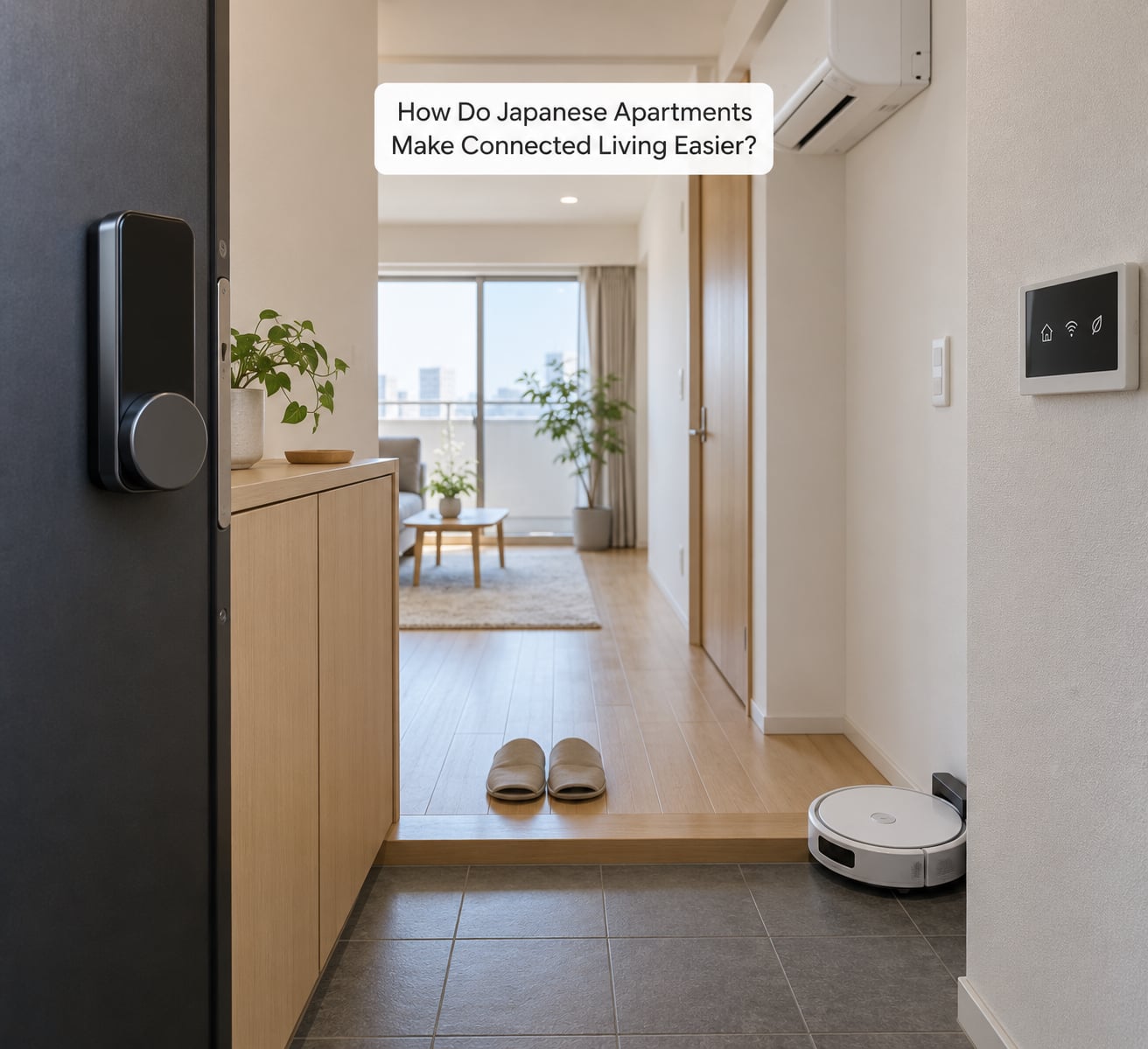
Take a typical one-bedroom rental in a Tokyo ward: about 25 square metres, one compact air conditioner, fixed ceiling light fittings, a balcony washer-dryer, and a landlord who will not allow structural changes. In that flat, the easiest wins are battery or adhesive-mounted devices — a robot vacuum, a plug, a camera on a shelf, a hub near the router.
The apartment format actively rewards some categories and blocks others. Multi-function wall units, washer-dryers and compact appliances are the products Japanese manufacturers have optimised for decades, so connecting them to a phone is a smaller step than it would be in a larger home. Off-peak electricity pricing and demand-response programmes mean a home that shifts laundry and dishwashing to cheaper hours has a measurable reason to automate.
Where it gets hard is lighting. Japanese apartments overwhelmingly ship with fixed light fittings, often with no bayonet socket and sometimes not even a neutral wire, which removes the natural entry point for smart bulbs. This came up repeatedly in r/japanlife discussions, where residents pointed out that the “easy” smart lighting product barely applies to Japanese rental stock. You are left replacing the fitting with a fixture the landlord approved, or giving up on smart lights entirely.
Everything else scales down cleanly. A smaller space needs less cleaning, less heating and more security, which is why robot vacuums and door cameras land well in Japanese flats while whole-home automation systems land badly.
Which Smart-Home Devices Have the Best Adoption Potential?
| Category | Why it works in Japan | Install effort | Privacy consideration |
|---|---|---|---|
| Security (locks, cameras, sensors) | Fastest growth at 10.81% CAGR; clear standalone value | Low | High — cameras and remote unlocking need thought |
| Smart appliances | Largest segment at 27.43% share; strong Japanese brands | Low, but appliances are expensive individually | Medium — usage-pattern data |
| Energy management | Subsidies, time-of-use pricing, HEMS controllers | Medium | Medium |
| Climate control | Compact living, room-by-room heating, humidity | Medium | Low |
| Lighting | Convenient when the fitting is replaceable | High in fixed-fixture apartments | Low |
| Health and care monitoring | Ageing in place; caregiver dashboards | Low to medium | High |
| Robotic helpers | Space efficiency; strong fit for small floors | Low | Low to medium, due to floor mapping |
The pattern across categories is consistent. Devices that replace something the household already owns and already worries about — a lock, a camera, an energy bill — get adopted. Devices that add a new object to a small room get resisted.
How Do Japanese Smart-Home Platforms Fit Together?
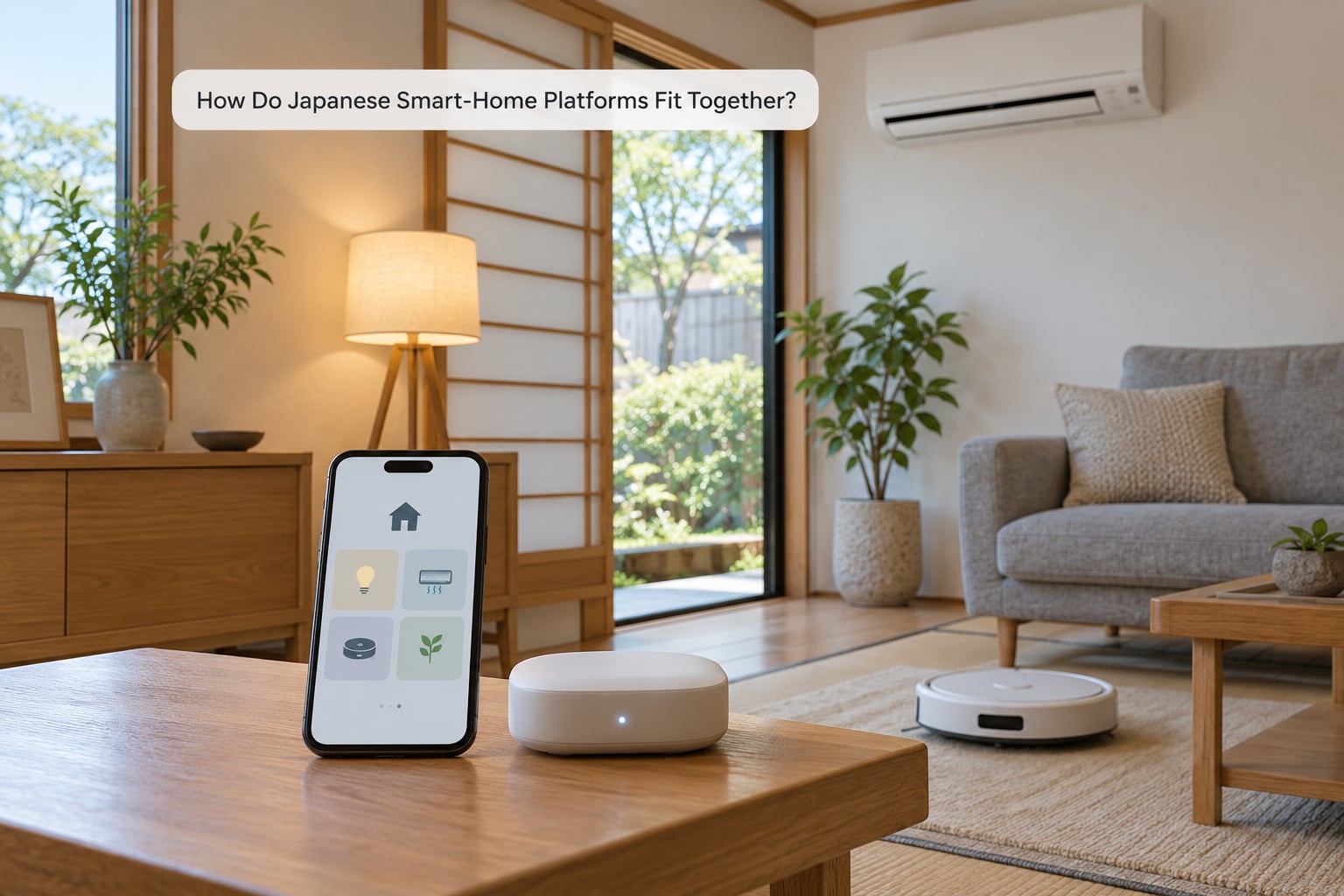
A working setup in Japan usually has five parts: a manufacturer ecosystem (Panasonic’s HomeX, Mitsubishi Electric’s Ene-Look, Sony’s devices, Sharp, Hitachi), a phone app, a voice assistant or hub, cloud services behind them, and a retail or telecom channel that supplied the hardware. Property managers appear at the edge of that, especially in new condominiums that ship building-level controls.
What sits between the parts matters more than the brands. Home energy management systems such as Ene-Look and NTT’s Hikari Cross 2.0 aggregate readings from meters, appliances and solar rather than replacing them. Echonet Lite remains in use as a domestic device protocol in that layer, alongside Matter and Thread at the edge.
Interoperability is the weak joint. A household running HomeKit, a manufacturer app and a HEMS controller usually ends up with three dashboards, and automations that cross ecosystems frequently stop working after a firmware update. The Smart Home Association of Japan has pushed standardisation for years, and Matter certification is finally arriving in Japanese retail, which is why interoperability shows up so heavily in adoption surveys.
What Is Slowing Japanese Smart Home Adoption?
Cost is the reason most people name, and it is a real one: hardware is priced individually, professional installation adds labour on top, and a whole-home system can run into five figures in yen before any subscription. Japan is not an expensive place to buy appliances, so the friction is the number of devices plus install labour, not the unit price.
The rest of the slowdown is less discussed:
- Renter rules. Most Japanese households rent, and landlords frequently refuse permission to modify fixtures, wiring or the intercom. Since apartments and condominiums make up 41.63% of the market, this caps the upper half of the owner-only categories.
- Legacy wiring. A large share of Japan’s existing housing predates modern wiring standards, so devices needing neutral wire or a dedicated circuit are sometimes simply not installable without work that triggers the landlord conversation again.
- Matter availability gaps. Retail availability lags global availability. Users searching Amazon.co.jp in English have reported finding only a handful of devices labelled “Matter Compatible”, with unclear real-world usability — a r/japanlife thread from 2023 exists precisely because Googling turned up no usable answer.
- Ambiguous labelling. A device marked “Matter compatible” may be a controller, a Thread border router, or a device that supports only part of the standard. Beginners conflate all three.
- Privacy and data residency. Academic work comparing Japan and the United States found higher technology anxiety on the Japanese side, with privacy concerns a significant deterrent to smart meter adoption. Camera and care monitoring devices sharpen it.
- Support quality expectations. Japanese buyers tend to judge a product on reliability and longevity. A device that needs an app update to keep working reads as disposable.
- Hub fatigue. Hub-based workarounds for bulbs add cost and defeat the point of a universal standard, which frustrates exactly the buyers who wanted to avoid brand lock-in.
The forum consensus in r/homeassistant, r/HomeKit and r/MatterProtocol threads is that Thread is the mesh layer that finally solves reliability problems, with Matter sitting above it as the application layer. Buyers searching in Japanese rather than English find a thinner picture, which is its own kind of barrier.
How Much Does a Japanese Smart Home Cost?
Nobody quotes one number, because a Japanese smart home is assembled rather than purchased. The cost that matters is the total for one room, one routine or one floor — not a catalogue.
Four levers drive the total:
- Number of devices. A single-purpose setup is a few devices. A whole-home system is one device per room, plus hub, plus any electrical work. Japanese appliances carry high individual price tags, so appliance-led builds are where budgets balloon fastest.
- Installation labour. With DIY at 62.47% of installations, most people start alone, then pay an electrician for the jobs they cannot do — new switch wiring, panel work, mounting a camera feed. Labour usually costs more than the hardware it serves.
- Subscriptions. Cloud storage, camera recording, monitoring services and HEMS platforms add recurring monthly cost. This is where a cheap device becomes an expensive habit.
- Subsidies and energy savings. ZEH-linked schemes can offset a real share of renovation and efficient appliance cost for eligible homeowners, and time-of-use automation can shift usage off expensive hours. Neither applies evenly, and neither makes a payback guarantee.
Renters should assume no subsidy and no electrical work, which pushes everything towards wireless, adhesive-mounted, reversible devices. Owners of post-2000 homes have more room to manoeuvre; owners of older homes should price electrician time into the first quote.
Who Is Adopting Smart-Home Technology in Japan?
Adoption follows housing tenure more than it follows age or income.
- Urban dual-income households in the Kanto and Kansai regions, where 32.00% of spending concentrates, adopt for remote monitoring and cleaning rather than for entertainment.
- Older adults living alone and their family caregivers are the fastest-growing user group, driven by fall detection and activity monitoring.
- Homeowners in older housing adopt most fully, because they can change wiring and fixtures without asking permission.
- Renters adopt selectively: locks, cameras, robot vacuums, plugs. No wiring, no fixed-fixture replacement.
- Small businesses and clinics use energy monitoring and security systems where occupancy patterns justify them.
- Enthusiasts remain a small, vocal group who assemble multi-ecosystem setups and accept the maintenance.
Rural prefectures sit at the other end. Where installer coverage is thin and broadband options are narrower, a self-installed wireless kit is often the only realistic route.
How Is Japanese Smart Home Adoption Different From the United States and South Korea?
| Factor | Japan | United States | South Korea |
|---|---|---|---|
| Dominant housing | Rental apartments and condominiums | Detached owner-occupied homes | Apartment-heavy, high-rise |
| Typical buyer | DIY assembler | Hive-style platform subscriber | Mobile-first apartment renter |
| Main driver | Ageing in place and energy policy | Ease of use and voice ecosystems | Connectivity and apartment infrastructure |
| Main barrier | Landlord permission and fixed fixtures | Subscription fatigue | Interoperability across brands |
| Integration path | HEMS plus manufacturer apps | Platform hubs | Telecom and apartment platform bundles |
| Privacy sensitivity | Comparatively high | More accepting of cloud data | Mixed |
Two differences do most of the explaining. Japanese smart homes are retrofitted into rental flats by people who cannot change the building, so the practical unit of adoption is a single device rather than a system. And Japan’s strongest motivation is care and energy, not entertainment, which is why the buying decisions look clinical rather than fun.
What Trends Will Shape Japanese Smart Homes Next?
Observed so far:
- Matter-certified devices reaching Japanese retail in meaningful volume, with Thread mesh as the standard install path.
- Telecom bundles absorbing the hub decision, which lowers the barrier to a first device.
- HEMS integration moving from new builds toward retrofit, pulled by subsidy schemes.
Reasonable forecasts, clearly separate from the above:
- AI-assisted home management moving from command-based voice control to routines that infer context, particularly around energy and care.
- Privacy-centred local processing, with more devices doing detection on the unit rather than in the cloud, partly in response to data residency expectations.
- Apartment retrofits led by property managers, where building-wide systems appear in shared areas and individual units gradually.
- Regional catch-up outside Kanto as installer capacity and broadband availability improve.
None of these forecasts require a step change in consumer enthusiasm. They mostly require the existing retrofit market to get less awkward, which is a slower process than the headlines suggest.
Frequently Asked Questions
What is the most common smart-home device in Japan?
Japanese research groups report by spending category rather than by unit count, so there is no reliable single-device league table. The largest segment is smart appliances at 27.43% of the market, and the fastest growing is security at 10.81% a year. In practice, door locks, cameras and robot vacuums are the most frequently installed devices in Japanese apartments, while smart lighting remains limited by fixed ceiling fittings.
Can I install smart-home technology in a Japanese rental apartment?
Yes, within limits. Most Japanese landlords will not allow rewiring, new switchgear, intercom replacement or changes to fixed light fittings, so anything requiring those is usually out. Battery and adhesive-mounted devices are the safe route: robot vacuums, smart plugs, shelf cameras, sensors and hub-based automation. Always ask the landlord or management company in writing before installing anything, even when the change looks reversible.
Are Japanese smart homes safe from hacking and privacy risks?
Risk is real but manageable. The main exposures are cameras, unlocked doors, voice assistants that transmit audio, and care sensors that describe a person’s daily routine. Use a strong hub password, enable two-factor authentication, keep firmware current, and prefer devices that process sensitive detection locally. Academic comparisons of Japan and the United States have found higher technology anxiety in Japan, with privacy a significant deterrent for some buyers.
Do smart homes in Japan reduce electricity bills?
Sometimes, and less dramatically than marketing implies. Home energy management can shift laundry, dishwashing and charging to cheaper off-peak hours, and monitoring makes waste visible. Savings depend on your tariff, your usage pattern and how much the household changes behaviour to match the automation. Equipment costs, installer labour and any monthly platform fee usually outrun the savings over a few years, so treat bill reduction as a secondary benefit.
Are smart homes useful for older adults living alone?
This is the strongest use case in Japan. Fall detection, activity monitoring, automatic lighting and caregiver dashboards give relatives visibility without daily visits, and single-person older households are a growing share of the population. Keep it simple: two or three devices that work reliably beat a large setup that needs constant maintenance. Local processing matters more here than anywhere else, since the data describes one person’s routine.
Will Japanese smart-home adoption grow significantly in the near future?
Yes at a measured pace, not a step change. Mordor Intelligence forecast 8.58% annual growth from USD 11.77 billion in 2026 to USD 17.77 billion by 2031. Growth is pulled by ageing in place, energy subsidies and Matter arriving in Japanese retail, and held back by renter restrictions, older housing stock and high labour costs. Expect steady expansion in apartments rather than sudden mass adoption.
Conclusion
Japanese smart home adoption is advancing for practical reasons — an ageing population that wants to stay at home, energy policy that pays for efficiency, and a housing market where renters need devices that work without touching the building. It is held back by landlord permission, older wiring and Matter devices that have not fully reached Japanese shelves.
The practical first step is one use case, not a whole house. Pick a single thing your household actually wants fixed — entry security, laundry timing, or a relative checking in safely — and build one interoperable routine around it. Everything else can wait until that one works without friction.