Japanese tax-free shopping works by removing the 10% consumption tax at the register when you show a passport at a licensed tax-free shop and spend at least 5,000 yen before tax in that shop on the same day. You leave with the goods and a receipt, present them at customs before your bag goes through, and get out of the country inside your permitted stay. The purchase is simple; the export side is where most travelers get it wrong.
I have watched enough friends lose tax-free status over a suitcase zipper to lead with the part that matters: keep the goods visible until customs has seen them, and understand the two different categories before you buy anything.
Table of Contents
- 1What Is Japanese Tax-Free Shopping?
- 2Who Qualifies as a Tourist?
- 3What Can You Buy Tax-Free?
- 4How to Use Tax-Free Shopping at a Store
- 5How to use tax-free shopping at the counter, step by step
- 6What Happens to the Price?
- 7What changes from November 1, 2026
- 8What Are the Spending Limits and Exclusions?
- 9Can You Get a Cash Refund or Use Tax-Free Shopping Twice?
- 10Common Mistakes Tourists Make
- 11Frequently Asked Questions
- 12Do I need to buy everything in one store to use Japanese tax-free shopping?
- 13Can I bring my passport every time I shop, or is there a limit?
- 14Is tax-free shopping always cheaper than buying with a foreign credit card?
- 15What happens if I do not leave Japan before my visa or permitted stay expires?
- 16Can I use Japanese tax-free shopping at convenience stores and department stores?
What Is Japanese Tax-Free Shopping?
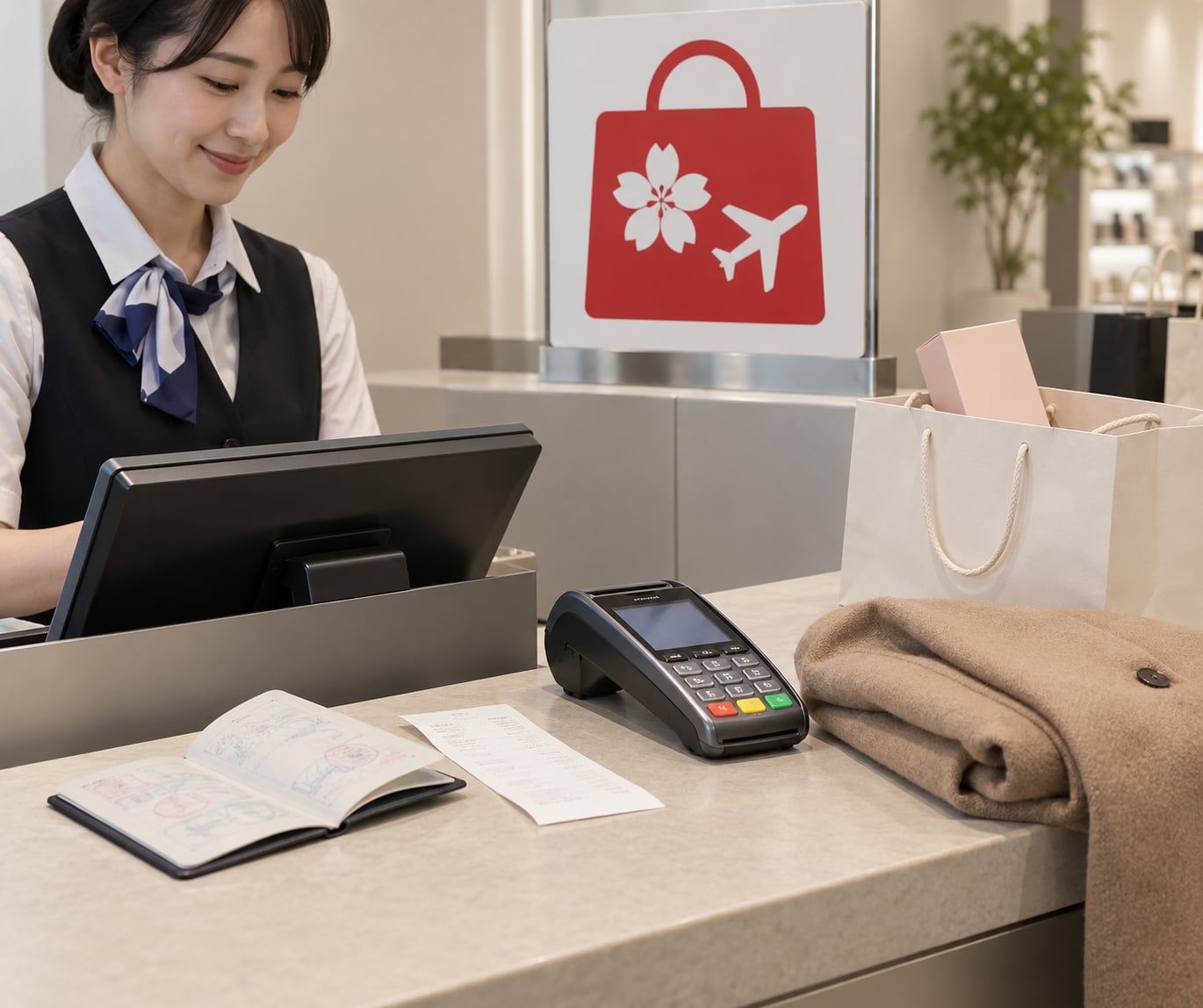
Japanese tax-free shopping is an exemption from the country’s 10% consumption tax, applied by shops licensed by the National Tax Agency. You display the 免税 sign, tell the staff you want tax-free before you pay, and hand over your passport so the purchase is recorded against it.
It is not a cash refund scheme. Under the rules in force through October 31, 2026, nothing is claimed back later in the city and nobody hands you money at the airport counter. The store takes the tax off at the moment of sale, and that record follows you to the departure terminal.
It is also not duty-free. Duty-free means buying in an airport departure zone where customs duties on exports are removed, and you never show a passport at the till. Tax-free happens in ordinary shops in town, on ordinary days, and the whole thing runs on your passport and your export record. Airport duty-free areas are unaffected by every rule below.
| Key rule | What it actually says |
|---|---|
| Who qualifies | Non-residents entering on Temporary Visitor or Diplomat/Official status, including cruise passengers landing under a shore permit |
| How long you must have been in Japan | Less than six months, and you must leave inside your permitted stay |
| Minimum spend | 5,000 yen before tax per person, at one shop, on one day |
| What you present | Your passport, scanned or copied before payment |
| At departure | Goods presented at customs before bag drop, exported within 90 days of purchase |
Who Qualifies as a Tourist?
Tax-free shopping is open to foreign visitors and to Japanese citizens living overseas, but only if you hold Temporary Visitor status or Diplomat/Official status on arrival. Residence permit holders, work visa holders and long-term residents are not eligible, even when they look like obvious shoppers.
Two things decide it: the status printed in your passport on entry, and how long you have been in the country. You must have entered within the past six months, and you must be leaving within the same permitted stay you were granted.
Temporary Visitor status covers ordinary sightseeing, short business trips and most study visits of up to 90 days. Cruise passengers who come ashore under a landing permit usually qualify too, as long as they leave on the same sailing. Japanese citizens whose home address is overseas qualify with proof of residence from the foreign country.
Your passport is the document that matters, not a visa. Most visitors from visa-waiver countries never receive a visa, and that is not a problem for tax-free shopping at all.
One practical warning: if you clear immigration through an automated gate and no landing stamp is printed, ask an officer for a landing permission record. A missing entry record is a routine reason a tax-free counter turns you away, and it is much easier to fix in the airport queue than in a shop on the third floor of a department store.
What Can You Buy Tax-Free?
Two categories decide what happens to your purchase after you pay, and they are treated very differently.
| Category | Examples | Minimum | Cap | Use it in Japan? |
|---|---|---|---|---|
| General goods | Clothing, shoes, bags, watches, jewellery, cameras, consumer electronics, furniture | 5,000 yen before tax per store per day | No upper limit | Yes. Wear it, carry it, use it |
| Consumables | Food, drink, medicine, cosmetics, toothpaste, supplement products | 5,000 yen before tax per store per day | 500,000 yen before tax | No. Sealed and unused until you leave |
General goods and consumables can be processed together in one purchase at the same shop, so a department store counter can put a bag and a box of tea on the same receipt. That combined rule has been in place since the category system was reshaped a few years ago, and most counters handle it without fuss.
Not every retailer participates, and some restrict themselves to certain items. Look for the 免税 or Tax-Free Shop marking in the window or on the till, and expect department store food halls and some convenience stores to decline the request entirely.
Gold and platinum bullion sit outside the system in both categories, and so do services. A repair, a restaurant meal, or food you eat inside the shop is never processed at a tax-free counter.
How to Use Tax-Free Shopping at a Store
How to use tax-free shopping at the counter, step by step
- Find a licensed shop. Look for the 免税 signage outside or the Tax-Free Shop sticker near the register before you pick anything up.
- Check the day’s basket. The 5,000 yen before tax applies per person, per shop, per day, so a large department store can usually handle several purchases in one building but two separate shops on the same street cannot combine.
- Ask for tax-free before you pay and hand over your passport. Staff scan it in a tax-free procedure terminal, or copy the details into a paper purchase record if the store has not gone digital.
- Read the receipt before you leave the counter. Eligible items and their values should be listed separately from anything taxable. Photograph it on the spot if you can.
- Keep every receipt with the goods. These are what the customs terminal and any officer will use to match your purchase to your passport.
- Leave the rules intact until departure. Consumables stay sealed; general goods stay with you.
Department stores often run a dedicated tax-free desk away from the main registers, so check before you queue at a till and then get moved. Bif Camera, the big electronics chains and the major department stores all handle this daily, and the staff at the desk will usually handle a mixed basket better than a general cashier.
Visit Japan Web can hold a tax-free shop QR code, which speeds up the passport scan at participating retailers and airports. It is not a replacement for your passport, and plenty of shops do not support it yet, so treat it as a shortcut rather than a plan.
What Happens to the Price?
When the exemption applies, the register charges the pre-tax price for eligible items. A 1,100 yen shelf price becomes 1,000 yen at the tax-free counter, which is roughly a 9% cut against the price printed on the tag rather than the 10% most guides quote.
The tax-free price is not automatically the best price you can get. Cashback offers from foreign cards, coupon apps and tourist coupons may be applied before the exemption, after it, or not at all, and each retailer decides whether it will stack them. If you are chasing a specific saving, check the store’s terms rather than assuming the exemptions stack.
What changes from November 1, 2026
The mechanics of the system change for purchases made from November 1, 2026. You pay the full tax-inclusive price in the shop, the purchase is recorded electronically against your passport, and you claim the tax back once customs confirms the export at departure.
| Up to October 31, 2026 | From November 1, 2026 | |
|---|---|---|
| At the register | Exemption applied, tax removed | Full tax-inclusive price paid |
| Refund | None, the saving is already applied | Claimed after customs confirmation |
| Consumables | Sealed packaging required | No sealed bag, but ineligible if consumed in Japan |
| Paperwork | Paper or electronic purchase record | Electronic record, less to handle at the counter |
| Timing | Immediate saving | Within 90 days of purchase |
| Departure step | Show goods before bag drop | Show goods, confirm export, then claim the refund |
If your trip crosses that date, the purchase date governs, not your flight date. Anything you buy before November 1 follows the old rules even if you fly home weeks later.
What Are the Spending Limits and Exclusions?
The numbers below are the ones staff check at the terminal, so they are worth knowing before you queue rather than after.
| Limit | Rule |
|---|---|
| Minimum purchase | 5,000 yen before tax per person, in one shop, on one day |
| Consumables cap | 500,000 yen before tax; above that, only part of the basket can be processed tax-free |
| Documentation threshold | At or above 1,000,000 yen, staff record more detail about the goods for customs |
| Time in Japan | Entry within the past six months, departure inside the permitted stay |
| Export window | Goods must leave Japan within 90 days of purchase |
On the exclusions side: services of any kind, restaurant meals and food eaten on the premises, gold and platinum bullion, and anything bought from a shop that does not participate all fall outside the system.
Shipping your purchases home instead of carrying them is the one that catches people. Since April 2025 the shop needs proof of export from the carrier, so ask how that is handled in writing before you buy something you intend to have shipped rather than checked.
Can You Get a Cash Refund or Use Tax-Free Shopping Twice?
Not today. Under the current rules there is no cash refund at the counter, because the exemption was applied when you paid. The refund step arrives with the November 1, 2026 method, where the money goes back to your card (usually one to two weeks), to a bank account (two to four weeks), or through a refund operator’s app. Some counters still pay cash on the spot, but treat that as a bonus rather than the rule.
Using it more than once is fine. You can shop at as many tax-free stores as you like during one trip, clearing the 5,000 yen minimum at each. What does not work is splitting a single basket across two shops and expecting either purchase to qualify on its own.
Each shopper has their own passport record. If you and your partner buy tax-free items together and fly out on different dates, each person’s purchases have to leave with that person. Consolidating everything into one suitcase under one passport is the detail that gets flagged.
If you stay past your permitted stay, the exemption is not valid and the consumption tax becomes payable. The 90-day export window and your landing permission run on the same clock, and the tax-free status expires with them.
Common Mistakes Tourists Make
- Checking the bag before customs. Do the departure tax-free procedure first, then bag drop. Goods buried in checked luggage are the reason travelers get stopped.
- Opening a sealed consumables bag in the hotel. Sealed means sealed until the goods are outside the country.
- Assuming clothes and bags must stay unused. General goods are yours. Wear the coat, use the backpack, carry the camera. That confusion is the single most repeated question in travel forums and it has a simple answer: only consumables are restricted.
- Buying a suitcase tax-free to hold everything else. A tax-free suitcase bought for the trip home often turns up at the airport with a do-not-open sticker already across the lid. Leave it sealed and pack your other tax-free goods where they stay visible.
- Assuming every shop participates. Chain stores, department stores and licensed shops do; many small shops, food counters and hotel boutiques do not.
- Crossing 1,000,000 yen without completing the detailed declaration, which the staff start recording at the terminal.
- Losing the receipts. Photograph each one before you leave the counter and keep them in the same bag as the goods.
- Shopping on day one of a long trip. The export window is 90 days from purchase, so late additions still qualify as long as they leave with you.
At the terminal, scan your passport and read the result. A green result means your record and goods matched. A red result is not a fine and it is not a dead end: go to a customs officer at the counter with your passport, receipts and goods, explain, and they will usually clear it there. Travelers carrying several large shopping bags do get looked at more often, so keeping the receipts in your hand matters more than it sounds.
Frequently Asked Questions
Do I need to buy everything in one store to use Japanese tax-free shopping?
No. The 5,000 yen before tax minimum applies per person, at one shop, on one day, so you can clear it again at the next store. What does not work is splitting a single basket across two neighbouring shops and expecting one half to qualify. A department store with a single tax-free desk is the exception, since several counters in one building usually feed the same purchase record. Keep every receipt from each shop and take them all to customs.
Can I bring my passport every time I shop, or is there a limit?
Bring it as often as you like. There is no cap on how many times a passport is scanned at a tax-free counter and no limit on how many stores you use during a single trip. Two conditions do apply: you must have entered Japan less than six months ago, and you must be leaving inside your permitted stay. Keep the passport with you rather than in a hotel safe, because a counter that cannot scan it will decline the exemption on the spot.
Is tax-free shopping always cheaper than buying with a foreign credit card?
Usually, but not automatically. Tax-free removes the consumption tax at the register, which works out at roughly 9% off the shelf price. Card cashback, coupon apps and tourist discounts may be applied before or after the exemption, and each store decides whether those stack with it. Ask at the counter before you pay rather than assuming. If a card offer conflicts with the tax exemption, check whether the store will honour the better of the two.
What happens if I do not leave Japan before my visa or permitted stay expires?
The exemption stops being valid and the consumption tax becomes payable on the goods you bought under it. You also have to export the goods within 90 days of purchase. That is why tax-free shopping is designed around short visits: the clock runs from your landing permission, not from your shopping day. If your plans change and you are extending your stay through a new visa, check with the store before you buy rather than after.
Can I use Japanese tax-free shopping at convenience stores and department stores?
Department stores can, and most large chains handle it well. Many have a dedicated tax-free desk where staff process a mixed basket of general goods and consumables in one go, which is easier than a general cashier. Convenience stores are mixed: the big chain stores and airport locations often participate, while smaller independent shops usually do not. Look for the 免税 or Tax-Free Shop marking on the door or the register, and ask before you queue.
Do one thing before you leave the hotel: put the tax-free goods in a bag you can open at the departure terminal, keep the receipts on top, and run the customs check before bag drop. Everything else about Japanese tax-free shopping is a ten-minute conversation at a register, as long as you show your passport and buy enough at one shop on one day. Store policies and tax rules do change, so check the shop’s own guidance and the National Tax Agency information when you are there.