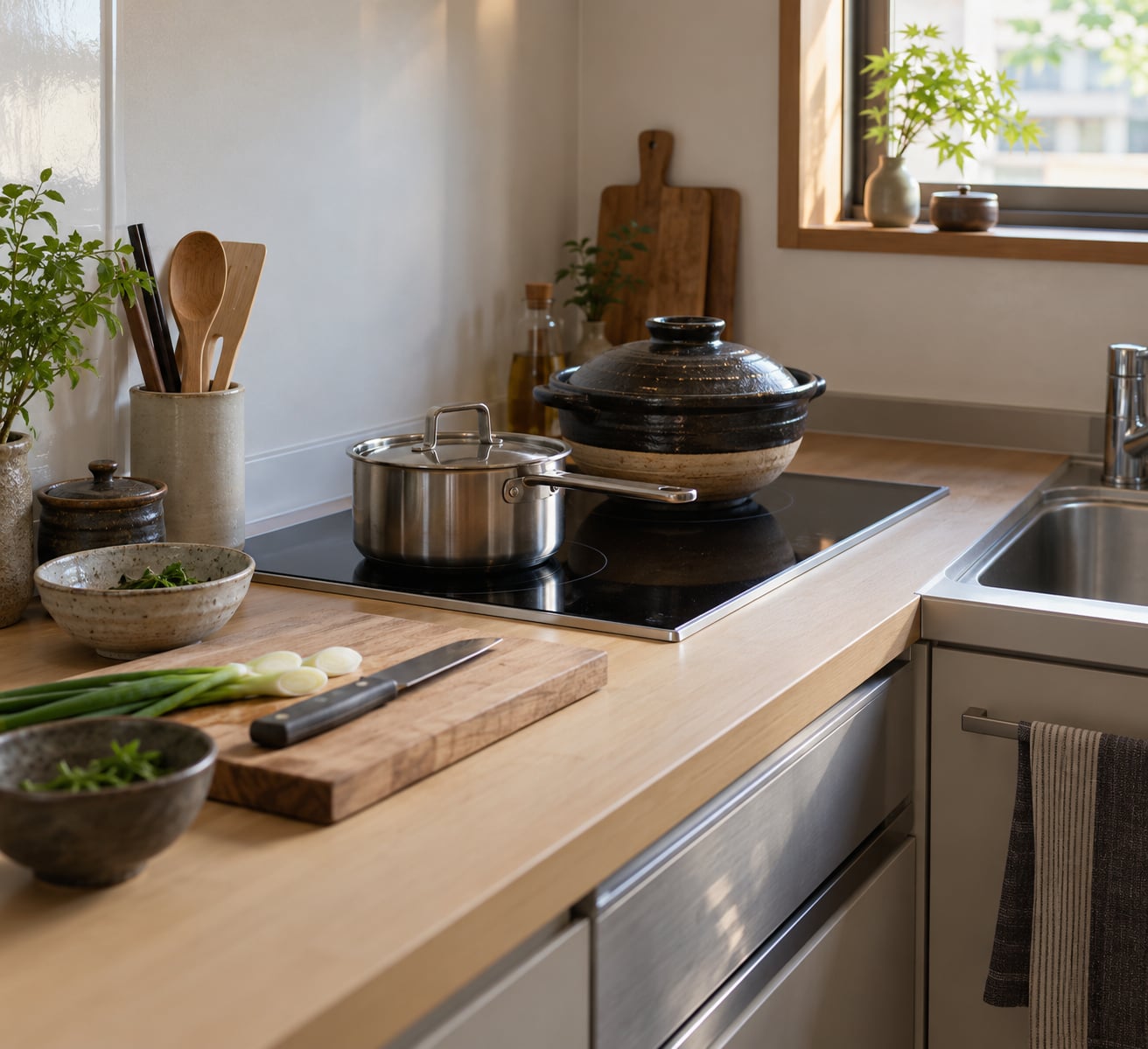
Japanese kitchens use induction cooktops because the cooking itself rarely needs an open flame, while almost everything else about the room rewards a flat, flush, electric surface. Small floor plans, a century of electrification, earthquake-aware safety rules and an appliance industry built around the IH cooking heater (the Japanese term for an induction cooktop) all pushed the same direction. Culture matters, but it is a supporting reason rather than the engine.
The result surprises people who picture Japanese stir-frying. Induction is close to standard in ordinary apartments, rare in many professional kitchens. That split tells you more about homes than about cooking.
Table of Contents
- 1Why Japanese Kitchens Use Induction Cooktops: The Short Answer
- 2How Induction Cooking Differs from Gas and Electric
- 3Compact Kitchens and Built-In Design
- 4How Fast, Precise Heat Control Helps Japanese Home Cooking
- 5Safety Without Open Flames
- 6Why Japanese Kitchens Use Induction Cooktops
- 7The 5 Main Reasons for Induction Adoption in Japan
- 8Cleaning fits how kitchens are actually used
- 9Electricity was the dependable fuel
- 10Restaurants went the other way
- 11What Still Holds Back Wider Adoption?
- 12Which Induction Features Are Most Useful in a Japanese Kitchen?
- 13Frequently Asked Questions
- 14Do Japanese households prefer induction over gas?
- 15Can induction cooktops be used with any frying pan?
- 16Are induction cooktops common in Japanese apartments?
- 17Does induction cooking require a special electrical circuit?
- 18Why do some Japanese cooks still prefer gas hobs?
- 19Conclusion
Why Japanese Kitchens Use Induction Cooktops: The Short Answer
Japanese kitchens standardised on induction for practical reasons, not aesthetic ones. Compact floor plans made a flush flat cooktop the only way to gain usable counter space, electrification made electricity the dependable fuel, earthquake and fire safety concerns pushed homes away from open gas flame, and flat glass is trivial to wipe clean. A mature domestic appliance industry then supplied IH cooking heaters tuned to those exact constraints.
Japanese everyday cooking reinforces the choice. Rice, simmered dishes, fish, soups, nabe and quick weeknight stir-fries all respond well to precise, immediate heat that a flat surface can deliver.
Cooks who want open flame still seek it out, and restaurant kitchens keep gas for good reasons. But in the home, the practical fit won.
How Induction Cooking Differs from Gas and Electric
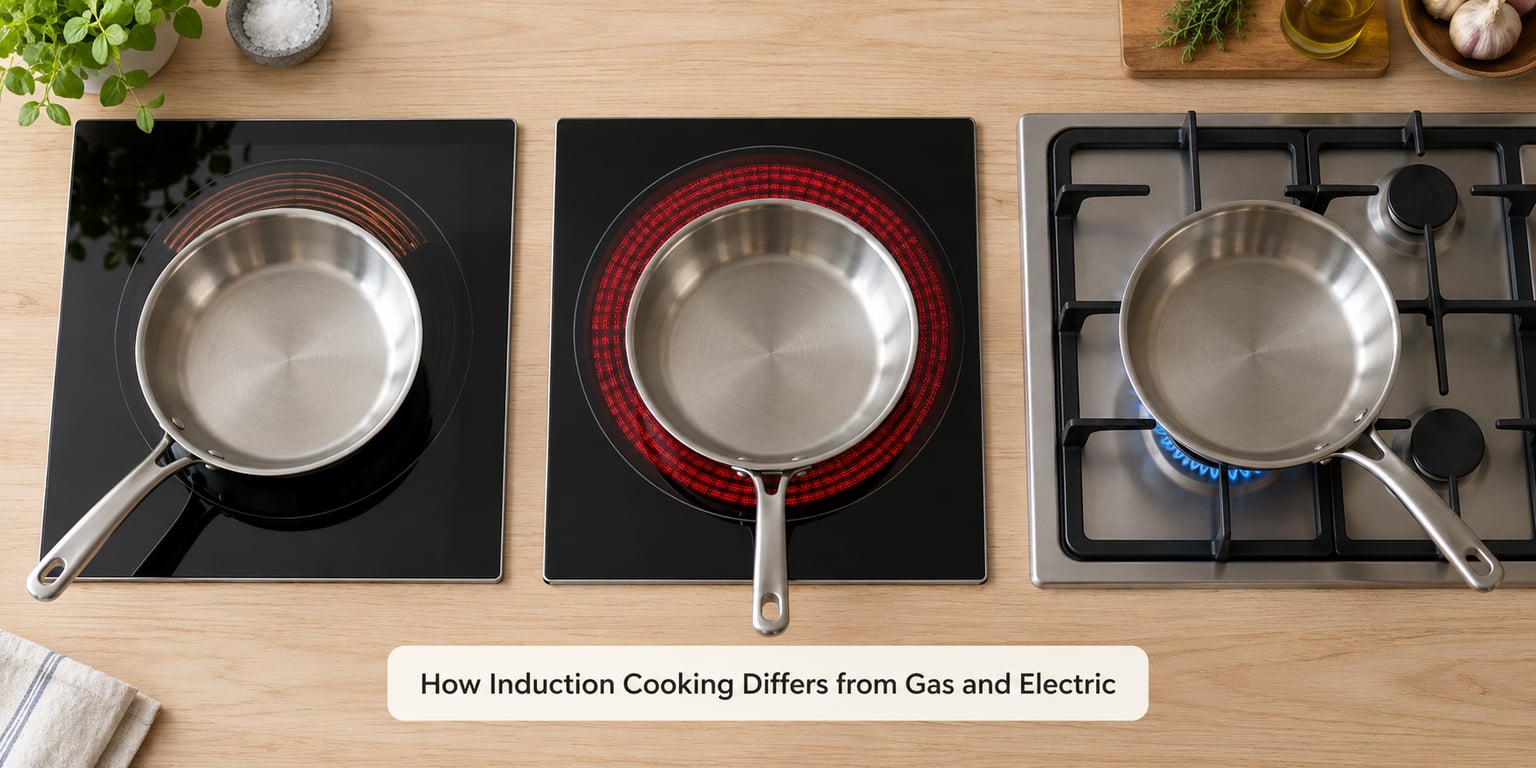
Induction heats the pan itself. A coil under the glass generates a magnetic field, and the field induces current in the pan’s base, which then heats by resistance. Almost nothing goes into warming the air above the hob.
Radiant electric hobs work in two stages. A coil below the glass heats the glass, the glass heats the pan, and the pan heats the food. Gas heats a flame, which heats a pan, which heats the food, with a portion of the energy lost to the room around it.
| How it cooks | Induction | Radiant electric | Gas |
|---|---|---|---|
| Heat path | Magnetic field heats the pan base directly | Coil heats glass, glass heats pan | Flame heats the base of the pan |
| Approximate efficiency | Around 85 to 90 percent | Around 70 to 75 percent | Around 30 to 40 percent |
| Response to a power change | Almost immediate | Slow, glass must reheat | Immediate |
| Low simmer control | Very fine, repeatable | Coarse, wide bands | Open flame flame-size control |
| Cookware requirement | Ferromagnetic base only | Nearly anything flat-bottomed | Nearly anything |
| Surface after cooking | Cool where nothing touched it | Hot across the whole zone | Warm above the burner |
| Cleaning | Wipe with a damp cloth | Wipe, but crumbs catch | Burner parts need dismantling |
| Heat pushed into the room | Low | Moderate | Highest |
Efficiency figures are approximate and vary by model and installation, but the ranking is stable across independent measurements: induction transfers more of your electricity into food than any other domestic cooking method, and considerably more than gas.
Compact Kitchens and Built-In Design
A standard Japanese apartment kitchen is short. The cooking zone is a run of cabinetry a couple of metres wide, and the sink, hob and drying space share it. On a standard plan the hob occupies roughly the footprint of a large stockpot.
A gas hob with grates, trivets and a raised lip needs clear space above it for pans that do not sit flat. An induction unit drops into the worktop and leaves the surface itself usable, because you can put a board, a bowl or a chopping board down on it. That single change recovers counter area that a grate hob eats.
Japanese kitchens also treat ventilation, lighting and storage as one system. A slim built-in hob, a compact range hood and an integrated lighting strip are specified together, which is why induction units in Japan tend to be narrow and shallow. Manufacturers build around the cabinetry rather than asking the room to grow.
Not every Japanese kitchen is small, and plenty still run gas. The point is that where space is tight, a flush flat surface wins on layout alone, before any cooking argument starts.
How Fast, Precise Heat Control Helps Japanese Home Cooking
Most Japanese home cooking is temperature-sensitive rather than fire-driven. Rice needs a controlled boil and a long tail of gentle heat. Simmered dishes such as nimono and oden depend on holding a temperature for a long stretch without boiling over. Nabe is kept just below a rolling boil at the table.
Induction suits that pattern. When you lower the power, the pan cools quickly and holds; when you raise it, heat arrives fast. Gas does this well too, but a flame’s small burner delivers a narrow power range, while an induction zone covers the whole spectrum from low simmer to full boil on the same ring.
Fish and eggs benefit from the same control, because you can hold a gentle temperature for a fry or a slow pan-cook rather than chasing a flame that overshoots. The glass also wipes clean in seconds after a splash, which matters in a room where the hob is one of the few uncluttered surfaces.
The honest limit is wok technique. A round-bottomed iron wok sits on a ring of flame, not on glass, so the smoke-char style that depends on a wok held in the flame is not something a home induction hob reproduces. Japanese home cooks mostly stir-fry in a flat pan anyway, so the loss is smaller in practice than the forum debate suggests.
Safety Without Open Flames
A flat induction surface has no flame, no glowing element and no exposed burner, which removes several everyday hazards at once. There is no gas line to leak and no ignition to fail, and in an earthquake a sealed electric hob presents less risk than an open flame in a small room.
Modern units add detection and cut-outs. Pan detection switches a zone off when no compatible cookware sits on it, and most models stop heating if a pan is lifted off. Overheat protection, residual heat indicators, child locks and automatic shut-off timers are standard on current Japanese domestic models, which matters in households with small children around.
Two cautions. First, a flat surface invites a hot pan to be set down on glass that feels cool, so use a trivet and read the residual heat indicator. Second, induction puts less heat and fewer combustion products into the room, but it does not remove the need for ventilation, because cooking still produces steam, oil vapour and humidity.
For installation, follow the appliance manual and have any fixed wiring or new circuit handled by a licensed electrician. Gas work needs a qualified installer too, which is part of why replacing a hob in a rented Japanese apartment is often less simple than the appliances themselves suggest.
Why Japanese Kitchens Use Induction Cooktops
Pulling the strands together, the reasons fall into five groups. Each one alone would be arguable; together they explain why the default appliance in a Japanese home is electric.
The 5 Main Reasons for Induction Adoption in Japan
1. Counter space. A flush glass top on a narrow worktop returns usable surface in a room measured in square metres of cabinet run.
2. Precise, immediate heat. Simmer control, fast response and repeatability suit rice, simmered dishes, soup and fish more than a big flame does.
3. Safety without an open flame. No gas line, no ignition point, no burner to knock over, plus detection, auto shut-off and child locks.
4. Energy and electrification. A country wired for electricity after the war, using a method that sends far more of that electricity into the pan.
5. A domestic appliance ecosystem. Panasonic, National, Hitachi, Toshiba, Sharp and Mitsubishi Electric all build for this market, so slim, quiet, deeply integrated IH units are ordinary rather than exotic.
Cleaning fits how kitchens are actually used
Flat glass removes the crevices, drip pans and burner rings that trap grease. A wipe with a damp cloth is the whole routine, which suits a room kept tidy out of the mottainai habit of avoiding waste and unnecessary effort. Spilled sugar still needs a scraper, but the difference from a gas hob is large.
Electricity was the dependable fuel
Japan’s shift from charcoal to town gas to electricity ran through the twentieth century, with rebuilding after the war accelerating it. Once a home has reliable power, an all-electric kitchen is simpler to supply and needs no fuel delivery or combustion venting.
Restaurants went the other way
Professional kitchens in Japan kept gas, and high-end counter dining still depends on flame. Open fire, char and wok work need gas, so the split between home induction and commercial gas is a deliberate division rather than a contradiction.
What Still Holds Back Wider Adoption?
Cookware is the real constraint. Only pans with a magnetic base work, which rules out aluminium, copper and plain stainless steel unless bonded to a ferrous layer. Round-bottomed woks and some traditional iron pots are left behind, and a house that cooks with those daily will feel the loss.
Second is familiarity. Gas has been the default in Japanese kitchens for decades, and flame has a reputation for high-heat searing that induction still has to answer. That perception is often overstated, since boost modes reach searing temperatures quickly, but perception drives purchases.
Third is the building. Older apartments may need a circuit and outlet checked before a hob goes in, and replacing gas with electric in a rental can involve the landlord. Upfront cost and the worry that an induction board is expensive to repair both come up, even though Japanese households tend to plan on a long appliance life rather than a quick swap.
Finally, not every household cooks the same way. The case for induction is strongest where kitchens are small, cooking is mostly simmering and boiling, and the people cooking want less heat in the room. Test a model with your own pans before committing.
Which Induction Features Are Most Useful in a Japanese Kitchen?
Before choosing anything, measure the space. Confirm the hob width and depth against the cabinet opening, the depth of the worktop for the glass, and the clearance the manufacturer requires around the unit.
- Hob width. Slim units built for a 45 cm cabinet run are the common Japanese format and suit a galley layout.
- Pan detection. Worth having in a kitchen where a child or a distracted adult may reach the surface.
- Power boost. Short high-power bursts matter if you sear fish or stir-fry at speed.
- Fine simmer control. Many power steps below the boil are what make nimono and rice work well.
- Timer and keep-warm. Useful for long simmered dishes and for holding broth at the table.
- Child lock and auto shut-off. Standard on current models, and cheap reassurance.
- Ventilation. Plan the range hood with the hob, not after it. Induction reduces kitchen heat but not moisture or oil vapour.
- Surface care. Confirm the glass is easy to wipe and check what the manufacturer says about scratch resistance.
- Cookware audit. Test the pans you already own with a magnet before you install anything.
Frequently Asked Questions
Do Japanese households prefer induction over gas?
In ordinary apartments, yes, induction became the default option in many markets while gas remains common in some regions and in larger homes. The preference is mostly practical rather than emotional: flat surfaces recover counter space, there is no flame or gas line, and cooking suits rice, simmered dishes and soups. Households that sear heavily or use round-bottomed woks are the ones that tend to keep gas.
Can induction cooktops be used with any frying pan?
No. An induction hob only heats a pan with a magnetic base, so cast iron, magnetic stainless steel and bonded aluminium or stainless pans work. Plain aluminium, copper and non-magnetic stainless steel do not. A quick test is to hold a magnet to the base of the pan: if it sticks firmly, the hob will heat it. Round-bottomed woks and traditional iron pots often fail this test.
Are induction cooktops common in Japanese apartments?
They are among the most common cooking appliances in Japanese apartments, especially in compact units where the cooking run is short. Slim IH cooking heaters built for narrow cabinet openings are widely sold, and many new fit-outs include one by default. Gas is still found in plenty of homes, and commercial kitchens usually keep it, so adoption is high rather than universal.
Does induction cooking require a special electrical circuit?
It depends entirely on the hob and the wiring already in the property. A single-zone unit with modest power may run from a standard outlet, while a multi-zone model with boost needs a dedicated circuit and a properly sized breaker. In an older apartment the supply should be checked before installation, and any fixed wiring work belongs with a licensed electrician.
Why do some Japanese cooks still prefer gas hobs?
Gas gives visible flame control that experienced cooks trust for searing, charring and wok work, and it accepts any pan shape, including round-bottomed woks. It also feels familiar after decades of use, and a flame is a visible cue that heat is on. Induction wins on precision, cleanability and safety, but it cannot reproduce open-flame technique, which is why gas persists in homes and commercial kitchens alike.
Conclusion
The honest answer to why Japanese kitchens use induction cooktops is fit, not folklore. Compact floor plans reward a flush surface, electricity was the dependable fuel, safety rules moved homes away from open flame, and a mature appliance industry built slim units for exactly that cabinet run.
Before you follow the same path, check your available space, test your existing pans with a magnet, plan the ventilation, confirm what your electrical supply can carry, and be honest about whether your cooking needs open flame. If it does not, most people come back afterwards wondering why they waited.