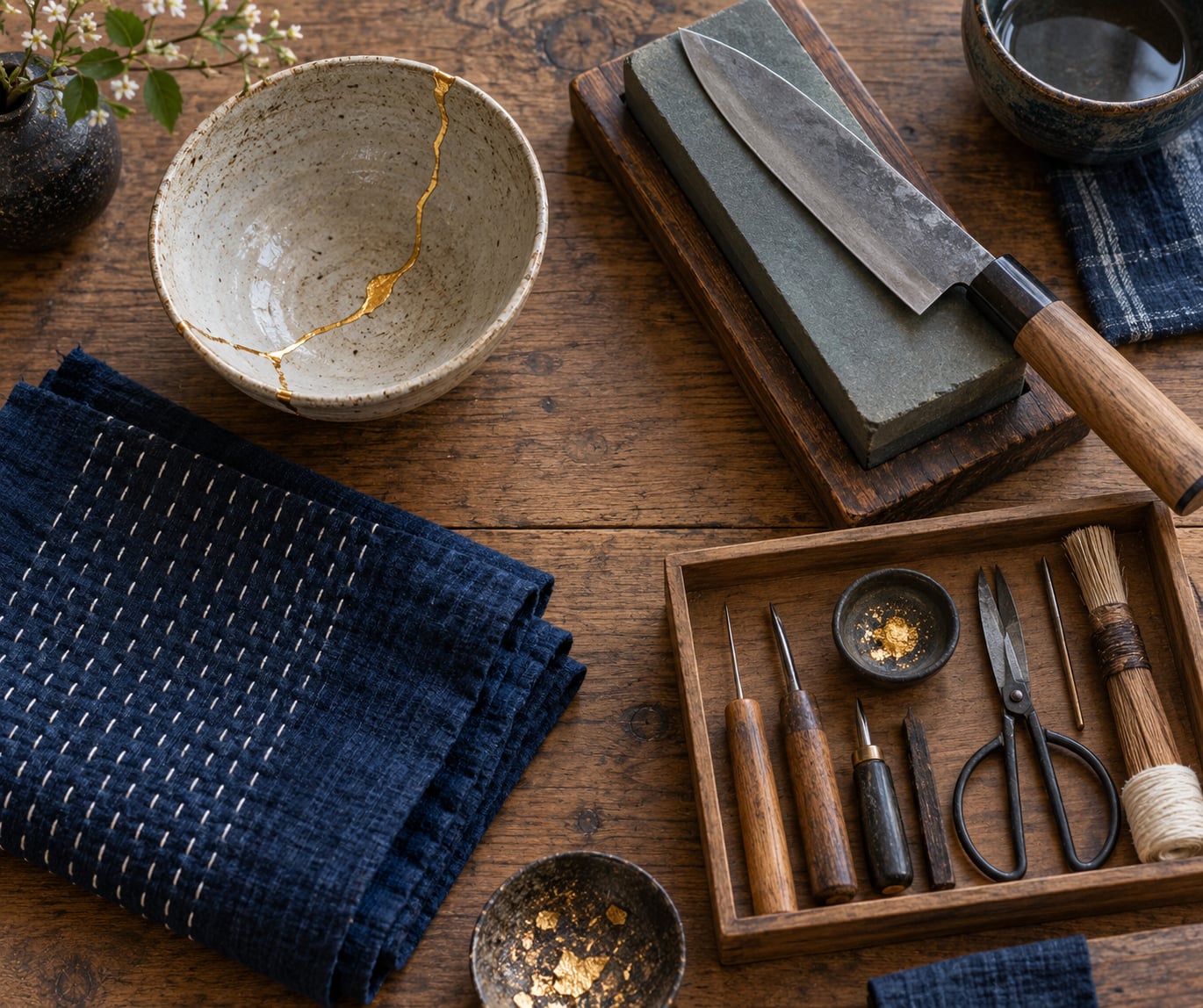
Japanese repair culture is the shared set of traditions, from gold-lacquered kintsugi and stitched sashiko to knife sharpening and the twenty-year rebuild of Ise Grand Shrine, built on one belief: an object’s history of damage is part of its value rather than a defect to hide. Repair is usually visible, the mend becomes part of the object, and the skills sit inside ordinary neighbourhood shops rather than museums. So how Japanese repair culture works is really a question about who does the work, with what materials, and why the seam is left in plain sight.
I have shopped for used Japanese appliances and spent enough time in Tokyo backstreets to know that the repair economy is less romantic than the craft websites suggest. A great deal of it is just competent trade work: a knife re-edged on a stone, a bicycle wheel trued, a toaster re-wired. The gold-lacquer tradition sits on one end of that spectrum. Both ends matter if you want to understand the thing properly, and both are worth planning for if you plan to buy something secondhand or travel with a broken item.
Here is what follows: what the culture actually is, why it exists, how it differs by product category, what happens at the counter, and how to find someone who can do the job.
Table of Contents
- 1What Is Japanese Repair Culture?
- 2Five repair traditions at a glance
- 3Why Do Japanese Consumers Repair Instead of Replacing?
- 4Where the argument does not hold
- 5How Japanese Repair Culture Works in Different Product Categories
- 6Ceramics and kintsugi
- 7Textiles: sashiko and boro
- 8Everyday trades
- 9Architecture and shrine rebuilding
- 10Where the picture is weakest: consumer electronics
- 11What Happens at a Japanese Repair Shop?
- 12How to Find a Good Repair Service in Japan
- 13Repair, Refurbish, and Replace: Where the Boundaries Are
- 14What Readers Should Know Before Visiting a Repair Shop
- 15Frequently Asked Questions
- 16What is the Japanese philosophy of repair called?
- 17What is the Japanese concept of mottainai?
- 18Can you do kintsugi yourself?
- 19What are the disadvantages of kintsugi?
- 20What is the Japanese trick for restoring cracks with gold?
- 21Can a visitor commission kintsugi or other repair work in Japan?
- 22What to Take From This
What Is Japanese Repair Culture?
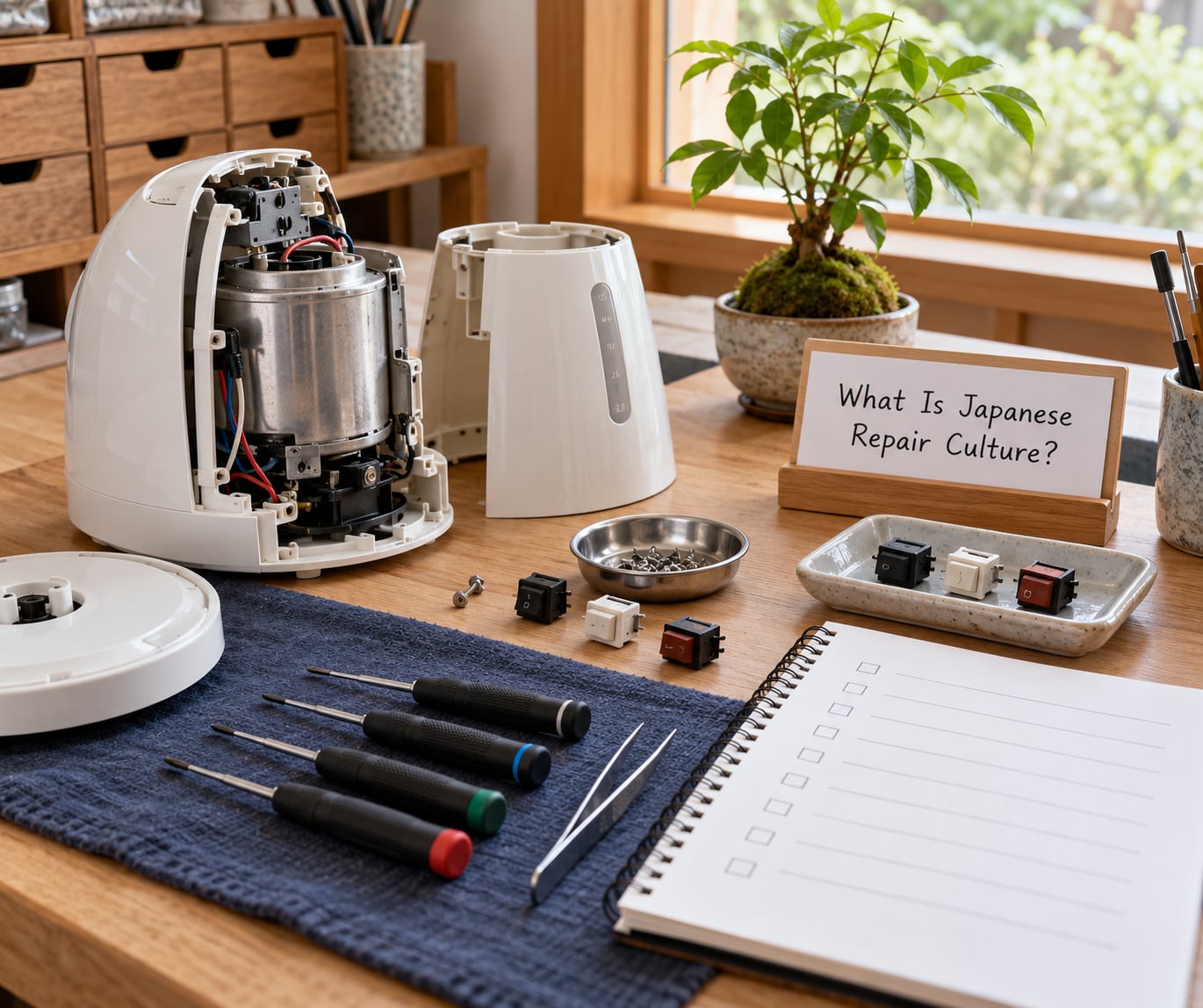
Japanese repair culture is the practice of extending the working life of everyday objects through skilled maintenance rather than replacement, and treating the marks that repair leaves as a feature of the item. It is not one craft but a cluster of them, held together by a shared logic about value and waste.
Three ideas sit underneath it, and each is worth defining on its own.
- Mottainai (もったいない) — literally “what a waste”. A reluctance to discard anything still usable, extended from food to objects to time. It is the ethical root of the culture.
- Wabi-sabi (侘寂) — finding beauty in impermanence, incompleteness and wear. Popular lists of “seven principles of wabi-sabi” are a modern Western framing; the idea itself is older and looser.
- Mushin (無心) — “no mind”, working without clinging to how the object was before it broke. In a repair shop it means meeting the damage as it actually is.
There is a language point that explains more than the philosophy does. Kintsugi (金継ぎ) breaks into kin, gold, and tsugi, to join — “golden joining”. The older term kintsukuroi uses tsukuroi, to mend or patch. Compare Latin reparare, which carries the idea of restoring and concealing. Japanese repair announces itself.
Five repair traditions at a glance
| Tradition | What it covers | Core material | Who does it | Still practised |
|---|---|---|---|---|
| Kintsugi | Cracked or chipped ceramics | Urushi lacquer, gold powder | Specialist artisans | Yes, plus hobby kits |
| Sashiko and boro | Worn or torn textiles | Cotton thread, patchwork cloth | Households, textile artists | Yes, in workshops and studios |
| Neighbourhood trades | Knives, shoes, umbrellas, watches, bicycles | Steel, leather, spare parts | Local craftsmen | Strongly, in most cities |
| Room maintenance | Tatami mats, shoji screens, sliding doors | Rush, washi paper, timber | Specialist contractors | Yes |
| Shikinen Sengu (式年造替) | Shrine architecture | Timber, cypress bark, tile | Craftspeople and shrine priests | Ongoing at Ise |
Why Do Japanese Consumers Repair Instead of Replacing?
The economic argument is the least interesting but the most reliable one. A skilled local trade is often cheaper than a new object of the same quality, and it is usually available on the same street. A blade re-sharpened can outlive several replacement versions of itself. Replacing a working kettle to fix a loose handle is wasteful in the most literal sense.
Durability does a lot of the work here. Japanese electronics and kitchen goods are frequently built to serviceable standards, with parts and manuals that outlast the product’s sales life. Manufacturers and repair shops coexist because the manufacturer knows the item will come back for a fifth or sixth owner.
Then there is skill density. In an older Tokyo neighbourhood you can walk past a knife sharpener, a shoe repairer, an umbrella fixer, a watchmaker and a bicycle shop within a few hundred metres. That clustering matters. When expertise is nearby, repairing is convenient; when you have to travel an hour and negotiate a specialist, most people quietly buy a new one.
Environment is usually listed next, and it is real but often overstated. Repair extends a product’s life, which avoids manufacturing emissions. But genuine kintsugi in urushi lacquer is a scarce, slow, skilled service — the sustainability case is strongest for the humble trades, not the gilded bowls.
Cultural value sits underneath. An object with a documented history carries information a replacement cannot. That is why people mend the family futon cover rather than buy a new duvet cover, why a chipped teacup gets repaired rather than retired, and why repair shows up as a metaphor for recovery in places ranging from design schools to therapy practices.
Where the argument does not hold
It is worth saying plainly that most broken dishes in Japan are replaced. Cheap mass-produced tableware is not kintsugied, and nobody claims it is. Kintsugi is a craft with a waiting list, not daily household maintenance, and the number of items in an average Japanese kitchen that would ever be sent to a lacquer artisan is tiny.
Nor is the anti-waste instinct exclusive to Japan. European furniture restorers, Swiss watchmakers and the international repair café movement run on similar logic, and Japan’s own repair habits were partly built by imported techniques and post-war scarcity. Treating the country as uniquely virtuous about waste is a comfortable story, but not an accurate one.
How Japanese Repair Culture Works in Different Product Categories
Ceramics and kintsugi
Kintsugi is the best-known form and the worst-understood. Three methods cover almost everything in practice. Hibi repairs a clean crack: join the pieces with lacquer, cure, sand back, lacquer again, then finish with gold. Kake no kintsugi handles chips where a fragment is missing, filling the gap with lacquer plus a shaped stand-in so the form returns. Yobitsugi is the joint call, used when several pieces meet rather than one simple break.
The material is the hard part. Authentic work uses mugi urushi, lacquer tapped from the Toxicodendron vernicifluum tree, cured for days in a humidity-controlled cabinet called a muro, then dusted with hon-kinpun, finely powdered gold. Raw urushi contains urushiol, a severe contact allergen, so craft work is done gloved and cured slowly. Every layer adds waiting.
The history is also routinely misreported. The popular tale says the shogun Ashikaga Yoshimasa sent a favourite bowl to China, received it back split with gold-seam cracks, and admired the repair so much he had his own bowls broken to match. The bowl in question, Bakōhan, is held by the Tokyo National Museum, and its seams are kasugai — stitched-together staples — not gold lacquer. Late Muromachi collectors did sometimes damage pieces to elicit a flashy repair, but the shogun story is folklore.
What did happen is a slow shift. Early repairs used plain lacquer with no gold; the shinier style emerged over time, and the art form cohered during the Edo period around figures like Hon’ami Kōetsu. The tea ceremony drove the demand. Murata Jukō’s wabi-cha aesthetic and Sen no Rikyū’s preference for plain, repaired vessels made a visible mend acceptable where a flawless bowl had been the only respectable option.
Textiles: sashiko and boro
Sashiko (刺し子) is visible stitching — usually a running stitch in white cotton on indigo — used to reinforce worn workwear. Boro (襤褸) is the layered result: patched fabric built from scraps until it is stronger and warmer than the original. It began as rural necessity, where every scrap was reused and decoration came free from what was already there. Today it appears in museum collections and high-end interior goods, and the prices have followed.
Where Japan and much of Europe parted company is visibility. A Western invisible mending — darning so fine it reads as woven fabric — treats the repair as a secret. Sashiko advertises itself. The stitch pattern records where the cloth failed and how many times somebody cared enough to intervene.
Everyday trades
This is the part most English-language coverage skips, and it is the part that proves the culture is real infrastructure rather than aesthetic performance.
- Knives are sharpened, not swapped. Stones, water, an angle learned by hand; a commercial kitchen blade can be re-edged many times over.
- Shoes and umbrellas get heels replaced, seams restitched, frames swapped. Leather repair shops still outnumber retailers in most cities.
- Watches and clocks go to specialists who service movements rather than discard a case that still runs.
- Bicycles get full maintenance in small shops, with parts kept in stock for models that left production decades ago.
- Tatami and shoji are maintained by dedicated trades. Rush mats are re-woven or re-covered; shoji panels are stripped and re-papered with washi.
Architecture and shrine rebuilding
Shikinen Sengu (式年造替) is the formal rebuilding of Ise Grand Shrine roughly every twenty years. The old buildings come down, the craft knowledge is transferred to a younger generation who rebuild them using techniques and materials that no longer work well, and the shrines stay standing. Seen one way it is an environmental disaster. Seen the intended way it is preservation: the ritual guarantees the buildings, the skills and the transmission never lapse.
Where the picture is weakest: consumer electronics
Modern phones, laptops and headphones are the poor relation in this story, and honest coverage has to say so. Sealed batteries, glued assemblies, parts pairing and software locks make repair difficult, expensive or impossible. Manufacturers in the sector are under sustained criticism for it, and Japanese consumers are not more patient about it than anyone else.
So the contrast is sharp: a domestic appliance with a replaceable heating element can be fixed in a neighbourhood shop, while a three-year-old device may have no practical repair path at all. Japanese repair culture has real weaknesses, and consumer electronics is where they show.
What Happens at a Japanese Repair Shop?
The process is orderly and slower than an Anglo-American repair counter. Bring the item in or send photos first, and expect to be asked for the serial number and model code before anyone touches it. For a fault that is hard to describe, a written account on the spot saves a return trip.
You will usually get a repair estimate rather than a diagnosis, and often both. The counter staff may hand you a printed estimate sheet, note what you have described, and quote a range with a turnaround estimate. Some shops will show you the estimate before you commit; others quote after opening the item. Ask which it is.
Work is approved, then the wait begins. Common jobs — a knife edge, a resoled shoe, a bicycle wheel — can be same-day or a few days. Anything involving lacquer, a rare part or an imported component can run for weeks, and a shrine-grade refurbishment can run for months. Part delays are normal and rarely the shop’s fault.
On collection you get an explanation of what was done, sometimes the old parts back in a bag, and a payment. Ask what happens if the fault comes back within a short period; many shops cover a repeat issue on the same fault for weeks without argument, though terms are informal and vary. Get the receipt with the model number and the work described, because it is your proof if the same fault reappears.
How to Find a Good Repair Service in Japan
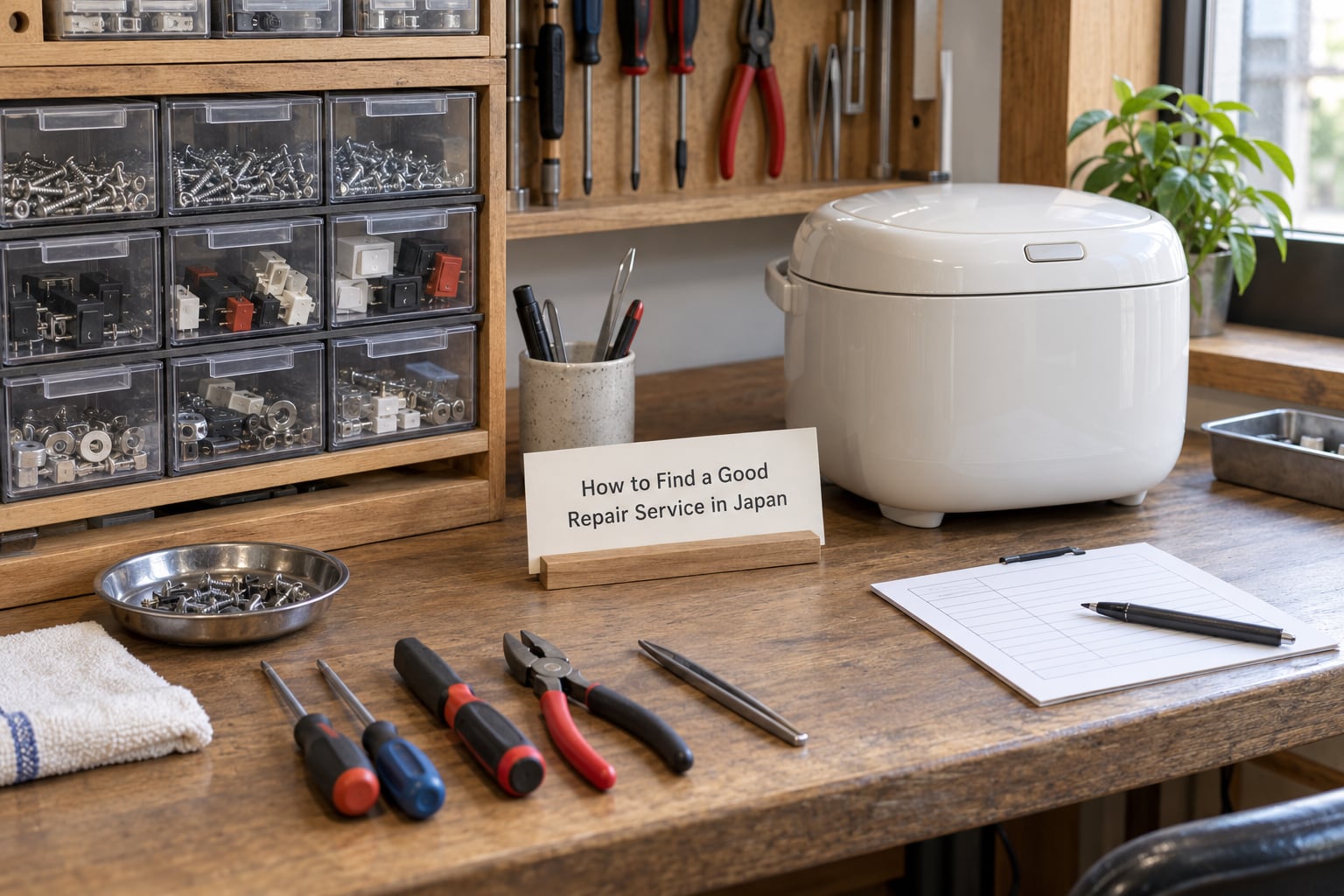
Search in Japanese, because the results are better. Useful terms include shūri for repair generally, shūri-ya or shūri kōten for a repair shop, shūri ryōkin for repair charges, kintsugi tsukuri for kintsugi work, and kaitai for dismantling an item you no longer want.
Check that the shop actually handles your category before you carry anything over. Some will look at an item and decline; that costs you nothing and saves a wasted visit.
Signs of a reliable specialist: an organised back area with parts organised by type, a willingness to explain what failed and why, a written estimate before work starts, and a straightforward answer when you ask about turnaround. Unhelpful signs: no estimate offered, pressure to decide on the spot, no receipt, and a shop that cannot say whether the part exists.
For parts availability, ask directly. A model that stopped being made years ago may have a common failure part in stock, or may not. Shops that service older equipment will usually know within a minute; shops that do not will tell you rather than find out later.
For visitors, language is the practical hurdle. A phone translation app gets you through a description and an estimate. Some shops in tourist districts handle basic English, and in larger cities you can often find a repair counter that does. Expect paperwork in Japanese, and photograph every estimate and receipt.
Repair, Refurbish, and Replace: Where the Boundaries Are
Four things get confused, and separating them makes the decision easier.
Repair returns a faulty item to working order with the original materials and identity intact. Replacing a failed heating element in a kettle is repair. Gilding a cracked bowl is repair in craft form.
Refurbish goes further than the fault requires, often to a standard the item never had. A serviced, re-cased, re-calibrated watch is refurbished, not repaired. This is a good option for a device that works but has been neglected, and a poor use of money for one with a dead battery.
Modification changes what the item is. Upgrading storage, changing a circuit, adding a different component. Legitimate and common, but it ends the warranty, changes the resale conversation, and can push something outside safety limits.
Replacement makes sense when the fault is structural, the part no longer exists, the labour approaches the cost of a new item, or when no technician for that product remains. A ten-year-old device with a paired, glued battery is often the honest case.
Sentiment changes the maths. If a bowl has no resale value and a story, paying a specialist is a decision about the story, not the object. That is a perfectly good reason, as long as you know that is the reason.
What Readers Should Know Before Visiting a Repair Shop
Bring every accessory. A charger, a case, a remote or a belt clip can identify the model faster than the serial plate.
Write down the model number and where you found the fault. Half of repair disputes are really communication failures.
Remove your data first on anything with storage. Wipe it yourself, remove the account from the device, and record the factory-reset step. A shop is not obliged to erase your files.
Expect parts delays, not shop delays. Two weeks for a part is common and unremarkable; you will rarely be told which stage the job has reached, so ask before the wait stretches.
Handle urushi safely if you are near the raw material. Urushiol causes severe allergic dermatitis, and reactions can appear days later and run for weeks. Never sand or handle uncured lacquer with bare skin.
Set realistic expectations for older goods. Grey-market components exist for many appliances but are not always equivalent to the original, and safety-critical parts deserve care. Ask what the shop knows about the specific model’s history.
Ask for the estimate in writing, in yen, with what is and is not included. Dismantling and transport are sometimes charged separately.
Language and paperwork. Most forms are in Japanese. Photographs of the estimate and receipt remove most of the difficulty of a later warranty conversation.
Frequently Asked Questions
What is the Japanese philosophy of repair called?
There is no single official name. The phrase most people want is mottainai, meaning a reluctance to waste what is still useful. Kintsugi is the best-known craft, joining broken pottery with lacquer and gold powder, and wabi-sabi describes the aesthetic that makes an imperfect, mended object more appealing than a new one. People also use mushin, the idea of meeting damage without clinging to how the object was before.
What is the Japanese concept of mottainai?
Mottainai, written もったいない, literally means what a waste. It began as an idea about food and thrift and later attached itself to time, energy and objects. In repair culture it means a broken item is not finished being useful simply because it is damaged. Critics point out that it is an everyday social pressure as much as an environmental one, and that Japanese households throw away a great deal.
Can you do kintsugi yourself?
Yes, and most first attempts use two-part epoxy with gold pigment from a craft supplier rather than traditional lacquer. It cures in minutes and costs little, and it is a real, repeatable entry point that many people find genuinely satisfying. It is not the same thing as urushi kintsugi, which cures for days in a humidity cabinet. For a valuable piece, take it to a specialist instead of practising on it.
What are the disadvantages of kintsugi?
Specialist work is expensive relative to the value of an ordinary bowl, and genuine urushi work can take weeks of curing between layers. Raw lacquer contains urushiol, which causes severe allergic dermatitis that can appear days later. Repair changes value for collectors, and the craft is hard to find outside Japan. Most broken tableware is simply replaced, so treating kintsugi as a general consumer practice is a myth.
What is the Japanese trick for restoring cracks with gold?
Bind the pieces with lacquer, cure the layer in a humidity-controlled cabinet, sand it back, apply another lacquer coat, cure again, then finish with finely powdered gold so the seam stands out. Simple cracks use one technique; missing fragments are filled with lacquer and a shaped stand-in; several meeting pieces need a joint called yobitsugi. The gold is not cosmetic paint, it is the visible record of the join.
Can a visitor commission kintsugi or other repair work in Japan?
You can, and it is worth arranging before you travel. Most artisans work from a workshop and expect a conversation rather than a walk-in. Bring the piece in a padded box with its model or maker details, and have your route planned around a possible multi-week wait. Photograph the finished piece for shipping back. Search in Japanese with kintsugi tsukuri, or ask a local shop to refer you.
What to Take From This
Start with the trades, not the gold. If you have a knife that has gone dull, a shoe that has separated or a bicycle that needs a wheel trued, find the specialist on your street and have the thing serviced this month.
Save the ornate route for objects with real value in a second sense — a piece with a story, a bowl worth gilding, something you would keep if it were not broken. That is the case where commissioning a craftsman, and waiting weeks for the work, is genuinely the right call.