The gap comes down to four compounding factors: Japan puts a 10% consumption tax directly on the shelf price, its retail sector has spent decades in a low-price competition, the yen moves constantly against the dollar, and the two countries simply do not sell the same products. Some categories land much cheaper in Japan, others are priced higher there.
That answer tends to surprise people who grew up with the idea of Japan as the place where everything electronic was half price. That reputation came from a specific era, and it no longer holds across the board. Here is how the pricing actually works, where the gap is real, and how to check it yourself before you buy anything.
Table of Contents
- 1What Is the Short Answer?
- 2Why Japanese Gadget Prices Differ from US Prices
- 3Do Japan and the US Show Prices Before or After Tax?
- 4Which Factors Cause the Biggest Price Differences?
- 5How Do Product Models and Features Affect the Comparison?
- 6Why Can Some Gadgets Cost Less in Japan?
- 7Why Can Some Gadgets Cost More in Japan?
- 8Does Japan’s Reputation for Cheap Electronics Still Apply?
- 9How Exchange Rates and Release Timing Change the Math
- 10What Extra Costs Appear When Buying in Japan?
- 11Is Buying a Gadget in Japan and Importing It Worth It?
- 12How to Compare Japanese and US Prices Before Buying
- 13Frequently Asked Questions
- 14Are electronics always cheaper in Japan than in the US?
- 15Does buying in Japan void the manufacturer’s warranty?
- 16Are duty-free electronics actually cheaper in Japan?
- 17Can I use a Japanese gadget in the United States?
- 18How much is import tax from Japan to the USA?
- 19What Should You Do First?
What Is the Short Answer?
Japanese gadget prices differ from US prices mainly because of tax display rules, domestic competition, exchange rates, and the fact that Japan-only models are not the same product as the US model. A Japan price also shows tax up front while a US price usually does not, so the two numbers are rarely comparable at first glance.
Strip out the tax, convert the yen at today’s rate, and many Japanese-brand gadgets still land noticeably below their US equivalents. Add duty, shipping and a warranty that stops at the border, and the gap can close fast.
Why Japanese Gadget Prices Differ from US Prices
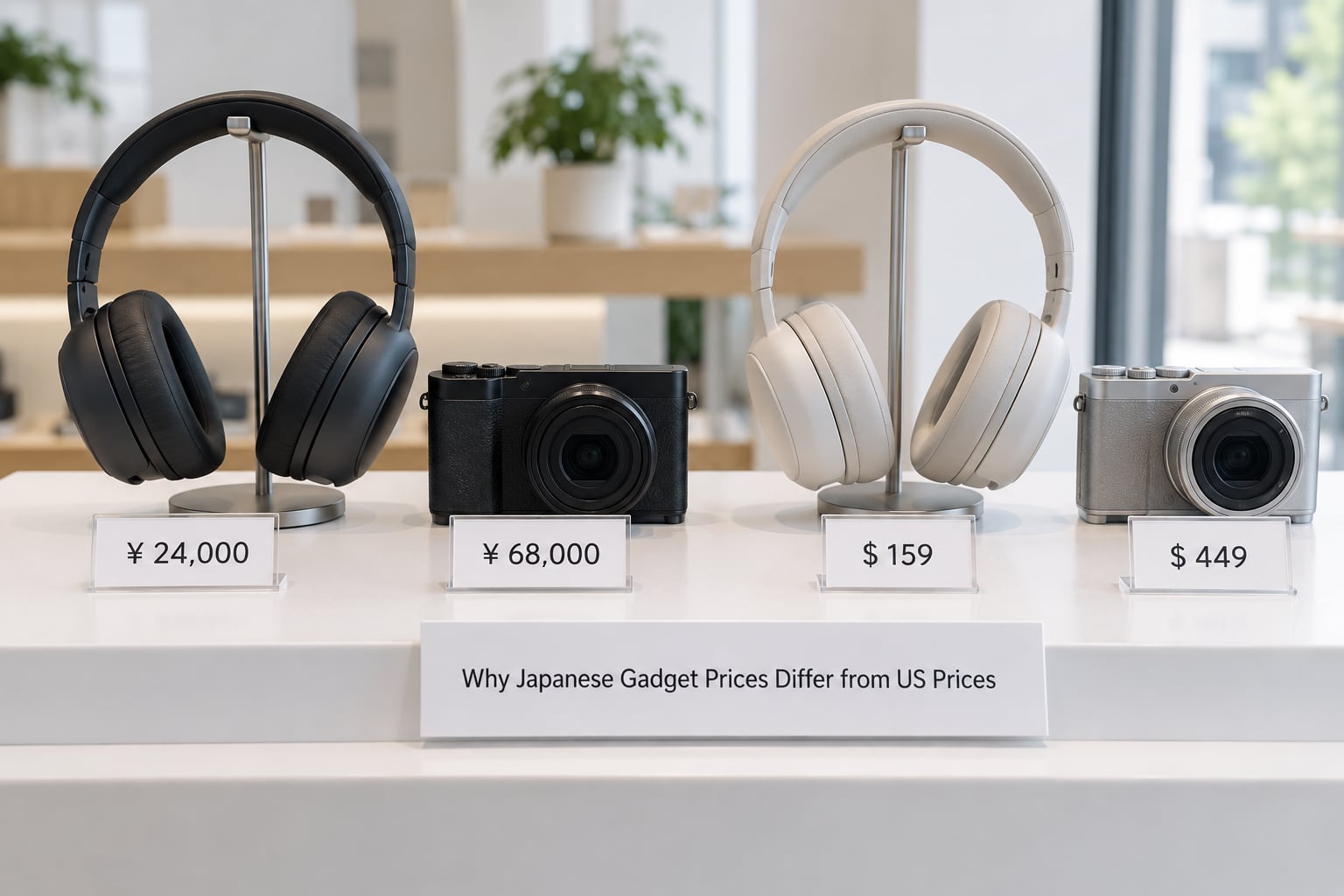
The first thing to separate is the sticker price from the price you actually pay. In Japan, the number on the shelf, the online listing, and the printed price tag already includes consumption tax. In the US, the advertised price almost never does.
That single difference distorts every comparison. A shopper who converts a Japanese price to dollars and holds it next to a US sticker price is comparing a taxed number with an untaxed one, and the gap looks larger than it is.
The second thing to separate is the product itself. Sony, Fujifilm, Panasonic, Bose, Dyson and Zojirushi products routinely run cheaper in Japan than their US counterparts, often by a double-digit percentage in yen terms. Apple products are the famous exception, and the gap there mostly disappears once tax is handled consistently.
The third thing is who sells it. Japan has a dense layer of chains, discount electronics shops, department store counters and online marketplaces competing on the same product, plus a very active secondhand market. Competition of that intensity is the single biggest reason domestic prices sit lower.
Do Japan and the US Show Prices Before or After Tax?
Japan’s consumption tax, called shōhi zeizei, is added to the shelf price. The standard rate is 10%, and a reduced rate of 8% applies to food and non-alcoholic drinks. Electronics are not on the reduced list, so gadgets are quoted at the full 10% rate, already built in.
The United States works differently. Sales tax is a state and local charge, so the rate depends on where you are, and it is added at checkout rather than printed on the product page. Some states have no sales tax at all, which makes an unadjusted comparison even more slippery.
To compare like with like, you have two options. Either remove the Japanese tax from the yen price, or add an estimated US sales tax to the US price. Doing both the same way is what makes a price comparison honest.
Japan also runs a tax-free shopping scheme for eligible non-resident visitors, administered through designated tax-free stores. Buying from one of those counters removes the consumption tax from a qualifying purchase. The rules, thresholds and documentation requirements are strict, and the scheme is changing, so treat any specific rule as something to confirm at the counter rather than assume.
Which Factors Cause the Biggest Price Differences?
This is the table I would want before any purchase decision. Each row is a factor that moves a Japan-to-US price comparison in a predictable direction.
| Factor | Effect in Japan | Effect in the US |
|---|---|---|
| Consumption tax | 10% included in the shelf price | State and local sales tax added at checkout, and rates vary |
| Tax-free shopping | Removes tax for eligible non-residents at designated stores | Not applicable |
| Model selection | Domestic SKUs with region-specific bundles and colours | US SKUs, sometimes with different storage or radio options |
| Warranty | Domestic coverage, generally tied to Japan service | Coverage anchored to the US service network |
| Channel pricing | Dense chain, discount and secondhand competition | Concentrated big-box and direct-from-brand channels |
| Exchange rate | Yen price fixed; dollar value moves daily | Dollar price fixed; yen cost moves daily |
| Promotions | Frequent point-based and seasonal discounts | Seasonal sales and manufacturer promotions |
| Gray-market imports | Little effect on domestic retail | Rarely priced below official channels, and carry warranty risk |
Read that as a whole and one point stands out. Taxes and exchange rate are arithmetic. Model selection, warranty and channel pricing are structural, and they are the parts that do not move on a given afternoon.
How Do Product Models and Features Affect the Comparison?
The same product name on both sides of the Pacific often means two different machines. A Japanese-market console ships with region-locked software and disc support that will not work on a US unit. That alone makes the price comparison meaningless, because the two products serve different markets.
Smartphones vary by radio band and by which model number is sold in which country. Cameras vary by bundled lens, by language packs, and by whether a regional firmware update is offered. Small kitchen appliances and hair care devices vary by plug type, voltage and mains frequency, since Japan runs a 100V grid at either 50Hz or 60Hz depending on region.
Physical design is the least obvious difference. Domestic models often get Japan-only colours, Japan-only accessories and Japanese-language documentation as standard, while the same product abroad ships with different bundled items. If a shopper compares a bundled kit against a bare unit, the numbers will never line up.
Why Can Some Gadgets Cost Less in Japan?
Start with the long deflationary stretch that followed Japan’s asset bubble era. Retailers that spent decades competing aggressively on price built a habit of discounting that US retail never fully replicated. Chain electronics retailers and discount shops all built their floor space on the same promise: you can walk out with the item today.
Convenience store and discount shop ecosystems reinforced the behaviour. When a shopper sees several sellers of the same model within a short walk, the anchor price drops fast, and sellers respond. That kind of density does not exist for most product categories in the US.
Japan-specific variants add another reason. Products sold without a cellular radio, or sold through a different bundle, or released in Japan first because the home market is the launch market, carry prices built on Japanese demand alone. When the home market is the whole market, pricing is more efficient.
The secondhand market is a quieter factor that still sets the ceiling. Japan has an unusually large and well-organised resale economy for cameras, lenses, audio and consoles. When a domestic buyer can buy a used unit almost as easily as a new one, the new price has to respect that ceiling.
Why Can Some Gadgets Cost More in Japan?
The reverse case is just as real, and it is structural rather than accidental. Telecom is the clearest example. Japan’s mobile market has historically sat among the most expensive in the developed world because regulation and high barriers to entry keep the number of capable competitors small, so plans and handsets stay priced above what the same service costs elsewhere.
Some device categories carry extra cost built into the rules. Radio certification requirements mean each model needs its own approval before it can be sold, which slows the market and reduces how many variants exist. Electrical safety marking and repair and recycling obligations for certain appliances add compliance cost that shows up on the shelf.
Distribution structure matters too. A fragmented retail network with many regional players can protect prices in categories where the buyer has few alternatives to compare. And where imported inventory or a small sales volume is the only source for a niche model, the seller sets the price without a local alternative to lose.
Apple is the case readers ask about most, because it feels like it should be cheaper. It generally is not meaningfully cheaper once tax is normalised, since brand-directed pricing keeps the two markets close together rather than letting the yen advantage pass through.
Does Japan’s Reputation for Cheap Electronics Still Apply?
Partly, and only in specific categories. The blanket version of the claim is out of date, and the honest version is a category-by-category check rather than a national reputation.
The gap tends to hold for Japanese and Japanese-adjacent brands in categories with dense domestic competition: cameras and lenses, headphones and earbuds, rice cookers and small kitchen appliances, hair care devices, and gaming hardware. The gap tends to vanish or reverse for global brand-direct products, carrier-tied phones and plans, and imported-only categories.
The practical takeaway is simple. Ask whether a specific model, in a specific configuration, is cheaper today. Do not generalise from the country.
How Exchange Rates and Release Timing Change the Math
Japanese prices are written in yen and change rarely, sometimes only at a model-year refresh. Dollar prices are written in dollars and also change rarely. The exchange rate is the one input that moves constantly, so a yen shelf price that looked like a bargain last quarter may not be one today.
Two directions matter. A weaker yen makes Japanese purchases more expensive for a US buyer and squeezes the apparent discount. A stronger yen does the opposite. This is why forum buyers keep reporting that a deal flipped overnight, and it is why any conversion you do should be redone close to the moment you buy.
Release timing adds a second distortion. Comparing a freshly launched US model against a Japanese model that is a year old tells you about release cadence, not about price levels. Compare like-for-like generations, and check whether the Japanese SKU is the current one or a leftover line being cleared out.
What Extra Costs Appear When Buying in Japan?
The shelf price is rarely the whole bill. Foreign payment cards often carry a surcharge depending on the card network and the merchant, and paying cash avoids some of it while adding its own inconvenience. Convenience-store payments and delivery services add their own fees on top of the purchase.
If you are shopping as a visitor, there are limits worth knowing. Tax-free counters exist at major international airports, but the eligibility rules, minimum spend thresholds and required documentation are strict, and a purchase that fails the check at the counter cannot be unwound afterwards. The Japanese government is also moving the tax-free scheme toward a refund-on-departure model, with the revised rules taking effect on November 1, 2026, so what worked on an earlier trip may not work on the next one.
For anyone shipping rather than carrying, add insured international freight, a customs broker if the carrier requires one, and the import duty and taxes assessed on arrival. That last part is where most disappointing experiences come from, and it gets its own section below.
Is Buying a Gadget in Japan and Importing It Worth It?
Only after you calculate the landed cost, which is the full amount that lands at your door rather than the number on the tag. Landed cost is the purchase price plus shipping plus duty plus taxes plus brokerage plus insurance. Compare that total to the US price for the equivalent model.
Here is a framework I would use. Start with the Japanese shelf price, and remove the consumption tax if you are eligible to reclaim it. Convert the result at the rate on the day you are actually buying. Add insured shipping for a bulky or fragile item, or courier rates for something small and light.
Then add the duty. Duties on consumer electronics shipped to the US vary by product classification and by trade measures in force at the time, so check the current rate rather than assuming. Add estimated import taxes assessed on arrival, and a brokerage fee if your carrier charges one. Buyers who skip these two steps are the ones whose savings evaporate.
Finally, price the risk. A Japan-only model that will not work on your grid, a console with region-locked software, or a product whose repair means shipping back to Japan each carry a cost that never appears on an invoice but always shows up in whether you actually use the thing. If the item has no local warranty and no local service, a modest saving is not worth much.
Used purchases from Japan follow the same logic with thinner margins. The secondhand market offers real value for cameras and lenses, but shipping a used lens means paying to ship something you cannot inspect first, and the same duty and insurance questions apply.
How to Compare Japanese and US Prices Before Buying
Run these seven checks and you will have an answer you can trust.
- Match the exact model number. Compare the domestic SKU with the US SKU, not the product family. A different suffix usually means different hardware.
- Handle tax the same way on both sides. Either remove Japan’s consumption tax or add US sales tax, then compare what is left.
- Convert the final tax-inclusive number. Do the arithmetic on what you will actually hand over, not on a pre-tax list price, and recheck the rate before you commit.
- Check the specification sheet for regional differences. Radio bands, storage, included accessories, colours, and language support all vary.
- Confirm what happens if it breaks. Manufacturer warranty coverage is usually anchored to the country of purchase, and international service is usually limited.
- Check the power and compatibility basics. Voltage, mains frequency, plug type, and region locks decide whether the device is usable at all.
- Add import costs before you decide. Duty, insurance, shipping and brokerage can turn a 20% saving into a 5% saving, or a loss.
If you are not crossing the border, the same checklist works in reverse. Expat and relocation buyers use it constantly, and it is the reason a Tokyo purchase and a US purchase are rarely the same decision.
Frequently Asked Questions
Are electronics always cheaper in Japan than in the US?
No. Cameras, lenses, headphones, rice cookers, hair care devices and gaming hardware from Japanese brands often price lower in Japan, sometimes by a double-digit percentage once tax is treated consistently. Globally branded products, carrier-tied phones, and imported-only categories price roughly the same or higher. The answer depends on the exact model and configuration, not on the country.
Does buying in Japan void the manufacturer’s warranty?
Usually in practice, yes for anything you take home. Warranty coverage is generally anchored to the country of purchase and to that country’s service network, so repairs may need to happen in Japan or through a Japanese service centre. Some brands offer limited international coverage, but the terms are usually narrower than the domestic policy. Read the warranty card before you buy, not after.
Are duty-free electronics actually cheaper in Japan?
They remove the consumption tax, which is the main discount, but not the whole story. You still have foreign card surcharges, delivery or courier costs, and strict eligibility rules involving your passport, purchase conditions and minimum spend thresholds. From November 1, 2026 the scheme moves toward a refund-on-departure model, which changes the process again. Confirm current rules before you plan a purchase around them.
Can I use a Japanese gadget in the United States?
Often yes, sometimes not. Check mains voltage and frequency, plug type, radio bands, region locks on software and discs, and whether the menus and manuals are Japanese-only. Small kitchen appliances and hair care devices carry the highest risk because of voltage and frequency differences. Consoles and some cameras carry software and media region locks. A cheap price is worthless on a device you cannot actually use.
How much is import tax from Japan to the USA?
It depends on the product classification and the trade measures in force when your shipment crosses the border, so there is no single rate to quote. Duties, import taxes assessed on arrival, and a customs brokerage fee can all apply. Personal shipments may qualify for a duty-free de minimis allowance above which they do not. Use the landed-cost formula from this article and check current rates before shipping anything expensive.
What Should You Do First?
Write down the two model numbers, not the two product names, and check whether they refer to the same machine. Then normalise tax on both sides and convert at the rate on the day you are looking.
That single step usually ends the debate. Most apparent bargains were a tax-display artifact, a generation mismatch, or a model that would not have worked once it crossed an ocean. Where a real gap survives all of that, you know exactly how large it is and what it would cost to collect it.