A Japanese pop-up tech shop is a temporary retail space, usually a short-lease kiosk inside a mall, station or park, where a gaming, gadget or electronics brand opens for a few days or weeks to sell limited-run merchandise, demo products and photo-worthy set pieces. It works on scarcity, foot traffic and social sharing rather than on everyday margin.
The format borrows from trade shows, but it sells. Visitors queue, try the hardware, buy things that will not exist anywhere else a week later, then take photos that carry the brand to people who were not in the room.
The rest of this guide walks through the brand-side operating model, the venues that host these shops, what it’s like to visit one, and how payment and promotion work.
Last updated: October 2026
Table of Contents
- 1How Japanese Pop Up Tech Shops Work
- 2The six-step operating model
- 3How it differs from a permanent electronics store
- 4Why Technology Brands Open Temporary Shops
- 5Where Japanese Pop Up Tech Shops Appear
- 6How the Shop Is Set Up and Staffed
- 7The zones inside a pop-up
- 8Who works there
- 9Staffed shop or self-serve display
- 10What Customers Can Expect Inside
- 11How Japanese Pop Up Tech Shops Handle Prices and Payments
- 12How Promotions and Product Launches Work
- 13What to Check Before Visiting
- 14Frequently Asked Questions
- 15Are Japanese pop-up tech shops open every day?
- 16Can visitors buy products at a pop-up tech shop?
- 17Do Japanese pop-up tech shops accept foreign cards?
- 18Is English usually available at Japanese pop-up shops?
- 19Are pop-up tech shops different from trade-show booths?
- 20How can I find the dates and location of a Japanese pop-up shop?
- 21What to Take Away
How Japanese Pop Up Tech Shops Work
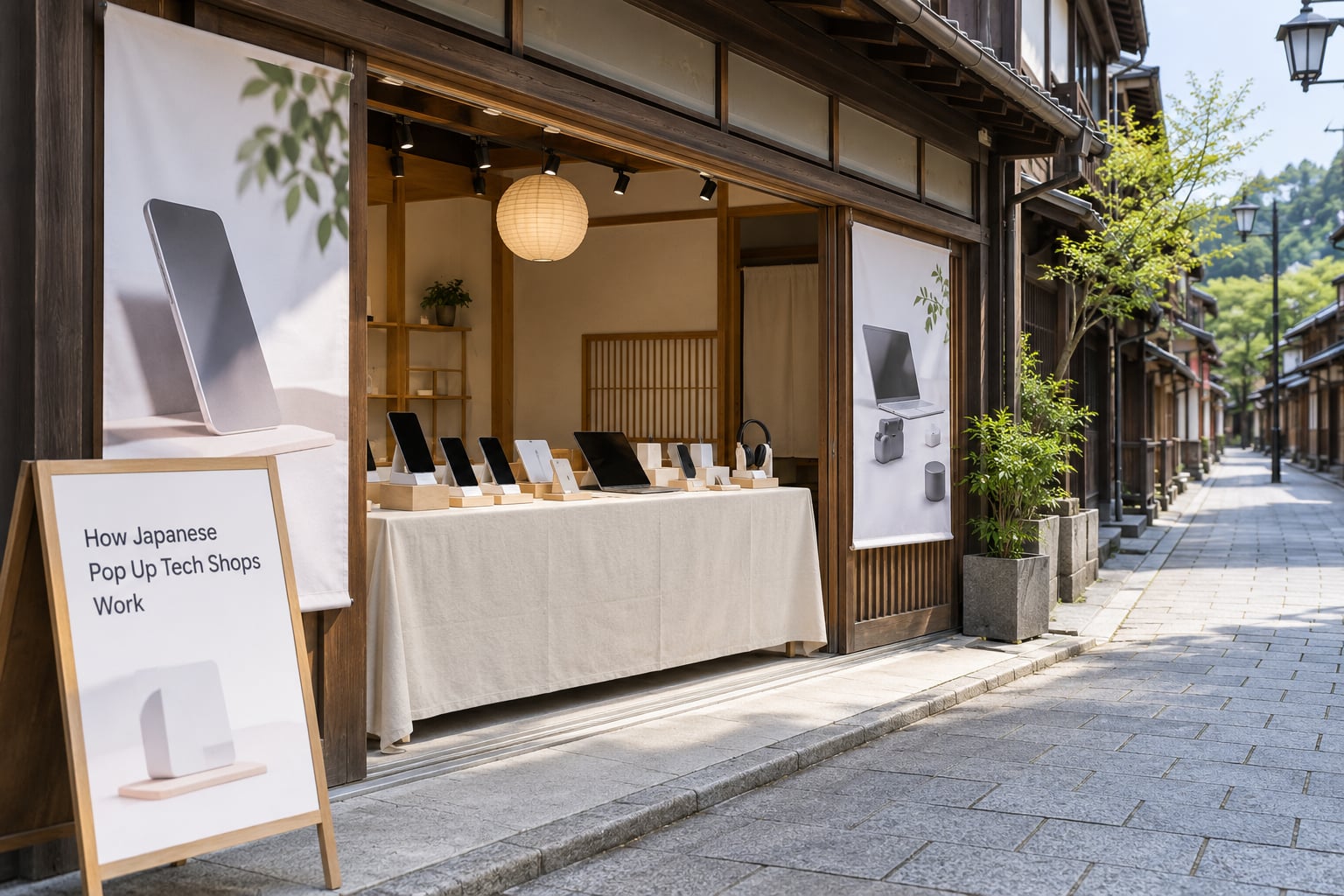
Behind every pop-up there is a fixed sequence, and it runs roughly the same way whether the tenant is a 60-year-old game company or a hardware startup from overseas. Knowing the sequence explains most of the things visitors find odd, like why there is a photo wall before there is a till.
The six-step operating model
1. The brand picks the drop. A team decides what the shop is for: an anniversary, a product launch, a collaboration with an anime or music property, a first test in Japan. The merchandise plan and the run quantity get fixed before anyone signs a lease.
2. A short-term space is booked. Venues like Shibuya PARCO or Miyashita Park rent kiosks and modular rooms for a fixed window, sometimes as short as one day. No long lease, no permanent staff, no fit-out that has to earn its keep for a decade.
3. A small exclusive run is produced. The shop carries a limited quantity of merchandise that is not sold online and not carried by regular stores. Scarcity is manufactured on purpose so people have a reason to come this week instead of next month.
4. The interior is built to be photographed. Counters, signage, lighting and often a themed café corner. Staff may wear costumes tied to the property. None of this is accidental; the set exists so visitors post it.
5. The run opens with a queue system. Attendance is driven from social accounts, sometimes with numbered RSVP slots or a lottery. LINE accounts, QR-linked rewards and AR filters turn foot traffic into a measurable digital campaign.
6. Teardown, then unsold items move online. When the window closes, the fit-out comes down and whatever is left over usually reappears on the brand’s online store, sometimes weeks later. Unsold limited items are the one thing that survives past the run.
How it differs from a permanent electronics store
A permanent shop in Akihabara exists to move volume: broad catalogues, staff who know the spec sheets, product on the shelf today and tomorrow, and prices that assume you came to buy. A pop-up tech shop exists to create a moment. It carries a narrow selection, opens on a schedule that resets every few weeks, and sells the same shirt to forty people who each think they found something rare.
That is also why nobody sensible treats a pop-up as a place to hunt for a bargain. Discounting is rarely the point, and the shop usually has no interest in comparing models side by side.
Why Technology Brands Open Temporary Shops
The commercial logic is simple arithmetic: a permanent Tokyo storefront costs money every single day it stands empty, while a pop-up costs a large amount once and then stops. For a launch window, a holiday push or a market-entry test, that trade makes sense.
- Market testing. A short run shows how people actually handle a product, what questions they ask and which bundle they pick, without committing to inventory for a year.
- Launch moments. A new console, phone or accessory needs somewhere physical to sit and be picked up. Retailers will not give a permanent shelf to something unproven.
- Scarcity and urgency. Limited quantities create a reason to visit now, which lifts foot traffic for the whole venue rather than just the kiosk.
- Real customer reactions. Staff hear objections in a way a product page never shows you. That feedback goes straight back to the product team.
- Partnership proof. A co-located café or a collaboration with an anime property borrows an audience that already trusts somebody else.
- Search and social presence. Pop-ups are extremely shareable. A week in a busy Tokyo venue can produce more brand impressions than a month of ordinary advertising.
There is also a structural reason Japan is dense with these shops. Central retail space is expensive, leases are long, and much of the prime ground floor has been swallowed by redevelopment around major stations. A short lease in an existing complex sidesteps the whole problem.
Inbound tourism has pushed the same lever from the other side. More visitors means a bigger addressable crowd for a two-week Tokyo window, and operators have noticed that the spend concentrates in exactly the districts where pop-ups already cluster. The effect since the Expo 2025 Osaka period has been more activation space around stations, not less.
Where Japanese Pop Up Tech Shops Appear
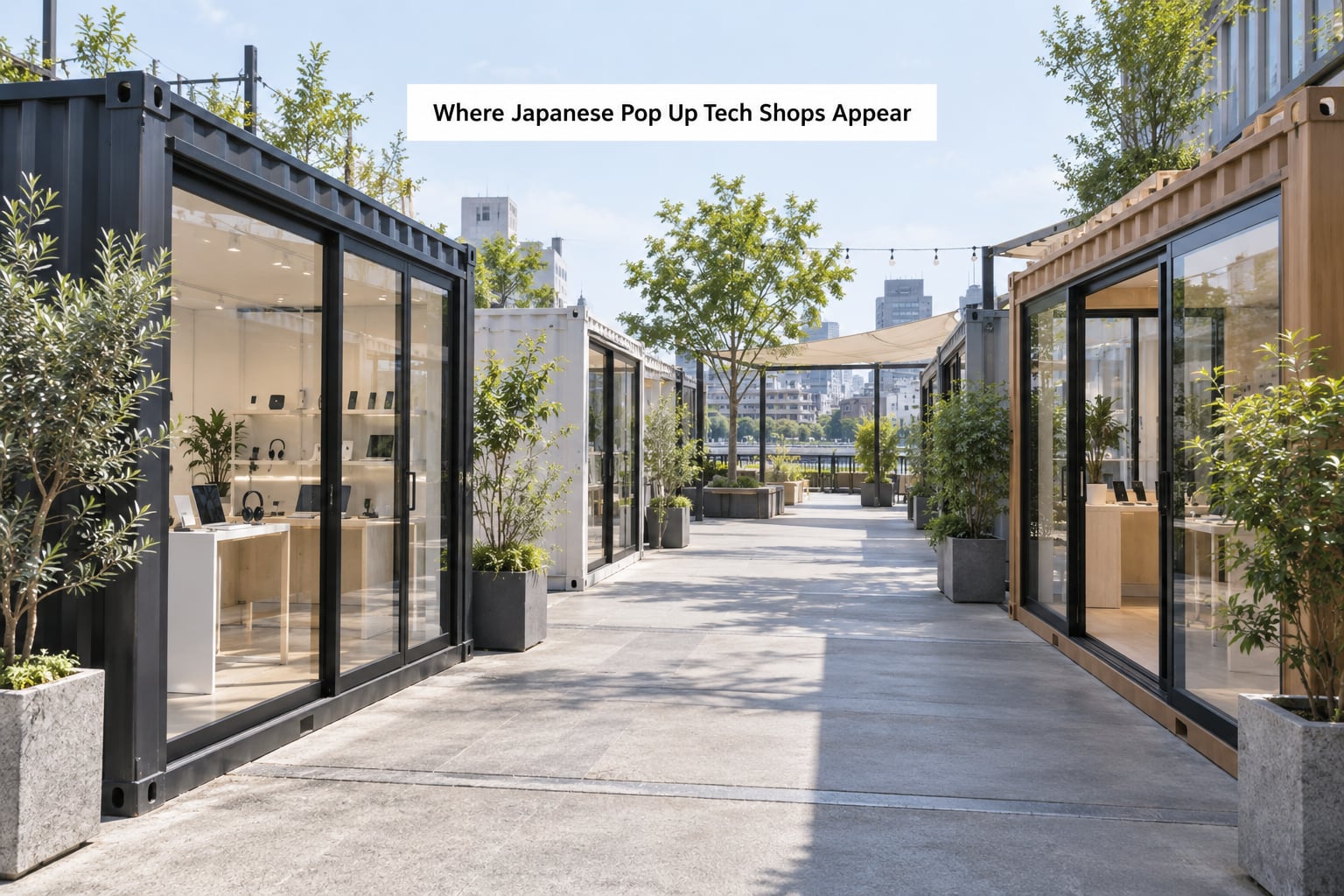
Location is the whole game. A brand will pay a premium for a space people already walk past on the way to a station, because foot traffic is the input everything else is built on. The most common formats are shopping-centre event zones, station concourses, department-store floors, street-front spaces, and temporary halls rented for a single campaign.
| Venue | Area | Format | Known for |
|---|---|---|---|
| Shibuya PARCO | Shibuya | Kiosks and multi-floor event zones | Anime, game and youth culture pop-ups; a very high volume of openings across the year |
| Miyashita Park | Shibuya | Open-air complex, modular rooms and storefront spaces | Big anniversary campaigns, including the SEGA 65th Limited Shop |
| Tokyo Solamachi | Tokyo Skytree | Mall event floors | Family and character-led pop-ups with a heavy footfall base |
| Shinjuku Station surroundings | Shinjuku | Concourse-adjacent and street-front spaces | Passenger volume; short runs that rely on walk-in traffic |
| Tokyu Plaza and the Harajuku side of Omotesando | Harajuku | Curated mall pop-up zones | Fashion and lifestyle collaborations, cleaner set design |
| Akihabara backstreets and Electric Town | Akihabara | Small shopfronts and arcades | Retro hardware, indie game stalls and maker demos rather than mainstream merch |
Which venue a brand picks says a lot about the campaign. A game anniversary goes somewhere crowded and young. A premium audio launch looks better in a curated mall than in a corridor next to a ramen queue.
How the Shop Is Set Up and Staffed
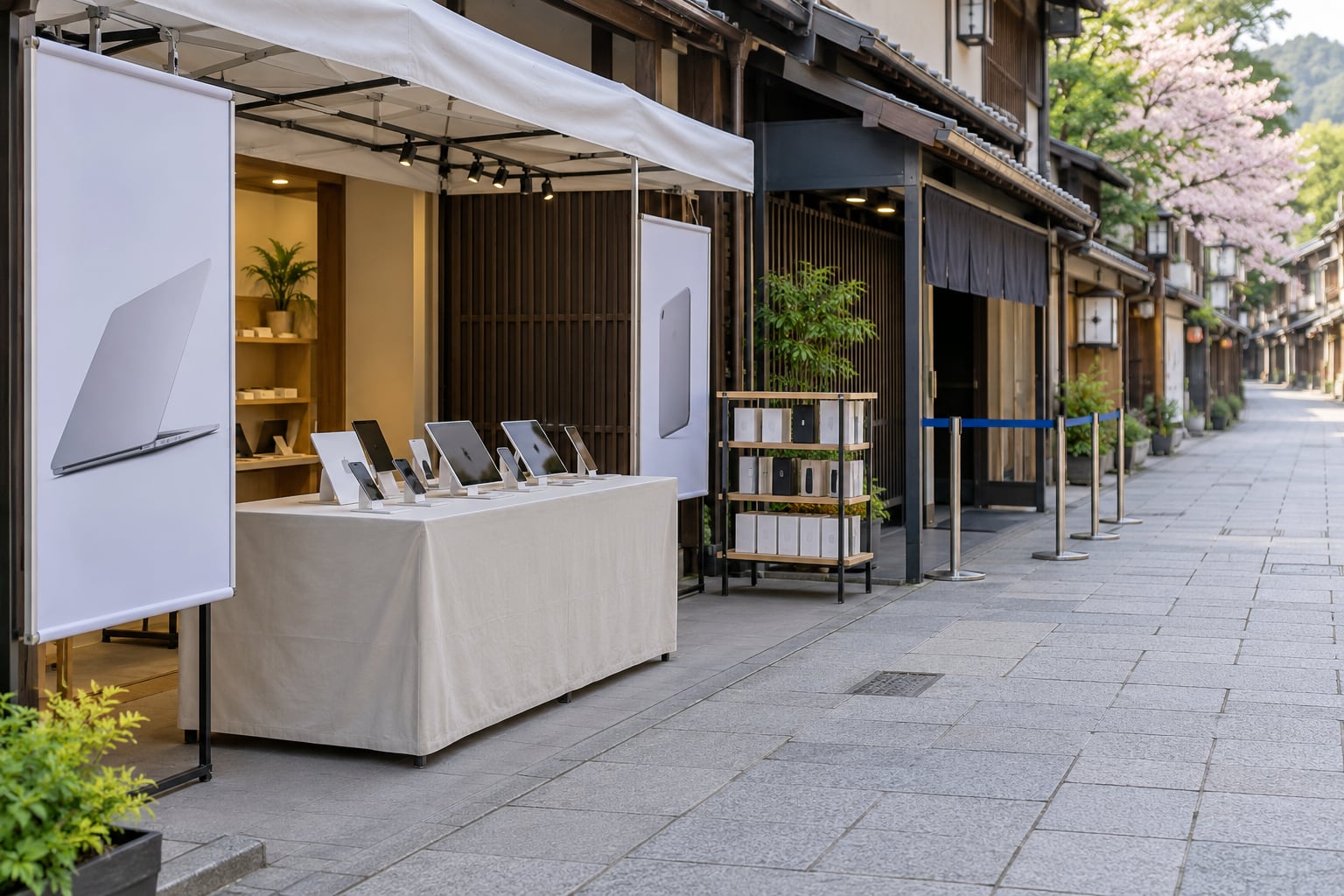
Most tech pop-ups follow the same floor plan, because the same agencies build them repeatedly. You walk in and hit the photo set or demo zone first, merchandise to one side, and the register somewhere behind it.
The zones inside a pop-up
A demo table usually carries working units you can pick up, with staff who know the short version of the manual. A merch wall stacks the exclusive run, often arranged by product line rather than price. A giveaway or spin-to-win station collects scans and keeps people in the space longer. A small café or a neighbouring restaurant adds dwell time and a second sale.
Who works there
Staffing is a mix of the brand’s own people and agency crew hired for the run. Expect someone welcoming at the entrance, product specialists on the demo floor, merchandise staff at the wall, and a supervisor who owns inventory counts and the queue. During a launch weekend, temporary staff are trained in a single shift and often work themed outfits.
Staffed shop or self-serve display
Not every pop-up is a staffed shop. Some are unstaffed display boxes or self-scan kiosks inside a larger mall event, where you buy through the venue’s own register. Others are staffed only at peak hours, which is why some shops look abandoned at midday and packed at night. If you are hoping to talk to someone about specifications, check the opening hours carefully.
What Customers Can Expect Inside
The customer journey is short and physical. You join a queue, you are let in in waves, you try the hardware, you ask a question in Japanese, and you either buy on the spot or find out the item is gone.
Expect queues and expect them to be real. Visitors report that limited merchandise, especially anniversary and collaboration items, frequently sells out within hours of opening, and that some shops use numbered RSVP slots or a lottery for entry rather than a first-come line. Influencer and agency priority lines are a known complaint among regulars, and it is not unusual to walk past a long queue and see a short side entrance.
Crowding cuts both ways. You will get hands on the products quickly, and you will probably not get a calm ten minutes with them. Staff service is polite and usually fast; detailed English explanations are less common.
Language is the practical stumbling block. Most signage is Japanese only, and demo staff speak Japanese unless the venue is in a heavy-tourist area or the brand has an English-speaking team on shift. Several shops keep a small English leaflet or a QR-linked multilingual page, and that is often the whole of the English support.
One more thing worth knowing: pop-up merchandise is genuinely different from standard merchandise far more often than sceptics expect. Retro gaming fans regularly find catalogue items that never reach regular shelves, which is exactly the point of a limited run.
How Japanese Pop Up Tech Shops Handle Prices and Payments
How pop-up tech shops handle prices varies by campaign, and that is why the honest answer is to check each shop rather than assume. Four models cover almost everything you will walk into.
- Direct sale. The shop has its own register and sells the exclusive run on site, usually in small numbered quantities.
- Reservation. Especially for expensive hardware, you reserve in person and collect later, sometimes at a permanent store or through an online order flow.
- Redirect to online. Some shops are pure demonstrations. Staff show you the product and send you to the brand’s online store with a campaign link.
- Event-only promotion. A discount or bundle that only exists inside the temporary space, tied to a raffle, a purchase threshold or a themed café menu.
On payment methods, cards are usually accepted and many venues support IC cards and mobile payments, since those are everyday defaults in Japan. Small shops and single-stall operations are more likely to be cash-only, and regulars repeatedly warn that IC acceptance at tiny pop-ups is less reliable than at big malls. Carry some cash and you will not be stuck.
Tax-free shopping for non-resident tourists works at pop-ups when the shop is a registered participant and when you bring your passport at the time of purchase. Not every temporary shop participates, and the point-of-sale setup for passport checks is often simpler than at a department store counter, so ask before you commit to a large basket.
The consumption tax exemption generally applies to purchases above a threshold in a single transaction at a participating store. If the shop does not handle tax-free processing, there is nothing a visitor can do about it on the spot.
How Promotions and Product Launches Work
Campaigns are built around a deadline. A run has a hard closing date, the quantities are finite, and every extra day the visitor waits is a day closer to the item being gone. That pressure is the promotion engine.
The SEGA 65th Limited Shop at Miyashita Park in Shibuya is a clean illustration. The video game company opened a seven-day shop for its 65th anniversary, running inside the open-air complex in a short-term unit, selling dozens of items that had not been seen before, including keyrings, acrylic stands, T-shirts and caps, plus collaborations with artists such as Lugosis & Strato and Shohei Ochiai. A neighbouring restaurant sold an anniversary cup, and a sticker came free with purchase during the run.
That pattern repeats across the category. Limited runs create the pull. Demonstrations and short workshops give people a reason to stay longer than a queue. Loyalty and spin-to-win mechanics collect contact details. A partnership with an anime, TV or music property borrows an audience that already has a habit of showing up on opening day.
Launch previews usually run before the public window, sometimes with press and creators invited in for a walkthrough. Independent creator video tends to reach further than a brand press release, which is why the same shop often looks busier than its marketing suggested.
What to Check Before Visiting
Pop-ups are announced with very little notice. Some appear on social accounts only days before opening, which is the single biggest reason visitors arrive in Tokyo and miss the shop they came for. A short checklist saves a lot of wasted train fares.
- Exact dates and closing time. A seven-day run often closes mid-afternoon on the final day once stock is gone.
- The exact space, not just the venue. “Miyashita Park” can mean several different units. Ask for the unit name and the floor.
- Admission rules. Walk-in, numbered RSVP, lottery or invitation only.
- Expected quantities. Whether items are genuinely limited or restocked daily changes how early you queue.
- Payment methods. Especially whether cards and IC are taken at that specific stall.
- Tax-free availability. And whether you need your passport at the till.
- Language support. Whether English-speaking staff are on shift during the hours you plan to visit.
- Whether it sits inside a bigger event. Some shops share a hall with a themed café or a stage programme worth an hour of your time.
Niche Tokyo media and the brands’ own social accounts are the reliable sources. Mainstream news tends to report a pop-up after it has already sold out.
Frequently Asked Questions
Are Japanese pop-up tech shops open every day?
No. Most run for a fixed window rather than a daily schedule. A campaign might open for seven consecutive days, but plenty of shops open only on weekends, or run one day and close. Some operate at specific hours with a last entry time well before closing. Runs are also seasonal, so a shop that exists this month may be gone next. Always check the announced dates and hours, and treat the final day as a sell-out risk rather than a guaranteed chance to visit.
Can visitors buy products at a pop-up tech shop?
Usually yes. Most pop-up tech shops have their own register and sell the exclusive run on site while quantities last, and many carry small batches that genuinely disappear. A minority operate as demo spaces only, where staff show you the product and send you to the brand’s online store. For expensive hardware, some shops take reservations in person for collection later. Ask at the entrance before you queue if you need a specific item.
Do Japanese pop-up tech shops accept foreign cards?
Most staffed shops in a large venue accept credit cards, and many take IC cards and mobile payments too. Small single-stall pop-ups are more likely to be cash-only, and IC acceptance is less reliable than the big malls suggest. Bring yen with you rather than relying on one method. If you hit a payment wall, the venue’s own stores and the convenience stores nearby will always take a card.
Is English usually available at Japanese pop-up shops?
Not reliably. Signage and demo staff are mostly Japanese-only, particularly at smaller units and outside tourist-heavy areas. Some brands staff English speakers at peak times, and larger venues sometimes provide a multilingual QR page or leaflet. If understanding the product matters to you, check whether English staff are on shift for the hours you plan to visit, or read the brand’s Japanese product page before you go.
Are pop-up tech shops different from trade-show booths?
Yes, though the formats overlap. A trade-show booth is built for demonstration and lead collection during a scheduled industry event, and visitors usually leave without buying. A pop-up tech shop is a temporary retail space with a register, merchandise and a queue, so it behaves much more like a small store. Several formats blend the two, with a stage or demo corner inside a shop that is genuinely selling.
How can I find the dates and location of a Japanese pop-up shop?
Follow the brand’s own Instagram and X accounts, plus Tokyo-focused pop-up and tech media, because announcements often appear only days before opening. Venue operators such as Shibuya PARCO and Miyashita Park publish their own event schedules, which is the quickest way to see everything running in one place. Save the exact unit name and floor when you find something, because several pop-ups often share a single venue.
What to Take Away
A Japanese pop-up tech shop is a short lease, a small exclusive production run, a set built for cameras, and a hard closing date. Those four things explain the queues, the sold-out merchandise and the slightly strange layout, and they are the quickest way to see how Japanese pop up tech shops work.
If you are planning to visit one, pick a target, follow the brand’s social account closely in the weeks before you travel, confirm the exact unit and admission rules, and go early in the run rather than on the last day. And treat the permanent stores in Akihabara as the anchor for anything you actually need to compare.