A pity system is a safety net inside a gacha banner: after a set number of pulls without the top rarity, the game forces one onto your account. In most major titles that ceiling sits at 90 pulls, a probability ramp kicks in somewhere in the mid-70s, and your first rare pull has a 50% chance of being the featured character. Here is how to understand gacha pity systems without the community shorthand.
I have watched a lot of new players burn through a banner they did not even want, then arrive at the character banner with no pity left and nothing to show for it. Almost every one of those cases came down to the same three ideas that nobody explains clearly on the first day.
Table of Contents
- 1How to Understand Gacha Pity Systems
- 2Gacha pity systems at a glance
- 3What Are Hard Pity and Soft Pity?
- 4How Does a Pity Counter Work?
- 5How to Read a Gacha Pity System in Practice
- 6What Do Pity Counters Reset?
- 7Why Do Games Use Different Pity Rules?
- 8Which Currency Does a Gacha Counter Track?
- 9What Does Soft Pity Mean for Your Chances?
- 10Why Do Pity Systems Differ by Game, Version, or Region?
- 11Common Pity-System Misunderstandings
- 12Frequently Asked Questions
- 13Does pity guarantee the character I want?
- 14Can I see my pity counter before pulling?
- 15Does a gacha counter carry over between banners?
- 16What happens if I pull a rare item before reaching hard pity?
- 17Are gacha pity systems the same on mobile and console games?
- 18What to Do First
How to Understand Gacha Pity Systems
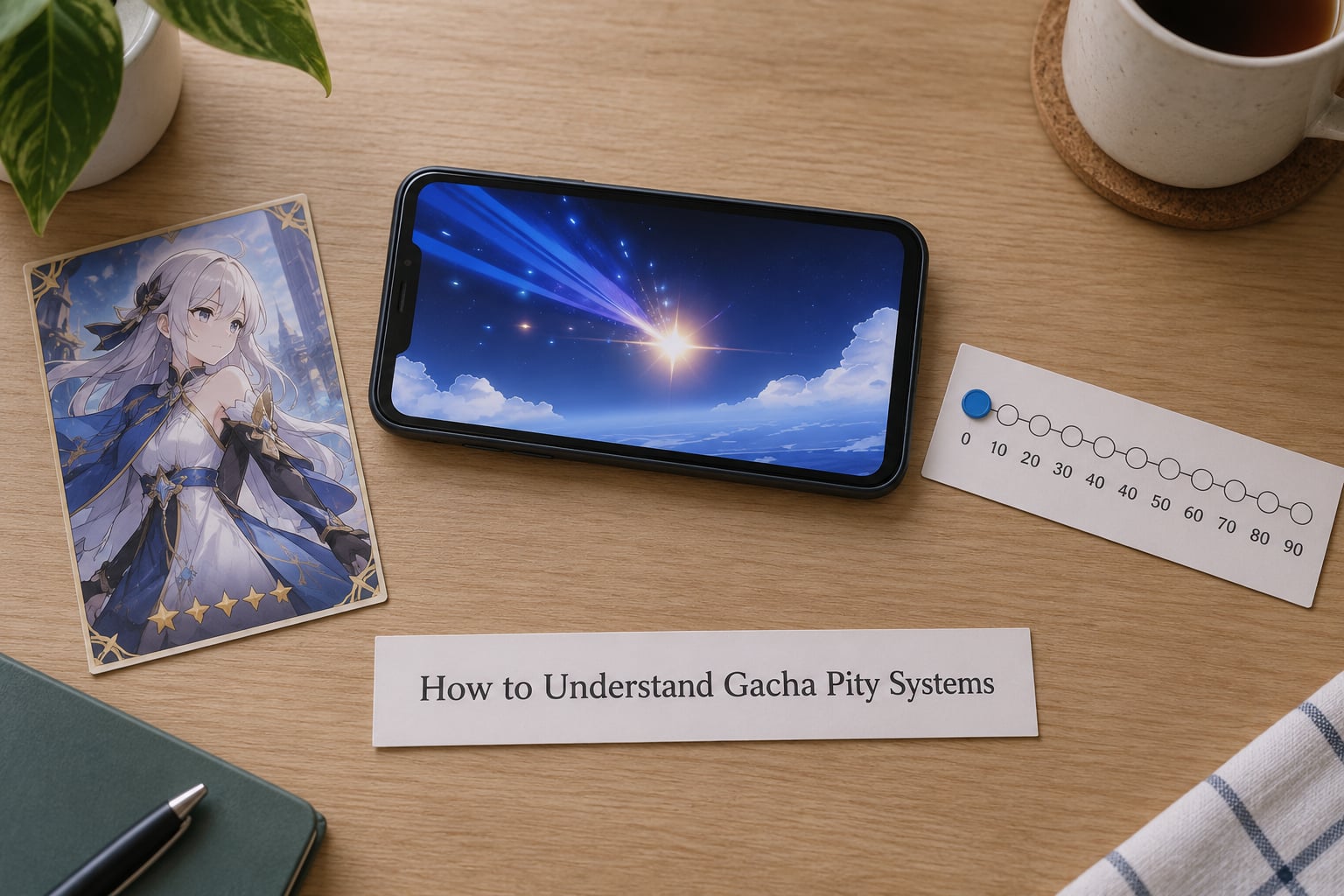
A pity system counts your pulls since your last top-rarity drop. Below a threshold, you are pulling at the base rate, usually below 1%. Past that threshold the odds climb sharply. At the ceiling, a rare item is guaranteed whether you like the banner or not.
Developers add pity for two reasons. The first is legal and regional: several markets require published rates and some form of bad-luck protection, and Japan is one of the strictest about that. The second reason is commercial, and players say it plainly on Reddit and GameFAQs. A visible floor converts a game of pure chance into a game with a knowable worst case, and a knowable worst case is much easier to spend against.
That second reason matters for how you read everything else here. Pity caps your downside. It does not make a banner good value.
The distinction beginners miss most: pity guarantees rarity, not identity. Your pity counter can sit at 89 and deliver a 5-star character who is not the one the banner is featuring. The featured-character rule, usually a coin flip, is a separate system layered on top. Forum threads are full of players who lost the coin flip and concluded that pity was broken. Nothing broke. Two different rules fired.
Gacha pity systems at a glance
Rates below reflect published in-game disclosures current as of 2026. Publishers adjust numbers between versions and between regional clients, so treat this table as a map rather than a contract, and confirm on the banner detail screen before you spend anything.
| Game and banner type | Hard pity | Soft pity (approximate) | Featured guarantee | Carryover between banners |
|---|---|---|---|---|
| Genshin Impact Character Event Wish | 90 | Around 74 | 50/50, then guaranteed | Character pool shared with later character banners |
| Genshin Impact Weapon Event Wish | 80 | Around 73 | 50/50, then guaranteed | Separate from character pity |
| Honkai: Star Rail Character Event Warp | 90 | Around 74 | 50/50, then guaranteed | Character pool shared with later character banners |
| Honkai: Star Rail Light Cone Event Warp | 80 | Around 73 | 75/25, then guaranteed | Separate from character pity |
| Wuthering Waves | 80 | Around 73 | 50/50, then guaranteed | Shared between character banners |
| Arknights | 90 per limited operator banner | Reported to start around 50 | First 6-star may be a different operator | Per banner |
| Arknights: Endfield | 80 | Reported to start around 70 | 50/50 style featured rule | Players report no carryover between banners |
| Goddess of Victory: Nikke | 50 pulls per 5-star | No published ramp | No featured targeting, 5-star is a shop character | Spark system counts shop points, not pity |
What Are Hard Pity and Soft Pity?
Hard pity is a ceiling and soft pity is a ramp. Hard pity is the number where the guarantee kicks in and the drop is not a question any more. Soft pity is the stretch before that where the odds rise, sometimes slowly and sometimes almost vertically.
| Mechanic | What it is | When it starts | What changes | What resets it |
|---|---|---|---|---|
| Hard pity (guaranteed pity) | A guaranteed top-rarity item on a set pull number | At the ceiling, for example pull 90 | The result, no matter what your odds were | Any top-rarity drop |
| Soft pity | A rising probability band before the ceiling | Usually somewhere between pull 50 and 80 | Your per-pull chance of a 5-star | Any top-rarity drop |
| Featured guarantee (50/50) | Whether your rare drop is the banner’s featured item | On every top-rarity drop | Your odds of getting the specific character | Each top-rarity drop starts a new round |
| 4-star pity | A much shorter counter with its own floor | Typically around 10 pulls, game-specific | Guarantees a 4-star at the ceiling | Any 4-star drop |
How Does a Pity Counter Work?
A typical 90-pull system looks like this in practice. Your counter starts at 0 and climbs by one every pull. At 0 pity, each pull is a 0.6% shot at a 5-star in games like Genshin Impact, which means most of your first 50-something pulls feel identical and uneventful.
At roughly pull 74, soft pity begins. The game quietly multiplies your per-pull chance, and the jump from one pull to the next can be dramatic. Players describe it as the point where 5-stars start appearing in bursts after a long dry spell, which matches what the numbers do. From there each pull is far more likely to pay out than the base rate suggests.
If you reach pull 90 with nothing, hard pity fires and the 90th pull is a 5-star. Your counter returns to 0, and the featured coin flip starts fresh. That loop is the whole system: climb, spike, guarantee, reset.
One useful detail for planning. On Genshin Impact, if your top-rarity drop is not the featured character, you gain a Fate Point, and one point guarantees the featured character on your next 5-star. That is the “captured” state players talk about, and Honkai: Star Rail does the same thing with Fate Points. It means a loss is never a total loss, only a delay.
How to Read a Gacha Pity System in Practice
Reading your pity in-game takes about a minute once you know where the screens are. The menus get renamed often, so look for the history or detail screens rather than memorising exact paths.
In Genshin Impact, the character Event Wish screen shows a pity counter next to the featured character, and the banner details screen lists the wish history with a running count. The History section of the in-game archive shows past wishes. For Honkai: Star Rail, the Warp menu has a history tab that shows your pulls since the last 5-star, and the banner screen displays whether your next 5-star is guaranteed. Wuthering Waves shows its pity count on the banner details panel and in the pull history.
Worked example. Your counter reads 68 on a 90-pull banner with soft pity around 74. You have 22 pulls to the ceiling. If you budgeted for 30 pulls, you can absorb a miss of 8. If you budgeted for 15, one bad stretch ends your banner and you are choosing between stopping or overpaying for the tail.
The calculation is simple enough to do before you tap anything: pulls remaining equals hard pity minus your current counter. Then compare that number to your budget, not to your hope.
Keep the wish history open after a loss. Forum advice to check your history after an unexpected result is good instinct, because it is the only reliable way to confirm the counter is behaving rather than misremembering. And if a counter looks wrong, screenshot it. Publisher support takes those seriously for the major titles.
What Do Pity Counters Reset?
Counters reset on rare drops, but the exact trigger varies. In most character gacha banners, any 5-star resets the 5-star pity counter, whether it was the featured character or an off-banner one. That is why losing the coin flip is painful in currency terms and mild in pity terms: you are back at 0, but you are guaranteed next time.
Some counters reset only on the featured item. Arknights runs its 6-star pity per limited operator banner, and Nikke has no featured targeting at all because its 5-star pulls are shop characters. A separate mechanism called the spark system tracks shop points instead of pity, so if you have seen Nikke described as having a pity system, the spark counter is what was meant.
Banner changes are the messy part. In Genshin Impact, Honkai: Star Rail and Wuthering Waves, a limited character banner draws from a shared character pool, so pity built on one character banner carries to the next one in that pool. Weapon banners keep their own counters, and character pity never touches them. In Endfield, players on r/Endfield and r/ArknightsEndfield report the opposite behaviour and describe pity as not carrying between banners, which is the sort of rule that catches veterans out.
Why Do Games Use Different Pity Rules?
Designers are balancing four things at once: the price of a character, how long a banner runs, how much currency players earn between banners, and how much revenue the banner should produce. Change any one of them and the pity numbers have to move with it.
Single-banner pity gives the clearest promise. Each limited banner has its own counter, so the guarantee is precise but any progress resets when the banner ends. Character-specific pity is what Genshin Impact and Honkai: Star Rail use: one shared counter across all limited character banners, which is more generous over a long enough wait. Shared pity extends further still, pooling counters across several related systems.
Spark systems invert the idea. Instead of promising a character, they promise progress toward a currency, which is a gentler promise with no single dramatic payout. It suits games where the 5-star pool is a shop rather than a banner.
For you as a player, the practical difference is one question: if the banner ends before I hit my ceiling, do I keep anything? Check that before you start, because it decides whether a banner you are only half-interested in is worth opening at all.
Which Currency Does a Gacha Counter Track?
A pity counter tracks pulls, and not every pull is equal. Free single pulls, premium currency pulls, event tickets and selector items all usually feed the same counter in most games, which is convenient. The exceptions are worth knowing.
Some games exclude specific items so that free currency cannot be converted into top-rarity drops. Where that happens, pulling with the excluded currency leaves the counter untouched, which is exactly why a player can spend a week of free pulls and still be sitting at 0. Read the banner disclaimer, because this is listed in the rules panel of most titles and skipped by nearly everyone.
Practice version of the same rule: a single ten-pull counts as ten toward pity, not one. Beginners often assume a multi-pull is a single transaction with one roll, and then their counters do not match their records.
What Does Soft Pity Mean for Your Chances?
Soft pity means your per-pull chance is no longer the number printed on the rates page. Below the threshold the published base rate describes the pull in front of you. Above it, the same printed rate is a floor for the underlying system, not a description of your next tap.
That is why two players at pull 78 have genuinely different odds, and why the reported shape of the ramp is game-specific. Some titles ramp gently across ten pulls, others spike almost vertically in the last stretch. Publishers rarely publish the curve, so the honest version is: soft pity makes late pulls dramatically more likely than the base rate, and the exact climb is set by each game.
Here is what the first 90 pulls of a 0.6% base-rate banner actually look like without pity protection, as a rough guide to how much the system is doing for you.
| Pull band | Chance of at least one 5-star across the band | What this means |
|---|---|---|
| Pulls 1-50 | About 26% | Most banners end here with nothing, which is normal |
| Pulls 51-73 | About 36% | Cumulative chance is still under two-thirds |
| Pulls 74-89 (soft pity) | Rises sharply, game-specific | The main reason pity exists rather than a flat guarantee |
| Pull 90 (hard pity) | 100% | The floor that makes budgeting possible |
Those first two rows are the part players misread. Roughly a quarter of accounts get a 5-star inside the first 50 pulls, and that is not a sign of a lucky account. The base rate is genuinely that low, which is why pity is not a generosity, it is a published limit.
Why Do Pity Systems Differ by Game, Version, or Region?
The same title can ship different rules to different clients. Japanese, Chinese and global builds of a game are operated by different publishers under different regulatory regimes, and published rates, guarantee wording and even counter behaviour can differ between them. Guides written for one region regularly quote numbers that do not match what another region’s players see.
Versions change rules too. A system that has run unchanged for years can be adjusted, and any article that gives you a number without a version qualifier is describing the past. Treat every number in this article, including the table above, as accurate as of 2026 and verify it yourself.
Verification takes a minute. Open the banner, read the details panel, and look for a rates or pity notice. Most titles also publish their probability disclosure in the store listing or in a dedicated in-game information screen, updated when the rules change. That source beats every guide, including this one.
Account type can matter as well, particularly for anyone comparing a fresh account to a veteran one. A player’s counter can sit at a different starting point depending on history, which makes community advice like “pull now to build pity” nearly useless without context.
Common Pity-System Misunderstandings
Five beliefs cause most of the confusion in these threads, and all five are wrong.
Pity guarantees the featured character. It does not. Pity guarantees rarity. The featured character is decided by a separate coin flip or weight split, and losing it is normal rather than a bug.
Hard pity is 60 or 70 pulls. It is not, in the games where those numbers get repeated. Genshin Impact and Honkai: Star Rail character banners cap at 90. Wuthering Waves and most weapon banners cap at 80. The 70 figure usually comes from a banner leaking into general conversation.
Every pull moves the same counter. Not true. Character pools, weapon pools and 4-star counters are usually separate, and some currencies do not advance any counter at all.
Soft pity is one fixed percentage. It is not. The ramp shape is set per game and per banner type, and publishers usually do not publish it. Treat soft pity as late pulls being much better than the base rate, not as a number you can plan around precisely.
A guarantee stays available forever. Also false. Where a guarantee exists, it is consumed by the rare drop that granted it, and any progress tied to a banner can vanish when the banner closes.
One last thing worth saying plainly, since most beginner guides skip it: pity is a monetisation tool. It reduces the risk enough that spending feels safe, which is exactly its purpose. Knowing the numbers should help you decide whether a banner is worth your currency. It should never be the reason you open one.
Frequently Asked Questions
Does pity guarantee the character I want?
No. Pity guarantees rarity, not identity. Your pity counter can sit at 89 and give you a 5-star that is not the banner’s featured character. Whether the featured character appears is decided by a separate rule, usually a 50/50 coin flip. Losing it means your next 5-star is guaranteed to be the featured one. Both rules are working normally when that happens.
Can I see my pity counter before pulling?
In most major titles, yes. The character banner screen shows the current counter, and the banner details panel plus the wish or warp history list show how many pulls have passed since your last 5-star. It is usually tucked into a sub-menu rather than the main pull screen, which is why so many new players believe it does not exist. Names change between versions, so look for the history or details entry.
Does a gacha counter carry over between banners?
It depends on the game. Genshin Impact, Honkai: Star Rail and Wuthering Waves share a limited character pool, so character pity carries forward between character banners while weapon pity stays separate. Titles with per-banner pity, such as Arknights, lose that progress when a banner closes. Players report that Endfield does not carry pity between banners. Always check before you start a banner you are unsure about.
What happens if I pull a rare item before reaching hard pity?
Your counter resets to zero and a fresh round begins, including the featured-character rule. The currency you spent is gone, but you are no closer to the ceiling than you were at pull 1. If the drop was the featured character, the next round starts fresh. If it was off-banner, most games grant a token that guarantees the featured character on your next 5-star.
Are gacha pity systems the same on mobile and console games?
Usually the pity rules are identical, because the same account and backend serve every platform. What differs is the interface: finding the counter is often easier on PC with a larger screen, and console builds sometimes hide banner detail panels in different menus. Rates, ceilings and carryover rules are controlled by the publisher, not the platform, so the numbers should match across devices.
What to Do First
Open the banner you are considering, read its details panel, and note two numbers: your current counter and the hard pity ceiling for that specific banner type. Subtract one from the other and you have your real budget.
Then decide whether you want the featured character at all. If you do not, the pity system gives you no reason to pull, however close your counter is.
And re-read the rules before every new banner. These numbers change with versions and between regional clients, and the in-game details screen is the only version of the truth that cannot go out of date on you.