The Japanese audio cassette revival is the return of compact cassettes as an object people deliberately seek out, buy and play in 2026 — not a return of a dead format, but a second acceleration of one that never fully stopped existing in Japan.
That distinction is the whole story, and it is where most coverage of the trend gets it wrong. Outside Japan, the cassette is usually described as a comeback, as if the format died and got resurrected. In Japan it never left. The difference shows up in who is buying, what they are buying it for, and which companies are still manufacturing shells and decks.
The evidence is checkable, and it does not require insider access: who is behind the buying, what counts as proof of a real market, which Japanese brands still make tape and players, and what separates genuine demand from nostalgia shopping.
Table of Contents
- 1Why Is Japan Experiencing an Audio Cassette Revival?
- 2What Counts as Part of the Japanese Cassette Revival?
- 3Who Is Buying and Releasing Cassettes in Japan?
- 4Why Does Japan Have Such a Strong Physical-Media Culture?
- 5Is This a Full-Size Tape Trend or Mostly Nostalgia?
- 6How Do New Japanese Cassette Releases Reach Buyers?
- 7How Can You Tell Whether the Revival Is Sustainable?
- 8What Does the Revival Mean for Listeners and Collectors?
- 9Frequently Asked Questions
- 10Is the Japanese audio cassette revival real?
- 11Why are young people in Japan interested in cassette tapes?
- 12Are Japanese cassette releases mainly for collectors?
- 13How are Japanese audio cassettes different from vinyl records?
- 14What should I check before buying a used cassette player?
- 15Conclusion: What to Look For First
Why Is Japan Experiencing an Audio Cassette Revival?
Japan is experiencing an audio cassette revival because a domestic market for physical media never collapsed, and a new group of mostly younger listeners has layered retro aesthetics and specific Japanese genres on top of it.
Two separate things are happening, and running them together is the most common mistake in writing about this trend.
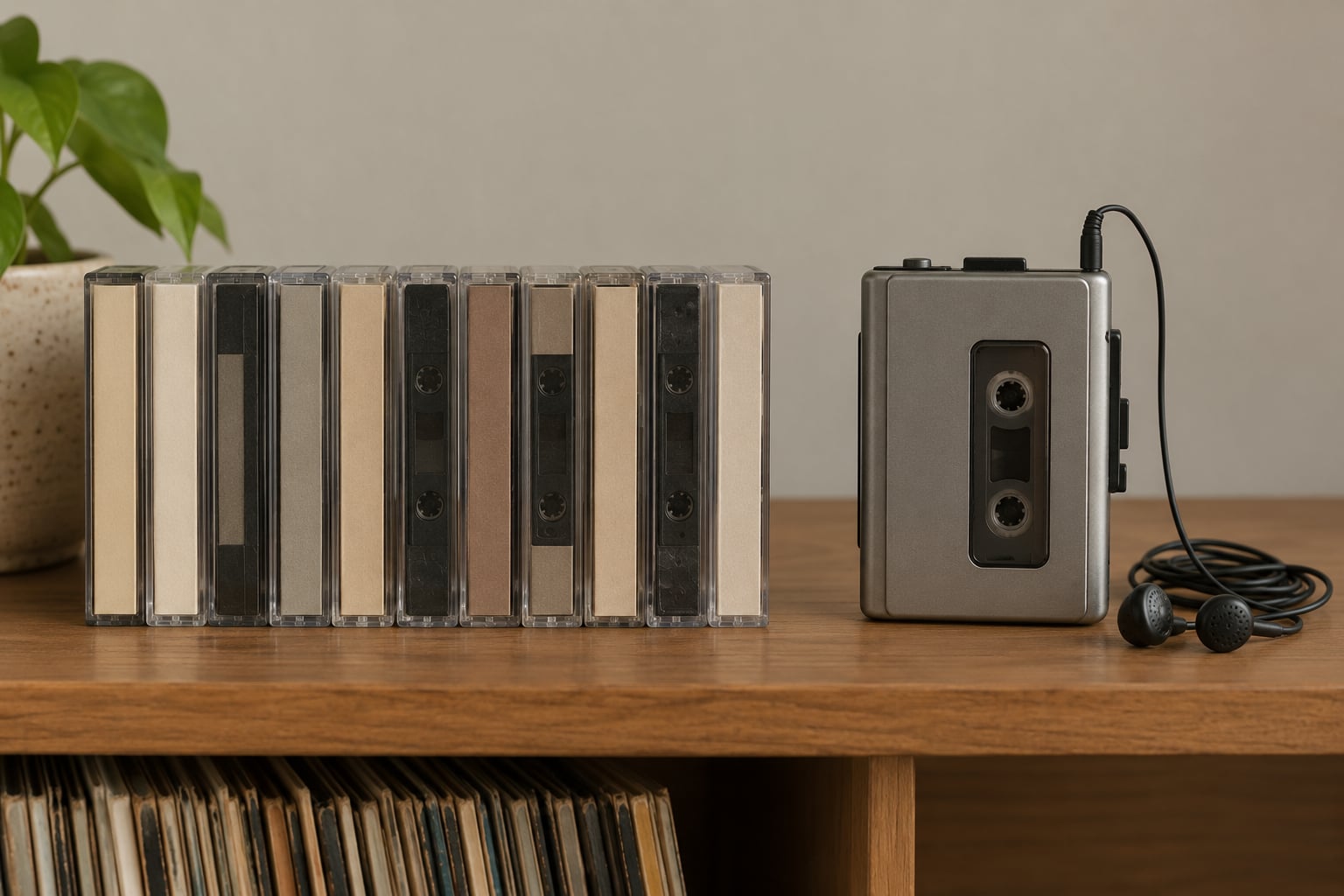
The first is continuity. Japanese households kept buying cassettes for practical reasons long after the West had moved on — karaoke practice, enka, language learning, in-car listening. Manufacturers here never fully stopped producing the hardware. Sony, TDK, Maxell, JVC, Toshiba and Sharp all retained cassette product lines, and companies like Nakamichi kept the deck tradition alive as a specialist product rather than a mass-market one.
The second is re-acceleration. A newer audience is now buying cassettes as a deliberate aesthetic and collecting choice, driven heavily by city pop, anime soundtracks and Shibuya-kei adjacent curation. Forum regulars on r/cassetteculture and Tapeheads frequently point out that the Western press treats this as a nostalgia curve, while in Japan it is better described as an old habit that gained new reasons.
This is also not the same phenomenon as the vinyl revival. Vinyl recovered on the back of record-shop culture and audiophile specification language. Cassette recovers on affordability, portability and impermanence — it is cheap to collect, small, and obviously not trying to be permanent.
It is worth being precise about the timeline, because the words get confused constantly. Cassettes never reached a moment of universal collapse. Compact discs arrived and took over the mass market, MiniDisc arrived and largely failed to take hold, and downloads arrived and removed the format’s main advantage. Through all of it, Japanese production lines for tape and players kept running because there was a domestic audience that needed them. What happened in the 2010s is that new groups started buying for reasons the older users had nothing to do with — image, curation, and the pleasure of a medium that cannot be updated.
So when you see a headline about cassettes returning, the useful question is returning to what. In Japan, mostly to a purchase that never stopped happening. Outside Japan, mostly to a shelf in a shop where the format had already been written off.
What Counts as Part of the Japanese Cassette Revival?
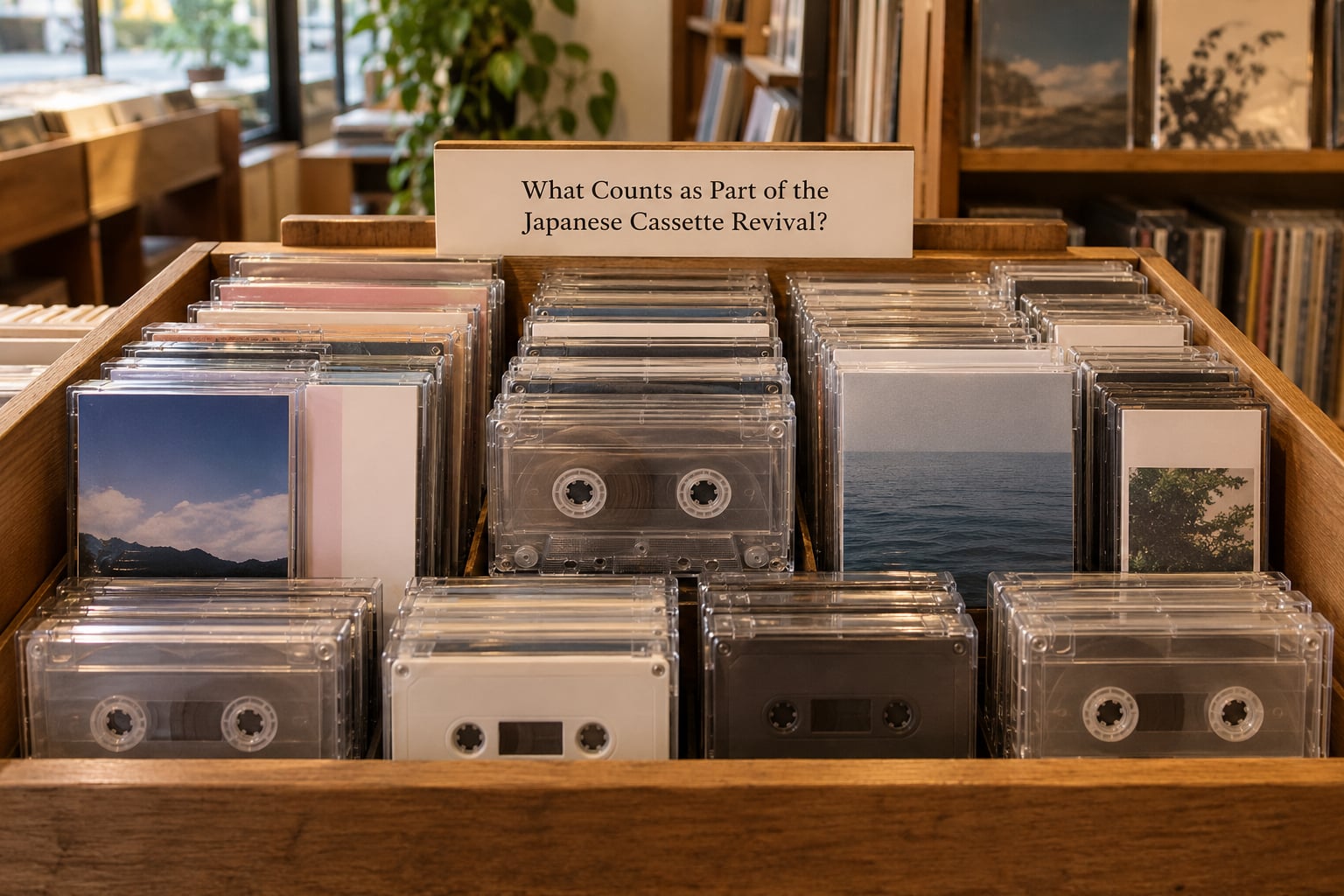
A trend only counts if it shows up in transactions, not just in photographs of people holding tapes. Four categories of evidence separate a real Japanese cassette market from a nostalgia mood.
New pressings and new pre-recorded releases. When an artist or label commits to a cassette run, that is a paid decision. The cost sits with the label: mastering, duplication, packaging, distribution and the near-certainty that some stock returns unsold. Repeated orders from the same artist matter far more than a single limited edition.
Blank tape that is actually manufactured. Blank media is the clearest demand signal in the format, because blanks are bought by people who intend to record. Japanese shelves carry Sony’s HF and successor lines alongside TDK, Maxell, Fuji and other domestic names. Retailers reorder what sells.
Hardware. Deck production is small but persistent. A new consumer deck model from a major Japanese maker is a much heavier commitment than a new blank tape, and both happened. The specialist high-end deck scene, long associated with Nakamichi and later generations of Japanese machines, continued to produce models through the period when most Western hi-fi brands had exited.
Listening events and retail presence. Cassette sections that occupy real shelf space in Tower Records, HMV and neighbourhood used shops in Shibuya, Shimokitazawa and Koenji tell you the format is being merchandised deliberately rather than incidentally.
What does not count: people photographing old tapes, a second-hand tape changing hands once, or a collector describing how much they love the format. All of that can be true while the market is contracting.
One more piece of evidence deserves separating out, because it inflates almost every published claim. A single pressing that sells out in minutes proves an audience exists for that specific object. It does not prove a market, because the run was deliberately kept small. The revival becomes a market when ordinary, unglamorous tapes at ordinary prices keep moving without any promotion at all — and that is exactly the part the Japanese domestic market has quietly supplied for years.
There is a related trap with blank media specifically. Blank tape buyers are the most committed people in the format, since they intend to record something. But committed and numerous are different things. A healthy blank tape business in Japan is partly a hobby retail business and partly a replacement business for a car deck that has eaten a tape.
Forum users make a related point often enough that it is worth repeating. The comeback framing is largely a Western media construct. In Japan, the format persisted through the digital transition rather than returning to it.
Who Is Buying and Releasing Cassettes in Japan?
Different buyers arrive at the format with different priorities, and the reasons rarely overlap. Misreading one group is how shops end up stocking the wrong thing.
| Group | What they want | What they check first |
|---|---|---|
| Older domestic users | Karaoke, enka, language learning, in-car playback | Playback reliability in a car deck, tape length, print legibility |
| Collectors | Rare pre-recorded pressings, obi strips, inserts, city pop and anime soundtrack editions | Shell condition, provenance, edition numbering, region of manufacture |
| Artists and small labels | A physical object that fans will actually keep and display | Duplication cost, minimum run length, packaging quality |
| Dedicated physical-media fans | Something tangible that is not a file and not a streaming dependency | Audio quality, blank tape formulation, deck capability |
| Younger listeners | Aesthetic and ritual, often through mixtape culture and short-form video | Design, colour, presence in a record shop, price of entry |
| Buyers outside Japan | Japanese pressings and editions unavailable through streaming | Region, catalogue number, whether the release was a genuine pressing |
The oldest group is the one Western coverage routinely ignores, and it is arguably the segment that kept the Japanese format commercially alive. Commenters on Japanese news coverage routinely describe the same reasons: an older relative who uses cassettes for karaoke practice, a car stereo that still takes them, English conversation tapes for study. Those buyers are not nostalgic in any meaningful sense. They just need the tape.
Collecting is the group that gets overestimated. They are real, they are knowledgeable, and they are also a small market relative to how loudly they are represented online. Enthusiasts point out that a collector can buy twelve cassettes for the cost of a single record, which makes cassette the cheap way into physical collecting — but cheap collecting is not the same as large-scale buying.
Artists and labels are where the aesthetic gets a commercial expression. Several Japanese and international acts have released cassette editions of recent or reissued music, and the presence of regular limited runs on Japanese streaming-store pre-order pages is a better indicator of sustained demand than press coverage is.
Younger listeners are the newest and most visible group, and their motivation is closest to pure image. r/cassetteculture regulars describe people who will not record anything buying blank tapes for the look of them, or buying pre-recorded tapes as objects. Forum consensus generally treats this as harmless rather than fraudulent, since those purchases keep physical media businesses solvent.
Blanks get bought for reasons that have very little to do with music at all. Someone putting together a recording setup for the first time, someone teaching a child what a tape is, someone building a themed set of shells for a shelf display. The physical-media fans overlap with this group, but they are the ones who will actually thread the tape through and hit record.
International buyers are the group most likely to encounter a Japan-first story that they cannot verify locally, and the one most exposed to paying too much for a listing that misrepresents a tape’s origin. Japan is one of the few places left where a pre-recorded cassette can still turn up in ordinary retail rather than only as a collector’s item, and that difference is mostly invisible from outside the country.
Why Does Japan Have Such a Strong Physical-Media Culture?
Japan’s attachment to physical media is older than the cassette trend and largely practical. Several conditions had to hold at once, and most of them were about industry structure rather than sentiment.
Domestic manufacturing never stopped. Japan’s electronics industry built cassette tape, decks and portable players at enormous scale for decades. Because the hardware was made here, the blanks were made here, and the repair knowledge stayed here. When Western buyers faced a market where blank tape had become a specialty import, Japanese buyers were still choosing between brands.
Retail density and resale infrastructure. Japan has an unusually dense layer of second-hand retail — Mandarake’s multi-floor stores, Don Quijote’s sprawling second-hand sections, and neighbourhood used shops that will happily appraise a single item. Resale has always been part of how Japanese consumers buy media, which keeps physical ownership cheap and low-risk.
Edition-focused collecting habits. Japanese buyers have long bought the same album in several formats because each version carries something different: obi strips, booklets, track listings, bonus tracks, regional bonus CDs. That habit transfers directly to cassettes, where the insert and the shell design are often the main event.
Products built to be kept. Japanese electronics were, and are, unusually durable. A deck from the late 1980s or early 1990s is still a working object in many homes, and enthusiasts on Stereo2Go and forums spend more time on belt and pinch roller replacement than on shopping for new hardware. When the object you own still functions after three decades, the argument for buying something new is weak.
Cultural weight on owning. The physical object carries status and memory in a way that streaming did not replace but diluted. Possession still means something here — which is part of why blank media keeps selling even when nobody plans to record anything.
None of this is exotic. It is the accumulated result of a large manufacturing base, a dense resale layer, and a consumer culture that never fully stopped treating recorded music as a thing you own rather than access.
The repair culture deserves its own note, because it is more visible in Japan than almost anywhere else and it is quietly doing a lot of work. Forums like Stereo2Go and SteveHoffman carry constant threads on replacing belts and pinch rollers, sourcing capacitors, and cleaning heads on machines that are three or four decades old. That kind of knowledge only accumulates where a lot of old hardware is still in daily use. Where players get scrapped, that knowledge dies with them, and the format becomes display-only. Japan’s continued domestic use has kept the repair skill alive, which in turn keeps the second-hand market useful.
Language is a quiet factor too. Much of the interesting material — Japanese cassette inserts, label design history, domestic pressing detail — exists in Japanese only. Forum users mention this repeatedly as a barrier, and it is part of why the Japan story is still told mostly from outside.
Is This a Full-Size Tape Trend or Mostly Nostalgia?
Both, in different proportions, and the honest answer separates a real buying market from an exaggerated cultural moment.
The case that it is real rests on continued domestic use and continued supply. People buy tapes in Japan for karaoke, practice, study and cars. That demand does not care about aesthetics and would survive any trend cycle. Retailers reorder what moves, and multiple brands still manufacture blanks.
The case that it is mostly nostalgia rests on where the excitement sits. The loudest part of the cassette revival online is aesthetic: short-form video, lo-fi production, colour-matched shelves, mixtape culture. That part of the movement is real but shallow, and it is the part most likely to fade when the visual language it feeds on moves on.
There is also a limit worth naming. Cassette cannot compete on convenience, and it was never going to. You cannot shuffle a tape, you cannot skip to a track, and you have to rewind. For music you already know and already love, those are tolerable — arguably part of the appeal. For discovery, they are a genuine barrier, and no amount of enthusiasm removes that.
Production cost is the other structural limit. Duplication is cheap per unit, which is why runs can stay small, but tooling, packaging design and minimum order quantities make short runs expensive for a label. That is the main reason cassette editions tend to appear for albums with an existing audience rather than as a discovery format.
One thing that does not transfer cleanly is the cassette’s sound reputation. Plenty of first-time buyers arrive expecting the warm tape sound that Western writing promises, then find that a cheap deck and a duplicated pressing sound thin and hissy. That disappointment has nothing to do with Japan. A clean, aligned deck playing a well-preserved tape is a different experience, and most of the gap comes from the machine rather than the format.
How Do New Japanese Cassette Releases Reach Buyers?
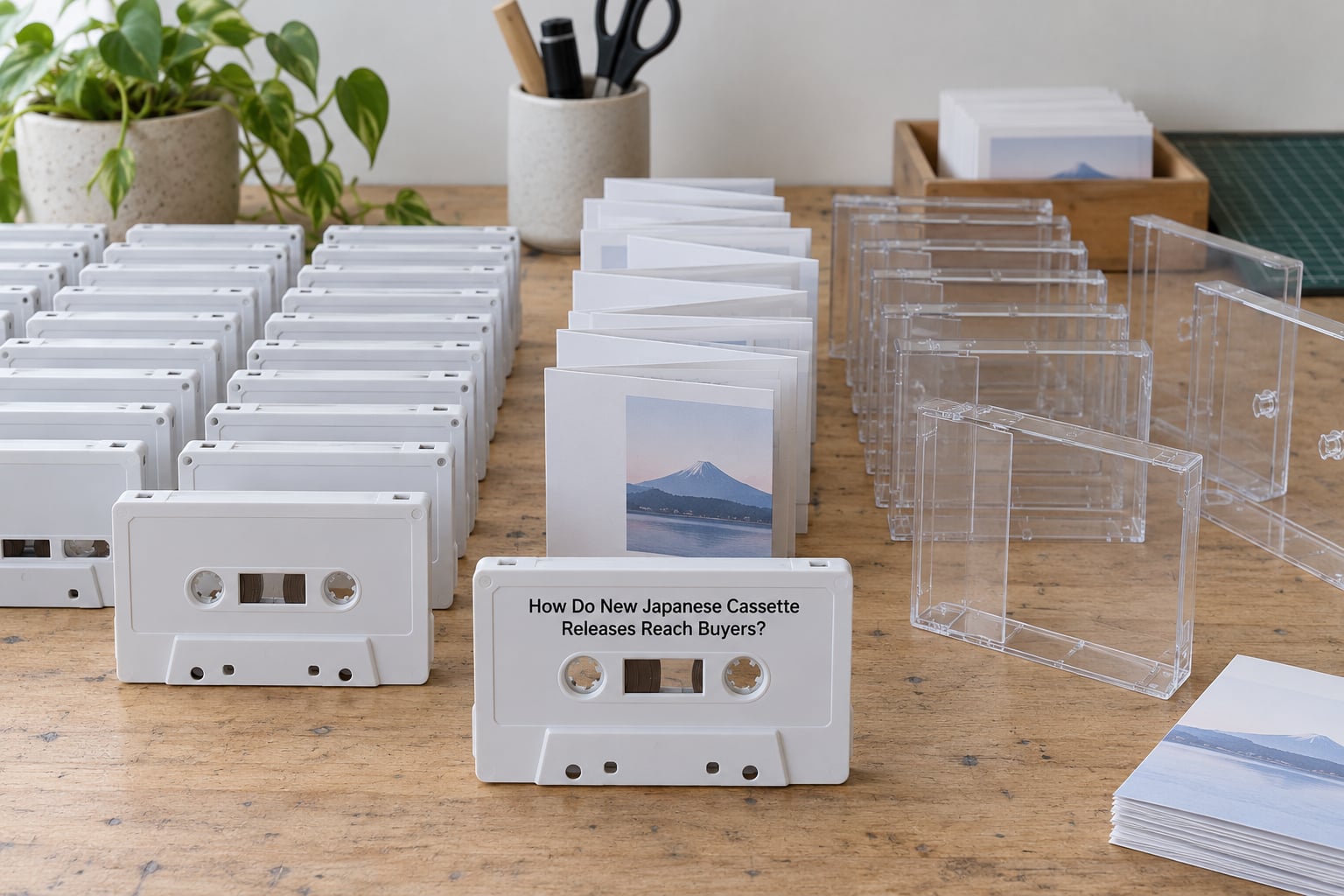
The route from an album to a cassette in Japan runs through a small number of predictable steps.
An artist or label decides the release fits the format — usually a reissue, a catalogue anniversary, an album with a strong physical edition history, or a record where the tape version is the object as much as the audio.
The album is mastered, and a duplication plant converts the master onto tape at the intended playback speed. Speed matters: duplication at twice the playback speed changes the noise floor and the head alignment required on playback, which is why professional pressings sometimes sound different from home recordings.
Shells are loaded, typically with duplicated inlays showing track order, running time and label credits. Japanese pressings have a strong reputation for inlay design, and enthusiasts argue at length about insert quality — it is one of the areas where Japanese cassette releases are often judged to beat Western equivalents.
Packaging follows, sometimes with obi strips and sometimes in a simple clear case. Limited editions add numbering or a bonus insert.
Distribution runs through specialist and general retail: Tower Records and HMV for major releases, local CD shops and used shops for the long tail, and online marketplaces for everything else. Mandarake and Don Quijote handle both new old stock and second-hand copies, which is where most collectors actually find anything.
Cassette singles exist in the same way singles always have — a two-track shell that some Japanese pressing plants produced in quantity — and they were the format’s cheapest, most convenient physical product for decades. Some labels still use the term; some just mean a short promotional run. Do not assume every “single” edition is a mass-market pressing.
None of this makes the market large. It makes it consistent, which is a different and more durable thing.
How Can You Tell Whether the Revival Is Sustainable?
Judge the trend by tracking behaviour over years, not by counting announcements. Several indicators are worth watching, and each one can be checked without any insider access.
Repeat pressings from the same artist. One limited edition is a marketing event. A label that reissues the same tape years later, or commissions a second run, is telling you the first one moved. This is the single clearest signal.
Distribution widening. A release that appears only in one online pre-order shop is a limited experiment. A tape that moves into physical retail chains and then into the second-hand trade has cleared the bar ordinary products clear.
Consumer prices in the used market. Follow what finished Japanese tapes sell for over time. A healthy market produces steady, ordinary prices. A market that is being artificially inflated produces rare and volatile ones, and that is where buyers get hurt.
New player models. New decks are expensive to design and manufacture, so their appearance is a slow but reliable signal. The most meaningful development for newcomers is not flagship hardware but the continued existence of simple, reliable, serviceable machines.
Whether club and event communities persist. Listening events, tape-swap meetups and physical-media communities that still meet in three years are worth more than any article about the trend’s popularity.
Whether the practical market stays intact. If karaoke, language-learning and in-car demand continues, the format has a floor beneath it that no trend cycle can take away.
Be equally careful with the opposite evidence. Social media volume is not sales. A viral video of someone recording a mixtape tells you almost nothing about whether anyone is buying tapes in Tokyo this month.
There is a practical test that costs nothing: look at what happens when attention moves on. If a shop that had a whole cassette wall quietly shrinks it over two years, the format was riding attention rather than demand. If the wall stays the same size through a trend cycle, there is a customer base underneath it that is not coming from social media.
And watch the unglamorous end of the market. Karaoke venues, driving-in style listening, study materials and language courses use cassettes constantly and are never going to post about it. Their persistence is the least interesting thing in the trend and the strongest evidence that the format has a floor.
What Does the Revival Mean for Listeners and Collectors?
For anyone new to this, the practical side matters more than the argument about warmth. Here is how to approach it without wasting money.
Decide whether you are listening or collecting. These are different hobbies with different costs. Listening is cheap: a serviceable deck, a few blank tapes, and music you already own digitally. Collecting is expensive and volatile, because the same format can contain both a common pressing and a genuinely scarce one.
Buy a deck that is easy to service. The most common newcomer regret is a beautiful machine that needs work. Belts, pinch rollers and lubrication are routine items, but on a complicated deck they are harder. Forums consistently recommend a simple, mechanical, well-documented mechanism over a feature-rich one. A used Nakamichi, Sony or Toshiba deck with a known service history is a reasonable target, but check the transport before anything else.
Check head compatibility before buying tape. Many decks are calibrated for Type I and Type II and handle older Type IV metal tapes poorly. Know what your machine is set for before you buy a box of the wrong formulation.
Start with Type I. Ferric oxide Type I is the compatible default, the cheapest and the least fussy. Type II, usually chromium dioxide based, gives better high-end on a deck that supports it. Type IV metal is the specialist option and the most likely to disappoint on an average machine.
Verify what you are buying. On Japanese pre-recorded tapes, check the catalogue number, the region code and the obi strip, and compare them against the label’s discography. Ask whether the insert is original to that pressing or a reprint. Plenty of listings online describe Japanese pressings without being specific enough to verify.
Store tapes properly. Heat and humidity are the real enemies, and the common mistake is leaving tapes in a car or a garage. Play them occasionally rather than storing them indefinitely, keep them away from direct sun, and treat any tape that has been somewhere hot as suspect.
Set your budget before you fall into the collector habit. Forum users are candid that vintage Japanese city pop and anime soundtrack tapes have climbed hard, and that most regret comes from buying a graded copy of something common. If the edition does not genuinely interest you, it is an expensive decoration.
One last piece of reassurance for the buyers who feel foolish for it: the ritual is the point. The rewind, the committed track order, the physical handling — enthusiasts across r/cassetteculture, Tapeheads and AudioKarma argue about this more than they argue about measured fidelity, and they are usually right about what makes the format worth the effort.
On the sound itself, the enthusiasts split between purists who think analog is measurably better and pragmatists who think it is mostly an aesthetic. Both camps describe the same practical reality: home recordings on good blank tape often sound better than most commercial pressings, because duplicated tapes carry a higher noise floor. If you record your own material on a decent Type I or Type II tape and play it back on a clean deck, you will hear something quite convincing, whatever the debate says.
Frequently Asked Questions
Is the Japanese audio cassette revival real?
Yes, but the framing matters more in Japan than elsewhere. Outside Japan the cassette is usually described as a comeback, as though it died and returned. In Japan it never fully left: manufacturers kept producing blanks and players, and domestic users kept buying for karaoke, enka, language learning and car stereos. What is new is a second wave of buyers treating tape as a collectible object, driven by city pop, anime soundtracks and retro aesthetics.
Why are young people in Japan interested in cassette tapes?
Mostly for the look and the ritual rather than the sound. Younger listeners buy cassettes as physical objects, use them to build mixtapes, and treat them as part of a broader retro-media aesthetic that shows up heavily in short-form video and lo-fi content production. That group is real and it keeps physical media businesses trading, though it is shallower than the persistent practical market of older users buying tapes for karaoke, study and in-car playback.
Are Japanese cassette releases mainly for collectors?
No. Collectors are the most visible group online but a small part of the market. Most Japanese cassette demand comes from people using tapes for a purpose: singing practice, learning English, listening in a car, or recording from radio. New releases also serve existing fans of a specific album rather than functioning as a discovery format, because cassette offers no way to skip tracks and cannot compete on convenience with streaming.
How are Japanese audio cassettes different from vinyl records?
The differences are practical rather than sonic. Cassettes are far smaller, cheaper and far more shock-resistant, so a car or a bag is a safe place for them while a record needs care. Collecting is also an order of magnitude cheaper per album, though that cuts both ways, because cheap editions are easy to mass-produce and hard to make scarce. Japanese cassette pressings are frequently praised for their insert and inlay design rather than for audio superiority.
What should I check before buying a used cassette player?
Check the transport first. Play a tape you know well and listen for slipping belts, uneven speed, and mistracking that worsens as the tape plays. Look for a service history and confirm replacement parts such as belts and pinch rollers are still available for that model. Check the head compatibility, since many decks handle Type I and Type II well but play older Type IV metal tapes poorly. A simple, well-documented mechanism is easier to maintain than a feature-rich one.
Conclusion: What to Look For First
The Japanese audio cassette revival is real, and the useful way to read it is as a surviving format that gained new reasons rather than a dead one that came back.
If you want to judge it yourself, look at four things: whether the same artists keep reissuing on tape, whether the cassettes actually turn up in ordinary shops rather than only online, whether used prices stay ordinary over years, and whether players keep getting made and serviced. The practical domestic market underneath all of it — karaoke, study, cars — is what gives the trend a floor.
Start small. A serviceable deck, a box of Type I blanks, and one release you genuinely want. Everything else can wait.