Vinyl never died in Japan because the CD era never tore out the physical ecosystem underneath it. Record shops stayed open, pressing plants kept their engineers, and CD-era pricing taught consumers that owning music was worth paying for, so streaming later became one more way to buy rather than the thing that had to replace ownership.
The result is a market Western observers keep calling a revival, when it is more accurately a thirty-year non-collapse. That distinction matters, because the usual story about vinyl assumes a global format death that Japan simply skipped.
Here is what actually held the format up, drawn from RIAJ production figures, the retail map of Tokyo and Osaka, and what collectors in vinyl forums consistently report about buying records there.
Table of Contents
- 1Why Vinyl Never Died in Japan at a Glance
- 2What kept vinyl alive in Japan?
- 3Why vinyl never died in Japan: the physical and cultural advantages
- 4How Japan’s music retail and media system supported vinyl
- 5Why did vinyl decline elsewhere but persist in Japan?
- 6What role did collectors, artists, and urban culture play?
- 7Is vinyl growing in Japan now, or is it a nostalgia effect?
- 8Frequently Asked Questions
- 9Why did vinyl survive in Japan when it declined in many other countries?
- 10Is Japan’s vinyl revival mainly nostalgia or a new music format?
- 11What makes Japanese record shops important to vinyl’s survival?
- 12Do young people in Japan still buy vinyl records?
- 13How does Japan’s music culture connect vinyl with artists, fashion, and technology?
- 14Is vinyl actually more popular than CDs or streaming in Japan today?
- 15Conclusion
Why Vinyl Never Died in Japan at a Glance
Six forces did the work. None of them is nostalgia on its own, and each one still shows up in 2026 retail behaviour.
| Force | What it looks like in practice | Why it protected the format |
|---|---|---|
| Physical media habit | Albums, singles and editions bought as objects | Ownership was already normalised before streaming arrived |
| Retail density | Tower Records, HMV, Disc Union, Shimokitazawa shop streets | Somebody was always open nearby to sell the format |
| Listening venues | Kissaten and jazz kissa with serious turntables | A daily ritual that needs physical records to work |
| Collectible demand | Limited editions, obi strips, inserts, coloured variants | Objects with scarcity and provenance, not just audio |
| Secondhand circulation | Shops that buy, grade and resell used records | A cheap entry point that keeps new buyers in the hobby |
| Chart visibility | Physical sales counted on the Oricon and RIAJ charts | Buying a record still moved an artist up a chart |
Two numbers frame everything else. RIAJ production figures show a peak of roughly 200 million records in the late 1970s, a low of about 100 thousand records in 2009, and a rebound to roughly 1.22 million records in 2019. That last figure is roughly twelve times the 2009 low, and it is still a rounding error against the late-1970s peak, which tells you something important about how this story should be read.
What kept vinyl alive in Japan?
The short answer is a combination of habit, infrastructure and an unusually durable appetite for editions. Japan never had a moment where physical music became worthless, so the format was never pushed into the bargain-bin status it reached in the United States and parts of Western Europe.
That bargain-bin status is the key. In America, the CD killed vinyl commercially, and by 1990 vinyl accounted for something like 4 percent of record industry sales. Discs that had been worth collecting became five-cent leftovers, and the collector base that would later drive the US revival learned during those years that physical music was cheap and disposable. Japan never ran that experiment at scale.
What Japan ran instead was a long period of expensive physical media, and collectors on vinyl forums make the connection bluntly: high prices for years is exactly what kept people buying discs rather than treating them as throwaway.
Why vinyl never died in Japan: the physical and cultural advantages
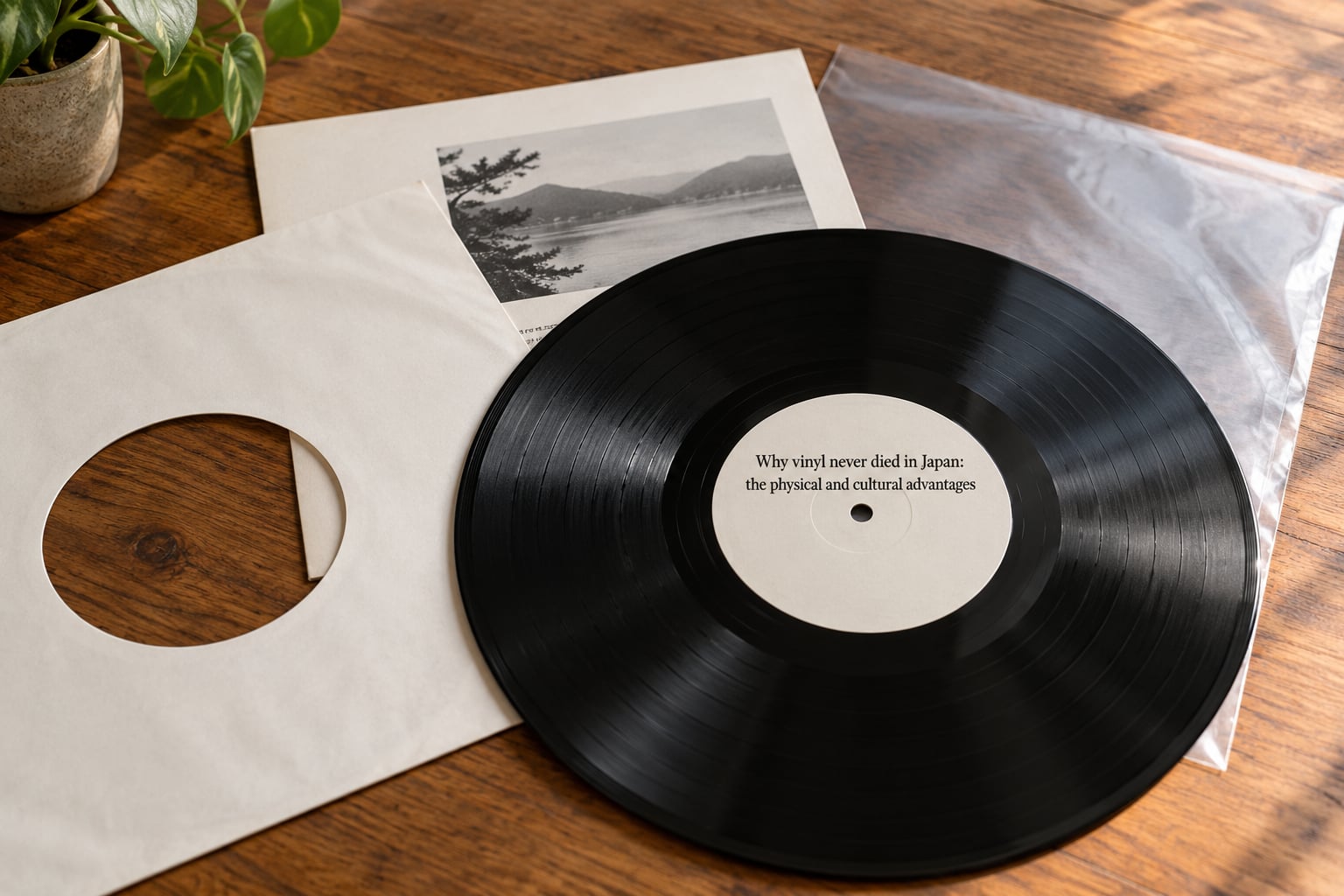
An album in Japan could function as an object long before anyone used the word collectible. The sleeve is printed on heavy stock, an obi strip runs across the front with catalog and pricing details, and the insert holds translated lyrics and photography. Pulling that disc out is a physical act with a sequence: remove the outer sleeve, slide the record, read the obi, put a needle down.
Collectors on r/vinyl and the long-running StereoNET threads describe Japanese pressings the same way, without any coordination between them. Heavier sleeves, textured paper stock, inserts that include translations, and a disc that feels like it has weight to it. None of that is about audio fidelity and all of it is about identity.
Limited runs matter more here too. Numbered pressings, coloured variants and obi-strip packaging turn a purchase into a small event with a date on it, and Japanese buyers are used to standing in a queue for an edition at the same time they would queue for anything else.
How Japan’s music retail and media system supported vinyl
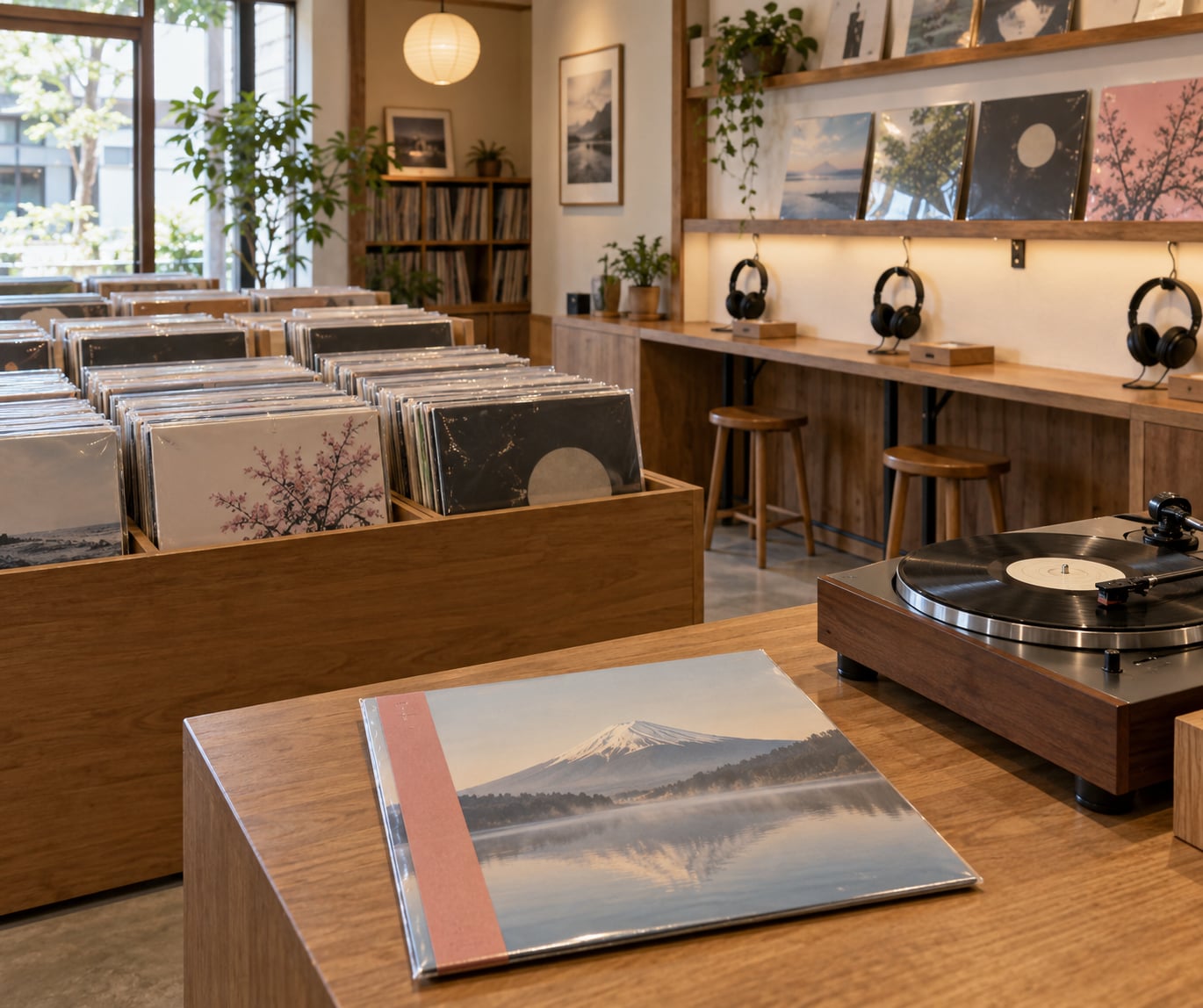
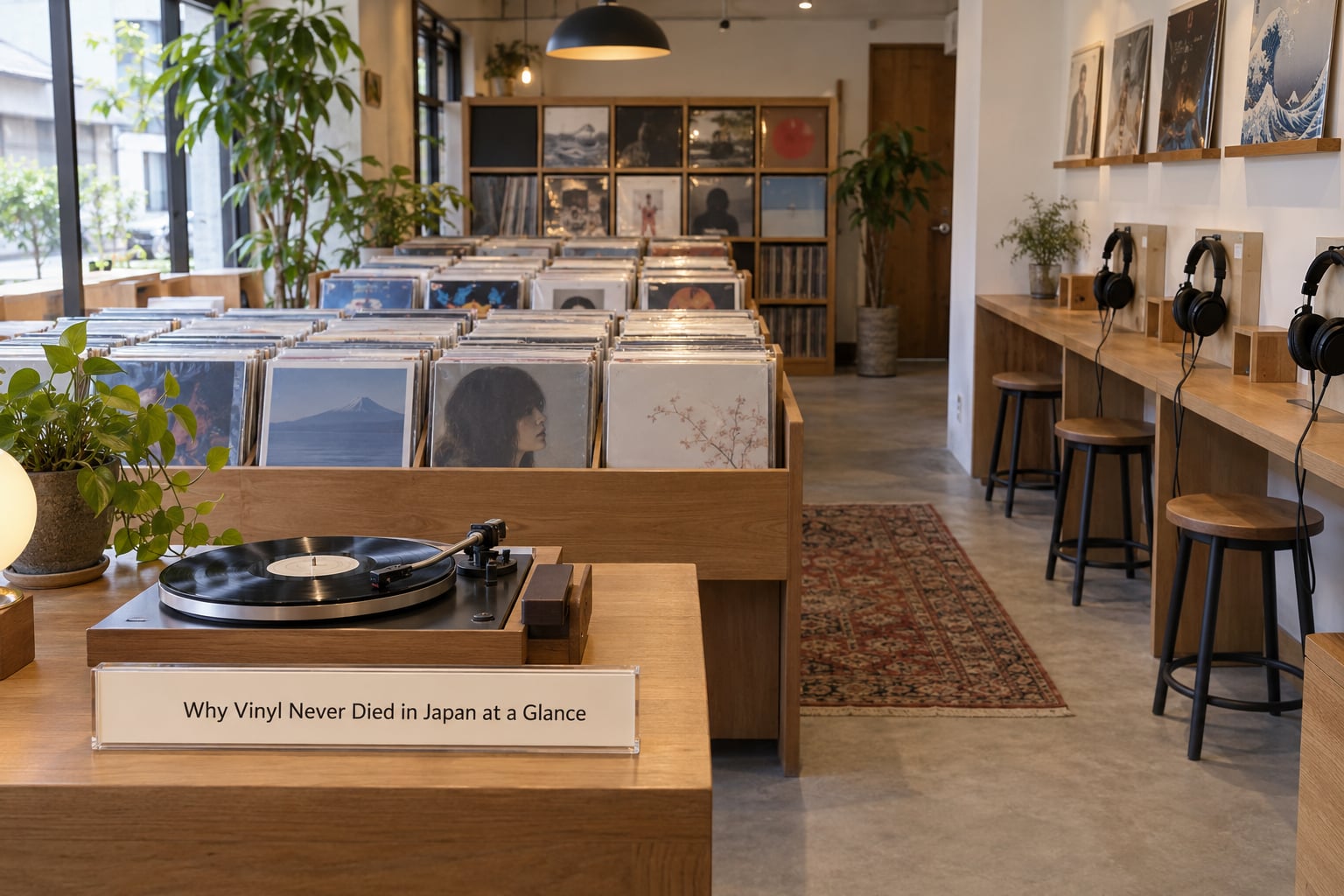
The retail map is the part most often skipped, and it explains more than any cultural theory. Tower Records alone built a flagship Shinjuku store whose vinyl floor opened in March 2019 carrying roughly 70,000 items, a physical commitment that would be absurd in a market that had already lost the format.
Chains are only half of it. Disc Union and a spread of independent shops fill Shimokitazawa, Koenji, Nakameguro and the back streets around Shibuya, and the independents are where the real curation happens. Staff at those shops recommend records in a way that streaming algorithms structurally cannot, because a person who has played something knows whether it holds up.
Buying and selling used is the other half. Shops across Japan buy collections, grade condition themselves, and resell at a price a beginner can absorb. That secondhand channel lowers the cost of getting into the format at fourteen or twenty, which matters more than any marketing campaign for what happens twenty years later.
Distribution follows the same durable pattern. Mail order and online retail were not bolted on after the shops; they grew out of the same CD-era infrastructure, so ordering a record online in Japan looks a lot like ordering one anywhere else. Forum users buying from Japan note that domestic editions usually cost less inside the country, which is why visitors and long-term residents stock up while they are there.
Then there are the charts. Physical sales were and still are counted toward Japanese chart positions through RIAJ and Oricon reporting, so buying a record was a visible act that moved an artist. Streaming arrived in a market where the physical purchase had not been demoted to a rounding error.
Why did vinyl decline elsewhere but persist in Japan?
It did decline elsewhere, and the contrast is worth stating plainly rather than treating Japan as an exception to a natural rule. Format death is not inevitable. It depends on infrastructure, pricing, retail density and whether anyone is still selling the thing on a Tuesday afternoon.
Timing does a lot of the work. Japan got its CD boom at enormous scale, and the industry built pressing plants, distribution and manufacturing expertise around physical production of a very high standard. Those same facilities were still standing when streaming arrived, and the knowledge inside them was still intact.
Pricing did the rest. Japanese physical media stayed expensive for long enough that buying a disc felt like a real purchase rather than a reflex. That sounds backwards until you look at the outcome: a consumer who has never seen a format go from expensive to worthless has no reason to treat the next format shift as a reason to stop buying.
Demographics matter less than people expect. The stereotype that vinyl in Japan is only for elderly collectors misses the fastest-growing part of the buyer base. What keeps younger listeners in the format is closer to shopping than to nostalgia, which is another reason the habit holds.
It is also not a clean national story. Japan’s physical share of the music market remains high by international standards, and its physical charts are dominated by album and single packages that include collectible components. Other markets moved straight from physical to paid downloads to streaming. Japan took the long route, and the long route left the infrastructure intact.
What role did collectors, artists, and urban culture play?
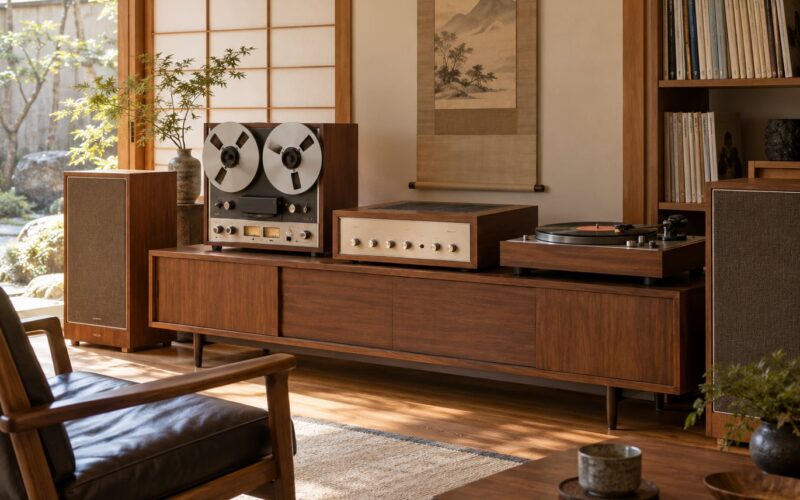
The kissaten is the piece most often used as an anecdote and rarely used as an explanation. A kissaten, or 喫茶店, is a coffee shop; a jazz kissa, or ジャズ喫茶, is a coffee shop built around records and a serious sound system, where the customer sits, orders, and plays an album start to finish. Tokyo has been the reference point for that format, with Osaka and Kyoto running their own scenes.
That matters because the ritual requires the record. You cannot stream an album to a room of strangers without ruining the point of the room, so these venues generate ongoing demand for physical media in a way that has no digital equivalent. They are small businesses, and there are only so many, but they have existed for decades and they are not going away.
Collectors then supply the second engine. Condition grading, matrix runouts, country-of-press markings and the presence or absence of the obi strip are all things regular buyers check now, which tells you how much of the market is repeat purchasing rather than casual browsing. Verified receipt or provenance shows up in secondhand buying conversations for the same reason.
Artists and local scenes keep feeding it. New releases on vinyl remain a normal release channel for J-pop, and anime, game and idol tie-ins add fans who buy records the way they buy other merchandise. Limited edition variants and lyric cards sit comfortably beside numbered anniversary pressings, and all of them are sold in the same shops by the same staff.
There is also an export effect. Collectors in London, New York and Berlin pay premiums for Japanese pressings, and Japanese packaging has become a visual reference point for listening culture abroad, which feeds back into the local market as something worth owning.
Is vinyl growing in Japan now, or is it a nostalgia effect?
Both, and separating them tells you more than arguing about labels. The revival is real: HMV footfall and store results improved visibly through the resurgence, Record Day on 3 November is promoted with about 30 participating music companies, and reissues, anniversary editions and coloured variants keep bringing listeners who never bought a record before.
The nostalgia layer is real too, mostly Showa-era material that a new buyer can put on a shelf without much context. That is a perfectly healthy version of the hobby, but it does not by itself explain why someone walks into a Shibuya shop and spends on an album by an artist they have never heard of.
So the honest counter-case: rising prices are pushing some buyers out, and forum users put it bluntly in the other direction, saying vinyl will die again from what records cost. The format survived its first death partly because it stayed cheap enough to enter. If entry prices keep climbing, the mechanism that saved it in Japan starts working against it.
What that means practically is that the surviving core is likely to be the same thing that sustained it: new releases, reissues, tie-ins and listening venues, supported by a secondhand market that keeps entry affordable.
Frequently Asked Questions
Why did vinyl survive in Japan when it declined in many other countries?
The short version is infrastructure. The CD boom in Japan built pressing plants, retail chains and manufacturing expertise that never shut down, and CD-era pricing kept physical media valuable enough that streaming became an addition rather than a replacement. Vinyl never had a decade of bargain-bin leftovers that would have trained a whole generation to treat records as disposable.
Is Japan’s vinyl revival mainly nostalgia or a new music format?
Both at once, and the split is not clean. Nostalgia drives demand for Showa-era reissues, while new listeners buy current album and single releases on vinyl as a normal release channel, often alongside streaming. The more useful question is not whether nostalgia is involved, but whether new-release physical sales are commercially real, and retailer results and chart reporting suggest they are.
What makes Japanese record shops important to vinyl’s survival?
They are the point of sale, the recommendation engine and the secondhand market at the same time. Tower Records, HMV, Disc Union and independent shops across Shimokitazawa, Koenji and Shibuya stayed open through the CD era, and their staff still recommend music in person. Buy and sell operations in those stores keep the cost of entering the hobby low for beginners.
Do young people in Japan still buy vinyl records?
Yes, though the reasons are less romantic than people expect. For many of them vinyl is closer to a purchase format and a physical product than to a nostalgia object, and anime, game and idol tie-ins bring fans who buy records the way they buy other merchandise. That buying behaviour is what keeps the format commercially live rather than ceremonial.
How does Japan’s music culture connect vinyl with artists, fashion, and technology?
Limited editions, coloured variants, numbered pressings and elaborate packaging sit at the intersection of music, design and retail, so a record release often looks like a small product launch. Artists still treat vinyl as a real channel, shops stage events around new releases, and listeners meet those releases in listening venues where a turntable is the point of the room.
Is vinyl actually more popular than CDs or streaming in Japan today?
Physical media still outsell streaming in Japan, which is unusual among large music markets and comes from a long CD history rather than a recent vinyl boom. Vinyl specifically remains a small slice of a physically large market. Comparisons with the United States are misleading because the US moved from physical to downloads to streaming while Japan built up its physical base first.
Conclusion
Why vinyl never died in Japan comes down to continuity. The CD era made physical music expensive and high quality rather than cheap and obsolete, and the shops, plants and listening venues built during that period stayed standing when streaming arrived.
Three things are worth checking first if you want your own answer. Look at how many record shops are still trading in a single Tokyo district. Look at what a Japanese limited edition physically contains, from the obi strip to the insert. And notice that a turntable in a coffee shop is still a normal place to spend an afternoon.
Whether vinyl in Japan keeps growing is a different question from whether it survives, and right now the honest answer is that rising prices are the live risk, not silence.