Why OLED panels come from Asia? The short answer is that the machines, the chemicals and the engineers who know how to run them are almost all in Northeast Asia, and an OLED production line costs billions with a yield ramp measured in years. Samsung Display, LG Display, BOE, TCL CSOT, Visionox, Tianma, Japan Display and AUO all fabricate panels in South Korea, China, Japan and Taiwan, and nearly every one of them buys its vacuum tools from the same small group of Japanese and Korean suppliers.
That is a useful mental picture for anyone who has wondered why a phone assembled in Vietnam still carries a panel from Korea, or why Japanese companies that invented the technology mostly stopped making it. The screen in your hand is the end of a very specific, very Asian chain, and it is not that way by accident.
Table of Contents
- 1Why OLED panels come from Asia
- 2Which Asian countries produce OLED panels?
- 3Why OLED panels come from Asia: who supplies what
- 4How are OLED panels manufactured?
- 5What manufacturing advantage does East Asia have?
- 6Why is OLED production difficult to start outside Asia?
- 7How important are South Korea, China, Japan, and Taiwan?
- 8Are OLED panels made entirely in Asia?
- 9Could OLED production move to other regions?
- 10What does this mean for OLED prices and availability?
- 11Frequently Asked Questions
- 12Which country makes the most OLED panels?
- 13Why does South Korea lead OLED display manufacturing?
- 14Are OLED screens only made in Asia?
- 15What role does Japan play in the OLED supply chain?
- 16Can OLED panels be manufactured in Europe or North America?
- 17Will production outside Asia make OLED displays cheaper?
- 18Conclusion
Why OLED panels come from Asia
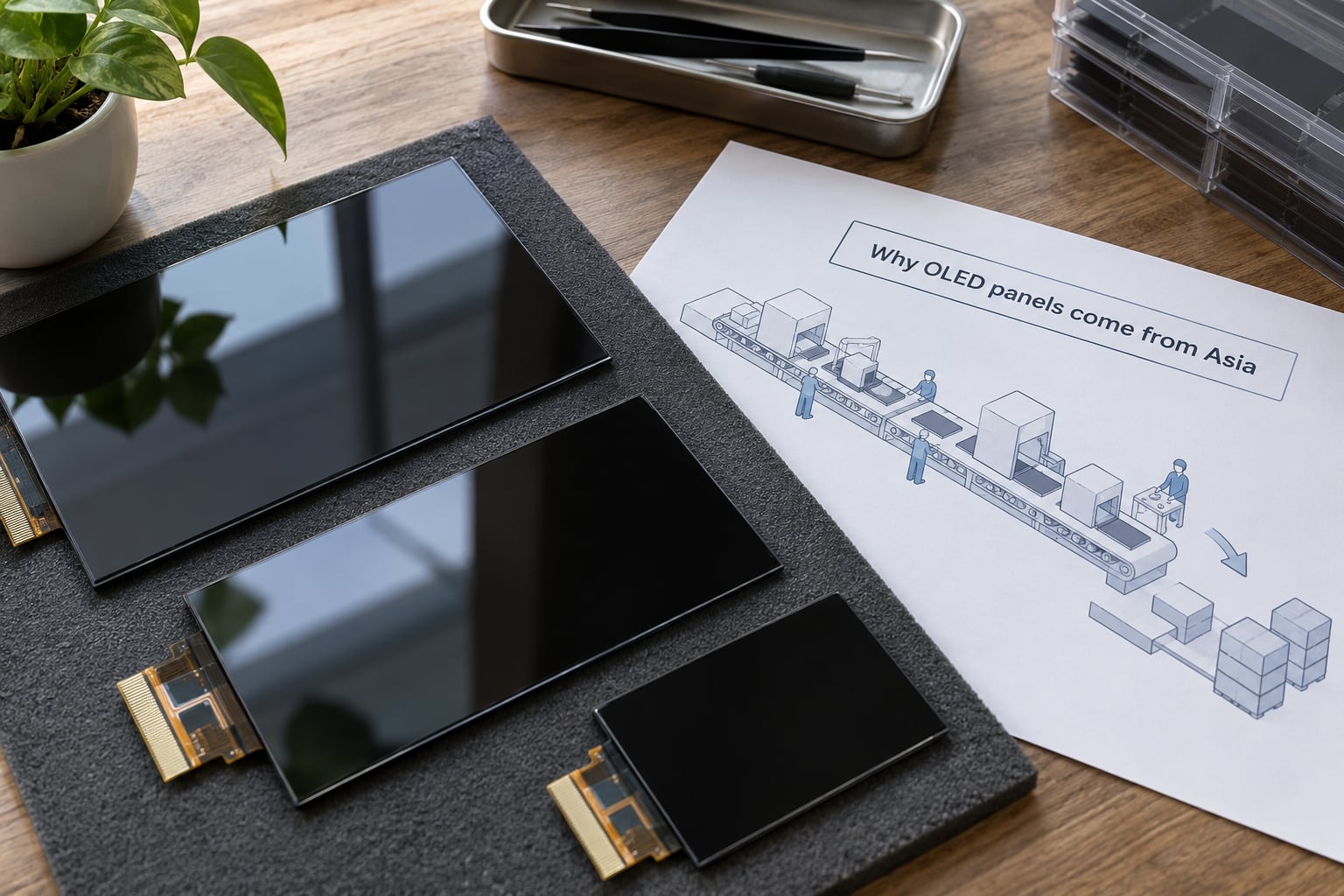
Why OLED panels come from Asia boils down to six reinforcing reasons that took roughly three decades to build, and each one makes the others harder to copy. None of them is about labour cost or geography in the romantic sense. They are about tooling, chemistry, capital and time.
- The equipment is made in Asia. Evaporation systems, fine metal mask tooling, deposition and inspection gear for flat panel displays are dominated by Japanese and Korean vendors. IHS Markit reported in 2019 that Japanese companies held more than half of the flat panel display equipment market. Chinese toolmakers like CETC are now pushing into LG Display’s supply base, which shows how much leverage that dependency creates.
- The materials are made in Asia. Organic emitter compounds, polyimide flexible substrates, thin film encapsulation layers and high quality driver integrated circuits are mostly developed and produced in the same region. You cannot make an OLED without them.
- A fab costs billions and takes years. A generation 6 or generation 8.6 line for OLED represents a capital outlay in the billions, and depreciation only comes down when the line runs at high volume.
- Yield is the whole game. Almost every organic layer is deposited in a vacuum at nanometre scale. A speck of dust or a misaligned mask ruins a whole sheet, and the only way to reach high yield is to climb the learning curve with the same process, on the same tools, over years.
- The clusters compound. Component suppliers, chemical plants, module makers, packaging houses and equipment engineers sit within a few hours of the fab. When something goes wrong on a line at 2am, someone is nearby who has seen it before.
- Policy has pushed in the same direction. Korean, Japanese, Taiwanese and Chinese governments have all treated displays as strategic industry. That keeps capital and engineering talent flowing into the same region.
Which Asian countries produce OLED panels?
Why OLED panels come from Asia: who supplies what
| Region | Role in the chain | Main panel makers |
|---|---|---|
| South Korea | Smartphone and tablet panel fabrication, large-area and automotive panels, driver ICs, panel production equipment | Samsung Display, LG Display |
| China | Fast-growing smartphone and tablet panel capacity, rising mid-to-large panel capacity, local equipment and material substitution | BOE, Visionox, TCL CSOT, Tianma |
| Japan | Evaporation and deposition equipment, fine metal masks, organic emitter and packaging materials, glass substrates, and some remaining panel production | Canon Tokki, JDI, Sharp |
| Taiwan | Panel assembly and back-end module work, driver IC design, touch and packaging integration around imported or locally made glass | AUO, Innolux |
These are not four interchangeable stages of one simple chain. Japan is largely an equipment and materials supplier that reduced its own panel output, while South Korea and China compete directly at the panel fabrication stage and Taiwan does more of the back-end work that turns a finished cell into a usable display module.
How are OLED panels manufactured?
Understanding the process explains why the barriers exist. An OLED panel has no backlight. Each pixel is its own light source, made from a thin film of carbon-based organic molecules that glows when current passes through them, which is why the technology is genuinely organic rather than marketing language.
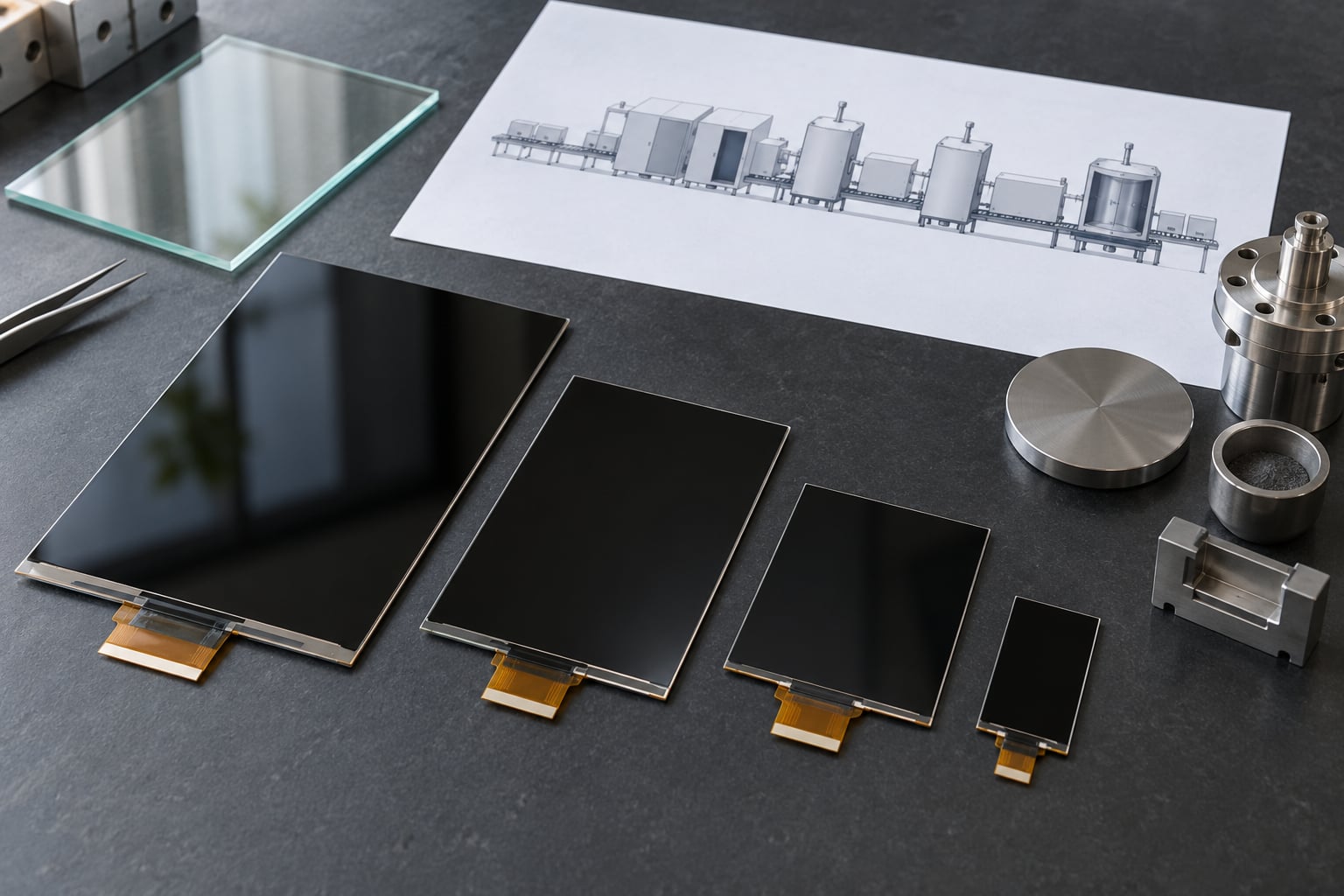
- Substrate preparation. A glass or flexible polyimide sheet is cleaned, treated and inspected. On flexible lines the polyimide is deposited and cured on the glass carrier before the carrier is peeled away later.
- TFT backplane fabrication. The transistor circuitry that switches each pixel is deposited and patterned onto the substrate. Low temperature polycrystalline oxide backplanes are widely used because they need less heat, which suits flexible substrates.
- Thin film deposition of organic layers. Organic emitter, transport and injection layers are evaporated in a vacuum through a fine metal mask, a perforated metal stencil with holes smaller than a pixel pitch. Every deposited atom has to land in the right place.
- Electrodes and sealing. Metal or transparent electrode layers go down, then the stack is capped with ultra-thin encapsulation so that oxygen and moisture, which destroy organic emitters, cannot reach them.
- Back-end module integration. The panel is laser cut, bonded to a driver circuit and driver ICs, laminated with touch and polariser layers, and tested pixel by pixel.
The steps that create the moat are deposition and encapsulation. They demand vacuum systems that hold pressure at extreme levels, masks that stay aligned for hours, and encapsulation layers thin enough to keep the panel flexible but thick enough to keep water out. IHS Markit in 2019 put Japanese vendors above half of flat panel equipment share, which means most of the world’s OLED capacity, wherever it is physically located, was built with tools from one region.
What manufacturing advantage does East Asia have?
The advantage is not one thing. It is a set of things that happen to be stacked in the same geography, and each layer makes the others more effective.
Process knowledge is the first. The recipe for stacking organic layers a few nanometres thick is written down in equipment settings, not in textbooks, and it has been refined by Korean and Chinese makers running nearly identical lines for years. A new operator can buy the same tools and still spend two or three years getting comparable yields.
Capital comes second. Large capital budgets let Korean and Chinese firms run several lines at once, absorb a poor yield year, and price below a newcomer who is still ramping. Scale in panel manufacturing compounds quickly, and so does scale in the surrounding supplier base.
Dense component ecosystems come third. Encapsulation film, mask parts, driver ICs, polarisers, touch sensors and the machine tools that handle glass all exist nearby. When a line has a yield problem, a supplier engineer can often be on site the same day.
Why is OLED production difficult to start outside Asia?
There are four barriers, and they arrive together rather than one at a time.
- Capital cost. A single OLED line runs into the billions, and most of that is equipment. Government subsidy can cover part of the bill, but not the operating losses during a multi-year ramp.
- Supplier absence. You cannot order an OLED evaporation tool, an organic emitter compound or a polyimide film from a supplier that has never made them at scale. The supplier base itself has to exist first.
- The yield learning curve. Early production runs produce defective pixels, and a plant that ships panels without defects being traced to the customer destroys its own reputation. Forum discussion on r/hardware and Asian hardware boards has covered the workaround Chinese makers have used, where extra panels are included with an order to cover defect rates. It tells you how hard the yield problem is to solve commercially.
- Talent. Engineers who have climbed the yield curve on real production lines are rare and mobile. That mobility is exactly how Chinese makers accelerated, and it is also why the pattern is hard to break anywhere else.
How important are South Korea, China, Japan, and Taiwan?
South Korea dominated OLED long before China was a serious competitor. Omdia figures reported in 2024 put Korean OLED share at roughly 90 percent in 2019 and below 60 percent by 2024, with Chinese makers moving past 40 percent in the same period.
By 2024, China accounted for 50.7 percent of smartphone and tablet OLED shipments against Korea’s 49.3 percent, a figure widely cited in Asian hardware forums. Korean firms have not lost everything, though. The Korea Herald reported that they held around 95 percent of the mid-to-large segment, meaning laptop and monitor panels, while Chinese makers supplied roughly half of the small and medium segments.
Japan’s story runs the other way. Japanese and Korean research labs produced the first commercial OLED displays in the late 1990s, and Sony sold an early OLED TV, but Japan largely withdrew from large-area panel manufacturing as LCD out-scaled it and OLED’s capital needs grew. Panasonic exited large-area OLED, and Sharp pulled back. Japan Display continued on, with industry discussion on r/hardware in 2024 noting its eLeap OLED was expected to reach laptop production around December 2024 while scepticism remained that it would ever scale to smartphones.
So Japan leads in what to make the panel with rather than the panel itself. Canon Tokki is central to evaporation and fine metal mask tooling, Japanese firms supply organic emitter chemistry and glass substrates, and IHS Markit put Japanese companies above half of flat panel equipment share in 2019.
Taiwan sits in the back end and the silicon. AUO and Innolux handle panel and module work, and Taiwan has a strong driver IC and packaging ecosystem. A display described as Taiwanese may well have been fabricated in Korea or China and packaged in Taiwan, which is worth keeping in mind when reading spec sheets.
Are OLED panels made entirely in Asia?
No, and the distinction matters because module sellers often blur it. Panel fabrication is highly concentrated in Asia. The inputs to that fabrication are not.
Organic emitter compounds originate from research programmes in several countries, some of it commercialised in Asia. Driver IC design is global, with fabs and design houses in the United States, Taiwan, South Korea and Europe. Glass substrates, vacuum systems, deposition tools and inspection equipment come overwhelmingly from Asia. Final electronics assembly, packaging and device assembly happen wherever labour and tax policy make sense, which is why a phone made in Vietnam can carry a Korean or Chinese panel.
The correction to the original question is small but useful: the screen is fabricated in Asia because the industrial base for it is in Asia, not because the raw inputs exist nowhere else.
Could OLED production move to other regions?
It can start somewhere. Sustained competitive volume is much harder, and the honest answer is that nobody outside East Asia has done it yet at smartphone scale.
Government support has funded announced fab projects in North America and Europe, aimed at automotive, industrial and defence supply rather than consumer phones. Two things decide whether such a line ever matters. The first is whether the project recruits process engineers who have already worked a real production line. The second is whether it achieves commercial yield, which is a different and much harder thing than producing working samples.
Technology is also shifting at the high end. Micro-OLED for AR and VR headsets, tandem RGB stacks, LTPO backplanes and foldable panels all change what counts as leading edge, and the regions investing in each of those are not identical. A factory announcement marks intent. It does not mark yield.
What does this mean for OLED prices and availability?
Geographic concentration is one input to what a display costs, and it is not the only one. Panel pricing moves with yield, utilisation, generation mix and how much a maker is willing to trade margin for volume. Omdia data reported through Nikkei Asia in 2024 showed a wide per-panel gap between leading Korean smartphone panels and Chinese ones, which tells you the gap is structural rather than a shipping artefact.
Concentration cuts both ways for buyers. Because a handful of fabs supply most panels, a production problem at one line can tighten supply for brands that have no easy second source, and long qualification cycles mean switching takes quarters. On the other hand, competition between Korean and Chinese makers has pushed prices down and widened the range of devices that get an OLED panel at all.
What concentration does not do is set a retail price on its own. Panel cost is one line in a phone’s bill of materials, alongside the processor, memory, cameras and enclosure.
Frequently Asked Questions
Which country makes the most OLED panels?
It depends on the segment, and the answer has changed recently. Korea led smartphone and tablet OLED for years, but Omdia data reported in 2024 put Korean share below 60 percent, with Chinese makers past 40 percent. For 2024, China accounted for 50.7 percent of smartphone and tablet OLED shipments against Korea’s 49.3 percent. Korean firms still hold roughly 95 percent of mid-to-large laptop and monitor panels.
Why does South Korea lead OLED display manufacturing?
Korea built the capability first, through Samsung Display and LG Display, and kept the supporting ecosystem close. Process knowledge accumulated on early lines is hard to buy, capital is large enough to absorb poor yield years, and supplier engineers are nearby when a line has problems. That combination of skill, capital and density is the real reason, rather than any shortage of land or labour.
Are OLED screens only made in Asia?
Panel fabrication is concentrated in South Korea, China, Japan and Taiwan, but the wider value chain is international. Organic emitter chemistry, glass substrates, vacuum and deposition tools, driver chips and final device assembly all draw from multiple countries. Remember that a panel can be fabricated in Korea, assembled as a module elsewhere and end up in a device built in a third country.
What role does Japan play in the OLED supply chain?
Japan increasingly supplies the means of production rather than the panels. Canon Tokki is central to evaporation and fine metal mask tooling, and Japanese firms lead organic emitter materials, glass substrates and encapsulation film. IHS Markit reported in 2019 that Japanese companies held more than half of flat panel display equipment share, which effectively means most OLED lines worldwide run Japanese tools.
Can OLED panels be manufactured in Europe or North America?
Technically yes, financially hard to sustain. Lines have been announced with government support in both regions, aimed at automotive, industrial and defence customers rather than consumer phones. The obstacles are capital, the absence of local suppliers for materials and tooling, a multi-year yield ramp, and the shortage of engineers who have worked a commercial production line.
Will production outside Asia make OLED displays cheaper?
Unlikely on its own. New capacity eventually lowers prices when it reaches high yield and high utilisation, but Western lines are still in the ramp phase and depend on imported tools and materials. Price movement today is driven more by Korean and Chinese competition with each other. Outside capacity would mainly add supply security rather than immediately cutting the cost of a panel.
Conclusion
The reason OLED panels come from Asia is not a story about a mineral or a low wage. It is a self-reinforcing ecosystem of toolmakers, chemical suppliers, capital and experienced process engineers that took thirty years to form in one region and is expensive to recreate anywhere else.
Two ideas are worth keeping. First, panel fabrication is a distinct step from module assembly and from the brand on the device, and conflating them leads to most of the confusion people have about display origin. Second, yield is the number that decides everything. A region with cheap land, generous subsidies and world-class machines still does not make competitive panels until it can make good ones, repeatedly, at volume.