Why importing from Japan costs more than expected comes down to one thing: the price you see is only the first of seven charges stacked on top of it. A Mercari listing at 12,000 yen, a Tokyo Otaku Mode preorder, a Yahoo! Japan Auctions win – each one is a fraction of what you eventually hand over. Add the proxy’s per-item and per-order fees, international postage, a courier brokerage charge, customs duty and import VAT, and a 30 to 40 percent gap between sticker and delivered is normal.
This guide is written for first-time buyers and small-scale importers who want a realistic number before they pay, not after the parcel is sitting at a depot somewhere demanding money.
Table of Contents
- 1Why Importing From Japan Costs More Than Expected: the Seven Cost Layers
- 2The seven cost layers in a Japan import, in the order you pay them
- 3What Is the Full Landed Cost of an Import?
- 4Which Japanese Shipping Methods Cause the Biggest Surprises?
- 5What Fees Do Proxy Buyers and Purchasing Agents Add?
- 6How Do Taxes, Duties, and Customs Brokerage Affect the Price?
- 7Why Do Product Type and Packaging Change the Final Bill?
- 8What About Currency, Payment, and Small-Order Fees?
- 9How Can You Estimate the Real Price Before Ordering?
- 10What Is the Cheapest Way to Import from Japan?
- 11Frequently Asked Questions
- 12Why does importing from Japan cost more than the product price?
- 13Are Japanese proxy buying fees worth it for small orders?
- 14Will I pay taxes or customs duty when importing from Japan?
- 15Is Japan Post forwarding cheaper than using a purchasing agent?
- 16How can I reduce the cost of importing electronics or collectibles from Japan?
- 17Conclusion: What to Do First
Why Importing From Japan Costs More Than Expected: the Seven Cost Layers
Japanese retail prices already include the country’s domestic consumption tax, and domestic delivery is either free or a few hundred yen. So the item cost is the cheapest layer of the whole transaction. Everything above it is added by intermediaries who each take a cut on their own line.
The seven cost layers in a Japan import, in the order you pay them
- Item price – the retail or winning bid, consumption tax included. Free domestic delivery on most marketplace orders.
- Proxy service fee – charged per item by Mercari and Yahoo! Japan Auctions proxy buyers such as Buyee, ZenMarket or OneMall, because those marketplaces ship Japan-only.
- Domestic Japan postage – the seller’s courier charge to the proxy’s warehouse, usually a few hundred yen, sometimes refunded after consolidation.
- Consolidation fee – a per-order charge for combining several purchases into one parcel.
- International postage – the big variable, billed on combined weight and box volume from Japan to your door.
- Brokerage or advance fee – DHL, FedEx, UPS or Japan Post clearing your parcel and demanding payment before release.
- Duty and import tax – customs duty plus consumption tax, VAT or sales tax assessed at the border once your parcel clears.
Buyers who budget only for the listing price usually discover layers six and seven on the delivery day, which is exactly the moment you have the least leverage.
What Is the Full Landed Cost of an Import?
Landed cost is the total you actually pay for the thing to be in your hands, usable. Item price plus domestic postage plus proxy and consolidation fees plus international postage plus brokerage plus duty plus import tax. If you cannot write the number down in one line before ordering, you are not comparing prices, you are hoping.
The table below maps each layer to who charges it and when, which is the question forum readers ask most often: who collects this, and at what point.
| Cost layer | Typical scale | Who charges it | When |
|---|---|---|---|
| Item price | Retail or final bid, consumption tax included | Japanese retailer or marketplace | Checkout |
| Proxy fee | A few hundred yen per item | Proxy buyer | At payment, after the auction closes |
| Domestic Japan postage | Often waived or refunded after consolidation | Seller or proxy | After delivery to the warehouse |
| Consolidation fee | One charge per outgoing parcel | Proxy buyer | At international dispatch |
| International postage | Scales with combined weight and box volume | Proxy or Japan Post | At dispatch, prepaid |
| Brokerage or advance fee | Tens of dollars on courier shipments | DHL, FedEx, UPS, Japan Post | On delivery, if anything is due |
| Customs duty | Depends on category and destination rules | Destination customs authority | At clearance |
| Import VAT or consumption tax | Applied to value plus postage in most destinations | Destination tax authority | At clearance or on delivery |
A few of these are optional, and which ones you get depends entirely on the seller and the postage tier. A Japanese store that does its own international dispatch through a courier produces a very different bill from a Mercari haul consolidated by a proxy and sent as one parcel.
Which Japanese Shipping Methods Cause the Biggest Surprises?
Japan Post offers several international tiers, and the differences between them matter more than most people expect. EMS is the fast tracked service and the only one with genuinely end-to-end tracking. Economy Air (e-packet) is slower and cheaper, and its tracking is patchy once the parcel leaves Japan. SAL, the slow air service that many buyers still remember, was suspended years ago and is not a realistic option now. Surface and sea mail remain the cheapest tiers and the least predictable, and they are where damage and the odd very long delay show up.
Courier services – DHL, FedEx and UPS – are the biggest surprise of all. They quote a clean rate at the counter, then act as the customs broker in your country and add a clearance or advance fee on top. One camera buyer on r/AskPhotography ordered an 85 dollar body from Japan and took a 27 dollar FedEx import charge they had not budgeted for. A buyer on r/BABYMETAL had already paid postage and then received a separate DHL demand for duties on the same parcel.
ECMS Express is the route many proxies use for Japan to the United States, and collectors on skullbrain.org note it now runs with duties prepaid and clearance fees applied before dispatch rather than collected on arrival. That arrangement is easier to predict, which is the point.
Three things turn a cheap quote into an expensive one:
- Volumetric weight. Carriers bill the greater of actual weight and a volume-based calculation. A figure in a big foam-lined box can be charged as if the box were full of water. Ask for measurements, not just weight.
- Consolidation economics. Postage is charged per parcel, so five small orders sent separately cost five times the postage of one combined parcel, even when the combined weight is the same.
- Remote area and signature surcharges. Some postcode ranges carry an extra fee, and services that require a signature add a handling charge the carrier decides on.
What Fees Do Proxy Buyers and Purchasing Agents Add?
A proxy exists because Mercari, Yahoo! Japan Auctions and Suruga-ya do not accept foreign cards or ship abroad. The proxy pays the seller, receives the parcel at a Japanese warehouse, and forwards it. Every step in that chain is priced separately.
- Service fee per item – the core charge, usually a few hundred yen per order placed.
- Per-order consolidation fee – charged when your several purchases are combined into one outgoing parcel.
- Domestic Japan delivery – from the seller to the proxy warehouse.
- Packaging or reinforcement – added when a figure or a set of records needs extra protection.
- Storage – free for a window of days, then charged per week. Long enough that a forgotten parcel turns into a real line item.
- Inspection and unboxing photos – an add-on, and worth it when the seller does not accept returns.
- Payment processing – a percentage on top of the item, depending on the card and the method the proxy supports.
Here is a single-item order through the whole proxy stack, in yen, to show how the layers stack:
| Line | Amount |
|---|---|
| Mercari item price | ¥12,000 |
| Proxy service fee per item | ¥300 |
| Domestic Japan postage to warehouse | ¥0 (waived) |
| International postage, tracked economy to the US | ¥2,400 |
| Consolidation fee | ¥0 (single parcel) |
| Total charged by the proxy in yen | ¥14,700 |
The item was 12,000 yen. The proxy’s stack is 22.5 percent on top, and the courier, duty and import tax have not been added yet. Legitimate agents publish this schedule before you pay, so read it first – the ones that hide the breakdown are the ones you end up arguing with later.
How Do Taxes, Duties, and Customs Brokerage Affect the Price?
Tax and duty treatment depends on your destination country, the shipment type, the product category, the declared value and the customs rules in force on the day your parcel clears. Thresholds change, so treat the figures below as a dated snapshot rather than a promise.
| Destination | Low-value threshold | Duty treatment | Import VAT |
|---|---|---|---|
| United States | USD 800 per shipment | Category-dependent, listed on the Harmonized Tariff Schedule | No separate federal import VAT; state use tax may apply later |
| United Kingdom | GBP 135 | Charged above the threshold | 20 percent on value plus postage |
| European Union | EUR 150 | Charged above the threshold | Country rate, roughly 19 to 25 percent, on value plus postage |
| Australia and New Zealand | Low-value allowance, currently AUD 1,000 / NZD 1,000 | GST applies above the allowance | 10 percent on value plus postage |
As of 2026, the US threshold is still USD 800, but it has been under active policy pressure and low-value shipment rules have been tightening. Do not build a buying strategy around the assumption that a sub-threshold parcel will always clear untouched.
Two further points catch people out. First, in most destinations import VAT is calculated on the item value plus the postage, so the tax itself makes the parcel more expensive to have taxed. Second, the importer of record is the named consignee, which on a consumer purchase is you. The Japanese seller usually cannot advise you on your country’s tax treatment, and a proxy often states in its terms that customs charges are the buyer’s responsibility.
Brokerage is the separate, less understood charge. When DHL, FedEx, UPS or Japan Post acts as the clearing agent, it may add a flat clearance or advance fee on top of the assessed duty. That is a handling charge, not a tariff, and it appears on the delivery notice without a line-item explanation. On r/SegaSaturn and r/Guitar the consensus is that the USD 800 threshold covers most single-item purchases, so the surprise is usually this courier fee rather than duty itself.
Why Do Product Type and Packaging Change the Final Bill?
Two items of identical value can clear with very different outcomes, because customs looks at the category and at the physical parcel, not just the invoice total.
- Batteries and power cells – lithium batteries are restricted by most international carriers and often need declared handling, a special label or a different service tier entirely.
- Liquids, cosmetics and aerosols – subject to quantity caps and flammable-goods rules. A perfume or a full-size skincare set can be refused or restricted.
- Food, supplements and plant matter – the most tightly controlled category. Meat, dairy, seeds and unsealed food products are commonly prohibited, and what is allowed often needs a certificate.
- Electronics – may attract a category-specific duty rate and can require authentication or an IMEI registration in some destinations.
- Fragile goods – figures, vinyl and glassware need reinforcement, and a proxy will charge for the extra packing that protects them.
Packaging is the sneaky one. Buyers often assume the outer box does not matter, so a 4 kg figure arrives in a 60 cm cubic box and gets charged on volume rather than weight. Measuring the packed box and comparing it with the carrier’s volumetric formula before dispatch is the single highest-return habit in this whole process.
What About Currency, Payment, and Small-Order Fees?
You are buying in yen or dollars and paying in your own currency, so the exchange rate is a real cost line that nobody itemises. A 5 percent move in the yen against the dollar on a large order is a bigger number than most of the fee lines people complain about.
Payment costs stack too: a card issuer’s foreign transaction fee, a platform’s own handling charge, and a minimum payment that can wipe out the benefit of a small order entirely. Lost volume discounts are the quiet one. A Japanese wholesale price that assumes you buy ten units costs more per unit when you buy one, and on a small order the saving evaporates.
Compare in your own currency. Convert the item, add the fee lines the seller or proxy actually states, then add the postage quote for your destination. If the total in your currency is close to a local price, the import is not saving you anything.
How Can You Estimate the Real Price Before Ordering?
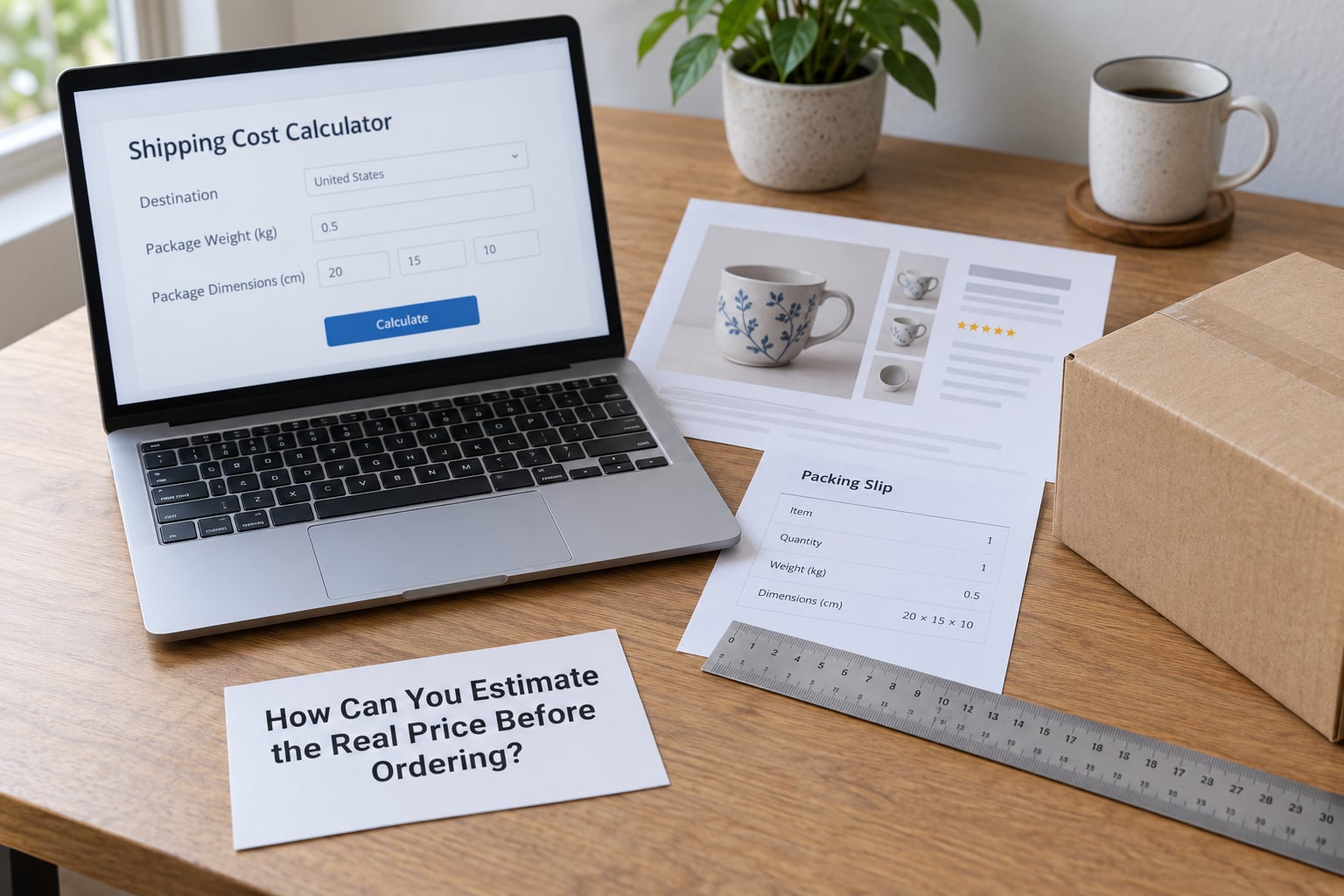
You can get very close to the real number with a short checklist before you pay. Work through it in order.
- Confirm the seller ships internationally at all. If the item is Japan-domestic only, you are buying a proxy whether you planned to or not.
- Ask for the complete quote in writing – item, domestic postage, proxy fee, consolidation, international postage. Legitimate agents give this before payment.
- Separate fixed fees from percentage fees so you can see what a second item would actually add.
- Calculate the volumetric weight of the packed box and compare both figures with the carrier’s rate table.
- Check your destination’s duty and VAT rules for that product category, using the current threshold figure.
- Compare the landed total with the local equivalent, in your own currency, including delivery.
- Save screenshots of the listing, the fee schedule and the written quote. If a charge looks wrong later, this is what you argue with.
If the delivered total lands within about 15 percent of the local price, buy locally. The import stops being an arbitrage and becomes an errand with extra steps.
What Is the Cheapest Way to Import from Japan?
The cheapest method is whichever produces the lowest reliable landed total, and that is not always the one with the cheapest postage line. Four options cover almost every case.
Direct international shipping from a Japanese retailer is cheapest when the store supports it and the order is a single item. No proxy fees, no consolidation step, and the seller usually handles the paperwork. This is the default for camera bodies, consoles and major electronics.
Consolidation inside a proxy wins when you are placing several small orders at once. Postage is charged per parcel, so combining five purchases into one parcel can remove four postage charges and one round of customs handling. It only works if you actually buy five things.
A proxy buying for you is the only route for Mercari and Yahoo! Japan Auctions, and it is the most expensive per order because of the per-item fee. It is still the right call for collectibles, Japanese-only pressings and used-market finds that simply do not exist elsewhere.
Buying through a local retailer looks expensive at the shelf but often wins the comparison. No duty, no brokerage, no exchange-rate exposure, and returns work. A collector on r/japanresidents described the same thing from the other side: the deals that clear with zero involvement were mostly the ones where nobody had to guess about fees.
One last reality. Mercari and most Japanese marketplaces generally do not accept returns, so a surprise fee is effectively non-recoverable. A community.ebay.com thread shows the asymmetry – duty charged on a returned item with no working refund path. Once the parcel is in the courier’s hands, your leverage is close to zero.
Frequently Asked Questions
Why does importing from Japan cost more than the product price?
The listed price is only the first layer. A typical order also carries a proxy service fee, domestic Japan postage, a consolidation fee, international postage, and possibly a courier brokerage charge. Customs duty and import VAT or consumption tax are added at clearance, often calculated on value plus postage. Buyers who budget only for the listing price routinely land 15 to 30 percent over.
Are Japanese proxy buying fees worth it for small orders?
For a single small item, a proxy is usually the expensive route, because the per-item fee and the postage do not get shared. It pays off when you place several orders in the same storage window and let the proxy consolidate them into one parcel. The math works best on Mercari and Yahoo! Japan Auctions, where no other option exists.
Will I pay taxes or customs duty when importing from Japan?
It depends on the destination, the product category and the declared value. The United States has an USD 800 low-value threshold, the UK charges duty above GBP 135 with 20 percent VAT, and the EU charges duty above EUR 150 with country VAT of roughly 19 to 25 percent. Thresholds change often, so check the current figure for your country.
Is Japan Post forwarding cheaper than using a purchasing agent?
Postage alone, usually yes. Japan Post Economy Air and surface tiers cost less than courier rates, and EMS is the tracked option. But a forwarding service adds its own handling charge, and couriers like DHL or FedEx add a brokerage fee at delivery. The cheaper postage tier can still produce the higher total once every layer is counted.
How can I reduce the cost of importing electronics or collectibles from Japan?
Consolidate multiple orders into one parcel, ask for the original retail box removed to cut volumetric weight, and compare quoted postage against both actual and volumetric weight before dispatch. Choose tracked tiers so a lost parcel is a claim rather than a write-off, and check whether your category attracts a reduced or duty-free rate before buying.
Conclusion: What to Do First
Calculate the full landed cost before you pay, not after. Write down the item price, the proxy’s published fee schedule, a postage quote for your exact destination, and your destination’s current duty and VAT rules – then add them up in your own currency and compare that total with buying locally.
If a fee still looks wrong on the delivery notice, take a photo of it before paying, and remember that undervaluing a declaration is customs fraud and shifts the liability onto you, not onto the seller.