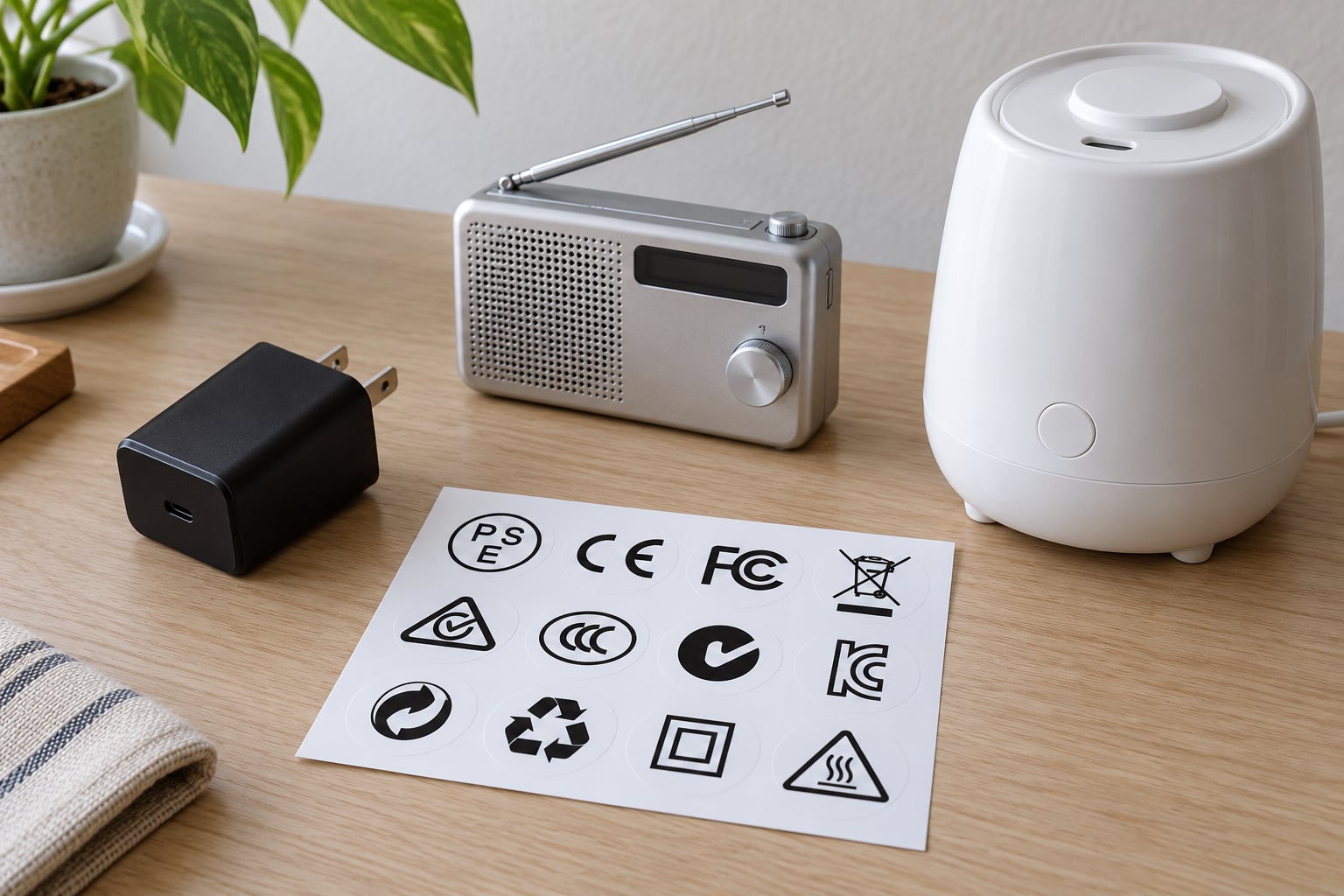
Japanese electronics certification marks explained in one line: the PSE mark is the legal mark for electrical safety, and the Giteki mark is the legal mark for radio equipment. A CE or FCC logo means nothing in Japan, and a recycling symbol on a fridge says nothing about safety.
Last updated: October 2026
Most people meet these marks by accident. A symbol on a charger, a square logo on the back of a wireless earbud case, a chasing-arrows label on a washing machine. Nobody hands you a reading list, and almost none of the guidance on the web is written for people who are not compliance specialists.
This guide is that reading list. It walks through every mark you are likely to find on a product bought in or sold to Japan, which law sits behind each one, whether it is mandatory or voluntary, and — just as important — what each mark does not prove.
Table of Contents
- 1What Are Japanese Electronics Certification Marks?
- 2Japanese Electronics Certification Marks Explained at a Glance
- 3What Does the PSE Mark Mean?
- 4How Can You Tell if PSE or TELEC Certification Is Real?
- 5What Does the Giteki Mark Cover?
- 6Are CE, FCC and Other International Marks Accepted in Japan?
- 7What Is the Japanese Home Appliance Recycling Law Mark?
- 8Which Marks Should Buyers and Importers Check?
- 9Japanese electronics certification marks explained by product type
- 10Frequently Asked Questions
- 11Is PSE required on all electronics sold in Japan?
- 12Does the Giteki or TELEC mark mean a product is electrically safe?
- 13Can a product with a CE or FCC mark legally be sold in Japan?
- 14What is the difference between circular PSE and diamond PSE marks?
- 15Where should buyers find the Japanese certification number?
- 16Does buying a used Japanese electronic device require new certification?
- 17What to Check First Before Buying
What Are Japanese Electronics Certification Marks?
They are official symbols applied to a product to show that it has been checked against a Japanese legal requirement. Two of them are genuinely mandatory for most electronics you would buy: PSE for electrical safety and the Giteki technical conformity mark for anything that transmits or receives radio waves.
Each mark belongs to a specific law and a specific ministry. PSE comes from the Electrical Appliance and Material Safety Act, administered by the Ministry of Economy, Trade and Industry (METI). The Giteki mark comes from the Radio Law, administered by the Ministry of Internal Affairs and Communications (MIC). Consumer product rules sit with the Consumer Affairs Agency, and energy labels sit with METI too, though they are not safety law.
The mark itself is applied by a supplier, usually a Japanese importer who has taken legal responsibility for the product in the Japanese market. That importer is known as a notifying supplier, and their name and number usually appear next to the mark.
Why it matters: a product without the required mark may not lawfully be sold in Japan, and the importer who sells it carries the liability rather than the foreign brand. A missing mark is also the single most useful warning sign when you are looking at a cheap grey-market device.
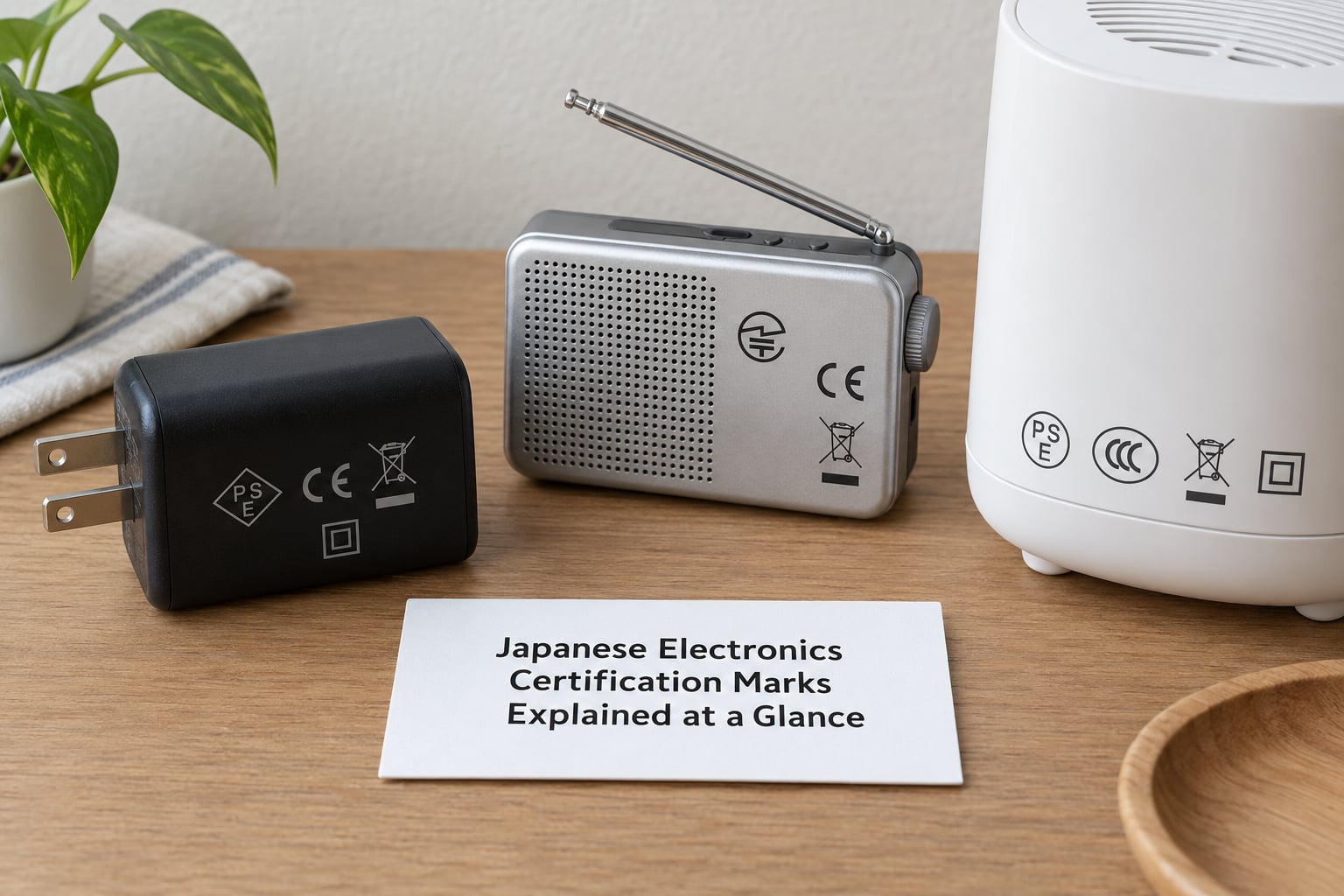
Japanese Electronics Certification Marks Explained at a Glance
| Mark | What it covers | Mandatory in Japan? | What it does not prove | Who normally displays it |
|---|---|---|---|---|
| PSE diamond | Electrical safety of specified electrical products such as fridges, washing machines and many lithium-ion batteries | Yes, on designated product categories | Radio approval, energy efficiency, ongoing quality | Importer and manufacturer, on the product or its packaging |
| PSE round (circular) | Electrical safety of non-specified electrical products such as adapters, USB cables, power banks and low-voltage devices | Yes, on designated product categories | Radio approval or third-party testing | Notifying supplier, usually printed on the housing or label |
| Giteki (technical conformity, often called TELEC) | Radio equipment performance and technical standards under the Radio Law | Yes, for radio equipment that needs it; some very low-power devices are exempt from marking | Mains electrical safety, which is a separate PSE question | Manufacturer or importer, with a technical conformity identification number |
| Home Appliance Recycling Law mark (chasing arrows) | Recycling obligations for covered household appliances | No, but it appears on almost every covered appliance | Any kind of safety, quality or performance claim | Appliance makers on the product, its packaging or both |
| CE | EU health, safety and environmental requirements | No | Anything about legal sale in Japan | European-market products, sometimes on Japanese-market goods too |
| FCC | US radiofrequency and emission rules | No | Radio approval in Japan, which uses different bands and limits | US-market products |
| VCCI | Voluntary electromagnetic interference and emission testing for information technology equipment | No | Any legal requirement at all | Japanese IT hardware makers as a market signal |
Read the mandatory column first. Three of these seven are legal requirements, and they cover different things: PSE covers mains and battery safety, Giteki covers radio behaviour, and the recycling mark is a legal obligation with nothing to do with either. A product can hold one, two or — for a mains-powered wireless device — both of the mandatory marks.
What Does the PSE Mark Mean?
The PSE mark is Japan’s electrical safety mark, and it exists because the country plugs in at 100 volts with tight, unforgiving sockets. The PSE mark is the symbol a product must carry to show it complies with the Electrical Appliance and Material Safety Act, the law often called DENAN after the ministry that administers it.
The important detail is that Japan splits electrical products into two groups, and the split decides both the mark’s shape and who is allowed to apply it.
Specified electrical products are the higher-risk category: large appliances, room heaters, hair dryers, some batteries and other items where a failure causes fire or injury. A registered conformity assessment body tests them, inspects the factory, and issues a certificate of conformity. Only a diamond-shaped PSE mark may be used on these products. The diamond is a strong signal because a supplier cannot simply print it and self-declare.
Non-specified electrical products are the lower-risk category: USB adapters, phone chargers, cables, power banks, many low-voltage accessories. A notifying supplier may apply the round, circular PSE mark after a self-declaration of conformity, keeping the test data on file. This is why a round PSE mark proves less than a diamond one, and why buyers tend to treat the two as the same thing.
Not everything needs a PSE mark at all. Products below a certain voltage or power threshold, and a long list of genuinely low-risk accessories, sit outside the scheme. Absence of a mark is not proof of danger. It only matters if the product is in a category that requires one.
Portable lithium-ion batteries and power banks fall inside the scheme, which is why they now routinely carry a round PSE mark with the notifying supplier’s number beside it. Non-compliance here is one of the most closely watched areas for Japanese regulators, and penalties land on the importer of record rather than on the overseas factory.
How Can You Tell if PSE or TELEC Certification Is Real?
Look for a number, not a logo. A genuine mark is always accompanied by an identifier: a notifying supplier name and number for a round PSE mark, a certificate reference for a diamond mark, and a technical conformity identification number for Giteki. A bare logo with no number underneath it, and no Japanese-language company name anywhere on the label, is decoration rather than certification.
Check that the model number on the mark matches the model in your hand. Marks are granted per model and per product family, so a valid number attached to a different model tells you nothing about the device you are holding. Group numbers are normal and fine; a number that belongs to a visibly different product is not.
Japan does not hand shoppers a simple public database to type a PSE number into. The realistic routes are asking the importer for the certificate of conformity, or asking the registered conformity assessment body named on the documentation to confirm a technical conformity number. Buyers who want a second opinion on a high-value or unusual device can ask METI or MIC directly, or bring the question to a qualified compliance professional. What does not work is trusting a marketplace listing that says certified.
What Does the Giteki Mark Cover?
The Giteki mark, formally the technical conformity mark, is the symbol for radio equipment and it is enforced by MIC under the Radio Law. It says the radio transmitter or receiver inside the product meets Japan’s technical standards for frequency, power and emissions. You will see the characters 無線, meaning wireless, built into the logo itself.
Most buyers call it the TELEC mark. That name comes from the Telecom Engineering Center, the body that historically issued radio certificates, and it is still the common way to describe Giteki certification in conversation and on marketplace listings. The mark people call TELEC and the mark people call Giteki are the same thing for practical purposes.
The identifier that matters is the technical conformity identification number, printed on the product, its label or its documentation. It carries a letter prefix and digits that indicate the equipment class and the issuing body. Some very low-power devices, including many wireless keyboards, remotes and low-power sensors, are exempt from needing the mark at all, so its absence on a remote control is not a warning sign.
Here is the confusion worth clearing up: Giteki says nothing about mains safety, and PSE says nothing about radio behaviour. A wired desktop router can carry PSE and no Giteki. A pair of battery-powered Bluetooth earbuds can carry Giteki and no PSE, because no mains current ever touches them. A smart plug with a radio needs both.
Are CE, FCC and Other International Marks Accepted in Japan?
No. Japan has no mutual recognition agreement that lets a CE or FCC mark stand in for a Japanese requirement. A device built for Europe or the United States can be perfectly legal in its home market and still be unlawful to import and sell in Japan without PSE, without Giteki, or both.
The radio side is where this bites hardest. Japan uses different frequency allocations and emission limits from Europe and North America, and some bands differ enough that a product sold as Japan-only exists purely because of radio rules. The mains side bites too: a 230-volt European heater or a 120-volt US appliance will not simply work on a Japanese 100-volt supply.
Foreign marks are still worth reading, just not as a Japan answer. CE tells you a product met EU requirements. FCC tells you about US radiofrequency emissions. UKCA replaced CE for many goods sold in Great Britain after the transition period, and it is a separate mark with its own declaration of conformity. VCCI is Japan’s own voluntary EMC mark, which carries no legal force and is seen mainly on Japanese IT hardware.
For shoppers, the practical version is simple. A product with CE and FCC logos and no Japanese marks is a foreign-market unit. Buying one is a grey area you accept at your own risk, and support is likely to be Japanese-only.
What Is the Japanese Home Appliance Recycling Law Mark?
The chasing-arrows symbol on a Japanese washing machine, air conditioner or television marks compliance with the Home Appliance Recycling Law. It tells you the product is a designated item that can be handed over for recycling at a collection point, and the related house-shaped mark means no collection charge is collected at the point of delivery.
None of that is a safety or quality claim. A product can be perfectly safe and still carry only this symbol, and a product can be dangerous and still carry it, because nothing about the manufacturing is being assessed. Look at the safety marks for that, and treat the recycling mark as what it is: a disposal obligation.
Which Marks Should Buyers and Importers Check?
Start from the product category rather than the brand, because the category decides which marks are legally required. Most confusion in this area comes from applying one category’s rules to another.
Japanese electronics certification marks explained by product type
Adapters and chargers. The AC brick or wall plug needs a PSE mark, normally the round one, with a notifying supplier number. A USB cable alone usually does not need one. Read the input rating and confirm it says 100 volts, and check the wording. Passively shaped plug adapters that people often describe as converters change the pin layout and nothing else, and some are even printed with wording that rules out use in Japan.
Batteries and power banks. Expect a PSE mark on the cell or pack itself, plus a capacity label in watt-hours. Transport is a separate matter: air and sea freight require UN 38.3 test evidence regardless of what is printed on the casing.
Wireless and Bluetooth gear. Earbuds, smart watches, wireless controllers, Wi-Fi routers and anything with a radio need the Giteki mark and its technical conformity identification number. Wired headphones need neither, because no radio is involved.
Game hardware. A console needs PSE for its power supply and Giteki for its wireless functions, so check both. Handheld consoles and region-locked software add their own separate constraints that no certification mark will tell you about.
Household appliances. Fridges, washing machines, rice cookers and air conditioners need PSE, most often the diamond for the largest categories, and carry the recycling mark as well. The Energy-Saving Label is a separate, largely voluntary efficiency label that you will see on major appliances.
Two other marks are worth recognising so you can place them correctly. The PSC mark, run by the Consumer Affairs Agency, appears on a limited list of designated consumer products and is not an electronics mark in the usual sense. The S-Mark, run by the Japan Electrical Safety Association, is a voluntary safety certification some makers add as an extra quality signal, and it carries no legal requirement to hold it.
If you are buying Japanese-market kit to use outside Japan, three physical details decide whether it works. The mains supply is 100 volts, against 120 in the United States and 230 across much of Europe. Frequency splits regionally, with much of eastern Japan on 50 hertz and the west on 60 hertz, which matters for motors and anything with a timing-sensitive motor. And sockets are type A, with two flat pins, sometimes with an earth pin. A heating appliance rated for 100 volts run on a 120-volt supply runs hot and can damage itself. A step-down transformer sized for the appliance’s wattage solves the voltage problem; a plug-shaper does not.
Warranty is a separate matter entirely, and no mark tells you anything about it. A Japanese-market device usually carries a Japan-only warranty, and the local importer is the party named on it, so servicing outside Japan tends to mean paying without cover.
Frequently Asked Questions
Is PSE required on all electronics sold in Japan?
No. PSE applies only to products in designated categories, which cover most mains-powered household and IT equipment, adapters, and portable lithium-ion batteries. Low-voltage accessories and genuinely low-risk items fall outside the scheme entirely. What is mandatory is that any product inside a designated category cannot be sold in Japan without the correct mark, either the diamond for specified products or the round for non-specified ones.
Does the Giteki or TELEC mark mean a product is electrically safe?
Not at all. The Giteki mark, often called the TELEC mark, covers radio equipment only: frequency, power and emissions under Japan’s Radio Law, enforced by MIC. It says nothing about mains electrical safety, which is what PSE covers. A Bluetooth earbud can hold Giteki and no PSE, and a wired router can hold PSE and no Giteki. Check the mark that matches the risk the product actually carries.
Can a product with a CE or FCC mark legally be sold in Japan?
Not on that basis alone. Japan has no mutual recognition agreement with the EU or the United States, so a CE or FCC mark does not replace a Japanese requirement. Selling a designated electrical product without PSE, or radio equipment without the required radio approval, remains a legal problem for the importer, and penalties fall on the party that sells in Japan rather than the overseas manufacturer.
What is the difference between circular PSE and diamond PSE marks?
The shape reflects the product’s risk category and who certified it. Specified electrical products, the higher-risk group covering large appliances and some batteries, need testing by a registered conformity assessment body plus factory inspection, and only they may use the diamond PSE mark. Non-specified products such as adapters, cables and power banks can use the round mark through a notifying supplier’s self-declaration of conformity.
Where should buyers find the Japanese certification number?
For a PSE mark, look for the notifying supplier’s name and number printed next to the mark on the housing, the label or the packaging, and check that the model number matches the device in your hand. For Giteki, look for the technical conformity identification number, which usually appears on the product itself, on a label, or in the documentation. A logo with no number and no Japanese company name beside it proves nothing.
Does buying a used Japanese electronic device require new certification?
No new certification is needed, and none of the marks expire simply because the product changes hands. The original PSE or Giteki approval stays with the model. What does matter is condition and paperwork: batteries from older devices are worth checking for swelling, the marks should still be legible, and a second-hand unit bought without a receipt or importer details can be difficult to support or resell.
What to Check First Before Buying
Work through it in order. Identify the product category, because that decides which marks are legally required. Find the mandatory mark for that category, then find the number that goes with it, and confirm the number matches your model. After that, read the Japanese-language label for the manufacturer, the importer of record, the voltage and the frequency.
When the documentation is unclear, ask the Japanese regulator responsible for that mark, METI for safety or MIC for radio, or bring the question to a qualified compliance professional. A mandatory mark means a legal duty to meet Japanese requirements. Anything else on the casing is a quality claim, an energy claim or a disposal rule, and it is fair to read it that way.