Phone number fields matter in Japanese apps because the domestic mobile line is the default proof of reachability and, to a lesser degree, of identity. Services send an SMS one-time code (OTP) to that number, which is how passwordless login, account recovery and fraud screening work here. That makes the field a gate rather than a form field, and getting the format or the number type wrong locks people out with no useful error message.
This matters for two different groups. People signing up for LINE, PayPay or a Lawson Tickets draw need to know why the form rejects what their phone natively produces. Teams shipping apps into the Japanese market need to know what breaks when they relax the field.
Japanese mobile usage is close to universal, cashless payment systems assume a reachable line, and email is not the trusted channel the way it is in Europe or the US. The number takes that role instead.
Table of Contents
- 1What Happens When a User Enters a Japanese Phone Number?
- 2Why Phone Number Fields Matter in Japanese Apps
- 3Which apps depend on it, and what happens without a Japanese number
- 4Why phone number fields matter in Japanese apps for product teams
- 5How Should Japanese Phone Numbers Be Formatted?
- 6The prefix cheat sheet
- 7Why Local Number Expectations Matter for Signup
- 8How Do Japanese Users Expect Verification to Work?
- 9What Should an App Store From a Phone Number?
- 10How Can Teams Handle Privacy and Fraud Without Friction?
- 11What Are the Most Common Japanese Phone Field Mistakes?
- 12How Should Product Teams Test the Phone Field?
- 13Frequently Asked Questions
- 14Should Japanese apps make a phone number mandatory?
- 15Can SMS verification prove that someone owns a Japanese phone number?
- 16Should a Japanese phone number field accept the +81 country code?
- 17Do Japanese users expect phone verification through SMS or messaging apps?
- 18How long should an app retain a verified Japanese phone number?
- 19Conclusion
What Happens When a User Enters a Japanese Phone Number?
The journey starts with keystrokes, and the first decision your form makes is whether to interpret what it received as a domestic number or an international one.
A domestic Japanese mobile number has ten or eleven digits and starts with 0, for example 090-1234-5678. An international rendering is +81 followed by the number with that leading zero removed, so +81 90 1234 5678. The same number, two valid-looking strings, and a form that accepts only one of them will feel broken to anyone who has never seen the local convention.
Assuming the input passes validation, the backend normalises it into a canonical E.164 form for storage and delivery, then hands the digits to an SMS gateway. The gateway routes by the Mobile Country Code and Mobile Network Code embedded in the number, which is what tells the network it belongs to NTT Docomo, SoftBank, au or an MVNO rather than a foreign carrier.
Then comes the step that strands people. The message is submitted, the form shows a timer, and the code simply never arrives. No error is raised, because from the app’s point of view the send succeeded. Forum users describe this silent failure more often than any other complaint about Japanese signups: the form accepted the number, the screen advanced, and the code was simply absent.
Three things cause it. The number belongs to a line with no SMS capability, which is the standard for 050 IP telephony. The number is valid but the carrier quietly filters short-code traffic. Or the number is outside Japan and the receiving network will not route to it at all.
If the code does arrive, the user types it back, the server checks it against the challenge it stored, and the session is upgraded. Only then is the account treated as reachable.
Why Phone Number Fields Matter in Japanese Apps
The direct answer: the field exists so a service can reach the person, prove the number is under a real subscriber, and recover the account later without a password. It does not prove who the person is. That distinction is where most outside expectations go wrong.
Five reasons cover almost every case you will find in a Japanese app.
- SMS one-time codes. The default login and second factor for domestic consumer apps, which removes the password problem in a market where credential reuse is rampant.
- Account recovery. A second factor that an SMS number can serve, so a forgotten password does not become a permanent lockout.
- Fraud and abuse prevention. A real subscriber line raises the cost of bulk account creation, resale and spam registration compared with a throwaway inbox.
- Operational contactability. Delivery drivers, ticketing, reservations and support all want a number a human answers.
- Regulatory reachability. Under the Specified Commercial Transactions Act, a seller advertising to consumers in Japan needs a means of being contacted, and a Japanese mobile number is the customary answer.
| Function | What the user gets | What it cannot do |
|---|---|---|
| SMS login and one-time code | No password to forget or reuse | Does not establish a legal identity |
| Account recovery | A way back in after a password reset | Helps only while the number is active |
| Abuse prevention | Fewer scam accounts reaching other users | Costs legitimate users a conversion step |
| Operational contact | Fast resolution with support or a courier | Adds a channel teams must actually monitor |
| Regulatory reachability | A service that can be contacted as required | Applies to sellers, not to every app |
Which apps depend on it, and what happens without a Japanese number
Here is the practical picture from the Japanese market. Behaviour changes over time, so treat it as a pattern rather than a guarantee.
| Service | What the number is used for | Behaviour with an overseas number |
|---|---|---|
| LINE | Account identity, login, friend discovery by number | Accepts many foreign numbers but blocks a set of virtual ranges; 050 numbers are reported to fail roughly one attempt in five |
| PayPay | Cashless payment identity, tied to a Japanese financial account | Effectively domestic-only; a foreign line cannot complete the setup |
| Mercari | Buyer and seller trust, payout details, identity checks | Seller features are gated behind Japanese identity and payout setup |
| Tabelog | Reservation confirmations and review accounts | Browsing works; account features are tied to a line |
| Lawson Tickets and similar ticketing | Ticket issuance, entry codes, identity check at the door | Hard blocks foreign numbers for popular draws; a recurring complaint on travel forums |
| Uber Eats Japan and Demae-can | Courier calls, arrival notices, support | Account creation may pass, but delivery contact relies on a working local line |
In a recurring r/JapanTravel thread, users put it plainly: most ticketing platforms in Japan require a Japanese phone number for verification and a Japanese credit card. That combination, not the number alone, is what locks people out of concert and pop-up draws.
Why phone number fields matter in Japanese apps for product teams
From inside a product team, the field is usually a conversion-versus-fraud trade that gets settled early and rarely revisited.
A mandatory number step measurably cuts the share of users who finish signup, and every one of those dropouts is revenue the team watches disappear. The counterweight is that a throwaway-email signup is cheap for an attacker to replicate at scale, and in a market where promo-code abuse, fake resale listings and ticket hoarding are real problems, the cost of abuse often outweighs the lost conversions.
Three practical arguments keep the field mandatory. Fraud losses concentrate on accounts without a second factor. Support cost falls when a customer service agent can resolve a payment dispute by messaging a number rather than exchanging identity documents. And domestic integrations, from carrier billing to cashless payments, assume a reachable local line exists.
The trap is treating SMS ownership as a substitute for identity verification. Posters on r/degoogle routinely enter arbitrary numbers to pass an SMS ownership check, which is exactly the point: everyone understands the signal is weak. Treat it as a liveness and reachability signal, not a proof of personhood, and pair it with real verification where the stakes demand it.
How Should Japanese Phone Numbers Be Formatted?
Japan’s international country code is +81. The digit 0 that begins every domestic number is a trunk prefix, not part of the number itself, so it is dropped when converting to international form. That single rule causes most of the friction at the form layer.
| Type | Domestic format | International (E.164) |
|---|---|---|
| Mobile | 090-1234-5678 | +819012345678 |
| Mobile | 080-1234-5678 | +818012345678 |
| Mobile | 070-1234-5678 | +817012345678 |
| Tokyo landline | 03-1234-5678 | +81312345678 |
| Osaka landline | 06-1234-5678 | +81612345678 |
Two more format details catch people out. Full-width digits, which is what a Japanese IME can produce, are not valid input to most numeric validation, so a form that rejects them looks like a bug to the user. And a field configured as a Japanese domestic field will often reject +81 entry outright, because the + is not a digit the domestic pattern allows.
The fix is to accept both. Let the country selector and a leading + override the domestic assumption, strip punctuation and whitespace on input, normalise full-width to half-width digits, and store one canonical E.164 string.
The prefix cheat sheet
| Prefix | Type | SMS codes | Note |
|---|---|---|---|
| 090 / 080 / 070 | Mobile | Yes | The safe choice for anything that sends a code |
| 060 | Mobile, incoming only | Partial | Approved December 2024, rollout delayed in a change announced 8 July 2026 |
| 050 | IP telephony (VoIP) | No | Cannot receive an SMS one-time code at all |
| 03 / 06 | Geographic landline | Varies | May lack a handset or messaging path |
| 0120 / 0800 | Toll-free | No | Business enquiries only, never a personal account |
To check the number a Japanese handset is actually using, open the settings phone or contacts section and read the own-number entry, or start a call and read the caller ID before dialling out.
Why Local Number Expectations Matter for Signup
Expectations shape the field as much as security does. In Japan, a mobile number is close to a default identity marker for consumer services, in the same position email occupies in many other markets, so a form without a phone step can look incomplete to users rather than respectful of their privacy.
Payment is the clearest example. PayPay and convenience-store payment require a Japanese financial account, and a Japanese mobile number is part of that chain. An app that sits inside that ecosystem inherits the assumption whether or not it ever touches payments itself.
LINE plays a similar role. Event registration, restaurant bookings and group coordination route through it, so LINE registration with a foreign number becomes a prerequisite for a chain of unrelated services. Once a user clears that first wall, the rest of the flow feels routine.
Support culture reinforces the same assumption. Customers expect to resolve a problem by messaging or calling a real number, and a service that cannot reach you also struggles when it cannot help you. Teams that add the field are answering a reachability expectation, not only a security one.
For users outside Japan, the reverse applies: a hard block on overseas numbers reads as a closed market. A warning plus an alternative path usually converts better than a refusal.
How Do Japanese Users Expect Verification to Work?
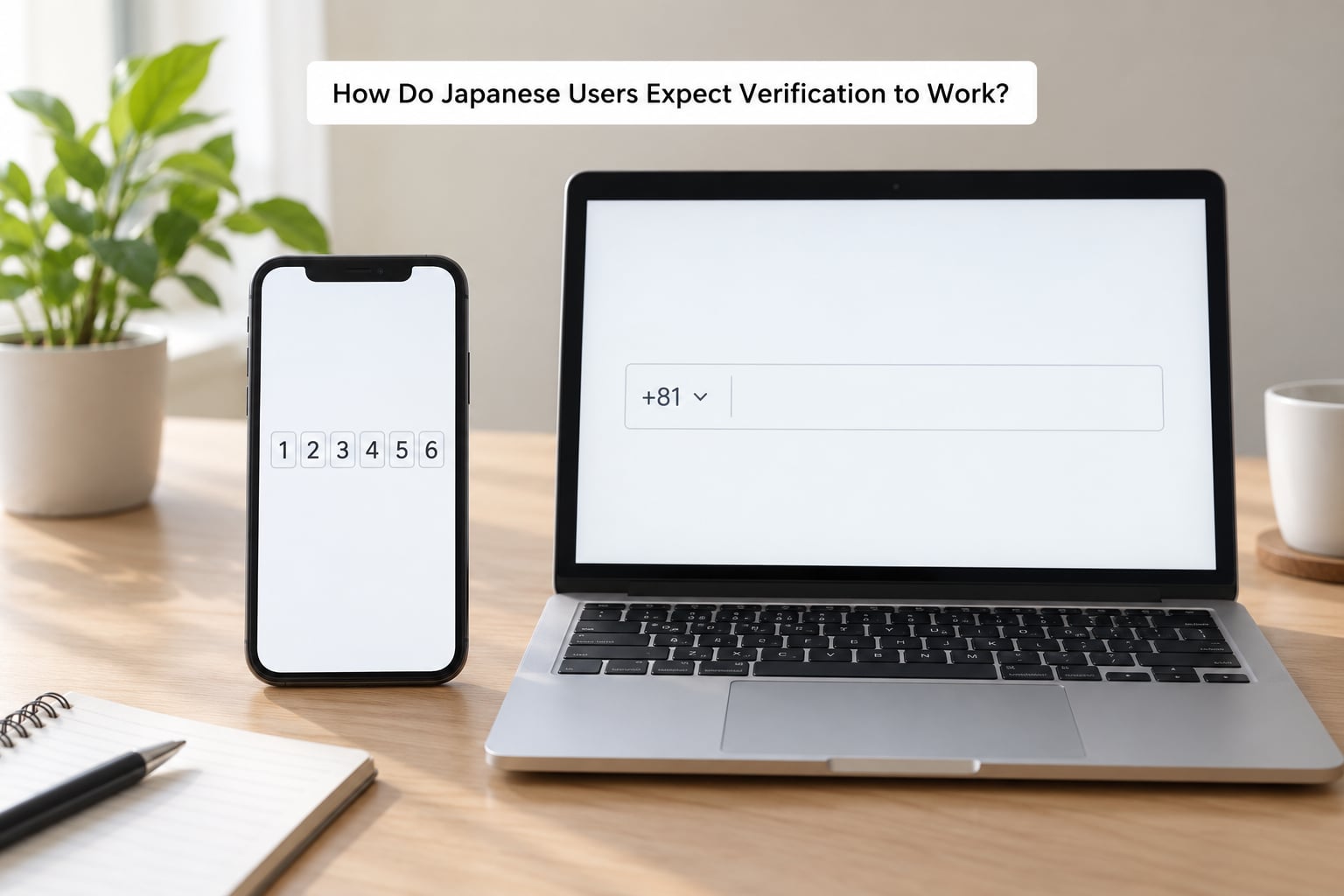
The default expectation is an SMS one-time code, usually four to eight digits, entered into a field that already knows the number and only asks for the code.
Users also expect a timer before a resend appears, a visible countdown, and a way to change the number if the first one was wrong. Codes typically expire within a short window, often five to ten minutes, and each resend invalidates the previous code. Getting that sequence wrong produces the exact failure people describe in forums: the code arrives after the screen has moved on, and there is nothing left to enter it into.
Two fallbacks are worth supporting. An email link for recovery when the phone line is unavailable, and an in-app or help-centre path for people who cannot receive SMS at all. Neither is as strong as SMS, and treating them as equal is a mistake.
For higher-stakes flows, the expectation shifts upward to electronic Know Your Customer (eKYC), which in Japan increasingly means My Number Card authentication through JPKI, the public key infrastructure, or an IC chip plus a selfie rather than an uploaded photo of an ID document. That change came through the 2026 revision to telecom identity confirmation rules, and anti-money-laundering amendments effective 1 April 2027 will further limit purely remote verification.
The boundary to hold is this: phone verification proves a person can receive a message at that number today. It is not identity verification, and services that need identity should ask for identity in a separate step.
What Should an App Store From a Phone Number?
Store the minimum that lets you send a code and find the account later: the number in canonical E.164 form, a flag for whether it has been verified, and the timestamp of that verification. Country is worth keeping separately, because it changes routing and reporting.
Everything else is optional. A full name, a date of birth or an address should only appear when a specific use demands it, and pushing for them at signup is how a phone field turns into a data-collection problem.
Normalise on the way in and never store the raw keystrokes. Convert full-width digits, strip separators, drop the domestic trunk zero for the canonical form, and keep only that one representation so two accounts can never be created from the same digits typed two ways.
Consent should be specific and separate from terms of service. Say what the number is used for, which is usually message delivery, and get agreement for that purpose on its own.
Retention should be proportional. Once the account is closed or the recovery window has passed, deleting the number and its verification record is the cleanest position under the Act on the Protection of Personal Information, and it is what support teams want when a customer asks what you hold about them.
Access should follow the account, not the org chart. Restrict visibility to staff who genuinely need it, log every lookup, and make deletion a supported action rather than a support ticket.
How Can Teams Handle Privacy and Fraud Without Friction?
Friction on legitimate users does nothing against a determined abuser. The controls that actually work target behaviour, not identity.
Rate-limit requests per number, per device and per IP, and step up rather than hard-block: challenge, then delay, then refuse. Ask for a second factor only after the risk signal appears, so the ordinary path stays one tap.
Use risk signals that need no extra personal data. Velocity, device reputation, payment instrument mismatch and unusual geography all help. Hash or tokenize the number for analytics so it is useful for troubleshooting without being a readable identifier sitting in a reporting tool.
Publish a plain privacy notice that names the purpose and the retention period. Under the Specified Commercial Transactions Act, sellers reaching consumers in Japan must be contactable and must disclose enough for a customer to reach them, which is part of why the number question comes up before any data-protection argument does.
The real balance is simple: collect the narrowest thing that answers the risk, keep it the shortest time that answers it, and delete it on a schedule you actually run.
What Are the Most Common Japanese Phone Field Mistakes?
Defaulting the country selector to something other than Japan. A field that assumes +1 rejects every domestic number before the user can type it. Default to the user’s actual locale and let the selector change freely.
Rejecting the international format. The same handset that sends 090-1234-5678 at home dials +819012345678 abroad, so a field that only accepts domestic digits fails the user precisely when they are travelling. Accept both.
Insisting on hyphens. Japanese users type without separators more often than with them. Strip punctuation rather than requiring it.
Ignoring full-width digits. A Japanese input method can produce them and standard numeric validation silently drops them. Convert to half-width on input.
Leaving whitespace or invisible characters in. Autofill and paste are the usual source. Trim every field value before validation.
Duplicating the country selector and the plus sign. Choosing Japan and then typing +81 produces a malformed string. If the selector says Japan, drop the plus.
Labelling the field optional while blocking the flow. Users who hit a hard block after a long form leave. Make it optional for real, or say plainly at the point of collection why it is required.
Treating a received code as proof of identity. Arbitrary numbers get entered to pass ownership checks every day. Use SMS for reachability, and a real verification flow for identity.
How Should Product Teams Test the Phone Field?
Run this as a script on both iOS and Android before every release that touches signup.
- Enter a domestic mobile number typed without hyphens.
- Enter the same number with hyphens and with a full-width form.
- Enter +81 followed by the number with the trunk zero removed.
- Enter the domestic number while the country selector is set to Japan, then again while it is set elsewhere.
- Paste a number copied from contacts, including any trailing whitespace.
- Trigger validation with an empty field, a single digit and a truncated number, and check the error text says what to do.
- Confirm the resend timer starts before the button is usable and that a new code invalidates the old one.
- Verify expiry behaviour and that the user can request a fresh code without losing the rest of the form.
- Test account recovery end to end from a device that was never used to sign up.
- Confirm analytics record the failure reason without logging the raw number.
- Test the deletion path and confirm the record is actually gone afterwards.
- Run the flow on an overseas SIM and on a data-only line to see what the failure looks like for someone who cannot receive SMS at all.
The last item is the one most teams skip. It is also the fastest way to see whether your error handling is any use to a real person standing in a shop in Shibuya with a foreign handset.
Frequently Asked Questions
Should Japanese apps make a phone number mandatory?
Only where the number does real work. Passwordless login, account recovery, delivery contact and domestic payment integrations all justify a mandatory field. A browse-first catalogue usually does not. If you make it optional, do not hard-block the flow later, and say at the point of collection why the number is needed. Users who understand the reason accept the step more often than users who hit it silently.
Can SMS verification prove that someone owns a Japanese phone number?
It proves someone received a message at that number at that moment, and nothing more. Numbers get shared, reassigned, sold and typed in by people who do not own them, which is why posters on r/degoogle enter arbitrary digits to clear ownership checks. Treat a received code as proof of reachability and light liveness. Where you need identity, such as opening a financial account, run a proper verification step as well.
Should a Japanese phone number field accept the +81 country code?
Yes. The country code for Japan is +81, and the leading 0 on a domestic number is a trunk prefix that disappears in international form, so 090-1234-5678 and +819012345678 are the same number. A field that only accepts domestic digits fails users exactly when they are abroad and their handset offers the international format. Accept both, normalise on input, and store one canonical E.164 string.
Do Japanese users expect phone verification through SMS or messaging apps?
SMS is the default for account verification, one-time codes and second factors, and it is what domestic consumer apps assume. Messaging apps like LINE matter for contact and coordination rather than for receiving login codes, so the verification path still runs through the carrier network. Teams sometimes add an in-app channel for delivery updates and support, but the SMS path stays the one that has to work.
How long should an app retain a verified Japanese phone number?
Keep it while the account is active and while a recovery window justifies it, which is often measured in months rather than years. Deleting it when the account closes or the recovery period ends is the cleanest position under the Act on the Protection of Personal Information. Avoid retaining raw number strings in analytics, since a readable identifier in a reporting tool survives long after the original purpose is gone.
Conclusion
A phone number field in a Japanese app earns its place when it carries a one-time code, opens a recovery route or makes the customer reachable. Outside those uses it is friction with a compliance costume.
Getting it right means accepting both the domestic form and +81, normalizing what arrives, explaining the collection at the point it happens, and deleting the number on a schedule you run rather than one you promise. Test it against a Japanese handset and against an overseas one, because the second is where the silent failures live.
If you are auditing an existing signup flow this month, start with two things: the country-code default on the number field, and the error handling for a code that never arrives. That pair explains more failed signups in Japan than anything else in the flow.