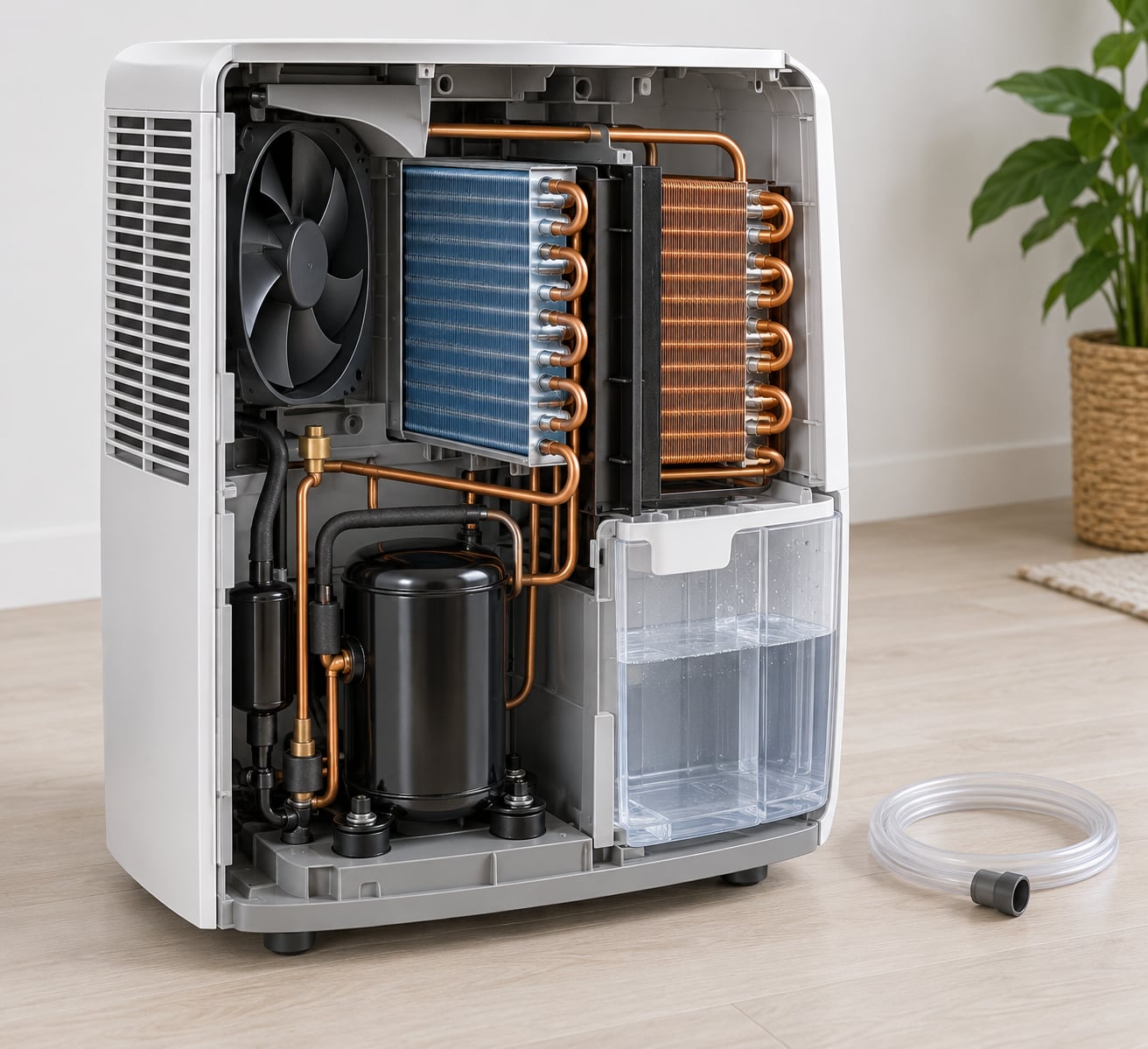
How Japanese dehumidifiers work is simpler than the spec sheet suggests: a fan pulls room air across a deliberately chilled coil, water vapour condenses on that coil like it does on a cold drink, and the droplets run down into a tank or a drain hose. Whatever moisture left the air has to go somewhere, so it ends up in the water container you empty. The compressor, refrigerant and thermostat underneath are what make the coil cold.
Nothing about that cycle is unique to Japan. What is Japanese is the vocabulary on the box, the way capacity is quoted, and the extra heating mode that Japanese households use to fight winter condensation. Those are the details worth knowing before you buy.
Table of Contents
- 1How Japanese Dehumidifiers Work
- 2The Compressor and Refrigerant Cycle
- 3How Warm Air Becomes Collected Water
- 4What Japanese Dehumidifier Features Mean
- 5Dehumidifying capacity (除湿能力)
- 6Room-size ratings (畳 and m²)
- 7Operating temperature range
- 8Modes, timers, sensors and ion features
- 9Dehumidifier Modes at a Glance
- 10Why Capacity and Room Size Matter
- 11Why Dehumidifiers Also Feel Warm
- 12Water Tanks, Pumps, and Continuous Drainage
- 13How to Use One Safely and Effectively
- 14Frequently Asked Questions
- 15Are Japanese dehumidifiers better than Western models?
- 16Why does a Japanese dehumidifier warm up the room?
- 17Can a dehumidifier run continuously without overflowing?
- 18What relative humidity should a dehumidifier maintain?
- 19Can one dehumidifier handle several rooms?
- 20Do Japanese dehumidifiers work in very cold weather?
- 21Conclusion: Start with the Model Label
How Japanese Dehumidifiers Work
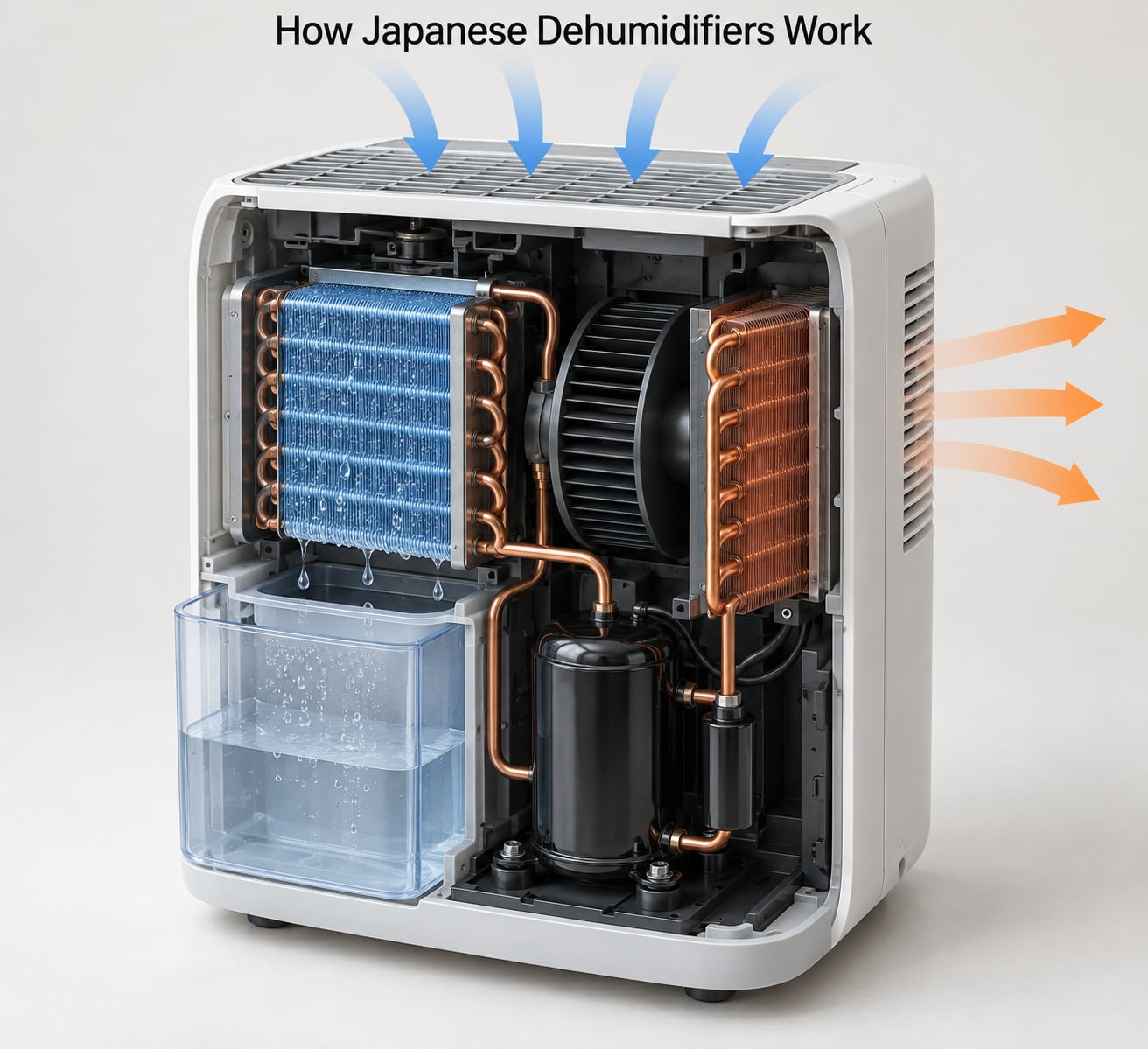
Almost every unit sold in Japan as a 除湿機 (joshitsuki) follows the same four steps, and the order matters more than the brand names. That loop is really the whole of how Japanese dehumidifiers work.
- Intake. A fan draws humid room air in through a grille, usually along the top or back, and passes it first through a thin dust filter.
- Cooling. The air crosses a refrigerant coil held several degrees below the room’s dew point, so the coil surface is wet-cold.
- Condensation. Water vapour touching that cold surface turns into liquid droplets that bead, merge and run down the coil into a drip pan.
- Reheat and return. The same air passes over a warmer second coil and is blown back into the room, drier and slightly warmer than it entered.
Step two is where the work happens. Cooling air past its dew point forces out more moisture than any fan filter could ever catch, and that single idea is the trick behind how Japanese dehumidifiers work.
The Compressor and Refrigerant Cycle
An electric motor drives a compressor that squeezes refrigerant gas into a high-pressure, high-temperature vapour. That hot vapour runs to the condenser coil, where it gives up its heat to room air and condenses back into a liquid. The liquid then moves through a narrow metering tube, which drops its pressure sharply, and arrives at the evaporator coil as a cold low-pressure liquid.
That evaporator coil is the cold plate your air touches. The refrigerant absorbs heat and boils there, which keeps the coil chilled, then it returns to the compressor as a gas to start over. No new heat is created anywhere in the loop. The unit simply moves heat from one coil to another, and the heat it dumps at the condenser is the heat it took out of the air plus the electricity the compressor consumed.
How Warm Air Becomes Collected Water
Humidity is a way of describing how much water vapour air holds compared with the most it could hold at that temperature. Warm air can hold far more than cool air. When the coil drops the incoming air below its dew point, the extra vapour has nowhere to stay and condenses onto the metal.
The water then slides down the coil fins into a drip tray, and from there it either collects in a removable tank or gets pushed up and out through a drain hose by a small pump. That last design is called 連続排水, continuous drainage, and it is the difference between a unit you empty every morning and one you can leave running overnight.
What Japanese Dehumidifier Features Mean
Japanese model labels and product pages lean on a handful of terms that translate badly. Knowing them makes the differences between two units obvious.
Dehumidifying capacity (除湿能力)
Printed as a volume of water per day, usually with an L/日 marker. It tells you the measured extraction under a fixed test condition, not what your room will produce. Capacities on household units range from roughly 5 to 20 litres a day, with larger closet and bathroom units sitting lower.
Room-size ratings (畳 and m²)
Japanese floor area is quoted in 畳 (tatami), where one standard mat is about 1.6 square metres in most modern housing. A 6-mat living room is roughly 10 square metres. Retailers list a recommended room size, but treat it as the manufacturer working at a moderate load.
Operating temperature range
Compressor units carry a stated floor, commonly 5°C to 10°C for consumer models. Below that the coil ices over, and the unit runs a defrost cycle that switches the heater on periodically to shed the ice.
Modes, timers, sensors and ion features
A humidity sensor (湿度センサー) closes a loop around your target setting. Timers run 2, 4, 8 or 12 hours, and many units offer a continuous setting instead. 冷除湿 is plain cooling-type dehumidification. 暖房除湿 adds a heating element or reuses compressor heat to run the cycle below the normal floor temperature, which is why it can handle a cold winter room. Ion, plasma or antifungal buttons on the front are air-treatment claims layered on top of the same mechanical cycle.
Dehumidifier Modes at a Glance
| Mode | How it works | Best for | Watch out for |
|---|---|---|---|
| Continuous | Runs at a fixed setting until switched off or the tank fills | Drying a room after a leak or renovation | Overworks an already dry room; needs a drain line for long runs |
| Humidity sensor (設定湿度) | Sensor reads the air and cycles the compressor to hold your target | Everyday mold prevention and sleep comfort | Needs a roughly level room or sensor readings drift |
| Laundry drying (洗濯物乾燥) | High fan output with frequent direction change, and heat on some models | Tsuyu and typhoon weeks with no balcony access | Louder, hotter, and far more power than normal running |
| Heating (暖房除湿) | Uses compressor heat plus an element so the coil works in cold rooms | Winter window condensation, damp bedrooms | Higher running cost and warmer exhaust air |
| Fan | Fan moves air with the compressor off | Circulating a room while you dry surfaces | Removes no moisture at all |
Why Capacity and Room Size Matter
An undersized unit will run continuously and still lose the fight, especially during tsuyu when outdoor humidity sits near saturation. The stated capacity is measured at a fixed indoor temperature and relative humidity, and because different brands pick different test conditions, two units with the same L/日 number can perform differently in the same room. Understanding how Japanese dehumidifiers work means reading that test condition rather than the number alone.
Match roughly 10 to 15 litres a day of capacity to a 6-mat room, and 5 to 8 litres to a 4.5-mat room or a closet. Bigger rooms, north-facing windows and laundry drying all push you up a size. In Okinawa and southern Japan, where humidity runs high far longer than a mainland rainy season, residents commonly run larger units nearly year-round rather than treating them as seasonal equipment.
Why Dehumidifiers Also Feel Warm
Because you cannot remove water vapour without removing heat. The latent heat that was holding that moisture in vapour form has to be released somewhere, and the condenser coil does it, straight into your room. The outlet air is warmer than the intake air by roughly the amount of heat taken out of the water, plus the compressor’s input.
That is not a defect. It is the price of mechanical dehumidification, and it is why nobody runs a dehumidifier to cool a room in August. Desiccant units behave differently: they absorb moisture into a rotating material and release it as vapour rather than as liquid, which lets them work at low temperatures without a frost problem but costs more electricity and leaves no tank of water.
Water Tanks, Pumps, and Continuous Drainage
Most household units come with a removable bucket, commonly around 3.5 litres, and a float switch that cuts power the moment it is full. That switch is the only thing stopping a full tank from spilling into a tatami room, so clear the alarm promptly and never pull the cord out to stop a full unit.
Pump models add an outlet and a small drain pump. Route the hose to a sink or drain with a continuous downward fall, secure it so kinks cannot form, and keep the end of the hose submerged in water if you are discharging into a bucket, otherwise the pump can pull air and stop. Check the manual before running unattended, and route the hose where a leak lands on a floor you care about rather than over a shelf.
How to Use One Safely and Effectively
Place it with clearance. Keep the intake and outlet clear and leave the manufacturer’s side and top gaps, usually a few centimetres. Set it on a level floor, not on tatami or carpet that blocks airflow underneath.
Close the room first. Treat a single room. Doors and windows shut, because a dehumidifier pulling humid outside air through an open window simply exhausts its effort. The one exception is a scheduled vent afterwards, once humidity is down.
Set a target around 50 to 60%. Below about 40% the air feels dry and the compressor cycles more than it needs to. Above 60% mold keeps its edge.
Clean the filter on a schedule. A clogged filter chokes airflow, lowers extraction and warms the coil. Wipe the filter and the cold coil monthly during heavy season.
Empty the tank, or drain it. If you are away for days, use continuous drainage with a tested route rather than hoping a bucket lasts.
Ventilate deliberately. Air the room out first, then leave the windows shut while the unit works. Opening them mid-session puts the moisture straight back where it came from.
Frequently Asked Questions
Are Japanese dehumidifiers better than Western models?
The core condenser cycle is the same everywhere, so quality differences come down to build, capacity and features rather than nationality. What Japanese units tend to add is a heating-dehumidifying mode for winter condensation, strong laundry-drying programs, and 3.5-litre buckets that suit tatami-sized rooms. Shops also assume Japanese room sizes and humidity levels. Check capacity in litres per day against your floor area rather than trusting the label’s country of origin.
Why does a Japanese dehumidifier warm up the room?
Removing water vapour means removing the heat that was holding it in vapour form, and that heat is released by the condenser coil into the same room. On top of that the compressor adds heat equal to its power draw. So the outlet air is warmer than the air it took in. Mechanical dehumidification trades heat for dryness, which is why 冷除湿 is not sold as a cooling function and why a dehumidifier is paired with a fan or air conditioner in summer.
Can a dehumidifier run continuously without overflowing?
Yes, if you fit continuous drainage. Connect the drain hose to the unit’s outlet, keep a continuous downward slope to the sink or drain, and check the manual for whether the pump can be left unattended. Without a hose, a tank unit stops on its own float switch when full, but it will not restart until someone empties it. Route the hose where a leak cannot reach a bookshelf or a plug socket.
What relative humidity should a dehumidifier maintain?
Aim for around 50 to 60% relative humidity in a home. Sustained readings above roughly 60% are where mold, mildew and musty odors establish in closets, bathrooms and under-floor storage. Below about 40% the air feels dry and the unit runs more often than it needs to. A cheap humidity meter lets you set the target properly instead of guessing, and a sensor-equipped model will then hold the band on its own.
Can one dehumidifier handle several rooms?
Only if the rooms share the same air. With doors closed it treats the room it stands in, and it will not pull moisture out of a neighbouring room beyond what drifts through a doorway. Open every door and you dilute its effect across the whole flat while pulling in humidity from hallways and wet rooms. For a whole apartment, running one unit per closed room works better than one unit moved around each day.
Do Japanese dehumidifiers work in very cold weather?
Standard compressor models lose effectiveness as the room cools, because the evaporator coil reaches 0°C and ices over; many carry a stated floor around 5 to 10°C and run automatic defrost below it. Heating-dehumidifying models marked 暖房除湿 use compressor heat plus an element so they can keep pulling water from a cold room, which is why households buy one before winter condensation appears on window glass.
Conclusion: Start with the Model Label
How Japanese dehumidifiers work comes down to one idea: chill a coil below the air’s dew point, let moisture condense on it, and put that water in a bucket. The compressor and refrigerant loop supply the cold, the fan moves the air, and the condenser gives the heat back to the room.
Before buying, read five things on the label: measured capacity in litres per day, the recommended room size, the minimum operating temperature, whether drainage is continuous or tank-only, and whether 暖房除湿 is included for winter use. Then follow the manufacturer’s manual for placement and hose routing. The plainest truth about the category, and one people repeat endlessly on Japanese home forums: a well-sized unit bought once tends to still be running years later.