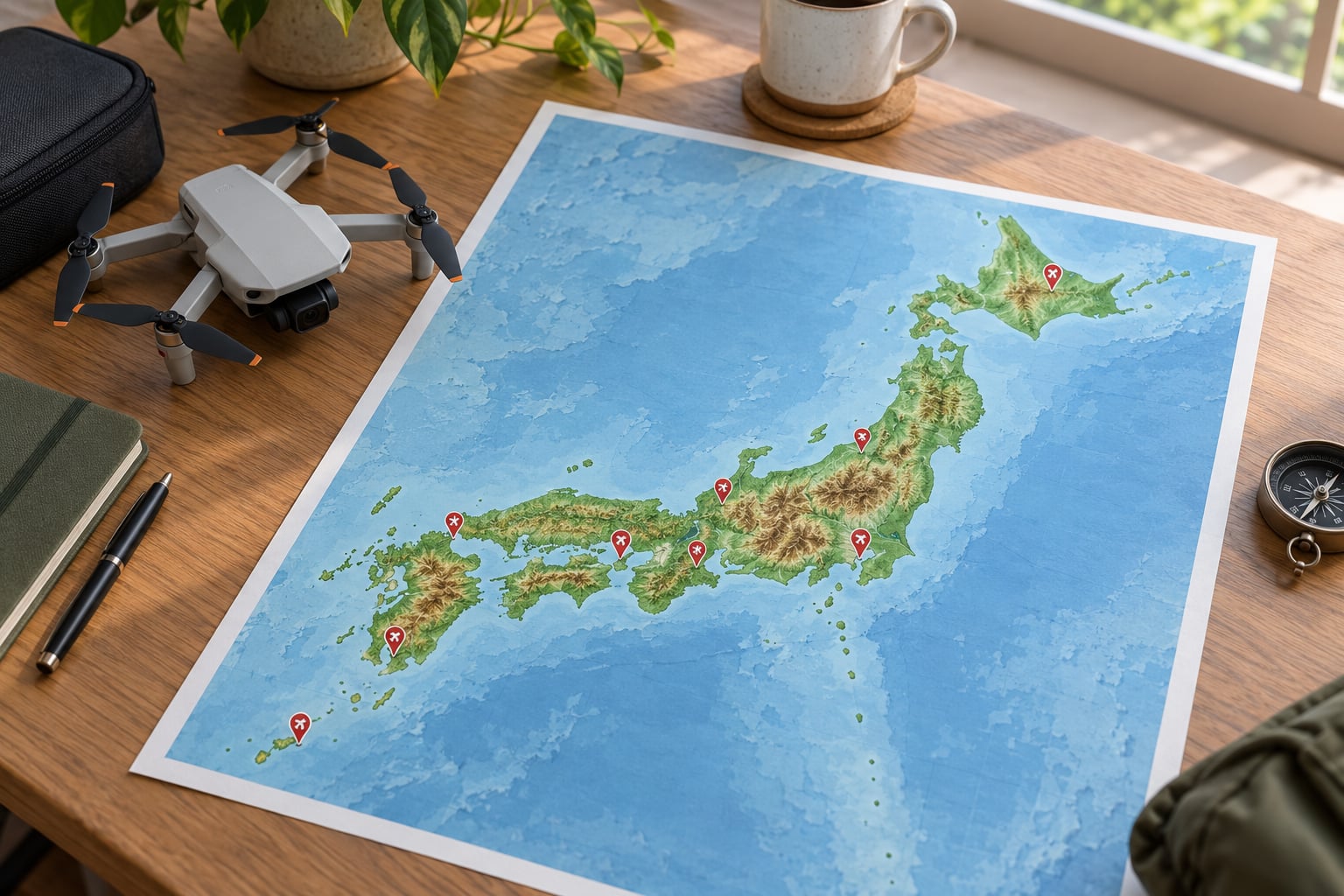
Drone rules are strict in Japan for five reasons that stack on top of each other: aviation safety, the 2015 incident with a drone on the Prime Minister’s office roof, a national security posture that treats critical infrastructure as a target, privacy norms that make bystanders watchful, and a general caution about new technology. Japan regulates drones as aircraft under the Civil Aeronautics Act rather than as consumer gadgets.
That last choice explains almost everything. Once a drone sits inside aviation law, registration, airspace clearance and operator certification kick in, and the everyday answer to “can I just go fly this?” becomes “not without checking five separate pieces of legislation first.”
The practical result surprises most visitors. Drones are legal in Japan. Flying one where you want to fly it usually is not, and the gap between those two statements is where nearly every broken rule lives.
Table of Contents
- 1Why Drone Rules Are Strict in Japan
- 21. A 2015 incident rewrote the law in months
- 32. Dense manned aviation shares the same sky
- 43. Privacy and anti-surveillance expectations are high
- 54. Critical infrastructure is treated as a security concern
- 65. A precautionary legal culture
- 7The Safety Problems Japan Is Trying to Prevent
- 8Why Drone Rules Are Strict in Japan’s Crowded Airspace
- 9The Main Rules That Reflect Japan’s Strict Approach
- 10Japan’s Airports, Controlled Airspace, and No-Fly Areas
- 11Privacy, Photography, and Anti-Surveillance Concerns
- 12What Drones Must Be Registered and Identified
- 13Why Tokyo and Other Crowded Cities Attract Extra Scrutiny
- 14What Visitors Need to Check Before Flying
- 15Why the Rules Do Not Amount to a Total Drone Ban
- 16Frequently Asked Questions
- 17Do I need drone insurance to fly in Japan?
- 18Can I use a drone at festivals or other crowded events in Japan?
- 19Are very small microdrones exempt from registration and Remote ID rules?
- 20Is it illegal to record identifiable people or private property with a drone in Japan?
- 21How can visitors verify current drone restrictions and controlled-airspace rules in Japan?
- 22Conclusion: What to Do Before Your First Flight
Why Drone Rules Are Strict in Japan
The short version: Japan’s drone regime is strict because the country treats unmanned aircraft as a flight-safety and security problem, not a photography accessory. Five forces drive it.
1. A 2015 incident rewrote the law in months
In April 2015 a small multirotor drone landed on the roof of the Prime Minister’s office. It carried no explosive payload and nobody was hurt, but the optics were bad enough that the amendment to the Civil Aeronautics Act covering small unmanned aircraft was enacted later that same year. Law firms writing about the regime still point to that timeline as evidence of how quickly Japan legislates after an incident involving technology.
2. Dense manned aviation shares the same sky
Japan is an archipelago of narrow plains boxed in by mountains, with major airports often sited near cities and numerous helicopters serving islands, mountains and emergency services. That leaves little spare room for low-altitude aircraft that nobody is watching.
3. Privacy and anti-surveillance expectations are high
A drone hovering outside a house is a camera at a window. Japan applies civil and criminal privacy norms to that situation, and the operating rules already build in distance and line-of-sight limits specifically to stop it.
4. Critical infrastructure is treated as a security concern
Japan legislated separately, through the Act Prohibiting the Flight of UAVs over Important Facilities, to create hard no-fly zones around specified sites, with a notification requirement to the Public Safety Commission in some cases. Nuclear, defence and other sensitive locations are treated as off limits by design.
5. A precautionary legal culture
Where the United States gives a recreational pilot a broad permission and then carves out exceptions, Japan starts with a narrow permission and requires you to earn broader access. The default answer is no until approved.
The Safety Problems Japan Is Trying to Prevent
Every clause in the Civil Aeronautics Act maps to a real hazard. A drone losing control in a residential street can injure someone on a balcony or at a crossing. Falling aircraft are a genuine risk over crowds, which is why event sites carry specific restrictions.
Interference matters too. Japan’s emergency helicopter services, police and disaster-response aircraft operate in areas a hobby pilot may never have thought about, and a drone in the climb or descent path creates a hazard for crewed flight. Power infrastructure is another concern, since inspection work near transmission lines is exactly the kind of flight that can be flown only with approval.
Why Drone Rules Are Strict in Japan’s Crowded Airspace
Dense development makes a flight look simpler than it is. In a Japanese city, an open space between buildings is usually a road, a schoolyard, a shrine or a small park, and each of those has people, structures and utilities underneath it. Emergency landing options are limited because there is very little flat, empty ground.
Mountainous terrain adds a second layer. Valleys and coastal corridors channel both crewed aircraft and drone flights into the same narrow bands of air, so a route that looks clear on the ground can sit directly under an approach path.
The Main Rules That Reflect Japan’s Strict Approach
Here are the core operating conditions most visitors run into, in plain English. Confirm current thresholds with the Ministry of Land, Infrastructure, Transport and Tourism (MLIT) before you fly, because details shift.
| Rule | What it means in practice |
|---|---|
| Registration threshold | Aircraft weighing 100 g or more must be registered under the Civil Aeronautics Act, and the registration number must be displayed on the airframe. |
| Altitude ceiling | 150 metres above ground level. Higher requires approval. |
| Densely inhabited districts | Flying over areas where people live or gather needs MLIT approval, which is the rule that catches out most visitors. |
| Visual line of sight | You must be able to see the aircraft unaided. Binoculars do not satisfy the requirement. |
| Daylight only | Flight between sunrise and sunset. |
| Distance from people and property | Stay at least 30 metres from people and structures. |
| Important facilities | Flights over listed facilities are prohibited outright, with some notification duties. |
| Event sites | No flights over festivals, concerts and other event areas. |
Two rules get overlooked. You may not drop objects from a drone, and you may not fly under the influence of alcohol or medication. Both sound obvious, both appear in the statute, and both appear in enforcement materials.
Japan’s Airports, Controlled Airspace, and No-Fly Areas
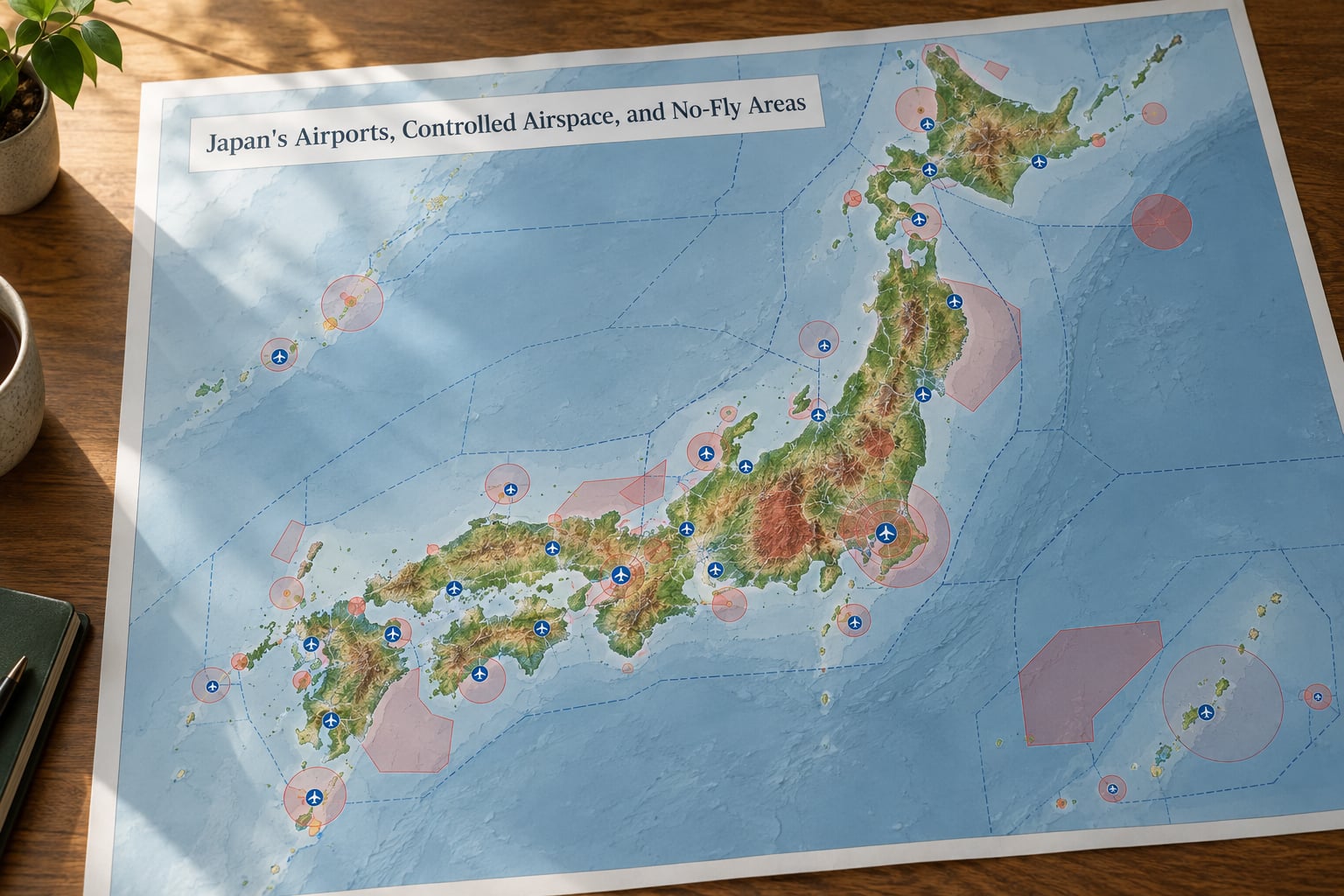
Airports are the reason “how close am I” is the most important question before launch. Japan does not present a single simple blanket distance to memorise, because the answer depends on the airport, the aircraft and the kind of operation. Some airports publish additional control areas on top of the statutory ones, and heliports matter too.
So do not estimate from memory. MLIT publishes prohibited airspace and the relevant zone maps, and the practical habit is to check the official drone information site or a reputable airspace app before every flight, not once a season. Search for your specific location rather than your city, then look for the nearest airport, any prohibited zone, and whether you are sitting inside a densely inhabited district.
If the map is ambiguous, treat the spot as unavailable and move. Nobody gets in trouble for choosing a different field.
Privacy, Photography, and Anti-Surveillance Concerns
Recording identifiable people or the interior of private property from the air is the risk that casual flyers underestimate most. Japan carries a defamation and privacy-penalty tradition alongside its aviation rules, and the aviation rules themselves already reflect it through the 30-metre distance requirement, visual line of sight and the ban on flights over populated areas without approval.
Public photography is not automatically illegal. Filming a street from a legal position, with consent where needed, in daylight and outside a prohibited zone, is ordinary lawful use. Persistent recording of a specific property, filming through windows, or hovering outside someone’s home is a different thing entirely and is where the law and social reaction both turn against you.
Forum threads on r/JapanTravelTips return to the same point from the visitor side: a legal flight can still attract attention, because people who did not ask to be filmed are not always willing to wait while you explain the aviation rules. Treat bystander discomfort as a real cost, not just a nuisance.
What Drones Must Be Registered and Identified
Registration applies to unmanned aircraft weighing 100 g or more. Once registered, the aircraft carries a registration number, and Remote ID broadcast requirements mean the aircraft can be identified during flight rather than after an incident. That identification requirement is the practical answer to “an anonymous drone over a restricted site” as a problem.
The distinction that confuses visitors is between registration, operator certification and permission to fly a location. Registering an aircraft says nothing about whether you are qualified to fly it. A second-class licence or first-class certification is a separate credential for operations beyond basic recreational flying. Permission for a specific site is a third approval again.
Travellers with foreign-registered aircraft should confirm the position with MLIT before departure rather than assuming home-country paperwork carries over. Some pilots report that this was the single most confusing part of planning a Japan trip, since the official registration flow is Japanese-language and residency-linked.
Why Tokyo and Other Crowded Cities Attract Extra Scrutiny
Population density does not create a separate rule, but it decides which rules apply. A flight over Tokyo, Osaka or Nagoya is very likely to sit inside a densely inhabited district, which is the same category of airspace that requires approval before flight rather than after.
Apartment balconies, utility lines, rooftop equipment, dense road traffic and constant emergency service movement all reduce the margin for error. Local governments can also add their own ordinances on top of national law, covering parks, event grounds and public facilities, which is why two cities can have different answers for similar-looking spaces.
Natural areas, parks outside city centres and rural coastline tend to be far more workable for casual filming, which is the pattern aerial photographers describe when they talk about urban Japan being effectively closed off.
What Visitors Need to Check Before Flying
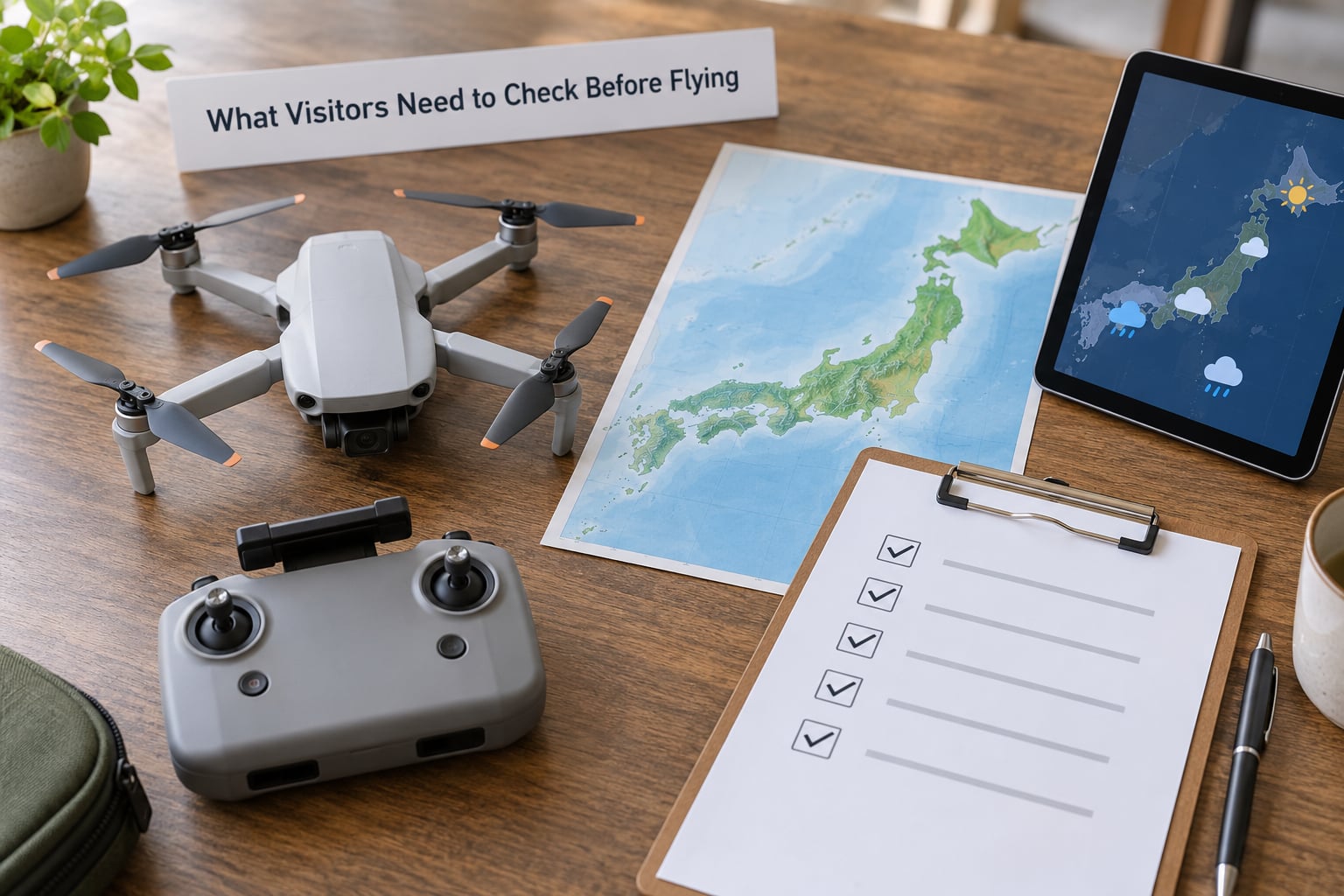
Work through this list before every flight, in this order.
- Check the current restrictions officially. Start with MLIT’s drone information pages rather than a blog or a forum answer from two years ago.
- Confirm your aircraft’s weight and whether it needs registration, and display the registration number if it does.
- Sort out credentials. Registration, operator certification and site permission are three separate approvals.
- Verify the airspace on a map for the exact spot, including nearby airports, heliports and prohibited zones.
- Work out the altitude budget and stay inside 150 metres above ground level.
- Read the weather, especially wind near buildings and any forecast for rain.
- Plan for visual line of sight and choose a launch point where you can keep the aircraft in view without watching through a screen alone.
- Count the bystanders. If you cannot hold 30 metres of distance from people and property, that is your answer.
- Check privacy exposure. Ask whether your shot needs anyone identifiable in it, and get consent where you can.
- Look at local ordinances and any event bookings that day.
- Consider insurance and what it covers for a foreign operator.
- Have a bail-out plan for the situation where people gather or a helicopter appears.
Japanese-language maps and apps dominate, which is the other practical friction nobody warns you about. Budget an evening for the vocabulary rather than an afternoon at the launch point.
Why the Rules Do Not Amount to a Total Drone Ban
Drones are used legally across Japan every day for construction surveying, bridge and infrastructure inspection, agriculture, disaster response, news filming and cargo delivery trials. The regime includes approval routes for operations that look complicated but are entirely legitimate, including flight with approval over inhabited districts and, under newer approvals, flight beyond visual line of sight.
What the rules restrict is unsupervised, unidentified flight near people and sensitive places. If your operation is planned, identified and located somewhere the rules permit, the path exists. It takes paperwork, and for a two-week holiday it rarely makes sense, which is a planning fact rather than a prohibition.
Frequently Asked Questions
Do I need drone insurance to fly in Japan?
Insurance is not a blanket legal requirement for ordinary recreational flights, but it is one of the most effective ways to handle the consequences of an accident or a privacy complaint. Some categories of operation and some local rules call for liability cover, and an approval for a riskier flight may ask you to show it. Visitors should read their travel policy first, then consider a policy that explicitly covers unmanned aircraft flown by a foreign operator.
Can I use a drone at festivals or other crowded events in Japan?
Generally no. The Civil Aeronautics Act prohibits flight over event sites where crowds gather, because a falling aircraft over people is the clearest accident scenario the rules target. Organisers of major events also publish their own restrictions, and local ordinances may add more. If your shot depends on a festival, plan to film from the ground instead. Approvals for genuine broadcast or production work are handled separately and start well before the event.
Are very small microdrones exempt from registration and Remote ID rules?
Registration kicks in at 100 grams, so genuinely micro aircraft below that weight sit outside the registration requirement. That exemption does not remove the operating rules. Altitude, visual line of sight, daylight, distance from people, airspace and the ban on flights over event sites all still apply to a very small aircraft. Weight changes whether you must register; it does not change whether the location is legal to fly over.
Is it illegal to record identifiable people or private property with a drone in Japan?
Not in every case, but the legal risk rises fast. The aviation rules already limit flights over inhabited areas and impose a 30-metre distance from people and property, and Japan’s privacy and defamation framework adds separate exposure for recording identifiable people or the interior of private premises. Public filming from a legal position is ordinary lawful use. Persistent recording of a specific person or property is not, and can be pursued independently of any aviation breach.
How can visitors verify current drone restrictions and controlled-airspace rules in Japan?
Use official sources first: the Ministry of Land, Infrastructure, Transport and Tourism drone information pages set the airspace and operating rules, and the National Police Agency covers the rules for important facilities. Then check the specific location on a current airspace map before each flight. Avoid travel advice written years ago, since the zone maps and registration thresholds have changed more than once. When a map is ambiguous, pick a different spot.
Conclusion: What to Do Before Your First Flight
Understanding why drone rules are strict in Japan changes how you plan a flight here. The strictness is a response to a specific 2015 incident, a crowded airspace shared with crewed aircraft, and a government approach that protects infrastructure and privacy by defaulting to permission rather than tolerance.
Before you launch, check the official MLIT information for your exact location, sort out registration and any credential your operation needs, and pick a spot outside a densely inhabited district with clear distance from people. Start small and legal, and most of the friction disappears.