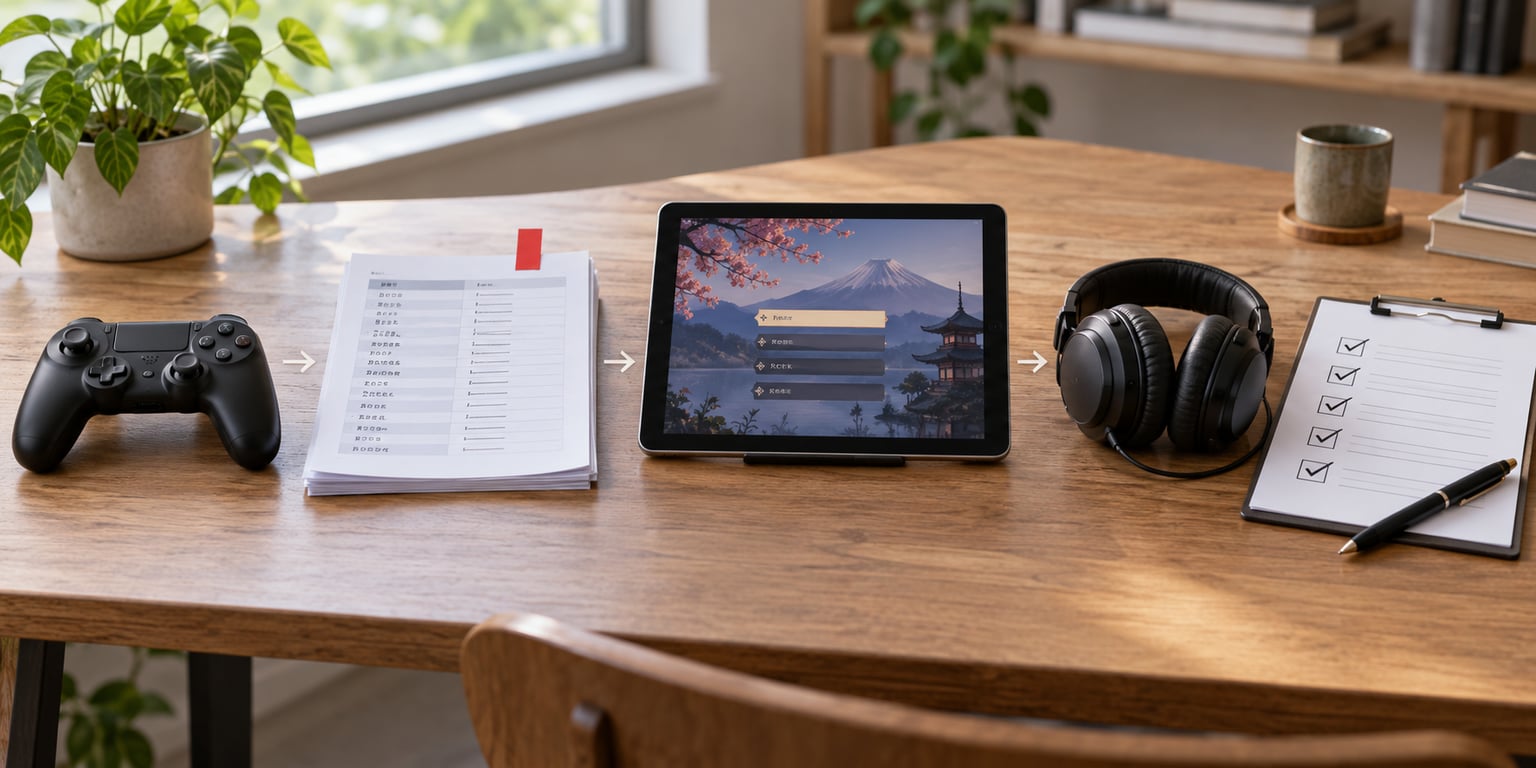
How Japanese localization works for games is mostly a pipeline problem. Teams pick target markets, engineer the build so every line of text can be swapped, then run those lines through translation, cultural review, audio recording and testing inside the actual game before anyone sees them. Japanese adds layers a straight translation never handles on its own.
That last part matters more than it sounds. A literal English rendering of Japanese dialogue often drops a social relationship, flattens a joke, or produces a menu label that does not fit the box it sits in. Good Japanese localization rebuilds the line so it carries the same meaning and the same feeling, without breaking the game around it.
Players themselves tend to describe a great localization as one they never noticed. That framing came out of a long-running r/JRPG discussion about localization becoming invisible, and it is a useful standard to keep in mind while walking through the process.
Table of Contents
- 1What Is Japanese Game Localization?
- 2How Japanese Localization Works for Games
- 3How the Localization Process Moves Through a Game
- 4What Happens During Japanese Translation and Cultural Adaptation?
- 5How Japanese Localization Works for Games at the Cultural Review Stage
- 6How Are Menus, Subtitles, Fonts, and Player Controls Adapted?
- 7What Changes When Voices and Music Are Localized?
- 8How Do Local Publishers and Testers Check the Result?
- 9Who Does Japanese Game Localization and What Tools Do They Use?
- 10What Makes a Japanese Localization Feel Native?
- 11Frequently Asked Questions
- 12Is Japanese game localization just translating the text?
- 13Should a game translated from Japanese be localized again for Japan?
- 14Do Japanese game localizers change jokes and cultural references?
- 15Does Japanese localization include voice acting and music?
- 16How long does it take to localize a game into Japanese?
What Is Japanese Game Localization?
Japanese game localization adapts a game’s text, visuals, audio and systems so they feel native to players in Japan, or so a Japanese-language game reads naturally for players elsewhere. It covers language, culture, interface design, voice work and market rules, not just words on a screen.
| Game translation | Game localization |
|---|---|
| Converts dialogue and text between languages | Adapts language, culture, UI, audio and content rules |
| Works inside whatever space the text already occupies | Changes the space too, so text still fits and reads well |
| Mostly a language task | A language, design, engineering and audio project |
| Ends when the words are correct | Runs through testing in the game and every later update |
Two directions use the same machinery. Japanese-to-English work, which is what most JRPGs do, carries embedded honorifics and layered politeness out of the source. English-to-Japanese work, which is what a Western studio does to launch in Japan, has the harder layout problem, because Japanese text and Japanese interface conventions behave differently from English ones.
How Japanese Localization Works for Games
It works as a pipeline. A localization producer picks markets and a shipping strategy, engineers internationalize the game so strings are external and expandable, a loc-kit defines tone and terminology, native translators and editors work through the strings, the audio team records or adapts voice, then linguistic QA plays the game in the target language until the text stops getting in the way. After launch the same pipeline repeats for every patch and seasonal update.
Each stage has a gate. Nobody starts translating before the strings are extractable, and nobody calls a version done before someone has read it inside the running game.
How the Localization Process Moves Through a Game
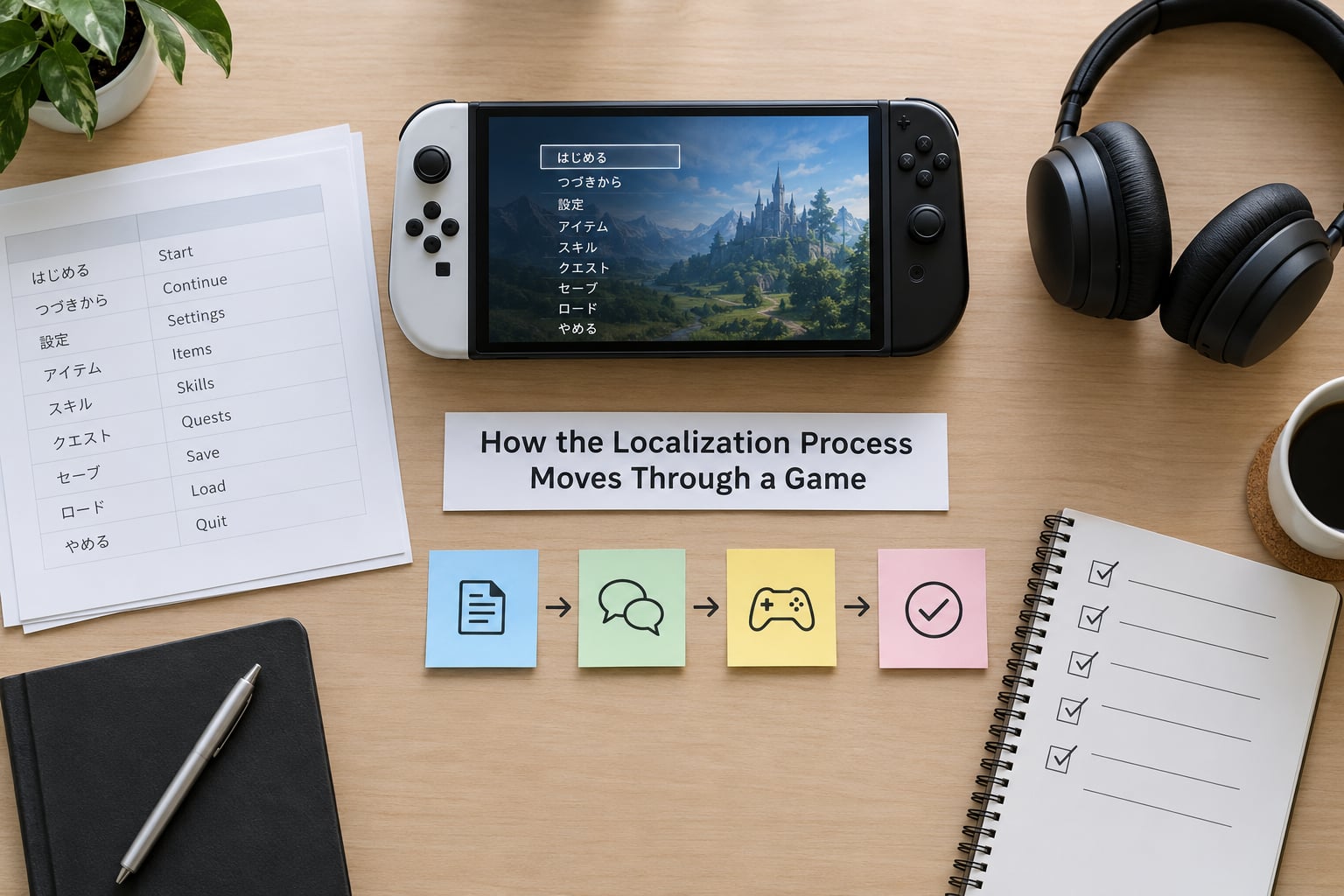
| Stage | Input | Main output | Who owns it | Sign-off test |
|---|---|---|---|---|
| Market and release planning | Sales data, wishlists, platform terms | Target list and launch strategy | Localization producer | Decided before translation budget is committed |
| Internationalization | Code, UI mockups, font files | Externalized strings, expandable layouts | Engineers and UI designers | Pseudo-localized build runs with no overflow |
| Loc-kit and prep | Script, screenshots, style rules | Style guide, glossary, term base | Lead translator or content lead | Every recurring term has one agreed form |
| Translation and editing | Extracted strings and context images | Reviewed target-language text | Translator, editor, native reviewer | Second pass agrees with the first on tone |
| Audio | Script, cast, direction notes | Recorded lines or subtitle files | Voice director and cast | Timing matches animation and on-screen text |
| LQA and release | Localized build | Bug list and sign-off | Localization QA and publisher | Played through to credits with no blockers |
Simultaneous launch, where every major language ships on day one, is the expensive option because translation, audio and testing all compress into the same window. Post-launch localization is cheaper and lets a team localize content that does not exist yet, which is why live-service games settle into a rolling pipeline.
What Happens During Japanese Translation and Cultural Adaptation?
Japanese encodes social distance in the grammar itself. A character might call a classmate sensei out of respect, drop the honorific later in the story to signal closeness, or shift from ore to boku when a mask comes off. English has no cheap equivalent, so a translator either loses the relationship or imports a word Japanese players find foreign in an English-language game.
The senpai debate in the Persona series is the clearest example. Retaining the Japanese honorific carries the character dynamic across; dropping it makes the English read more smoothly. Fans still argue about whether the choice worked, which tells you something useful: this decision is never neutral.
Beyond relationships, teams deal with honorifics, sentence-final particles that carry emotion, keigo used in service or workplace scenes, and humor built on wordplay that simply does not survive a direct rendering. Jokes are usually rewritten around a new pun rather than translated literally.
How Japanese Localization Works for Games at the Cultural Review Stage
At cultural review, a reviewer who grew up with the material looks at the English script the way a native player would. That person flags a joke that lands flat, a reference that quietly assumes background nobody in the target audience has, a social assumption that reads backwards, or an honorific used where a character would not use one.
This stage is about credibility rather than accuracy. Localization teams are explicitly warned against reaching for stereotypes, because the fastest way to make a game feel foreign is to lean on the lazy version of a culture instead of its actual detail.
A lot of the friction players see online comes from this step being invisible. When a line has been deliberately adapted, there is usually nothing in the game telling you so, so an error and an intentional choice look identical from the outside.
How Are Menus, Subtitles, Fonts, and Player Controls Adapted?
Interface work is where a localization that looked fine on paper fails. English text is quoted in words, and Japanese text is quoted in characters, which makes budgets, box sizes and expansion allowances behave very differently depending on the direction of the project.
Japanese runs dense per character, so a line that fits an English dialogue box can overflow it going the other way. When English is the source language, planning usually assumes text expansion of roughly 20 to 35 percent, and layouts are built with room for that.
Japanese also follows kinsoku shori, line-breaking rules that forbid certain characters from starting or ending a line. Small marks, long vowel marks and closing punctuation have to be pushed to the previous line instead, which shifts where every following character lands. A translation tool or engine that ignores these rules produces text that technically fits and visually stutters.
Fonts need glyph coverage for the whole set, and placeholder names in source code are never shipped as final labels. Controller prompts get rebuilt per platform, since Japanese button labels differ from English ones and hardware differs between console, PC and handheld releases. Legal text and rating notices are handled separately by the publisher, since CERO and consumer rules apply to a Japanese release regardless of what the game contains.
Subtitles follow Japanese conventions too. There is no space between characters, lines are kept short, and speakers are identified differently than in English subtitles.
What Changes When Voices and Music Are Localized?
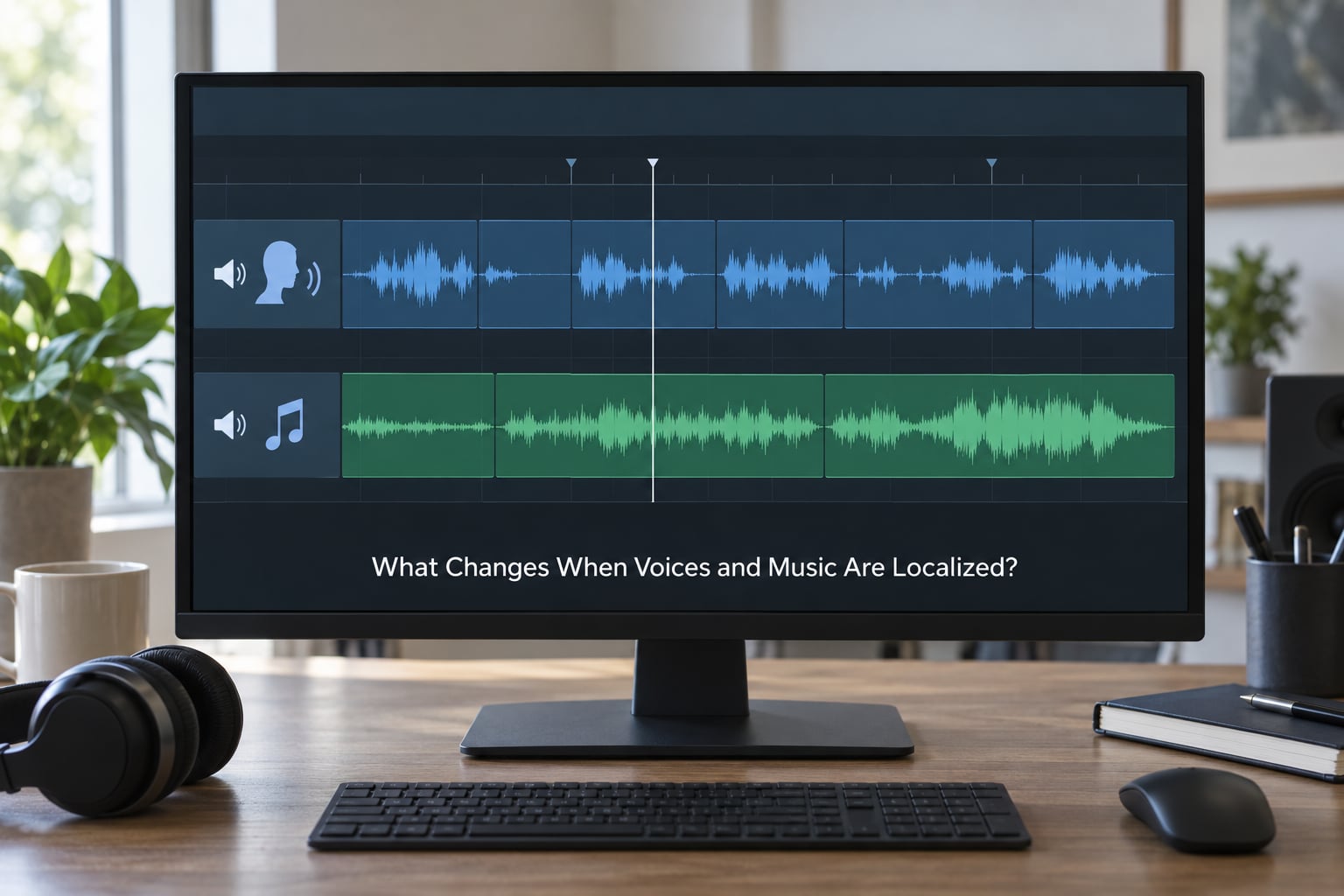
Audio comes in three tiers. Subtitle-only is the cheapest and still the norm for many Japanese RPGs going west. Partial localization keeps original voice for barks and grunts and re-records story scenes. A full dub replaces every line, which is the most expensive tier by a wide margin because of casting, direction, studio time and retakes.
Japanese dubs have their own shape. Casting is handled around seiyuu, the professional voice actors whose existing fan bases can carry a character on their own, and scripts are often adjusted for the mouth before recording, since Japanese and English syllables do not line up one to one. Direction happens in the studio with the actor, and lip sync becomes a timing problem rather than a language problem.
Music and sound effects usually stay untouched. When a title mixes languages, a song in Japanese playing under English dialogue is normal, and teams decide deliberately whether to keep original vocals, replace them, or use instrumental versions.
How Do Local Publishers and Testers Check the Result?
Localization QA is not regular game QA. Functional testers ask whether the build works, and localization testers ask whether a Japanese player can understand and enjoy it. They play the localized build from the first screen, not a spreadsheet.
Typical checks include truncated labels, text bleeding past buttons, wrong glyphs, missing furigana where it is expected, inconsistent terminology against the glossary, honorific slips, mismatched subtitle timing, and content that sits differently in the target market than in the source. Screenshots in the loc-kit exist so reviewers can see the original layout while they judge the new text.
Bug reports carry severity, because a mistranslated tutorial step and a slightly awkward menu label are not the same conversation. Publisher sign-off is the final gate, and a correction patch after launch is normal rather than embarrassing.
Who Does Japanese Game Localization and What Tools Do They Use?
The localization producer owns the schedule and the budget. Translators handle the language, editors polish and standardize, and a native reviewer in Japan checks cultural fit. Engineers own string extraction and layout. A voice director handles casting and recording. Localization QA plays the build repeatedly, and the publisher signs off.
For indie developers, the practical version is smaller. One person often plays producer, editor and reviewer, with native speakers hired per language. r/gamedev threads where developers share word counts and vendor costs are the realistic source of expectations here, because almost nobody publishes real figures and the ones who do tend to describe the same pattern: cost scales with volume, and voice is the line item that surprises people.
Tools fall into a few categories without needing to name a vendor. Computer-assisted translation tools and translation memory reuse approved wording across a title and its updates. Translation management systems route strings, track status and store the term base. Engines handle the technical build side. AI now drafts first passes in some pipelines, usually with a human reviewer on top, and one Japanese developer has publicly defended the approach. Players are less enthusiastic, which is why unreviewed machine output reads as a deal-breaker to them rather than a shortcut.
What Makes a Japanese Localization Feel Native?
Native-feeling localization shows up in small places. Dialogue sounds like people talking rather than a script being read aloud. Honorifics stay consistent for the whole game, including the updates. Menu labels read as labels, not sentences. Text fits without cutting off. Voices stay synchronized with animation, and a joke still lands.
Players tend to notice the negatives faster. Forum threads on Japanese-to-English releases and on the state of modern localization keep circling the same complaints: broken honorifics, names that turn into unfortunate words in English, terminology that shifts between the base game and its DLC, and jokes that disappear entirely. Those are the things to test for first.
The trust signal is transparency. A localization that credits its translator, keeps a visible glossary, and explains what it changed reads better than one that claims to be word-perfect and is not.
Frequently Asked Questions
Is Japanese game localization just translating the text?
No. Translation converts words between languages. Localization adapts the whole game so it works in the target market: dialogue tone, honorifics, menu labels, UI layout, fonts, audio casting, rating notices and legal text. The word on screen is the smallest part of it, and the part that fails most visibly when it is treated as the whole job.
Should a game translated from Japanese be localized again for Japan?
Rarely. Japanese-to-English localization adapts a game outward, usually softening or replacing references that do not travel. Japanese players get the original Japanese script, so they receive the source version, not a re-localization. What changes for them is hardware, packaging, ratings and support, not the language itself.
Do Japanese game localizers change jokes and cultural references?
Often, yes. Puns built on Japanese wordplay rarely survive a direct rendering, so they get rewritten around a joke that works in the target language. References with no equivalent are substituted or explained. The goal is to preserve how the line felt in the original, and veteran reviewers are specifically trained to avoid leaning on stereotypes when they substitute.
Does Japanese localization include voice acting and music?
It depends on the tier. Subtitle-only, partial re-recording and a full dub are all common, and many Japanese RPGs ship subtitle-only for English. A Japanese dub means casting seiyuu and re-timing lines to fit mouths. Music and sound effects usually stay in their original form, even when dialogue around them changes language.
How long does it take to localize a game into Japanese?
It scales with text volume, audio hours and how much of the layout work is already done. Small indie titles often manage in a few months with a handful of people, while a large multi-language launch runs on a much longer cycle with audio and testing compressed against the release date. Engineering the game for localization early is the single biggest lever on the schedule.
Start at the beginning and decide where your text lives. If strings are embedded in the code, pull them out and widen the boxes before a single line gets translated. Everything after that step, including the cultural calls and the voice work, goes faster once the engineering is finished.