Gacha is not banned in Japan. What is regulated is the part players cannot see: the real probability behind each prize. Japanese rules force publishers of paid randomized-item games to publish those odds, to describe them honestly, and to cap spending for minors — so why gacha rates are regulated in Japan is really a question about what buyers are allowed to be misled about.
The short version: a paid chance mechanic combined with hidden or manipulated rates became a consumer-protection problem, and Japanese regulators responded by regulating transparency rather than the mechanic itself. That distinction surprises a lot of players who assume Japan took the hard-ban route that Belgium later took.
Below is a plain-English walk through what the rules cover, what they demand from operators, and what they genuinely do not promise you.
Table of Contents
- 1Why Gacha Rates Are Regulated in Japan
- 2What Counts as Gacha Under Japanese Rules
- 3How Japan’s approach differs from Belgium, the Netherlands, the UK and the US
- 4Why Japan Introduced the Gacha Rules
- 5What Publishers Must Disclose About Gacha Rates
- 6Why Japan regulates gacha rates but not gacha itself
- 7How Japan’s Gacha Spending Limits Work
- 8What Protections Apply to Minors
- 9How Gacha Operators Are Required to Control the System
- 10What Japan’s Gacha Rules Do Not Guarantee
- 11What Players, Parents and Publishers Should Check First
- 12Frequently Asked Questions
- 13Is gacha illegal in Japan?
- 14Does Japan require gacha probabilities to be completely accurate?
- 15Can players get a refund for spending too much on gacha in Japan?
- 16What is the monthly spending limit on gacha in Japan?
- 17Do Japan’s gacha rules protect overseas players?
- 18Are minors allowed to use paid gacha in Japan?
- 19Conclusion
Why Gacha Rates Are Regulated in Japan
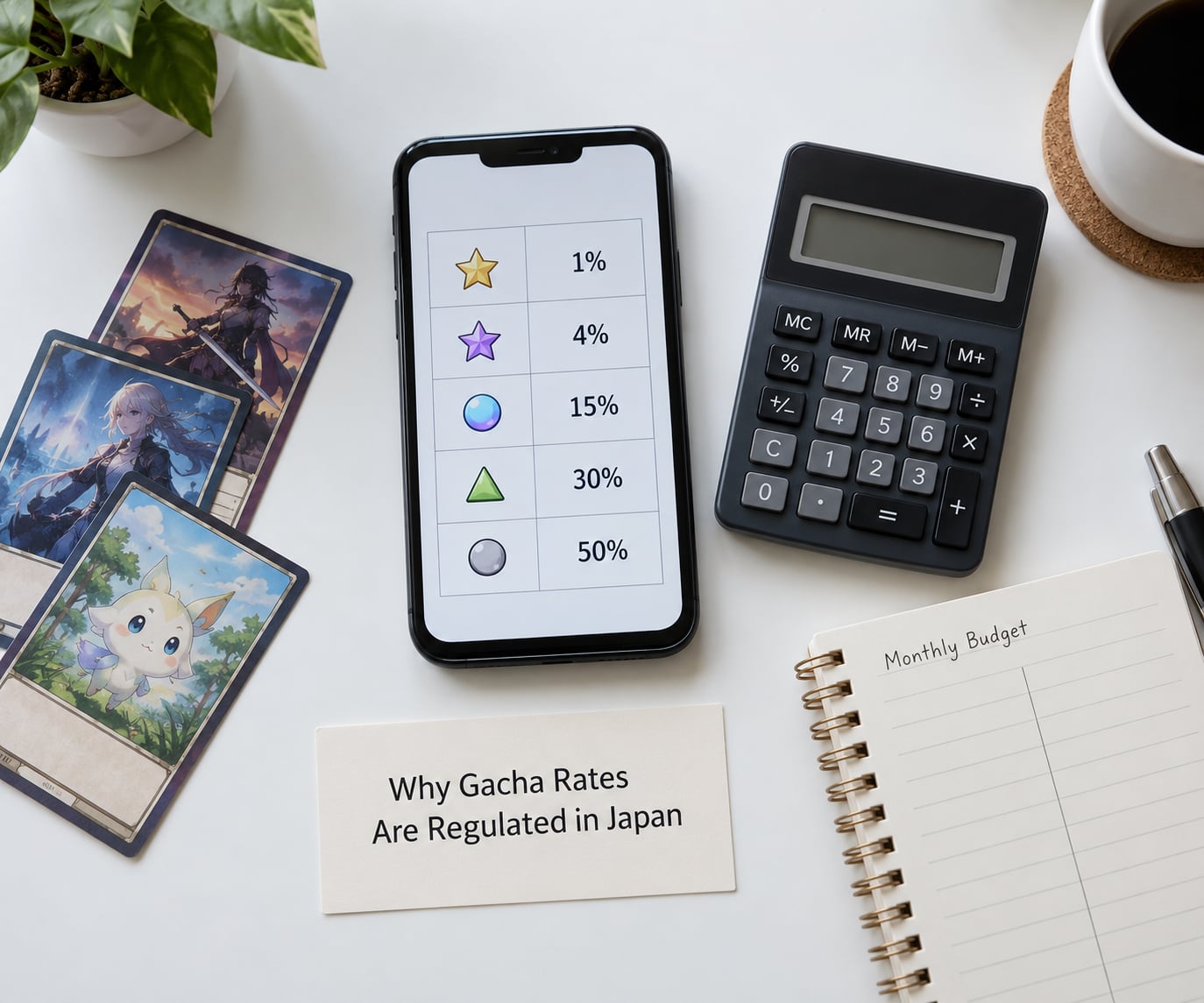
Japan regulates gacha rates because a player who pays real money for a chance at a random prize is a consumer, and consumers are entitled to know the odds they are buying. Regulators moved in after documented cases of advertised rates not matching what players actually received.
The reasoning breaks down into a handful of points:
- Opaque odds cannot be checked. A drop rate a player cannot see is a claim they cannot test, and unchecked claims drift.
- Misstatement is the real harm. Case studies in Japan, including the Granblue Fantasy controversy and the 2018 Square Enix class action filed in the Tokyo District Court, involved rates presented one way and delivered another.
- Spending runs away quickly. A mechanic with no cost ceiling lets a session become a budget breach in an evening.
- Minors were targeted by design. Recurring payments and bright character art land hard with younger players, which is why separate spending rules apply to them.
- Chance-based spending resembles gambling. Japan already has a tightly bounded framework for gambling, so letting a chance mechanic grow unbounded looked inconsistent.
- Commercial trust depends on it. A domestic standard that survives scrutiny is easier to export than one that keeps collapsing under complaints.
None of those points requires the mechanic to disappear. They require publishers to show their working.
What Counts as Gacha Under Japanese Rules
Gacha under these rules means a prize obtained by chance where the player spends money for the opportunity to draw. The spending is the trigger, not the randomness itself. That is why two systems that feel identical to a player can sit on opposite sides of the line.
| Mechanic | Does money buy the chance? | Typical treatment |
|---|---|---|
| Paid character or item draws | Yes | Gacha — probability disclosure and spending controls apply |
| Characters earned by playing | No | Not treated as paid chance-based prizes |
| Random loot from crafted or farmed content | No direct purchase of the chance | Generally outside the disclosure regime |
| Conventional card packs bought outright | Yes, the pack is the product | Not a chance-based transaction |
| Physical gachapon capsule toys | Yes, the capsule is bought | Separate rules for capsule and toy quality, not the digital prize table |
Physical capsule toys are worth separating out. Gachapon is an ordinary retail product sold through ordinary vending machines, and the concerns there are about contents, labelling and safety standards rather than digital probability disclosure.
How Japan’s approach differs from Belgium, the Netherlands, the UK and the US
Japan regulates the disclosure of rates. Other jurisdictions have taken stiffer routes, and the contrast explains much of the confusion international players bring to the topic.
| Market | Stated approach | Nature of the rule |
|---|---|---|
| Japan | Regulates rates and representations | Disclosure duties and caps on chance-based spending |
| Belgium | Treated paid loot boxes as gambling | Broad restriction on paid randomized items |
| Netherlands | Treated some loot boxes as gambling | Enforcement position on chance-based purchases |
| UK | Self-regulatory ruling | Advertising Standards Authority decisions on how loot boxes are marketed |
| United States | FTC scrutiny of deception | Enforcement against misleading claims rather than a category ban |
The practical effect: a Japanese publisher has a documented disclosure duty, while a US publisher may face action only if the FTC can show the marketing was deceptive. Different tools, different bite.
Why Japan Introduced the Gacha Rules
The trigger was a 2012 wave of complaints about designs called complete gacha, or kompu gacha, where a prize pool could be exhausted yet the draw kept accepting payment. Players paid into a machine that could no longer deliver what they were buying, and the Consumer Affairs Agency (Shōhisha-chō) said so publicly.
The public reaction was immediate and severe. Major game developers saw market value fall sharply in the days after the statement, and the pressure on the industry grew through the decade. Rules followed, because the alternative was leaving a commercial practice in a legal grey zone.
| Period | Event | What changed |
|---|---|---|
| Early 2000s | Revisions to the Act against Unjustifiable Premiums and Misleading Representations | Strengthened penalties for misleading representations about prizes |
| 2012 | Consumer Affairs Agency statement on complete gacha | Exhausted pools continued to sell draws became a public enforcement target |
| 2016 | Further amendment introducing gacha provisions | Probability disclosure and chance-based labelling requirements |
| 2018 | Square Enix class action in the Tokyo District Court | Litigation over drop rates described as differing from reality |
| 2022 | Amendment to the digital platform transparency and fairness act | Spending control framework for minors, applied from 2023 |
| 2023 onward | Consumer Affairs Agency guidance for operators | Detailed expectations for disclosures, confirmations and spending limits |
Note the shape of the response. No ban, no age floor on the mechanic itself. Instead, an obligation to tell the truth and a ceiling on how much a minor can lose.
What Publishers Must Disclose About Gacha Rates
Publishers must show the probability of each prize in a form a player can read before paying, not a summary buried in terms of service. In practice that means a per-item rate table with exact percentages, plus clear labelling that the transaction is chance-based.
Three different numbers get confused constantly, and it helps to separate them:
- Advertised rate — what the publisher states the chance is.
- Confirmed rate — the rate the operator commits to honouring, verified against a controlled random process.
- Observed rate — what a player’s own results suggest. One unlucky streak proves nothing; a hundred pulls at a rare rate is a normal outcome, not evidence of tampering.
Operators are also expected to control how odds change. Where a rate is altered, that needs to happen in a way that does not retroactively disadvantage a player mid-draw-sequence, and changes are expected to be announced rather than slipped in.
Players have noticed the difference. In a thread on r/gachagaming about the biggest red flags in a gacha game, the recurring complaints were unchanged rates with no notice, rate changes announced badly or late, and reward events that sound generous but behave badly. Those are disclosure failures, which is exactly the category Japanese rules are built around.
Why Japan regulates gacha rates but not gacha itself
Because the rule targets the asymmetry of information rather than the presence of chance. A player can accept a 1-in-1000 shot. What a player should not have to accept is a shot whose true odds are hidden, adjustable at will, or different from the ones advertised. Removing that asymmetry addresses the documented harm without suppressing a legitimate design choice that Japan is unusually attached to as cultural and commercial output.
How Japan’s Gacha Spending Limits Work
Spending controls sit on top of disclosure. They exist because accurate odds do nothing about a player who loses track of what they are spending.
| Control | What it limits | Notes |
|---|---|---|
| Minor aggregate monthly cap | Total charged to a single minor across paid randomized items in a calendar month | Set under the 2022 amendment, applied from 2023 |
| Minor aggregate cap for all paid items | Total charged to a minor across every category of paid content | Separate ceiling from the randomized-item one |
| Short-window cap for younger minors | Spending over a multi-day window rather than a calendar month | Designed to stop fast consecutive spending |
| Operator-set spending limit | A user-set ceiling applied within a game or platform | Player-controlled, not a legal maximum |
| Per-draw or per-purchase limit | Size of a single transaction | Common in-game feature, distinct from monthly ceilings |
| Voluntary total caps for adult users | Suggested monthly and six-month totals across all services | A guideline rather than a statutory limit |
The distinction that trips people up: a monthly cap and a per-draw limit are different animals. A cap on one transaction does nothing for a player making many small ones, which is why the statutory framework focuses on aggregate totals over a window.
Implementation details, exceptions and the current figures change, so treat the table above as the shape of the system rather than a substitute for checking what your operator applies and what the competent Japanese authority currently requires.
What Protections Apply to Minors
The 2023 shift is directional rather than absolute. Japan moved away from relying on paid randomized draws as the primary way to monetise minors, and the spending caps above sit alongside parental consent requirements and age verification at purchase time.
For a parent, the practical controls are worth knowing: a registered payment method tied to an adult account, a spending cap that can be lowered below the statutory maximum, and visibility of purchase history. Publishers that fall short face instructions to correct their design.
What the rules do not do is treat every minor identically, or guarantee the same protection across every game. Age bands, transitional arrangements during implementation and platform-level differences all matter. Check the specific title rather than assuming a global standard applies to it.
How Gacha Operators Are Required to Control the System
Disclosure is only worth something if the numbers behind it are controlled, so why gacha rates are regulated in Japan also comes down to operational duties rather than paperwork.
- Random number handling — draws need a process that cannot be quietly steered by the operator or a third party.
- Pre-draw confirmation — the interface shows the player what they are buying before the transaction completes.
- Rate-change management — changes are governed by rules that prevent mid-sequence disadvantage.
- Records — prize configuration and probability records are kept, with retention obligations attached.
- Complaint handling — players need a route to raise a suspected odds problem with a defined response.
- Third-party assessment — qualifying operators commission external verification of their randomisation process.
That last point deserves a caveat players often miss. A third-party assessment confirms the system and the published rates. It is not a promise that any individual player’s run was lucky, and it is not evidence about a specific disputed outcome.
This is also where enforcement reality gets discussed. A Reddit thread on r/DuelLinks about AI-manipulated drop rates argues that Japan’s rules are stronger than those in the US or Europe, and that this limits how freely a domestic publisher can quietly adjust drops. Whether that constraint bites hard in practice is exactly what players argue about, and the honest answer is that complaints and correction orders happen, while spectacular punishments are rarer than players would like.
What Japan’s Gacha Rules Do Not Guarantee
Several widespread beliefs do not survive contact with the actual framework:
- No guaranteed rare prize. Disclosure tells you the odds. It does not promise the drop will arrive.
- No automatic refund for bad luck. A long losing streak is a normal distribution, not a defect. Refunds generally attach to a demonstrated failure — a wrong rate, a broken confirmation, a misdescription — rather than to disappointing results.
- No guarantee against streaks. Independent draws produce runs. Expecting the law to flatten a random sequence misunderstands what probability means.
- No promise that every character is equally reachable. A rate table may show exactly how unequal access is. The disclosure is the obligation, not parity.
- No protection you can assume from outside Japan. Which protections reach you depends on where you are, which version of a service you use, and the terms that apply to you.
A confirmed probability is a claim about the system over the long run. It is not a forecast about your next pull, and treating it as one is how a 1-in-1000 rate turns into a budget problem.
What Players, Parents and Publishers Should Check First
For players, the checklist is short. Find the per-item rate table before your first paid draw and note the rarest prize you want. Check whether the pity or guarantee counter is visible in the interface, since a hidden counter is worse than no counter. Look for a rate-change notice or change log. Set a spending limit inside the service and treat it as a hard stop rather than a suggestion. Save screenshots of the rate table and your purchase history, because a dispute is far easier with dated evidence.
For parents, review the age classification and payment setup, lower the spending cap below the maximum if you can, and check how refunds or chargebacks are handled on the specific platform.
For publishers and operators, the pre-launch questions are harder. Are rates readable in the language of every market served? Does any wording imply a guarantee that the numbers do not support? Is the change log real? Can a support agent escalate a suspected odds bug to someone who can pull records? Is the randomisation process documented well enough for an external reviewer to check?
Rules and enforcement guidance shift over time, and individual disputes turn on facts. For anything with legal or payment consequences, a qualified Japanese professional is the right call rather than a forum thread.
Frequently Asked Questions
Is gacha illegal in Japan?
No. Japan permits paid randomized-item draws as a commercial mechanic. What is prohibited is describing those draws misleadingly and operating chance-based purchases that cannot deliver what they advertise, such as a complete gacha whose prize pool is exhausted. Regulation targets transparency and excessive spending, not the existence of chance mechanics in games.
Does Japan require gacha probabilities to be completely accurate?
Publishers must disclose the probability of each prize and must not misrepresent it. Operators are expected to control the randomisation process and to manage any change to rates so players are not disadvantaged mid-sequence. Disclosure obligations carry less weight when the underlying figure is deliberately inaccurate, which is why accuracy and rate-change control sit together in the framework.
Can players get a refund for spending too much on gacha in Japan?
Not automatically. Ordinary disappointment is not a defect, so losing streaks alone do not create a refund claim. Claims tend to succeed when there is a demonstrated failure: a rate that differs from what was advertised, a misdescribed prize, a broken confirmation screen or a billing error. Keep dated screenshots of the rate table and your purchase history before raising anything.
What is the monthly spending limit on gacha in Japan?
Japan introduced aggregate spending ceilings for minors through the 2022 amendment to the digital platform transparency and fairness act, applied from 2023, alongside short-window limits for younger minors and player-set limits inside services. Figures and implementation details change, so confirm the current amounts with the operator and the competent Japanese authority rather than relying on a general article.
Do Japan’s gacha rules protect overseas players?
Not reliably, and the reason is which regime applies to you. Japanese consumer protection rules govern activity directed at consumers in Japan, and an overseas player may instead be dealing with the publisher’s terms and the rules of their own country. Playing a Japanese-language version from abroad does not automatically bring Japanese consumer protections into play.
Are minors allowed to use paid gacha in Japan?
Usage is restricted rather than prohibited. Japanese guidance moved away from paid randomized draws as the primary way to monetise minors, with parental consent, age verification at purchase, and aggregate spending caps layered on top. Age bands differ and implementation changed over time, so check the specific title and platform rather than assuming one rule covers every Japanese game.
Conclusion
Japan regulates gacha rates because a paid chance mechanic with hidden odds creates real consumer harm, and because regulators found publishers misstating or manipulating what they had advertised. The answer to why gacha rates are regulated in Japan is therefore not moral panic about chance. It is a disclosure and spending-control regime aimed squarely at information asymmetry.
Before you pay, read the per-item rate table, look for a visible pity counter, set a spending limit inside the service, and check whether the service offers protection suited to where you actually live. If a dispute turns serious, talk to a qualified Japanese professional rather than a forum. And if you want to see how players themselves read these rules, that discussion is worth following as new cases land.