Japanese products tend to last longer because durability is designed into them rather than inspected in at the end of the line, because parts and repair support stay available for decades, and because makers improve their own processes continuously instead of treating quality as a final checkpoint. It is a design and business model story, not a national-character story.
That distinction matters, because plenty of people buy on the strength of the label and end up disappointed. The useful question is not “is this Japanese?” but “who designed this, who built it, and can I get it fixed in five years?” Those three answers predict lifespan better than a flag on the box does.
Table of Contents
- 1What makes Japanese products last longer?
- 2The seven factors behind why Japanese products last longer
- 3How durable materials and finish quality affect lifespan
- 4Why Japanese manufacturers design products for repair instead of replacement
- 5Why screws beat glue on a product you might fix
- 6How quality control and conservative engineering create reliability
- 7What role does minimalism play in product longevity?
- 8How Japanese repair culture and product support extend useful life
- 9Spare parts availability beats build quality at purchase
- 10Which Japanese products are known for lasting longer?
- 11What can buyers check before choosing a long-lasting product?
- 12Check the label, not the brand name
- 13Work out the cost per year, not the sticker price
- 14Frequently Asked Questions
- 15Do all products made in Japan last longer?
- 16Is a product made in Japan automatically higher quality?
- 17Why do some Japanese products use screws instead of glue?
- 18Are long-lasting Japanese products always more expensive?
- 19What is the core philosophy behind Japanese craftsmanship?
- 20Is the reputation of Japanese quality just bias?
- 21What to do first
What makes Japanese products last longer?
Seven things show up again and again: durable materials, restrained design, modular construction, tighter quality control, repair support that outlasts the warranty, engineering with fewer failure points, and owners who maintain rather than discard.
None of these are unique to Japan. A German car and a Japanese car both age well for overlapping reasons. What is distinctive is how consistently the Japanese reputation shows up across ordinary household objects rather than a few flagship products.
The seven factors behind why Japanese products last longer
- Durable materials. Steels, ceramics, coatings and engineering plastics chosen for wear rather than for appearance in a showroom photograph.
- Restrained design. Fewer moving parts, fewer modes, fewer things to break. A rice cooker with four settings lasts longer than one with thirty.
- Modular construction. The worn component is a replaceable module, not a sealed assembly you throw away.
- Quality built in at design. Tight tolerances and conservative engineering, checked before the first unit exists.
- Repairability. Screws instead of adhesive, standard fasteners, serviceable batteries, published documentation.
- After-sales support. Spare parts and trained technicians kept available for years, sometimes decades.
- Ownership habits. Owners in Japan descaling, oiling and repairing things because that is normal, and replacement is comparatively expensive and inconvenient.
The seventh one is easy to overlook. A knife that gets sharpened and a kettle that gets descaled will outlive an identical one that is never touched, purely because of what the owner does.
How durable materials and finish quality affect lifespan
Every product fails at its weakest material first. A plastic gear that was chosen to save a few cents will crack after a few years of load cycles even when the housing around it is excellent.
Thicker steel, borosilicate or alumina ceramic, and higher-grade engineering polymers resist wear and corrosion in ways that feel almost boring until you compare service life. Coatings matter as much as the base material: a blade that holds a hard carbon layer behaves differently from a cheap stainless that dulls in a month.
Tolerances are the quiet part. A door seal that is cut a fraction too loose leaks air and wears its channel; a hinge pin a fraction too tight binds and scores the door frame around it. Japanese makers in categories with long service histories tend to spec these gaps deliberately rather than leaving them to whatever the tooling happens to produce.
Short version: buy the product with better material in the part you actually touch every day, not the one with better material in the part you never see.
Why Japanese manufacturers design products for repair instead of replacement
The single most useful thing you can learn about a product before buying is whether a single failed component can be replaced. A product that can be opened has a second life by default. A product sealed shut at the factory has exactly one.
Serviceable design shows up in concrete choices: screws rather than glue, a battery that is a separate part rather than potted into the chassis, standard screw sizes across a whole product range, printed diagrams in the manual, and parts catalogues that remain browsable years after a model is discontinued.
Repairability and durability are different qualities. A sturdy product that cannot be opened still gets thrown away when its weakest part fails. A moderately built product with a replaceable motor, switch and cord will run for twenty years through three repairs. Owners on appliance and hobby forums consistently describe replacement parts disappearing within a few years for cheaper brands as the moment a product stops being worth fixing, long before the rest of it wears out.
Why screws beat glue on a product you might fix
Adhesive is faster and cheaper on the line. That is exactly why it is everywhere. It also means a single failed part condemns the whole unit, and it removes the ability for anyone to inspect what is going on inside.
A screwed assembly can be opened, cleaned, diagnosed and reassembled. It can be checked by a technician or by you. That inspectability is the reason a product can be repaired, and repaired products keep their embodied materials in use rather than in a bin.
How quality control and conservative engineering create reliability
Japanese manufacturing runs on a formal version of what is usually written as kaizen, or continuous improvement. The idea is small, documented changes to a production line, week after week, made by the people who run it.
The part that actually affects your product is not the slogan. It is that mature factories running a product for many years have settled their process. Suppliers, jigs, inspection routines and component specs are stable, so variation shrinks. A new model may be exciting. A model in its eighth year is usually a well-understood machine.
Standardisation plays a role too. Japanese Industrial Standards cover a wide range of dimensions, materials and testing methods, which makes components from different suppliers more interchangeable than they would be under a purely in-house spec. A standardised part is a part that can be replaced.
Conservative engineering is the quieter half. Companies in long-lived categories tend to reuse proven motors, pumps and control boards rather than redesigning them for the sake of a thin wall or a lighter chassis. Fewer redesigns means fewer new failure modes.
What role does minimalism play in product longevity?
Every moving part, button and mode is a potential failure and a task you have to learn. Restrained products cut both costs.
A simple product has a shorter manual, fewer error states, and fewer ways for a user to defeat it. It is also cheaper to service, because a technician only needs to understand one version of it. Interface complexity adds work for the owner and for the people fixing it.
This is not an argument for cheap products. It is an argument for products that do a small number of things properly, which is where a lot of the durable Japanese reputation actually sits.
How Japanese repair culture and product support extend useful life
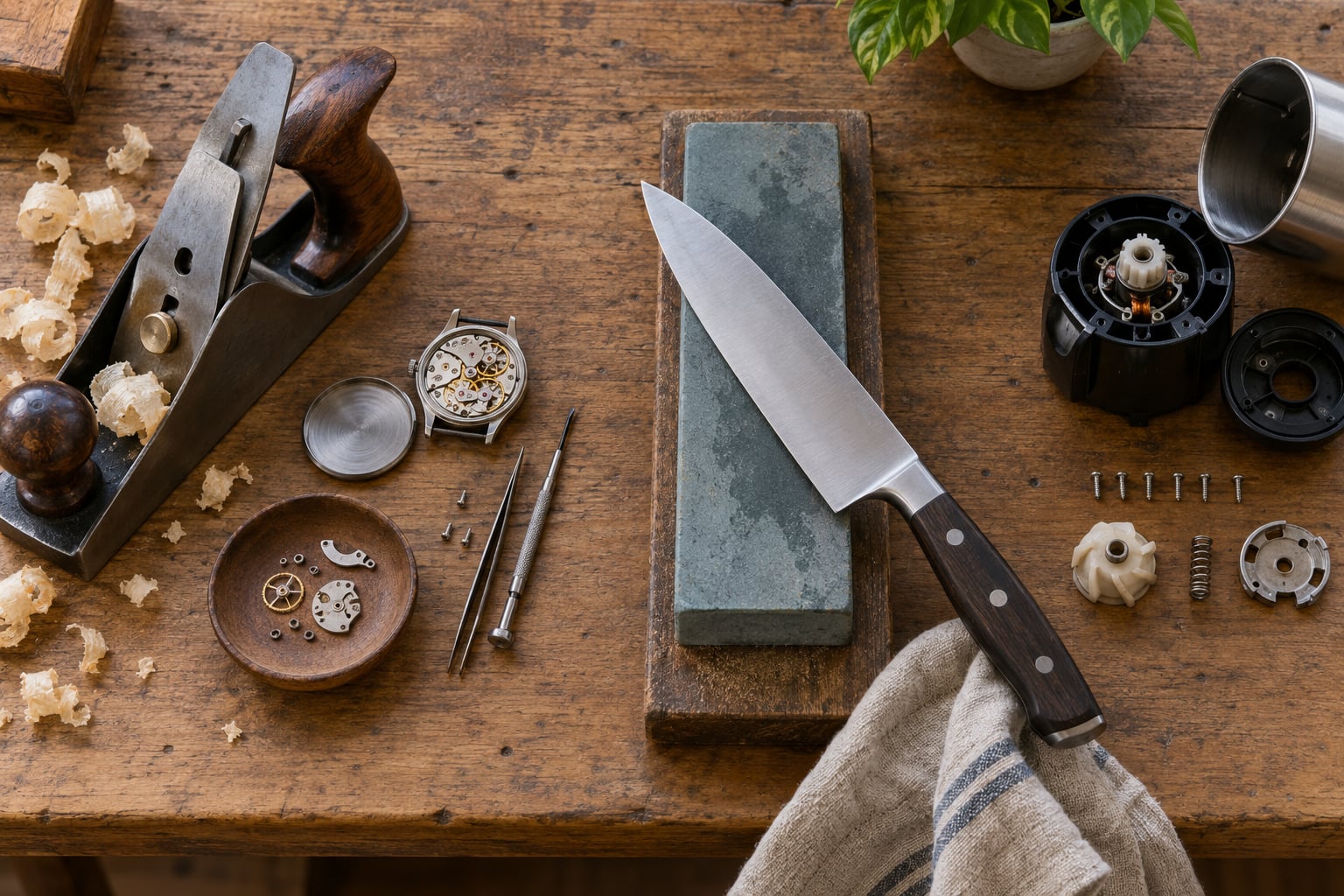
Japan has an unusually visible secondhand and refurbishment economy. Used cameras, kitchen knives, sewing machines and power tools circulate with the expectation that a specialist will clean, adjust and re-certify them before reselling.
That only works when documentation is public and parts exist. Manuals with exploded diagrams, standard fasteners, and a parts catalogue that a small shop can order from are what make refurbishment an industry rather than a favour. Where those three things exist, a ten-year-old machine is a product with a future, not e-waste.
Spare parts availability beats build quality at purchase
Experienced buyers tend to trust parts availability more than anything on a spec sheet. A mid-range product with a ten-year parts commitment is a better long-term bet than a premium product whose spares vanish when the model is discontinued.
Ask the question directly before you buy. How many years will parts be available after the model is discontinued? Is the battery replaceable? What does a service visit cost when the warranty ends, and is it cheaper to replace the part than the unit? Three questions will tell you more than any material claim.
Which Japanese products are known for lasting longer?
The reputation is strongest in categories with heavy use, high repair cost and a long service record.
| Category | Where longevity is strongest | What to verify |
|---|---|---|
| Kitchen knives | Japanese steel holds an edge and takes repeated sharpening | Steel type, hardness, whether it is resharpened or thrown away |
| Major appliances | Large-ticket repair cost makes modularity worth building in | Assembly country on the specific model, parts policy |
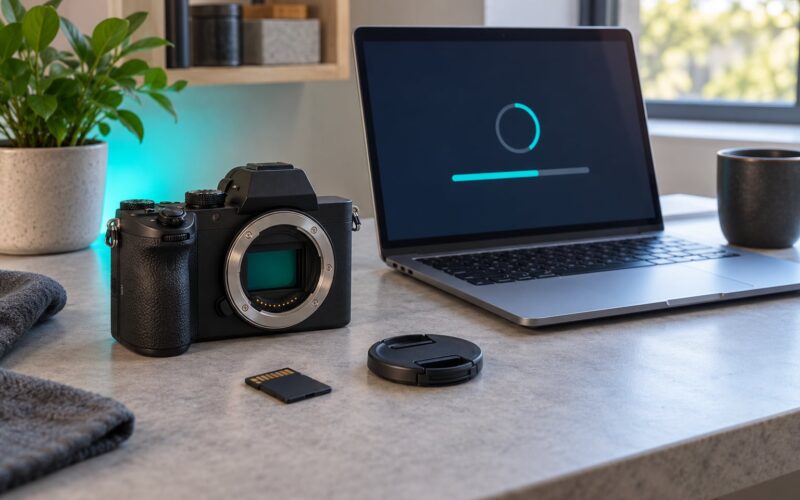
| Cameras and lenses | Shutter counts and service networks are well documented | Shutter rating, repair cost estimate, sensor cleaning |
| Bicycles | Frames and components are standardised and rebuildable | Frame material, component standard, local repair shop access |
| Stationery | Low cost, so failure just means another one | Refill availability rather than durability |
| Small electronics | Less consistent | Parts availability and battery replaceability |
Being honest about where the reputation is thin matters as much as listing where it is strong. Small consumer electronics, fast-moving phones and seasonal goods rely heavily on annual redesigns, so parts disappear by design regardless of where they were made.
What can buyers check before choosing a long-lasting product?
A short checklist does most of the work. Run through it before you pay, not after it breaks.
- Read the origin mark. Country-of-origin labelling is required in most markets and is usually printed or stamped on the body, not just the carton.
- Separate brand from assembly. A Japanese brand may manufacture the same product line in several countries, sometimes in different spec. The model number, not the logo, tells you which one you are holding.
- Ask about parts after discontinuation. A stated parts window of ten years is a much stronger signal than a long warranty that excludes parts.
- Check whether it opens. Screws, a serviceable battery and a downloadable manual are the fastest signals you will find.
- Look for independent testing. Repairability scores and durability tests tell you what the manufacturer’s material claims did not show.
- Read the return policy. A long return window lowers the risk of the mistake you are making right now.
Check the label, not the brand name
This is the most useful habit on the list, and the one experienced buyers on appliance forums repeat most often. Origin has shifted around within single brand ranges. The same product name can ship from different countries with different component suppliers in different years.
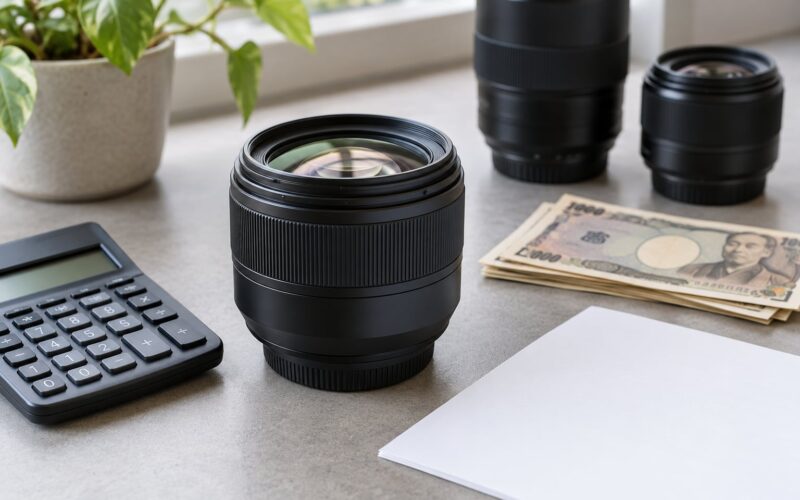
Do the arithmetic on cost per year rather than sticker price. A product costing three times as much that lasts fifteen years instead of four comes out well ahead. A product costing three times as much that fails the same way at year four is simply an expensive mistake. Your own replacement history is better evidence than any claim, so use it.
Work out the cost per year, not the sticker price
Divide what you are about to pay by the number of years you realistically expect to use it, then add an estimate for maintenance and consumables. Compare that number across the products on your shortlist.
Also price the failure case. If the worst outcome is losing a small appliance, buy the one with the better parts policy. If it is losing a tool you depend on for work, the calculation changes quickly in favour of the heavier, serviceable option.
Frequently Asked Questions
Do all products made in Japan last longer?
No. Longevity depends on the category, the model, the materials, the manufacturer, maintenance and how it is used. A Japanese brand making a disposable item will not produce something durable, and a well-made product from elsewhere can outlast one from Japan. Country of origin is a useful hint, never a guarantee.
Is a product made in Japan automatically higher quality?
Not automatically. Origin gives you useful context, but quality tracks the manufacturer, the model, the component specs and the inspection regime behind it. Within one brand the same product name can be built in several countries to different specs, so check the specific model rather than the flag. Compare materials, parts policy and warranty in writing.
Why do some Japanese products use screws instead of glue?
Screws allow a product to be opened, inspected, repaired and refurbished. When one small component fails, a screwed unit keeps its working parts and gets going again. Glued assemblies are faster to build and cheaper, but a single failure condemns the whole item. Openability is what makes a durable product last through several lives.
Are long-lasting Japanese products always more expensive?
No. A higher price may reflect better materials, tighter tolerances, repairability or a longer warranty, but it proves nothing on its own. Plenty of inexpensive products last for decades. Judge cost per year of expected service instead, and remember that the expensive option is only cheaper if it actually survives the period you are calculating over.
What is the core philosophy behind Japanese craftsmanship?
The core idea is usually expressed as monozukuri, the craft of making something well, supported by jikenyokukoka, improving that work continuously and steadily. In practice it shows up as designing for durability, fixing problems at the line rather than at the end, and passing knowledge between experienced workers. It is a management discipline, not a national trait.
Is the reputation of Japanese quality just bias?
Partly. Cultural interest inflates expectations, and experienced buyers regularly push back on the idea that Japanese workers are simply better. Japanese manufacturers have produced serious failures too. What survives the bias is narrower and more useful: repairability, published standards, parts availability and design-for-maintenance are practices you can verify on any product from any country.
What to do first
Start with the model number, not the brand name, and check the country-of-origin mark on the unit itself. Then ask one question before you pay: how long will spare parts be available after this model is discontinued?
That single answer separates the products built to be kept from the products built to be sold. Everything else in this guide is detail hanging off that one number.