Last updated: October 2026
Japanese product launches happen in spring because the country’s fiscal year, school year, wage cycle and holiday calendar all restart on the same date. April 1 unlocks company budgets and new sales teams, sakura season pulls crowds into stores, shunto raises land in workers’ paychecks, and Golden Week converts the whole country into travelers and gift buyers. Spring is where money, attention and readiness overlap.
This page was updated for 2026. The April 1 mechanics are stable, but the cherry blossom front line moves every year, so any fixed spring date needs checking against the current bloom forecast.
Six reasons at a glance
- The fiscal year resets on April 1. Budgets, sales targets (kigyo keikaku, 事業計画) and approval authority for the new year (shin-nendo, 新年度) all start fresh, so a product launched in early April is measured against a brand new sales plan.
- March is a commercial dead zone. The old expression 3月売れない (“March doesn’t sell”) describes a month of budget exhaustion, year-end close and frozen approvals.
- The school year also starts on April 1. Entrance ceremonies, new uniforms, new homes and bicycles create a household spending wave that runs through March and April.
- Sakura season concentrates attention. Hanami (花見) blocks draw enormous footfall, and seasonal limited editions only make sense inside a tight window that the blooms define.
- Shunto (春闘) puts money in pockets. The annual wage settlement produces April pay rises for most of the workforce, releasing new purchasing power at the same moment.
- Spring events stack the room. Technology, gaming, startup and trade events concentrate press, partners, investors and buyers in a few weeks, so a spring launch gets visibility almost for free.
Table of Contents
- 1Why Japanese Product Launches Happen in Spring
- 2How Japan’s April fiscal-year start shapes launch timing
- 3How spring consumer demand influences product releases
- 4Why spring events create launch momentum
- 5How retailers and media shape a spring launch window
- 6What this means for startups and product teams
- 7Frequently Asked Questions
- 8What is the financial year for Japan?
- 9Why does school start in April in Japan?
- 10What is the symbol of spring season in Japan?
- 11Are there cherry blossoms in Japan during April?
- 12Why is March a bad month to launch in Japan?
- 13What is Golden Week in Japan?
- 14Conclusion
Why Japanese Product Launches Happen in Spring
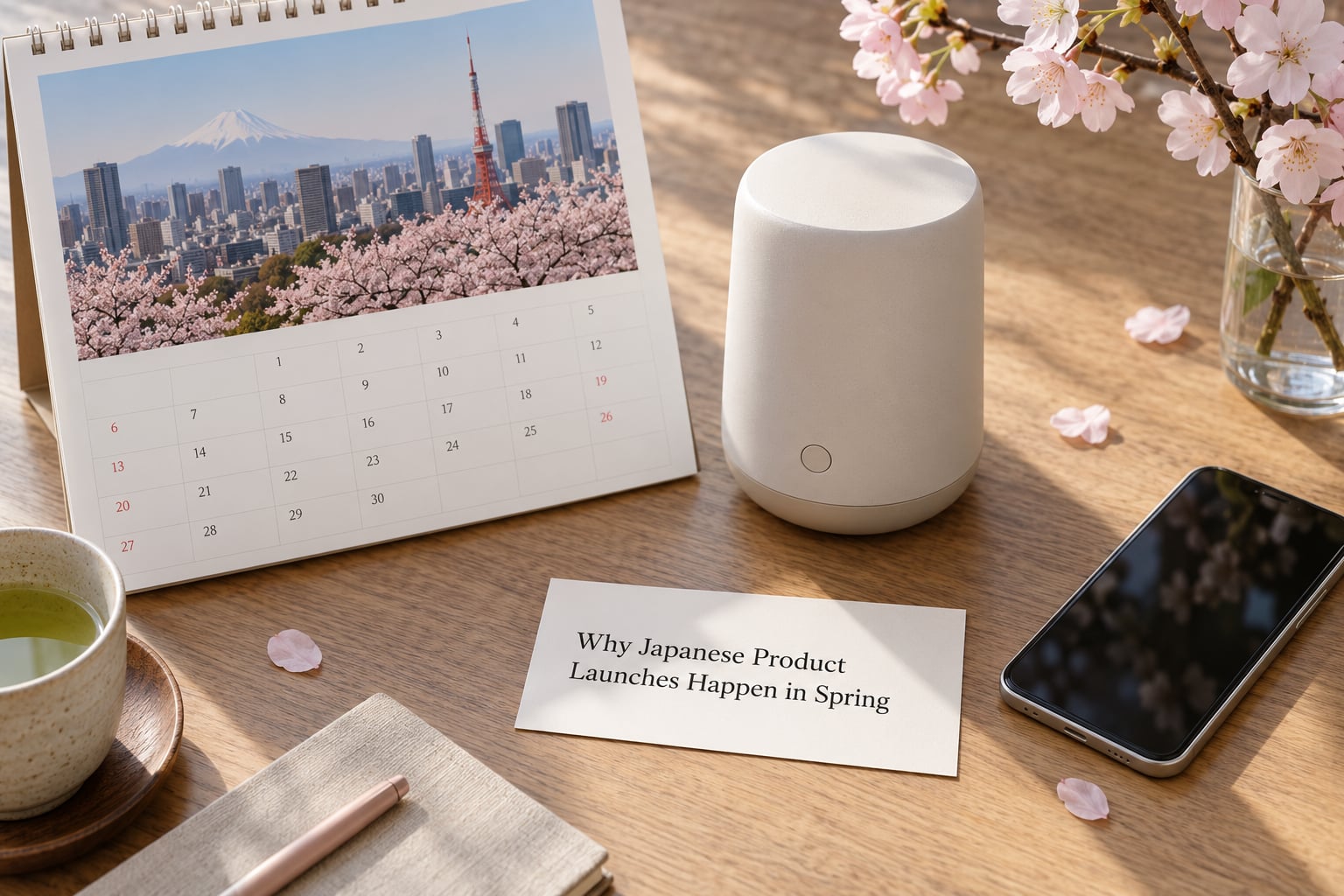
The honest version of this answer is that no single rule forces a launch into April. Nothing in Japanese law requires a company to release a product in a particular month. What exists is a set of structures that all peak in the same eight weeks: money becomes available, people are available, and attention is available.
When every incentive lines up at once, the industry settles into a rhythm. The result is why Japanese product launches happen in spring more often than in any other window, and why the same four weeks keep filling up with limited editions, new models and new campaigns year after year.
How Japan’s April fiscal-year start shapes launch timing
Japan’s financial year runs from April 1 to March 31, which puts it one month ahead of the calendar year. Companies build their annual plan, revenue targets and spending limits around that boundary, which means a product that ships on April 1 lands inside a fresh budget line rather than competing with a budget that has already been spent.
That is a different commercial situation from a Western launch in, say, November, where the year’s budget was set the previous autumn and is mostly committed. In Japan, the person approving your spend may have started the job two weeks earlier.
Two related shifts happen at the same time. Companies that missed the target by March 31 have a strong incentive to launch immediately afterwards, and companies that beat it have approval to spend again. Either way, April is when decisions get made rather than when they get made about decisions.
How spring consumer demand influences product releases
Households in Japan spend heavily in a short window around the start of the school year. Entrance ceremonies (nyugakushiki, 入学式) pull in formal wear, suits, shoes and cameras, while new students arrive with a list of supplies, a new bag and often a new bicycle or tablet.
April is also when people move. Graduation in March triggers job transfers, new rentals and new furniture purchases, which pushes home goods, appliances and furniture launches into the same weeks. The season does two jobs at once: a new household setup and a new academic year.
Then there is sakura. Hanami is less a festival than a national habit, and the practical effect on retail is that people spend on small, impulsive, shareable things while they are out in the park. Limited-edition packaging, seasonal flavours and short product cycles exist because that window will close.
The other half of the equation is what happens before spring. March is a month of year-end accounting, exhausted budgets and slow approvals. For businesses that think in these terms, skipping the spring window costs a full twelve months.
Why spring events create launch momentum
Japan’s spring event calendar is unusually dense for a short period. Technology showcases, gaming events, startup conferences and trade fairs cluster across April, May and early June, and each one pulls in a different slice of the people a launch needs: press, partners, investors, developers and buyers.
A product that launches inside that cluster can be picked up by trade coverage and consumer media in the same week. The same product launched in late August is competing for attention against the Obon travel period and the tail of summer, when fewer people are reading trade news and retailers are already planning autumn assortments.
There is a second, less obvious deadline: the sakura front line. The bloom advances slightly earlier almost every year, and the moment full bloom is forecast, the sakura-themed window opens and closes. Brands that want a spring launch with seasonal positioning have to work backwards from that forecast, which quietly pulls planning earlier each cycle.
Events also create a deadline from the other side. Bookings, hospitality slots and press embargoes have to be arranged a long way ahead, so teams that miss the spring booking window often find themselves aiming at the following year instead.
How retailers and media shape a spring launch window
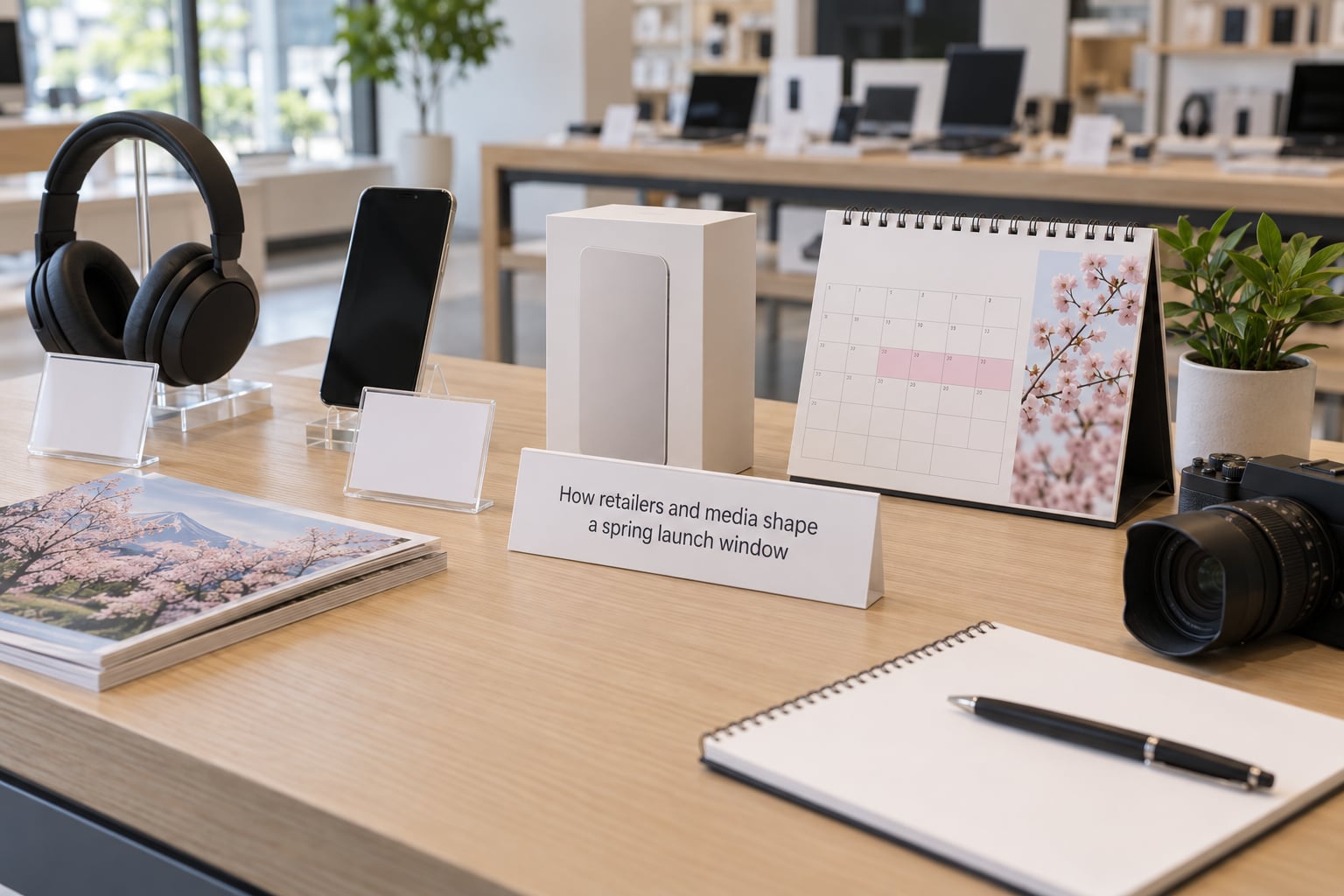
Retail is where a launch either gets a floor or does not. Japan’s major electronics retailers build seasonal assortments well ahead of the season itself, so a product that is not in the spring plan by autumn the previous year has usually missed the shelf cycle entirely. This is why companies that talk about “launching in Japan” are really talking about booking a place in a retail calendar built months before.
Media works the same way. Consumer technology and gaming publications plan coverage around the event calendar, and the months around Golden Week are usually thin because the country is away. A launch that lands in the last week of April can be technically on time and practically invisible.
This is the timing map I would build before choosing a date:
| Timing signal | Window | What it means for a launch |
|---|---|---|
| Year-end close | March | Budgets spent, approvals slow, retailers focused on clear-out. Poor choice. |
| Fiscal and school year start | April 1 | New budgets, new sales staff, new household spending. The window opens. |
| Sakura bloom | Late March to late April, shifting | Seasonal positioning is only credible if the shelf date matches the bloom. |
| Shunto pay increases | April onward | Disposable income rises after settlement, supporting discretionary purchases. |
| Golden Week | Late April to early May | Store closures, travel, thin news coverage. Avoid for anything needing attention. |
| Early summer | June | Best availability and press attention for a launch that wants to be in the market through summer. |
| Autumn wave | September to November | A second real window, stronger for some categories and for year-round products. |
One more practical note: the bloom date is not fixed. A launch built around sakura has to confirm the current forecast before printing packaging, and a window that was right two years ago can sit a week early or late now.
What this means for startups and product teams
If you are a foreign team planning a Japan launch, copying a Western release calendar is the most common mistake. The dates that work elsewhere will usually land in the wrong part of the Japanese business year.
Start planning in January, launch in early April. January is when Japanese companies draft the next fiscal year’s plan, so that is when a partner or retailer starts listening. The announcement itself should sit before Golden Week or after it, not inside it.
Build the holiday list before the campaign list. Golden Week, Obon in mid-August, New Year and the long spring break all change staffing and media behaviour. A launch plan that ignores them usually discovers the problem in week one.
Align partners to the Japanese fiscal year, not yours. Distributors, retailers and agencies all plan in the April-to-March frame. Ask what they are already committed to in April, then work around it.
Treat localization as a gate, not a polish step. Support, documentation, invoicing and a local contact usually need to exist before launch, not after. Teams that discover this in month two lose the spring window and wait a year.
And check whether spring is even right for you. Snacks and beverages, beauty, apparel, consumer electronics and mobile devices all peak with the season. B2B software, industrial products and year-round services follow the customer’s budget cycle instead, which often means targeting June or September rather than April.
Frequently Asked Questions
What is the financial year for Japan?
Japan’s fiscal year runs from April 1 to March 31, one month ahead of the calendar year. Company budgets, sales targets and approval authority reset on April 1, which is why so many launches land in spring: a product released in early April is measured against a brand new sales plan instead of a budget that is nearly spent.
Why does school start in April in Japan?
The school year follows the fiscal year, running from April through March, so children finish the school year in March and start the next one in early April. This produces the entrance ceremony season, with new uniforms, school supplies and often a new bicycle or device, and it creates a concentrated household spending wave that lifts several product categories in the same weeks.
What is the symbol of spring season in Japan?
Cherry blossoms, or sakura, are the symbol of spring in Japan. They are treated as a marker of renewal and a fresh start, which is part of why the fiscal and school year also begin in April. Hanami, or blossom viewing, is the national habit of going to look at them, and it drives retail footfall, seasonal packaging and short product cycles.
Are there cherry blossoms in Japan during April?
Usually yes, but it depends on the region and the year. Blooming starts in the south in March and moves north, so the peak shifts later as you travel, and the front line has been trending earlier over time. The blossom date moves year to year, so any launch built around sakura positioning should confirm the current forecast before committing to packaging or shelf dates.
Why is March a bad month to launch in Japan?
March is the tail of the old fiscal year. Budgets are largely committed, approval chains are slow, and the sales team is often busy closing out targets and preparing annual plans. The expression 3月売れない, meaning March doesn’t sell, captures how little new business the month generates. Launching in March means being measured against a budget with nothing left in it.
What is Golden Week in Japan?
Golden Week is a cluster of national holidays, including Shōwa Day, Constitution Day, Greenery Day and Children’s Day, that usually runs from late April into early May. It is one of the year’s two or three biggest domestic travel periods, and a large share of the population is away for part of it. Retail activity concentrates around it, but media coverage and office staffing thin out, so it is a poor week for a launch that needs attention rather than a sales rush.
Conclusion
Japanese product launches happen in spring because four calendars reset at the same time. New budgets on April 1, new salaries from shunto, new households from the school year and new attention from sakura all land within a few weeks of each other, and a launch that catches that wave is competing against a frozen March and a slow summer instead.
Start with the fiscal year. Put your planning work in January, keep the announcement clear of Golden Week, and check the blossom forecast before anything seasonal goes to print.