To pitch Japanese tech media, you write one short, tailored email to one named journalist at one outlet and explain why your news matters to that outlet’s readers. That is the whole job. Everything below, from the media list to the follow-up schedule, exists to make that single email land in the right inbox with the right evidence attached.
Last updated October 2026. Outlet details in this guide were last verified in October 2026. Newsrooms change desks and inboxes constantly, so confirm each contact on the outlet’s own site before you send.
This guide is for founders, communications leads and market-entry managers at companies outside Japan that want coverage in Japanese tech press. It is also for teams with a Japanese-speaking spokesperson who want a repeatable system instead of one-off outreach. It is not aimed at consumer product launches aimed at Japanese shoppers, where pricing, support and retail distribution decide whether anyone writes about you.
One warning before you start. A working tech newsroom receives dozens of press releases a day and publishes a handful. Silence is the default outcome, not a verdict on your company, and the difference between silence and coverage is almost always preparation.
Table of Contents
- 1What You Need
- 2Step-by-Step: How to Pitch Japanese Tech Media
- 3How to Pitch Japanese Tech Media: Research the Right Outlet
- 4How to Pitch Japanese Tech Media: Turn the Product Into a Story
- 5How to Pitch Japanese Tech Media: Personalize the Subject Line
- 6How to Pitch Japanese Tech Media: Send the Right Materials
- 7How to Pitch Japanese Tech Media: Follow Up Without Spamming
- 8Common Mistakes
- 9Frequently Asked Questions
- 10Do Japanese tech journalists accept pitches in English?
- 11Should I send a Japanese press release to English-language media?
- 12What subject line works best for a Japanese tech media pitch?
- 13How long should I wait before following up?
- 14Should I offer an interview or exclusive story to every outlet?
- 15How do I pitch a startup based outside Japan to Japanese tech media?
- 16Conclusion
What You Need
Six things, and you want all six finished before you contact a single outlet. Turning up half-prepared usually produces the same result as turning up with nothing.
- A newsworthy angle. One sentence on why this is news now, written from the outlet’s readers’ point of view rather than your company’s.
- A short pitch. About 150 words in the body of the email, not a document. Attach the detail, do not paste it in.
- Evidence. Funding amount and named investors, customer or download numbers, a named Japanese partner, or a launch date. Japanese tech editors treat traction as a credibility check.
- A targeted media list. Fifteen to twenty-five outlets you can justify individually, with a named beat-relevant journalist or a published contact route for each one.
- Press assets. An editable Word file, high-resolution text-free images, a short founder biography, and a one-page company fact sheet with your website, founding year and location.
- A realistic target. For a first campaign aimed at trade and online tech press, expect a small number of replies and a handful of published items. Plan for the possibility that a campaign yields no coverage at all.
The last item is the one teams skip and then regret. Outreach where nobody answers is a normal result, and the way to survive it is to decide in advance how many attempts count as finished rather than deciding in the moment whether to send a fourth email.
Step-by-Step: How to Pitch Japanese Tech Media
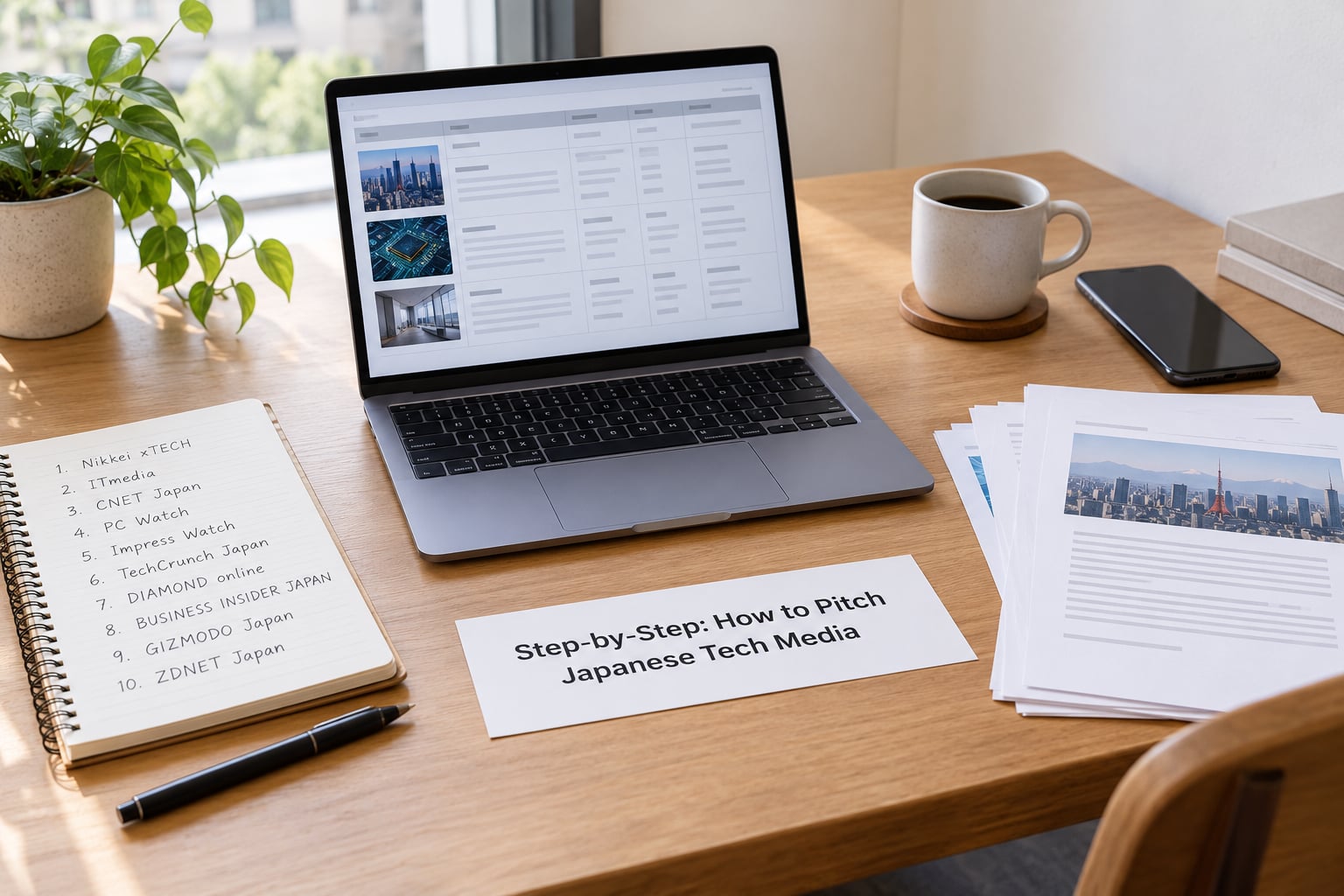
Six stages, in this order: research the outlet, turn the product into a story, personalize the subject line, send the right materials, follow up on a schedule, and stop. Skipping straight to the email is why so many foreign companies get no coverage in Japan.
How to Pitch Japanese Tech Media: Research the Right Outlet
Japanese tech coverage is not driven by national newspapers the way it is in the UK or US. It runs through trade press, online newsrooms and vertical industry titles, each with a narrow beat and a small editorial team. That structure is good news for a newcomer: the person who covers enterprise SaaS at an online tech title is usually reachable, and they read everything that reaches them.
Work down from broad to specific. National business coverage such as Nikkei and the English-language Japan Times is where funding rounds and serious market moves surface. Tech trade press such as ITmedia and ASCII STARTUP is where product, funding and startup news runs daily. Online newsrooms and device titles cover launches and hardware in near real time, and vertical press covers a single industry in depth.
Here is a starter list, grouped by what each tier actually runs. Treat it as a starting point rather than a finished media list, and confirm the current desk before you pitch.
| Outlet | Focus | Language | What it typically runs |
|---|---|---|---|
| ITmedia | Enterprise and consumer IT, business software | Japanese | Daily news, product and service announcements, market explainers |
| ITmedia News | Breaking technology and tech business news | Japanese | Short funding, partnership and product news items |
| ASCII STARTUP | Startups, funding, new business models | Japanese | Funding rounds, founder interviews, event coverage |
| Nikkei | National business and industry | Japanese | Corporate strategy, funding, industry and market moves |
| The Japan Times | English-language national and business news | English | Foreign companies entering Japan, business and policy |
| The Bridge | Startup and venture ecosystem | Japanese and English | Startup profiles, funding rounds, ecosystem reporting |
| Device Watch | Devices, hardware and gadgets | Japanese | Launch coverage, hands-on impressions, release timing |
| Barks | Apple and Mac ecosystem | Japanese | Apple product news, releases, software updates |
| Robotics Start | Robotics, automation and industrial tech | Japanese | Funding, deployments, industry and research coverage |
| TRIMM | AI and business software | Japanese and English | Enterprise AI, tooling and company reporting |
Now check the language fit before you write a word. English pitches are genuinely read by business editors at the national dailies, by English-language titles, by startup desks serving international readers, and by bilingual technology writers. Japanese pitches are what domestic-facing consumer, device and enterprise desks read. If your audience is Japanese businesses, English-only outreach mostly reaches the wrong people.
Find the person, not the inbox. Open the outlet’s byline or author pages, read the last three pieces each candidate published, and check that the topic genuinely matches your angle. Then confirm the byline is still current, because journalists move between outlets more often here than in many Western markets and a six-month-old title is often simply wrong.
Never publish or buy a scraped list of journalist email addresses. It is a dead end and it reflects badly on you. Use the address published on the outlet’s own contact page, its official press or reader submission form, or a named representative listed by the outlet.
How to Pitch Japanese Tech Media: Turn the Product Into a Story
If a Japanese tech editor cannot say your news in one sentence, it will not run. Ask yourself what changed since last week that a reader would care about, and write that sentence first.
Roughly, this is what counts as news: a funding round, especially one with named investors; entry into the Japanese market with a local entity, partner or hire; a partnership with a named Japanese company; a product launch with a real availability date; a significant customer win; an executive appointment that changes the company’s direction; or a certification or award that unlocks a regulated market.
And this is what does not: a survey you commissioned, a report with no new data, an infographic, a routine engineer hire, a revenue target, a vague partnership announcement with no named partner, or a feature that already shipped quietly in a changelog. A pitch built on any of these gets filtered, and usually gets filtered correctly.
The classic five Ws still apply, who, what, when, where and why, but Japanese tech editors add two expectations on top. The first is why now, usually a date, a funding event or a market condition that makes the timing non-arbitrary. The second is market context: what this means for Japanese companies or users specifically, and what has already been proven in another market.
Send a story that another outlet has already run in the last day or two and you are late. Editors know what their peers filed, and speed is part of why they run a thing at all.
How to Pitch Japanese Tech Media: Personalize the Subject Line
The subject line and the first two lines of the email decide whether the rest gets read. A working editor is scanning for the news angle in seconds, not reading documents, so put the news in the subject line rather than in paragraph three.
- Name the specific thing. Series B, Japan launch, partnership with a named company. Vague subjects are ignored.
- Keep it short. Roughly under 40 characters, and readable in a phone preview.
- Reference their work when you genuinely can. A line about their recent coverage on the same topic, if it is real, earns the reply.
- Put the company basics in the first two lines. Website, founding year, headquarters. Pitches without them are discarded unread.
- Skip “Dear Editor”. A named person or a specific desk reads as research done, and anything generic reads as a blast.
A useful test is whether the subject line would still make sense if pasted into a pitch for a competitor. If it would, it is not personalized yet.
How to Pitch Japanese Tech Media: Send the Right Materials
Keep the email body around 150 words and end it with one clear ask: a short interview, a comment on a specific question, or a look at the product. Multiple asks read as indecision.
Attach an editable Word file rather than a locked PDF. Editors retitle, trim and reformat what they receive, and a PDF they cannot edit often becomes a story someone else files first. Include high-resolution images with no text baked in, and a one-line explanation of what each image shows.
Who sends matters. Practitioners report a clear preference for hearing from the founder or CEO rather than from an agency account, particularly at smaller trade titles. If an agency handles outreach, keep the founder as the named contact and copy them visibly.
Timing is unglamorous and it works. Send weekday mornings in Tokyo time, when inboxes are opened fresh. A mid-afternoon send sits unread until the next day, and the news cycle may have moved on. Build a few extra days into your plan around Japanese public holidays, when editorial desks are thin.
Two levers are worth using deliberately. Advance notice of a few days to a small group builds trust, and an exclusive to a single named outlet works when the story is genuinely yours to give. Do not hand the same exclusive to five people on the same afternoon.
For anything that needs to reach many outlets at once, a Japanese press release distribution service is the standard route. The services startups look at first are PR Time, Dream News, Infini and @Press. Distribution works like this: you submit a release with a unique, permanent URL, editors and media-monitoring systems pick it up, and some of them file a story or reference the release. That means the release is written for Japanese readers, usually requires Japanese text or native review, and follows each service’s editorial standards, which reject thin announcements.
Distribution and direct outreach are not competitors. A wire submission gives you reach and lets editors find you; a direct pitch to a named journalist is what gets you the considered story, the interview and the quote.
How to Pitch Japanese Tech Media: Follow Up Without Spamming
Most no-news pitches get no reply at all, so the follow-up is where campaigns are quietly won or lost. A simple schedule works: one follow-up after five to seven business days, one final follow-up about a week after that, then stop.
The first follow-up is a short bump. Reference the original subject line, add one genuine new detail such as a new customer, an updated funding figure or a demo availability, and repeat the ask. The second follow-up is your last and should be equally short.
Japanese business communication tends toward indirectness, so a reply is not always agreement. Phrases along the lines of “we will consider it” or “it is difficult to cover right now” usually mean no, and pressing after that is the fastest way to damage the relationship. A question, a correction or a genuine update is an opening. Silence after two follow-ups is a closed door.
When someone does reply, answer fast. Most editors are working to a deadline that day, and a slow response usually ends the story quietly.
Common Mistakes
Almost every failure here is avoidable, and most of them repeat the same errors Western press-release advice produces.
- Sending the same release to everyone. Fix: one angle per outlet, chosen from what that journalist already covers.
- Claiming things you cannot support. Fix: cut the superlatives and keep only claims you can evidence in the release.
- Sending English copy to Japanese consumer or device desks. Fix: match the language to the outlet’s readership, or work with a native reviewer.
- Using a direct or sales-heavy tone. Fix: write at the level a careful businessperson would use, which for Japanese business communication usually means polite, measured and indirect.
- Attaching uneditable PDFs and a bundle of files. Fix: one editable release, one image folder, one fact sheet.
- Chasing publication with no deadline and no news hook. Fix: if there is no date and no reason it is news today, wait for one.
- Offering exclusives to everyone. Fix: one outlet, one exclusive, agreed timing.
- Reaching out to a journalist who has moved on. Fix: re-verify the byline the same week you send.
One last decision. If you have a native Japanese writer, a market-entry team and a clear story to tell, pitching yourself is cheaper and it keeps the founder’s voice intact. If your news is a Japan market entry, you have no Japanese-language materials, and the story depends on local context you cannot supply, a Japanese PR agency earns its fee by supplying exactly that. The warning signs are a pitch template you have not read yourself, guaranteed placements, and anyone suggesting payment for coverage. Placement cannot be bought in Japan’s tech press, and an agency that implies otherwise will damage your standing with every editor who finds out.
Frequently Asked Questions
Do Japanese tech journalists accept pitches in English?
Yes, at specific outlets. Business editors at the national dailies, English-language titles such as The Japan Times, startup desks serving international readers, and bilingual technology writers all read English pitches without difficulty. Domestic-facing consumer, device and enterprise desks usually do not. For a foreign company, the practical route is an English pitch to the international desks plus a Japanese release distributed through a wire service for everyone else.
Should I send a Japanese press release to English-language media?
Usually not, unless you can also offer a short English summary for the angle the story needs. A full Japanese release to an English-language desk is wasted effort, because the desk works in English and needs the point in that language. The reverse also holds: an English-only release submitted to a Japanese wire service will usually be rejected, since those services publish to Japanese readers. Match the language of the release to the audience it will be read by.
What subject line works best for a Japanese tech media pitch?
A short, specific line that names the news itself, such as a funding round, a Japan launch, or a partnership with a named company. Keep it under about 40 characters and readable in a phone preview, and avoid generic openings like Dear Editor or a subject that would work for any company. If you have genuinely read the journalist’s recent coverage, a brief reference to it is worth more than any amount of polite phrasing.
How long should I wait before following up?
Five to seven business days for the first follow-up, then one final note about a week later, then stop. Each follow-up should add something real, such as a new customer, an updated figure, or a demo slot, rather than repeating the original request. Japanese business communication is indirect, so a polite non-answer usually means no. After two unanswered follow-ups, close the file and keep the relationship for the next story.
Should I offer an interview or exclusive story to every outlet?
No. Offer an interview broadly, because it costs you little and gives editors an easy way in. Offer an exclusive to one outlet only, and only when the story is genuinely yours to give, the outlet beats the others on that beat, and the timing is agreed. Sending the same exclusive to several outlets on the same day is how a story loses all of its value at once, and editors across the same beat do talk to each other.
How do I pitch a startup based outside Japan to Japanese tech media?
Lead with the market entry itself, because that is the news. Name your Japanese entity, partner, distributor or first hire, give a launch date, and show evidence that the model already works in another market. Japanese editors also want to see visible proof that other customers have adopted the product, so include customer names or usage numbers where you have permission. A Japanese-language site or product interface is a meaningful credibility signal, not a detail.
Conclusion
How to pitch Japanese tech media comes down to preparation, personalization and restraint. Research the outlet, write one story angle that is genuinely news, put the company basics in the first two lines, send an editable release in the reader’s language, follow up twice with something new, and stop.
Start today rather than waiting for a launch. Pick ten English-language and Japanese-language outlets you can justify, choose the single strongest angle you have, and send one email to each before the week ends. That first small batch will teach you more about what Japanese tech editors respond to than a month of planning.