Kaizen is a Japanese management philosophy built on the idea that continuous improvement, made up of many small changes rather than a few big ones, produces better products over time. Applied to product teams, it means running short improvement cycles: find a specific problem, measure it, change something small, check whether the metric moved, and keep what worked.
The interesting part is not the Japanese word. It is the operating rhythm underneath it, which happens to fit software delivery far better than most of the manufacturing material written about it suggests.
Table of Contents
- 1Kaizen Explained for Product Teams: The Core Idea
- 2What kaizen is not
- 3Where Did Kaizen Come From?
- 4The cultural layer a Tokyo publication should name
- 5Why Should Product Teams Use Continuous Improvement?
- 6Kaizen approach vs infrequent big-bang development
- 7What Are the Main Principles of Kaizen?
- 8Start from the customer’s problem, not the team’s output
- 9Observe the actual process, not the org chart diagram
- 10Change continuously rather than in campaigns
- 11Standardize what works
- 12Involve the whole cross-functional team
- 13Learn from evidence
- 14Stop work that creates waste
- 15How Do You Turn Kaizen into a Product Improvement Cycle?
- 16What Does Kaizen Mean in a Product Team?
- 17How Do You Run a Small Kaizen Workshop?
- 18The 90-minute agenda
- 19Roles, artifacts and one caution
- 20How Do You Measure Whether Kaizen Is Working?
- 21Goal to metric to decision rule
- 22When Does Continuous Improvement Go Wrong?
- 23Frequently Asked Questions
- 24Is Kaizen suitable for software and digital products?
- 25How is Kaizen different from a lean startup approach?
- 26How often should a product team run Kaizen improvements?
- 27Who should participate in a product improvement cycle?
- 28Does Kaizen mean a product team should avoid large changes?
- 29Conclusion
Kaizen Explained for Product Teams: The Core Idea
Kaizen, written 改善 and read as kaizen, means change for the better. The two kanji split neatly: 改 (change) and 善 (good, better). It is a philosophy of steady, incremental improvement carried out by everyone on a team, not a project methodology with a kickoff and a finish date.
The Japanese word kaikaku (改革) gets used for the opposite move: sweeping reform, a structural break. Kaizen sits between those extremes. It assumes the current system works well enough to keep running while it gets better, one slice at a time.
For a product team that means the roadmap keeps shipping while small, measured improvements happen alongside it. A checkout flow gets 10% faster and clearer this month. Support tickets about password resets get a self-serve fix next month. Nobody pauses the roadmap for a transformation program.
What kaizen is not
Three things it is regularly mistaken for:
- A framework. There is no certification-required body of kaizen steps. Different organizations run it differently, and practitioners on forums repeatedly describe it as mostly mindset with a light toolkit.
- A replacement for strategy. Improving an existing product very well does not tell you whether to build it at all. Discovery and new bets stay separate work.
- A reason to avoid big changes. Some changes genuinely need a redesign or a rewrite. Kaizen is the wrong tool for those, and pretending otherwise wastes months.
Kaizen vs kairyo (the Japanese term for innovation or radical reform) is a live argument among practitioners. The useful resolution: kaizen handles the existing system, kairyo handles the parts of it that need to be replaced. A team doing both needs to say which is which before it starts, otherwise everything slowly becomes incremental.
Where Did Kaizen Come From?
Kaizen took shape in post-war Japanese manufacturing, where rebuilding industrial capacity under severe resource constraints forced a different question than the one Western factories were asking. Not how to plan the perfect production line, but how to make the line you have slightly better tomorrow.
Taiichi Ohno and Shigeo Shingo developed the Toyota Production System over decades, and the TPS became the best-known home for kaizen thinking. Masaaki Imai later made the idea travel widely in the West through his book Kaizen: The Key to Japan’s Competitive Success, which translates the philosophy into steps any organization can run.
Two ideas carried over to software product work more cleanly than most people expect.
The first is muda, waste, categorized as the seven wastes: defects, overproduction, waiting, non-value-added steps, inventory, motion, and transport. Several map almost perfectly onto product work. Waiting is a PR sitting for three days for a design review. Overproduction is a feature built that nobody asked for. Inventory is a backlog nobody is going to prioritize.
The second is standardization. Once a change works, the process gets rewritten so the improvement sticks rather than evaporating when the person who made it moves on.
What does not transfer is the physical factory floor. A line supervisor can walk the gemba, the actual place where work happens, and watch a defect happen. A product team gets the equivalent through session recordings, support tickets, funnel data and watching someone fail at a form.
The cultural layer a Tokyo publication should name
There is a reason the phrase sits oddly in some Western companies. In a Japanese manufacturing context, the person standing on the line suggesting a change to the process is the person whose process it is, and the expectation is that suggestions are welcome and expected. When a Western team adopts kaizen as a top-down program announced at a company all-hands, the people closest to the work experience it as something done to them.
That mismatch is the single biggest predictor of whether improvement work survives past the first month.
Why Should Product Teams Use Continuous Improvement?
Shipping is only half the job. The other half is steadily removing the friction users and engineers hit every sprint, and that work compounds in a way a quarterly feature push does not.
Concretely, continuous improvement tends to pay out in five places.
Faster learning. A one-week cycle time between a hypothesis and a result beats a quarterly planning cycle. You find out in days whether an idea was wrong, while it is still cheap to be wrong.
Lower release risk. Small changes mean small blast radius. A copy tweak cannot take down checkout, so teams ship more often and worry less.
Closer feedback. Support tickets, session replays and funnel drop-off are continuous user research that nobody had to schedule.
Incremental customer value. A steady drip of small improvements often moves retention more than one large launch, because users experience the product as a whole rather than in release-sized chunks.
Better team habits. Teams that run improvement cycles get better at root-causing, at writing measurable hypotheses, and at saying out loud when something did not work.
Kaizen approach vs infrequent big-bang development
| Dimension | Continuous improvement (kaizen) | Infrequent big-bang development |
|---|---|---|
| Feedback speed | Days to weeks per cycle | Months between attempts |
| Risk per change | Small, reversible, feature-flagged | Large, all-or-nothing at cutover |
| Effort shape | Steady, spread across the roadmap | Front-loaded spike, then a long pause |
| When you find out it was wrong | Next week | After the migration and the rollback |
| Organizational learning | Compounds across many small wins | One big lesson, expensively obtained |
| Effect on team energy | Momentum, if scoped; churn if spammed | Exhaustion, then a plateau |
The honest counterpoint: big-bang work is sometimes right. Replacing a billing system, rebuilding a platform on a new architecture, or a genuine product repositioning cannot be done in 5% increments. Teams that use kaizen to avoid hard decisions end up polishing a product nobody wants.
What Are the Main Principles of Kaizen?
There is no official canonical rule set, and you will see different lists everywhere. The version below is the set that transfers cleanly to product work, with an example for each.
Start from the customer’s problem, not the team’s output
A team shipping more tickets is not the same as a team improving anything. Anchor the cycle in a user-visible outcome: completion rate, time to first value, the second week of retention. If nobody can name the user problem in one sentence, the cycle is not ready to start.
Observe the actual process, not the org chart diagram
The documented workflow is a guess. Watch a real user hit the flow, read the actual support tickets, look at where sessions stall. In one product team’s case, the process map said two steps and the recording showed seven.
Change continuously rather than in campaigns
One change a week beats one project a quarter. Practitioners on r/ProductManagement and r/projectmanagement describe the same failure repeatedly: teams front-load a lot of improvement ceremony and go quiet for months, then wonder why nothing stuck.
Standardize what works
If shortening the payment form helped, the shorter form becomes the default, the checklist gets a line item, and the pattern goes into your design system. A change nobody documents is a change waiting to be undone by the next person.
Involve the whole cross-functional team
Product, design, engineering, data, support. The thread that shows up in practitioner accounts is that the improvements which survive are the ones the engineers who own the code helped design. Cross-functional participation is repeatedly cited as the difference between an effort that lasts and one that dies at the end of the workshop.
Learn from evidence
Measure the baseline before you change anything. This is the step teams skip, and skipping it is why nobody can prove the delta. Five Whys is the standard tool: ask why until you hit something you can actually change, not a system or a person’s attitude.
Stop work that creates waste
Removing a step counts as an improvement. Deleting the quarterly reporting meeting nobody reads, the duplicate data entry between two tools, the second approval on small changes: these are the same waste categories Toyota was attacking, just with software on the line.
How Do You Turn Kaizen into a Product Improvement Cycle?
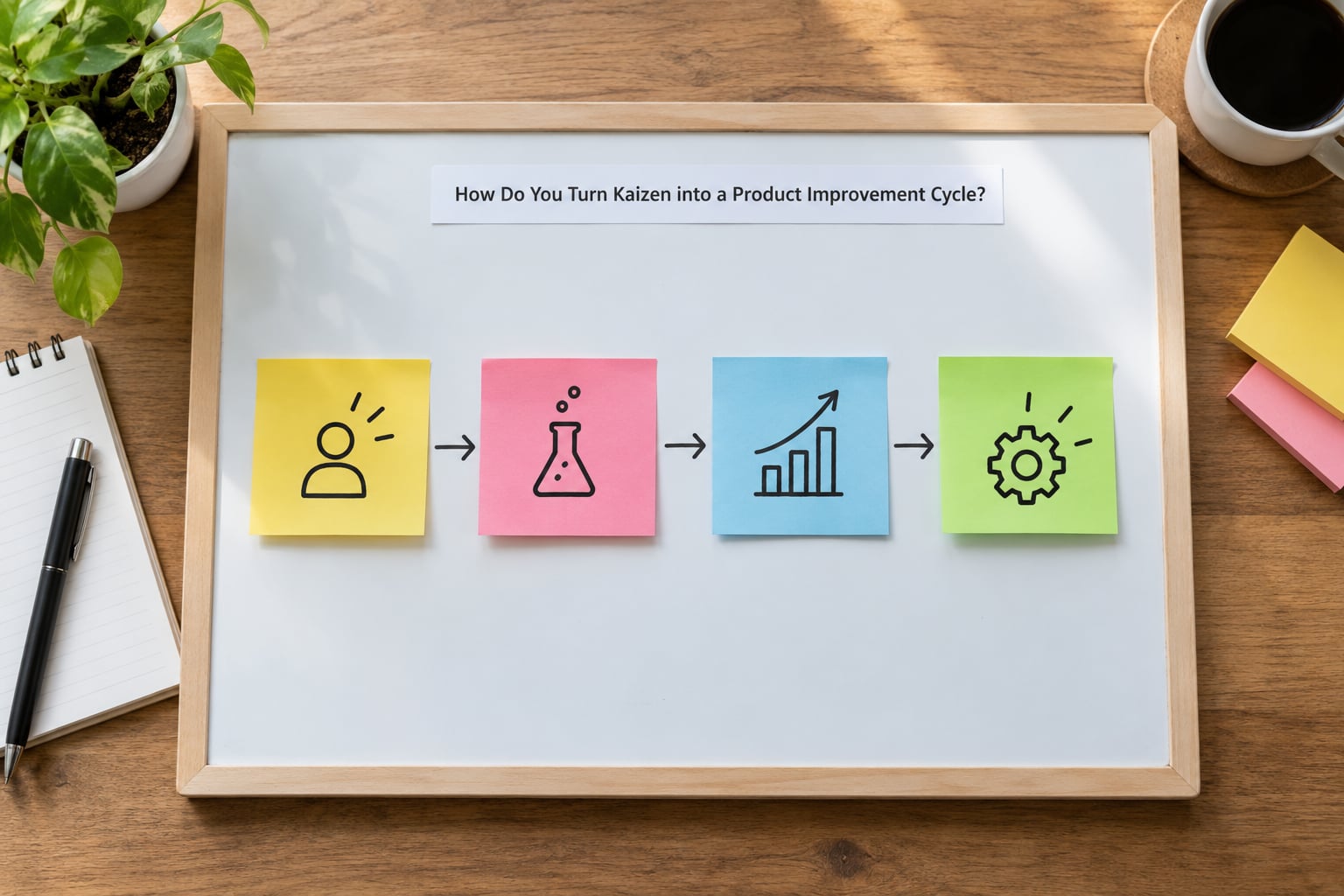
This is the PDCA loop (Plan-Do-Check-Act) made operational. In plain language: decide what outcome you want, look at how the work actually happens, find the friction, change something small, ship it, look at the number, then adopt, adjust or revert.
| Stage | The question to ask | Evidence to collect | Expected output |
|---|---|---|---|
| 1. Set the outcome | What user-visible outcome are we improving? | Baseline metric plus its current value | One sentence and one number |
| 2. Observe | Where does the user or the team actually struggle? | Session recordings, tickets, funnel steps | Workflow map of the real process |
| 3. Find friction | What causes the drop-off or the wait? | 5 Whys chain, annotated map | One root cause you can act on |
| 4. Hypothesise | What is the smallest change that could move it? | Prior art, competitor checks, prior attempts | A written prediction with a number |
| 5. Change | What is the minimum useful scope? | Design review, estimate | One shipped change behind a flag |
| 6. Release safely | How do we undo this in one minute? | Rollout plan, kill switch | Live change for a slice of traffic |
| 7. Check | Did the metric move, and by how much? | Same metric as step 1, same window | Result with a confidence read |
| 8. Decide | Adopt, adjust or revert? | Result plus qualitative feedback | Standardized, queued change or a revert note |
Steps 1 through 4 are planning and usually take one session. Steps 5 and 6 are engineering. Step 7 needs a defined observation window, long enough that the change is not judged on one quiet Tuesday. Step 8 is the one teams skip, and skipping it is how improvement work becomes noise.
What Does Kaizen Mean in a Product Team?
Translated into product-team language, kaizen shows up in places most teams already go: the experiment backlog, the sprint retrospective, release notes, usability fixes, support-loop reviews, cleanup of handoffs, and post-launch learning.
A worked example, because abstractions are cheap. Say onboarding drop-off sits at 42% after the email verification step, and support gets about 30 tickets a week asking where the confirmation email went.
The cycle: watch ten session replays past that step, and the friction is obvious, users land on a blank screen with no idea whether to resend, wait or give up. Root cause via 5 Whys, no resend option is the first why, the confirmation screen has no next action is the second, nobody owns post-signup state is the third.
The smallest change, a resend button plus one line of plain text on the confirmation screen, ships behind a flag in four days. Two weeks later drop-off sits at 36% and verification-related tickets are down to about eight a week. The team then standardizes it: the pattern goes into the component library, and post-signup state gets an owner in the checklist.
That is kaizen end to end. The interesting part is that nothing here required a strategy document.
What does not qualify: unstructured busywork dressed up as improvement, scope churn disguised as learning, a redesign that never gets scoped, or a team running improvement cycles on a product still searching for product-market fit. If nobody is sure the problem is worth solving, better solving it faster does not help much.
How Do You Run a Small Kaizen Workshop?
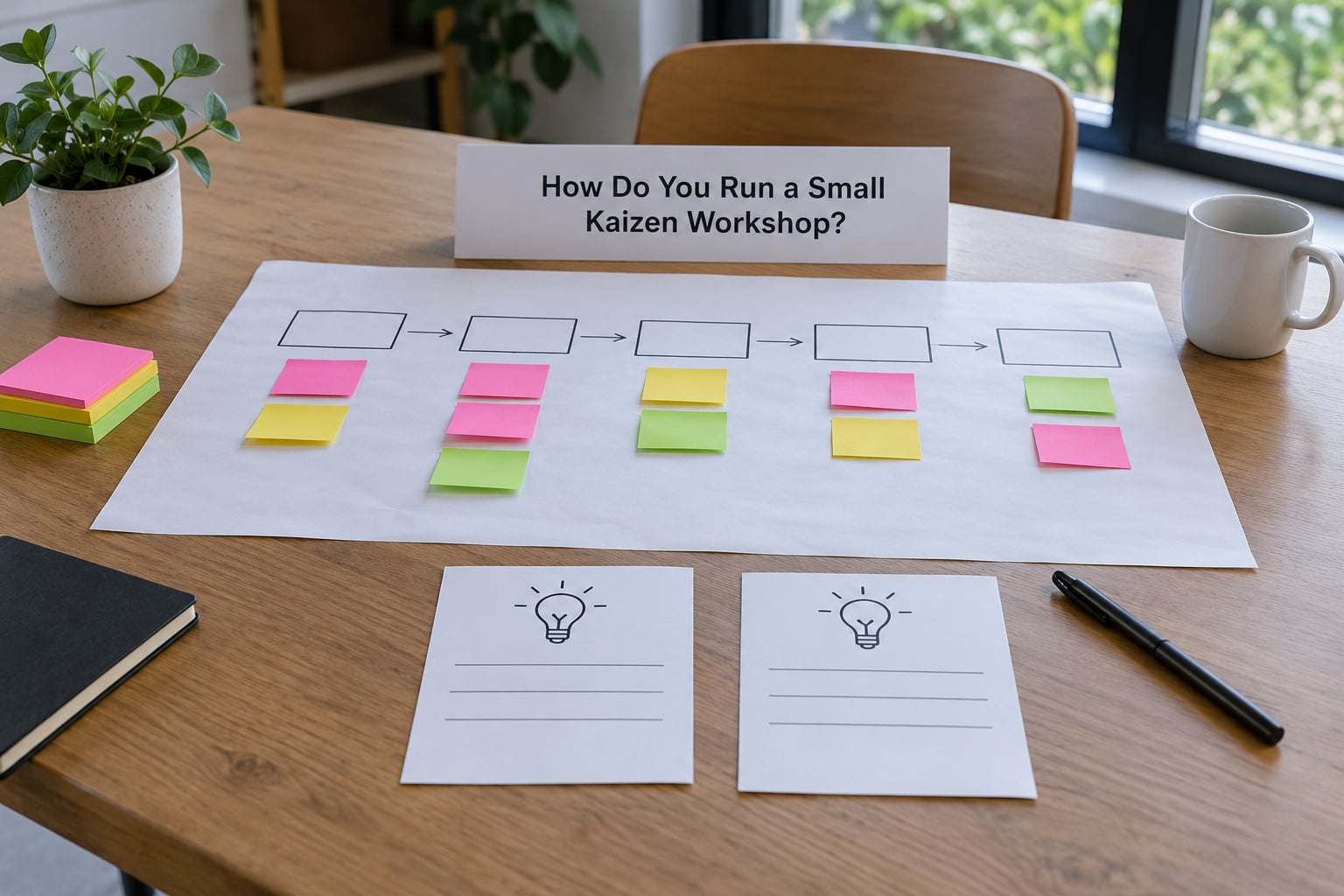
A focused session works well for one bounded problem. Ninety minutes, six to eight people, one problem. Anything longer and it turns into a workshop about the process of workshops.
The 90-minute agenda
- 0-10 min, frame. One person states the user problem and the current number. If the number does not exist, the session ends here and you go measure first.
- 10-25 min, map the current state. On paper or a whiteboard, walk the actual workflow step by step. Use what people actually do, not the process documentation.
- 25-45 min, mark the friction. Everyone adds sticky notes where the flow stalls, waits, or gets redone. Cluster them. The biggest cluster is your candidate root cause.
- 45-60 min, five whys. Pick one friction point and ask why repeatedly until you reach something a team can change this week.
- 60-75 min, write two experiments. Smallest possible change, plus a slightly larger one. Each gets a prediction, a metric, and an observation window.
- 75-90 min, commit and assign. Pick one. Name an owner and a date. Write down what would count as a revert.
Roles, artifacts and one caution
A facilitator keeps time and stops arguments. A scribe owns the board so nobody’s hands are tied up holding a marker. Everyone else contributes friction, including whoever does support, because they see the failures before product analytics does.
You should leave the room with three things: a workflow map with friction marked, two experiment cards, and one owner with a date. That is the whole deliverable. If the group wants a slide deck, it has drifted into a presentation.
The caution matters more than the agenda. Improvement sessions go wrong when they feel like a performance review, and engineers who have watched a dozen initiatives announced and abandoned read a kaizen session as management looking for someone to blame. Open with the metric, not with a person’s name.
How Do You Measure Whether Kaizen Is Working?
Two sets of numbers. Product outcomes tell you whether customers felt anything. Process health tells you whether the improvement habit itself is alive.
Leading indicators describe how the cycle runs: experiment cycle time, release frequency, how long it takes from a support ticket to a decision, percentage of shipped changes with a stated hypothesis.
Lagging indicators describe what the customer got: conversion, retention, support volume, task success rate, crash and error rates.
Goal to metric to decision rule
| Improvement goal | Metric to watch | Decision rule |
|---|---|---|
| Faster releases | Lead time from commit to production | If it has not moved in four cycles, the bottleneck is elsewhere, not in process changes |
| Lower support load | Tickets per 1,000 active users | Revert any self-serve fix whose ticket category does not fall after two weeks |
| Better onboarding | Activation rate within the first session | Keep the change only if the lift holds at 30 days, not just at 7 |
| Less rework | Share of tickets reopened within 14 days | Fix the process cause before starting a second cycle |
| Healthier cycle | Share of changes shipped with a written hypothesis | If under half, slow down the cycle count before adding more |
The baseline problem is real, and it has a workable answer. If nothing was tracked before, most analytics tools can reconstruct historical values for anything stored as events, and support systems export history going back years. Where reconstruction is impossible, run a two-week measurement-only cycle before making any change.
When Does Continuous Improvement Go Wrong?
Every failure below has a matching practice. Naming them up front is more useful than a disclaimer at the end.
Improving theater. The session happens, the deck is beautiful, nothing ships. Fix: the session does not end until one change is in production. If it cannot ship in 30 days, the problem is too big for one cycle.
Optimizing a local metric. Support ticket volume drops because tickets got harder to submit. The team optimised the measure instead of the thing. Fix: pair every efficiency metric with a customer outcome, and check it is not just moving the burden somewhere less visible.
Confusing activity with improvement. Forty experiments, twelve retained, twenty-eight reverted, no visible change. Fix: track adoption rate of accepted changes, not the number of ideas raised.
Shipping untested ideas at volume. Small changes still need evidence. Fix: a stated prediction before the change goes out, with the number it predicts.
Ignoring technical debt. Every quick fix lands on a surface nobody wants to touch properly, and the friction grows under the improvements. Fix: put a fixed share of each cycle on structural cleanup, and treat slowing throughput as a signal rather than a failure.
Exhausting the team. Improvement fatigue is the most common complaint in practitioner threads. Small pushes all day never add up to visible progress. Fix: improvement work takes a real slice of roadmap capacity. Teams report the biggest wins come from removing handoff friction and rework rather than from tooling changes, which is a smaller total ask.
Failing to standardize or revert. The improvement decays within two months because nothing was written down. Fix: a named owner and a follow-up date for every adopted change, and an honest revert note when one fails.
Frequently Asked Questions
Is Kaizen suitable for software and digital products?
Yes, with one caveat: the tools transfer better than the setting does. The manufacturing floor gives you direct observation of work, and a product team substitutes session recordings, support tickets, funnel data and watching a user fail. The loop itself is unchanged: pick one problem, measure it, make a small change, check the result, standardize what works. It works best once a product has real usage and a team that ships regularly.
How is Kaizen different from a lean startup approach?
A lean startup is about testing whether a business idea works at all: build a minimum version, measure whether anyone wants it, then pivot or persevere. Kaizen assumes the product exists and is already used, and improves how well it works for the people using it. They can run in the same team, but they answer different questions, and confusing them is how teams end up polishing a product with no demand.
How often should a product team run Kaizen improvements?
Once a week is a realistic cadence for a healthy team, and once a sprint is often the more honest starting point. What matters more than frequency is that each cycle ends in a decision: adopted, adjusted or reverted. Running three cycles a month with a clear outcome beats running ten with no follow-through, because unmeasured ideas pile up and start to look like progress.
Who should participate in a product improvement cycle?
Five to eight people from across the functions that touch the problem, usually including product, design, engineering and whoever handles support. People who did not build the current flow tend to see the friction most clearly. Teams report that cross-functional participation is the main difference between improvement work that survives and work that ends when the session does.
Does Kaizen mean a product team should avoid large changes?
No. Kaizen covers the existing system; large, structural changes are a different category of work, sometimes called kairyo or kaikaku in Japanese. Rebuilding a platform, replacing a billing system or repositioning a product cannot be delivered in small increments, and forcing it to be produces a long grind with no shippable outcome. Decide explicitly which kind of problem you have before choosing an approach.
Conclusion
Pick one measurable user or team problem this week. Write down its current number, make the smallest evidence-based change you can ship, and run one full cycle before planning a second.
That is the whole practice behind kaizen explained for product teams: no transformation program, no new vocabulary, just a short loop that ends in a decision every time. Consistency and learning beat a large redesign, and one finished cycle this sprint teaches more than another plan for the next quarter.