Japan did not lose its entire chip industry in one collapse. Its lead in memory and consumer electronics eroded over roughly two decades, from about 50% of global semiconductor sales in 1988 to near-invisibility among the top ten suppliers by the 2010s. Korean and Taiwanese firms scaled faster, business models changed, leading-edge fabs moved offshore, and capital spending fell behind.
The useful way to read that story is as a chain rather than a single mistake. Understanding how the Japanese semiconductor industry declined means untangling currency, trade policy, memory economics, corporate structure and where each part of the supply chain ended up in 2026.
Table of Contents
- 1How Japanese Semiconductor Industry Declined: A Short Answer
- 2What Does Semiconductor Industry Decline Mean?
- 3When Did Japan Lose Its Semiconductor Lead?
- 4How Japanese Semiconductor Industry Declined in Two Stages
- 5What Happened to Japan’s Major Chipmakers?
- 6Why Did Japanese Semiconductor Companies Lose Their Advantage?
- 7How Did Government Policy Affect the Industry?
- 8Why Did South Korea and Taiwan Gain Ground?
- 9Did Japanese Technology and Engineering Also Decline?
- 10What Is Japan Doing to Rebuild Its Semiconductor Industry?
- 11What Lessons Does Japan’s Semiconductor Decline Offer?
- 12Frequently Asked Questions
- 13When did Japan’s semiconductor industry start to decline?
- 14Why did Japan lose its lead in DRAM memory chips?
- 15Was government policy responsible for Japan’s semiconductor decline?
- 16Is Japan still technologically competitive in semiconductors?
- 17Can Japan successfully rebuild its semiconductor industry?
- 18Conclusion: Start With the Business Model, Not a Single Bad Decision
How Japanese Semiconductor Industry Declined: A Short Answer
The short version: Japan went from roughly half of world chip sales in the late 1980s to a sliver of the leading edge, and nobody flipped a switch to cause it. A strong yen after the 1985 Plaza Accord made Japanese chips expensive abroad, the 1986 US-Japan Semiconductor Agreement capped Japanese share of the US market near 20%, and an oversupply-driven DRAM price war erased the profits that had funded the lead. Japanese companies then relocated advanced fabs to cheaper locations, exited memory almost completely, and ceded logic fabrication to TSMC, Samsung and Intel.
What Does Semiconductor Industry Decline Mean?
“Decline” hides at least five different measurements, and they do not move together. Japan lost companies, lost share, lost domestic capacity and lost employment in different proportions at different times.
| Measure of decline | What it shows | What happened in Japan |
|---|---|---|
| Company exits | Firms leaving or collapsing entirely | Elpida Memory filed for bankruptcy in 2013 after earlier rescues; several logic divisions were sold or merged |
| Market share | Revenue share of global chip sales | About 50% in 1988, then a steep slide through the 1990s and 2000s |
| Supplier ranking | How many Japanese firms sit in the global top ten | Six in 1990, four in 1995, three in 2000, three in 2006, two in 2012, one in 2013 |
| Domestic production | Advanced capacity built inside Japan | Rapid shrinkage after 2005, leaving Japan dependent on imported chips |
| Technology influence | Control of process and design capability | Retained upstream in materials and tools; lost at the leading-edge fab and in chip design |
The distinction matters for searchers who assume a country that builds superb lithography tools cannot build chips. It can, but the cost, the capital and the customers all have to line up.
When Did Japan Lose Its Semiconductor Lead?
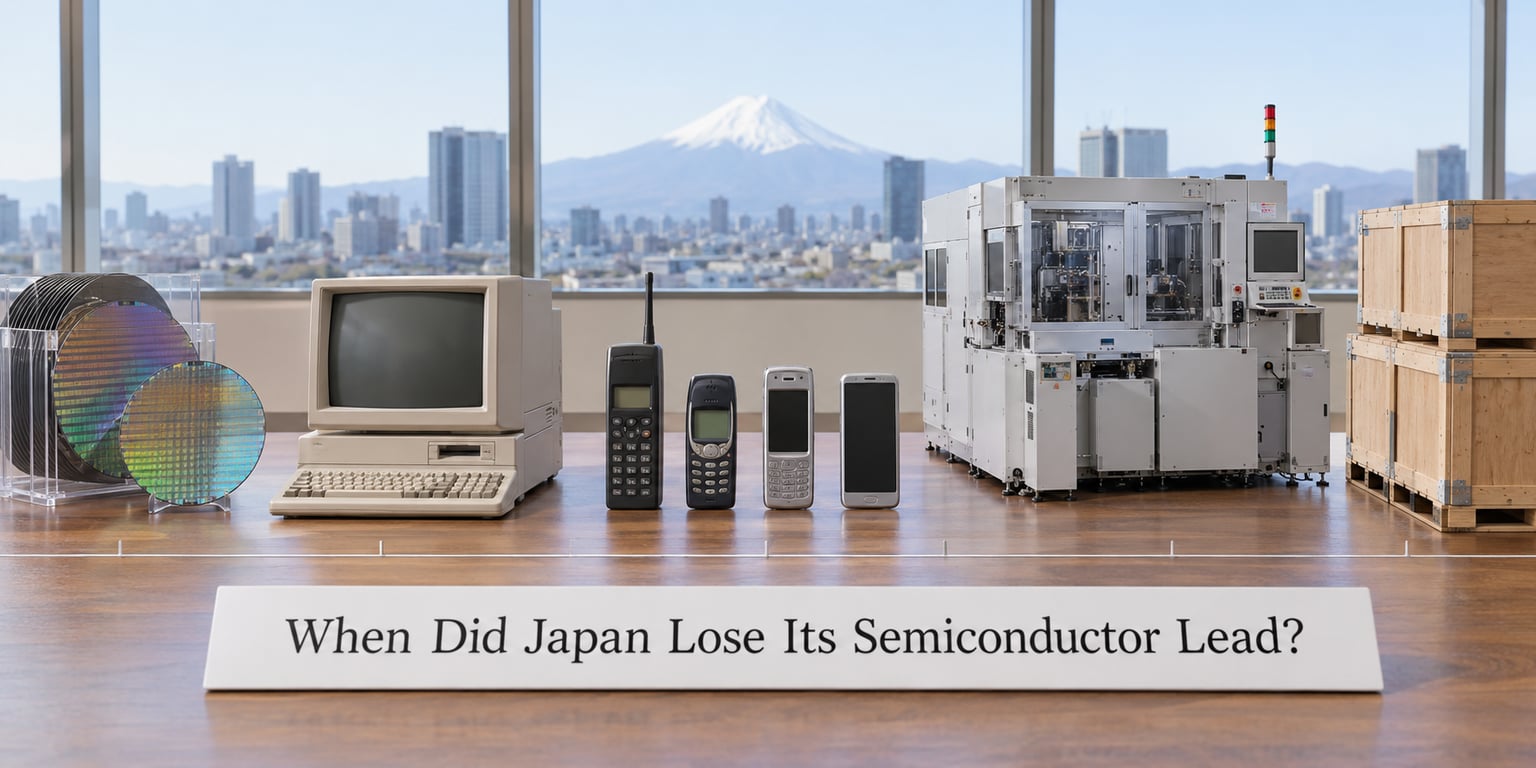
Erosion began in the late 1980s, became undeniable in the 1990s and turned into a rout during the 2000s. There was no single crisis year, which is exactly why the “Japan fell behind” version of the story keeps failing to explain anything.
How Japanese Semiconductor Industry Declined in Two Stages
Stage one: the memory squeeze. Through the late 1980s and early 1990s, South Korean DRAM producers, backed by chaebol finance and export targets, built capacity faster and cut prices hard. Japanese memory makers, holding high costs and conservative capital plans, watched margins collapse. By the mid-1990s Japanese firms had ceded the commodity DRAM market they had invented.
Stage two: structural drift. After 2000 the problem spread to logic. Japanese companies consolidated into a handful of groups, sold or closed fabs, and shifted toward an asset-light model where a fab is owned but production happens elsewhere. Japan’s share of global semiconductor revenue fell from over 40% in 1988 to single digits within 25 years, and the number of Japanese top-ten suppliers kept shrinking.
What Happened to Japan’s Major Chipmakers?
The outcomes look like a list of corporate casualties, but each one follows from a specific strategic choice.
| Company and year | Business outcome | Underlying cause |
|---|---|---|
| NEC and Hitachi, 1990s onward | System LSI and logic businesses folded into later joint ventures | Lost the process race to foundry and fabless competitors |
| Fujitsu, 1990s-2010s | Microelectronics division divested, fabs closed or sold | Deliberate retreat from commodity logic to focus on servers and software |
| Elpida Memory, 1999-2013 | Merged from Hitachi and NEC, then bankruptcy in 2013, later acquired by Micron | DRAM price war plus repeated delays on new capacity |
| Renesas Electronics, 2003 and 2010 | Created through mergers; later acquired by a consortium including the Japanese government | Microcontroller strength survived, fab footprint did not |
| Toshiba Memory, 2016-2018 | Sold to a Bain Capital-led consortium | NAND scale-up against Samsung and SK Hynix became unaffordable |
| Kioxia, 2018 onward | NAND maker under foreign ownership, among the few survivors | Specialisation in flash rather than commodity DRAM |
| Mitsubishi Electric, 2020s | Withdrew from leading-edge logic development | Concluded it could not match TSMC or Samsung on process roadmap |
Renesas is the useful exception. Its automotive microcontrollers are still a real strength, because a mature, high-reliability node is a different business from chasing 2nm.
Why Did Japanese Semiconductor Companies Lose Their Advantage?
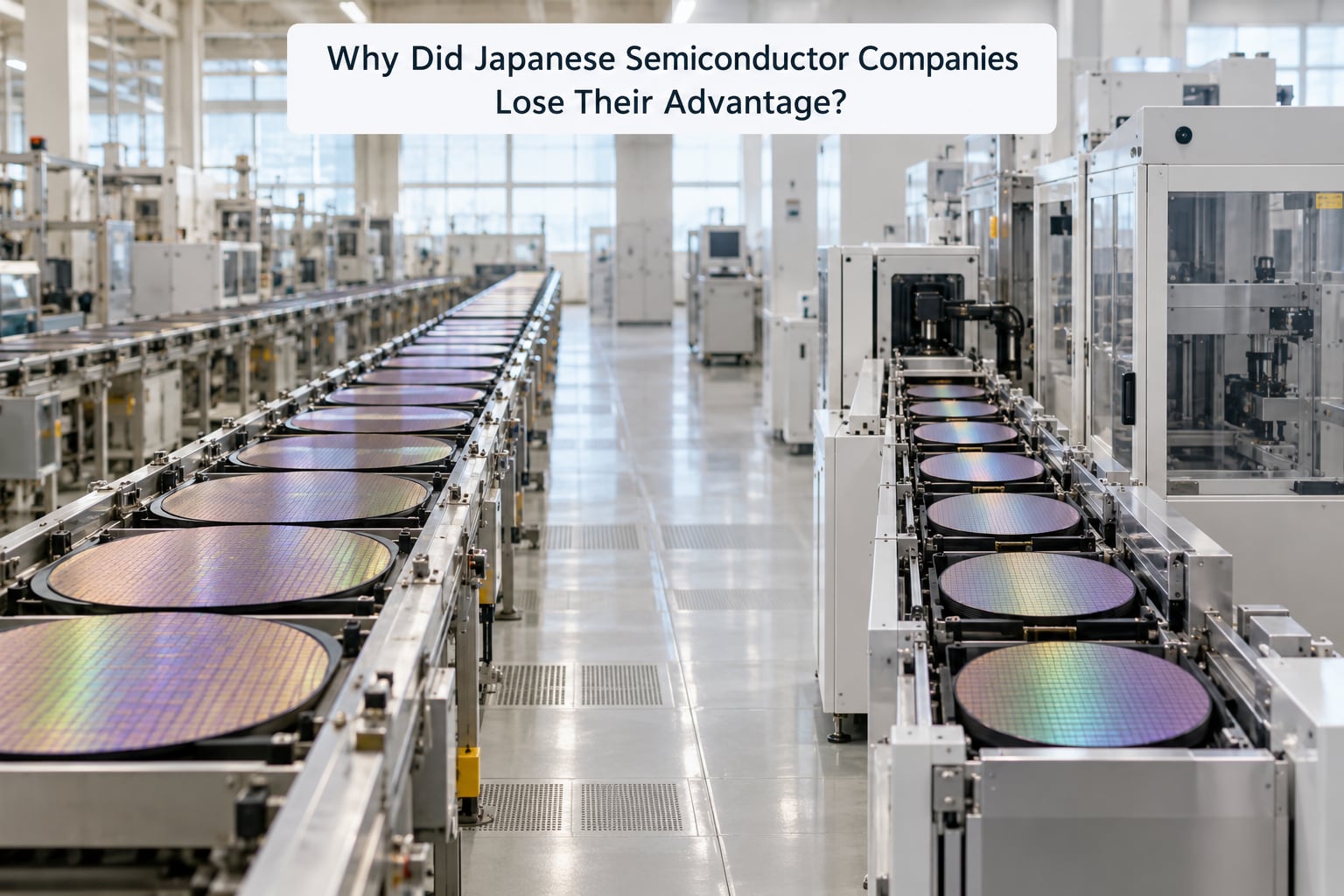
Seven pressures compounded. None alone would have ended Japan’s lead; together they did.
1. DRAM became a commodity. Memory has always been price-driven, but in the early 1990s the product itself was standardising. Japanese makers kept high manufacturing costs and slow capacity decisions while Korean rivals treated volume as a weapon.
2. The yen roughly doubled. After the Plaza Accord, a strong yen inflated the overseas cost of Japanese chips. A manufacturer could be the most efficient in the world and still lose on price in dollars.
3. Capital spending slowed. Japanese companies debated and deferred new fabs where Korean competitors committed first. In a cycle where capacity decides price, hesitation is expensive.
4. Overcapacity followed. The same successes that built Japan’s 1980s share produced excess supply by the early 1990s. Falling prices destroyed margins across the industry.
5. Diversification blurred focus. Conglomerate groups spread R&D across unrelated businesses and cross-subsidised weak units, so no single chip line got the sustained investment a leading-edge product demands.
6. Consensus slowed decisions. Long internal agreement cycles meant a product roadmap moved at the pace of the slowest approving department, while competitors shipped.
7. Assembly and advanced fabs went abroad. Lower-cost locations absorbed the mature nodes, and the most advanced Japanese fabs closed or were sold. Assembly moved first, then capability.
Engineers and analysts discussing this on Reddit and Quora consistently describe a slow management failure rather than a single shock, which matches what the corporate record shows.
How Did Government Policy Affect the Industry?
Policy both built the industry and then slowed its adaptation. In the 1970s and 1980s Japan’s protected domestic market, generous industrial funding and tight coordination between chipmakers and electronics manufacturers supported the climb to first place. That arrangement worked while consumer electronics boomed at home.
The 1986 US-Japan Semiconductor Agreement pushed the other way. It set a target limiting foreign-made chips to roughly 20% of the Japanese market and attached price-undertaking and dumping penalties through US enforcement. Forum discussion treats it as shelter: keeping Korean and Taiwanese suppliers out of Japan removed the competitive pressure Japanese DRAM makers needed.
Later policy tilted toward protecting incumbents and moving production to lower-cost markets, rather than funding the next process node. Contemporary subsidies work differently, with support attached to specific capacity targets and new entrants rather than to existing firms.
Why Did South Korea and Taiwan Gain Ground?
Neither country started further ahead than Japan in engineering talent. The difference was how each converted talent into capacity.
| Factor | South Korea | Taiwan |
|---|---|---|
| Corporate structure | Chaebols with deep bank finance and patient capital | Focused specialist firms with clear product identities |
| State role | Export targets, credit direction, coordinated clusters | Industrial parks, infrastructure, precision clusters |
| Market focus | Memory first, logic later | Foundry-only from the start, no competing products |
| Supplier network | Domestic materials and equipment built alongside | Dense SME supplier base around a few fabs |
| Weakness that followed | Cyclical memory dependence | Concentration risk in a small number of customers |
Samsung and SK Hynix accepted brutal short-term margins to buy scale, then used that scale to fund the next node. TSMC chose the opposite of a Japanese conglomerate: one business, obsessive execution, and customers who trusted the roadmap more than any single product.
Did Japanese Technology and Engineering Also Decline?
No, and this is the most misleading part of the standard story. Japan remains strong upstream, supplying the tools and materials that TSMC, Samsung and Intel depend on. Japanese photoresist, silicon wafers, mask blanks and precision equipment remain essential inputs for leading-edge fabs run anywhere in the world.
Suppliers such as Tokyo Electron, Shin-Etsu and SUMCO, plus materials firms like JSR, hold positions that a fab shutdown cannot easily replace. That is a position of chokepoint power, and it is why “Japan lost semiconductors” is an oversimplification of a value-chain repositioning.
Japan also kept strength in automotive and power semiconductors, where reliability over decades matters more than node leadership, and in imaging sensors, display materials and precision machinery. Engineers and analysts make the same point in forum threads: Japan’s shift was upstream, not out.
What Is Japan Doing to Rebuild Its Semiconductor Industry?
The response has three parts. Roughly ¥3.9 trillion of state support was committed across 2021-2023, and the policy emphasis moved from protecting incumbents to securing supply and attracting new capacity. Foreign investment was courted, with TSMC’s JASM operation in Kumamoto receiving support of about ¥476 billion for two fabs.
Second, Rapidus is attempting a domestic leading-edge logic business at 2nm, with support reported around ¥920 billion and technology partnerships with IBM and others. It is the most ambitious attempt since the 1980s and by far the least proven.
Third, the older suppliers are being treated as strategic assets, and workforce development has been pushed through university-industry links and faster approvals for foreign engineers.
The constraints are equally real. Leading-edge fabs cost multiples of what the older generation cost, power and water requirements are heavy, and every new fab competes with Taiwan and Korea for the same customers. Advanced packaging, talent and demand uncertainty remain open questions as of 2026. The 2021 chip shortage, which halted Toyota production, made the cost of dependence obvious to policymakers.
What Lessons Does Japan’s Semiconductor Decline Offer?
Reinvest before the cycle turns. Japanese companies debated capacity while competitors committed. In a capital-intensive industry, slow approval has a price tag.
Compete on cost and execution, not product variety. TSMC’s single-focus model beat broad product lines for a simple reason: customers could trust the roadmap.
Watch for commodity traps. Memory looked like a Japanese success story right up until the product turned into a price-compared commodity.
Preserve the chokepoint position. Japan’s materials and tools strength is the reason it has leverage today. Upstream positions are slow to build and slower to replace.
Do not confuse one segment with a whole industry. DRAM’s collapse says little about automotive microcontrollers, sensors or specialty materials.
Read subsidy programmes closely. Support aimed at existing firms preserves jobs; support tied to new capacity changes outcomes. Japan’s post-2021 shift reflects that lesson.
Frequently Asked Questions
When did Japan’s semiconductor industry start to decline?
The erosion began in the late 1980s and ran continuously through the 1990s and 2000s. There was no single collapse year: a strong yen from 1985, the 1986 US-Japan Semiconductor Agreement, the DRAM price war and the relocation of fabs each tightened the pressure at different moments. By the 2010s only one Japanese company remained in the global top ten suppliers.
Why did Japan lose its lead in DRAM memory chips?
DRAM turned into a price-compared commodity, and South Korean producers backed by deep chaebol finance added capacity faster and accepted thinner margins to win volume. Japanese makers carried higher costs, slower capacity decisions and older production lines, so when prices fell the gap between the two models widened fast. By the mid-1990s Japanese firms had given up commodity DRAM almost entirely.
Was government policy responsible for Japan’s semiconductor decline?
Policy mattered in both directions. Protection and industrial funding helped build Japan’s lead, while the 1986 agreement’s roughly 20% foreign share target and price undertakings sheltered domestic makers from the competition that forced Korean and Taiwanese firms to improve. Later subsidies favoured overseas production over new domestic capacity. Policy shaped the pace of the decline but did not cause it alone.
Is Japan still technologically competitive in semiconductors?
Yes, but upstream rather than in leading-edge fabs. Japanese firms such as Tokyo Electron, Shin-Etsu, SUMCO and JSR supply lithography tools, silicon wafers, mask blanks and photoresists that leading-edge fabs worldwide depend on. Japan also retains strength in automotive microcontrollers, power devices and imaging sensors, even after losing share in commodity memory and advanced logic.
Can Japan successfully rebuild its semiconductor industry?
A full return to its 1980s position looks unlikely. Domestic leading-edge capacity faces far higher construction costs, tighter power and water requirements and customers who already have committed suppliers. Support of roughly ¥3.9 trillion since 2021, the JASM fabs and Rapidus’ 2nm attempt could still secure meaningful domestic capacity. Most realistic forecasts expect a stronger foothold in mature and specialised chips rather than a full reversal.
Conclusion: Start With the Business Model, Not a Single Bad Decision
There is no single bad decision to point at. How the Japanese semiconductor industry declined is the sum of a strong yen, a trade pact that reduced competitive pressure, a memory price war, slow capital decisions, sprawling corporate structures and the steady relocation of advanced fabrication offshore.
Start with the timeline, then read the business decisions alongside it. The most useful takeaway for anyone watching an industry leader today is that positions at the top of a supply chain do not survive on reputation; they survive on reinvestment, cost and execution, checked every cycle.