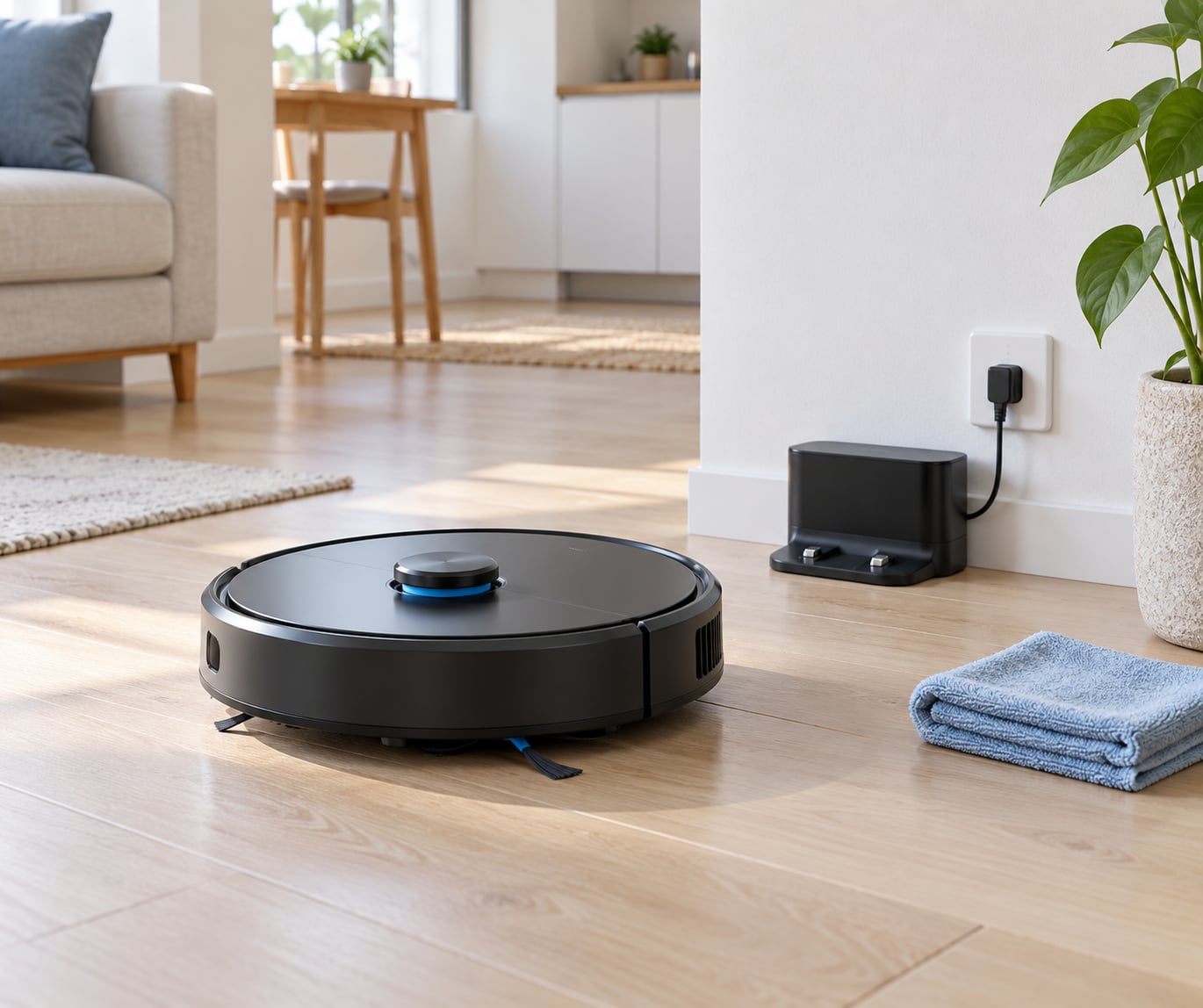
If you have seen the same robot vacuum listed in Tokyo and in Berlin or Chicago, the two versions are not always the same machine. Japanese vacuum robots are built, branded and tuned for Japanese homes, and how Japanese vacuum robots differ comes down to five things: how they fit through a low apartment, how they treat tatami and hard thresholds, how quiet they run, how the app speaks to you, and who repairs them when something breaks.
The core cleaning logic is the same everywhere. Every robot maps a floor, drives a route, picks up debris and returns to a dock. What changes between markets is the hardware around that logic and the support behind it.
Table of Contents
- 1How Japanese Vacuum Robots Differ at a Glance
- 2Navigation and Mapping Differences
- 3Why room detection matters more in Japan
- 4Cleaning Systems and Obstacle Handling
- 5Surfaces Japanese homes actually have
- 6Mop systems: combo or vacuum only
- 7Size, Hardware, and Apartment Fit
- 8How Japanese vacuum robots differ on height and clearance
- 9Apps, Controls, and Language Support
- 10Noise, Battery Life, and Maintenance
- 11Price, Parts, and Regional Availability
- 12Which Should You Choose?
- 13Frequently Asked Questions
- 14Are Japanese robot vacuums better than models sold elsewhere?
- 15Can a Japanese robot vacuum be used outside Japan?
- 16Do Japanese robot vacuum apps support English?
- 17Which Japanese robot vacuum is best for a small apartment?
- 18Do robot vacuums sold in Japan work on carpet?
- 19Conclusion
How Japanese Vacuum Robots Differ at a Glance
Here is the short version before the detail.
| Criterion | Built for the Japanese market | Built mainly for other markets |
|---|---|---|
| Body size | Built low and narrow to clear low furniture and tight room turns | Often a little taller and wider, trading clearance for a bigger battery |
| Floor surfaces | Tuned for wood, laminate, tile and tatami, with soft-surface detection | Tuned for a mix of carpet and hard floor common in North America and Europe |
| Thresholds | Adjusted for the small step-ups and sliding door rails found in Japanese housing | Adjusted for thicker outdoor thresholds and deeper pile carpet |
| Suction class | Often moderate, because Japanese homes rarely have deep carpet | Often quoted at higher pascal figures for carpet pickup |
| Dock | Small dock footprint for a genkan alcove or a bathroom corner, plus wash-and-dry versions with plumbed water | Larger docks with bigger dust bags, often plumbed in |
| App | Japanese-first interface, with English often secondary or absent | English-first, Japanese available in most cases |
| Support | Local repair, Japanese-language hotline, parts held in Japan | Support routed to the country of purchase |
One more difference deserves a mention up front, because buyers keep tripping over it: most robot vacuums sold in Japan are made in China. Japanese brands such as Panasonic, Hitachi, Sharp, Toshiba and Fujitsu design and assemble products for the Japanese market, but they sit in the same global supply chain as the imported flagships from Roborock, Ecovacs, Dreame, iRobot and SwitchBot. If your priority is not country-of-design but which model actually fits your floor plan and your language settings, start there instead.
Navigation and Mapping Differences
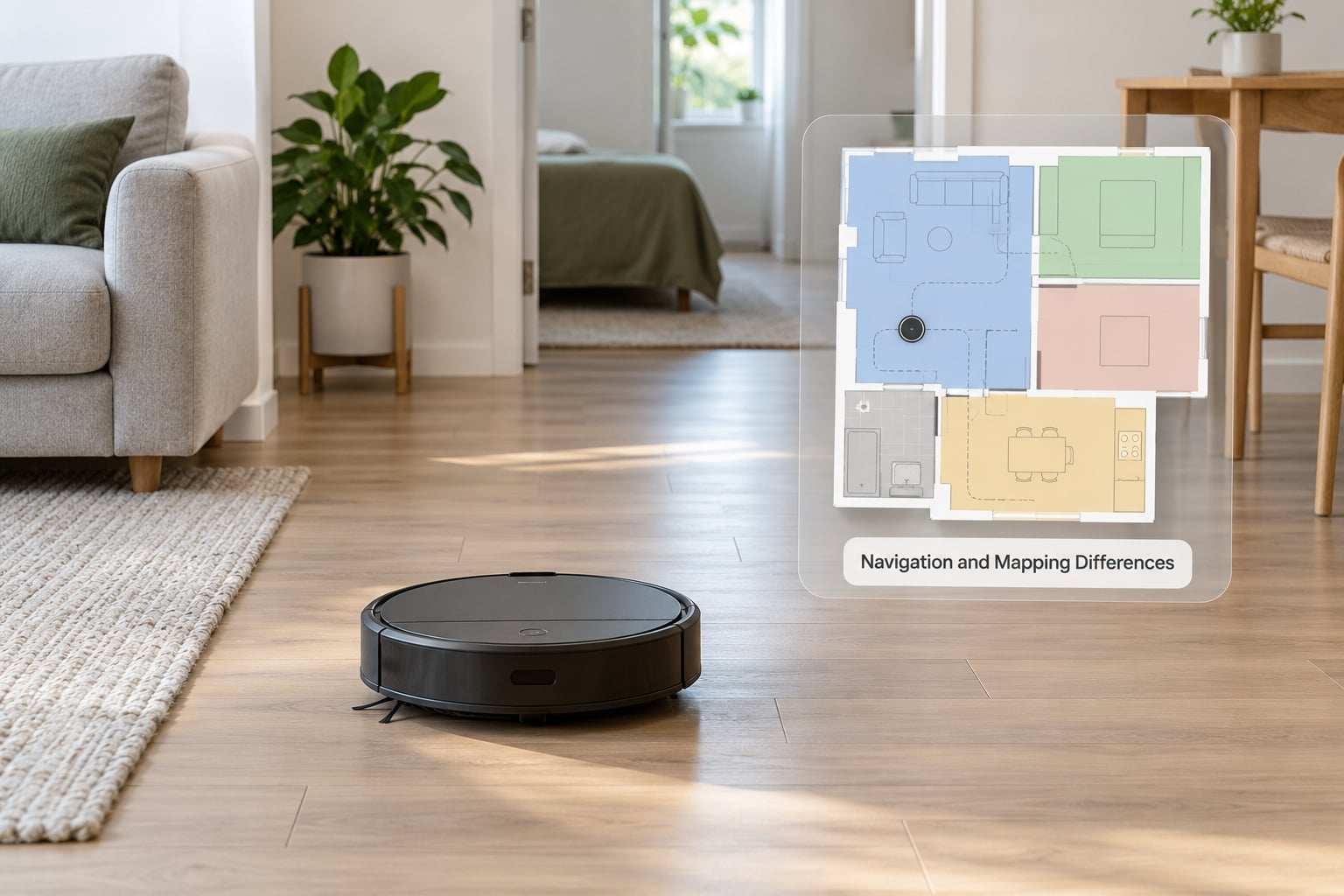
Mapping is where a Japanese apartment changes the brief. A robot in a large open-plan house can afford to wander a little. A robot in a one- or two-room Japanese flat cannot, because every metre of a shuffled route is a metre of runtime lost in a space that has four of them.
Four sensor approaches show up in the market. Lidar units spin a laser to build a distance map and are the most consistent in dim rooms and under furniture. Camera and structured-light units read the room like a machine vision system and add object recognition, at the cost of needing light to see well. Gyroscope and infrared bumper units are cheaper and simpler, and cope acceptably in a plain rectangular room. Random-pathing bumpers with no mapping at all still exist at the cheap end of the market.
Why room detection matters more in Japan
The software behaviour that follows from mapping is where Japanese tuning shows. No-go zones let you protect the futon storage area, the shoe cabinet nook and the bathroom step. Room zoning matters when one room needs a wet mop pass and another must stay dry. Scheduling matters for a different reason too: Japanese apartments share walls, so a machine running a long cycle at midday is an audible event for your neighbours, and early-morning or late-evening runs are the norm.
Multi-floor mapping is worth checking explicitly. If you own a townhouse with a split level, some models store two or three maps and switch between them. If your home is a single-level flat, spend that attention on recovery behaviour instead: what the robot does when it bumps a threshold and fails. Forums like r/homeautomation keep coming back to this, with owners describing robots that need rescuing from low furniture more often than they would like. A brand name does not fix that failure mode. Test it in week one.
Cleaning Systems and Obstacle Handling
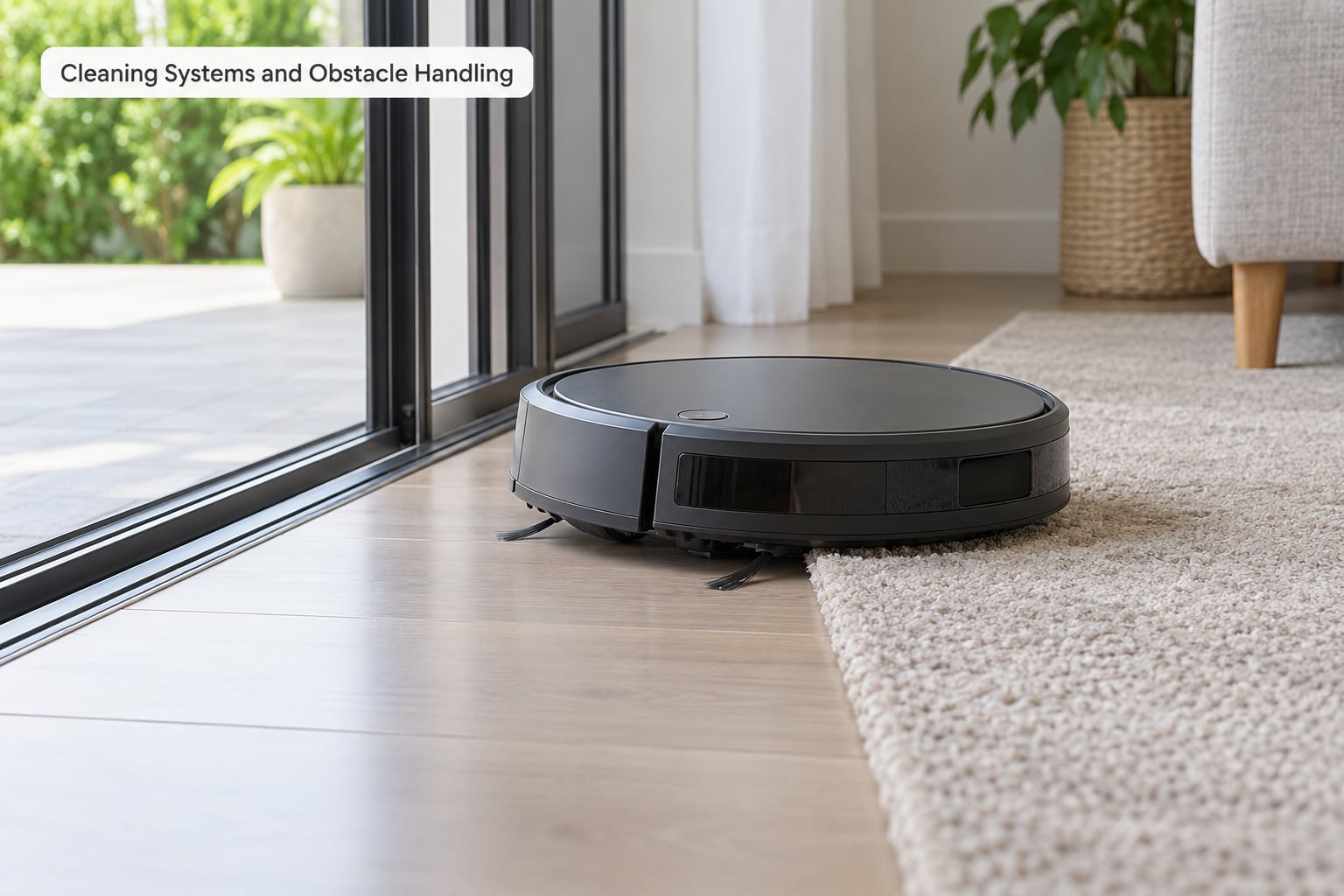
Brush design, suction and edge coverage are where two robots that both claim to clean a room end up very different.
Surfaces Japanese homes actually have
Most Japanese apartments are hard floor: wood, laminate, tile or vinyl. Carpet exists, but it is a bedroom or a hotel, not the whole flat. That changes what a robot needs. Strong suction for embedded carpet pile is close to useless on a smooth wood floor, where the work is fine dust along skirting boards and in the gap beside the tatami edge.
Tatami is the surface people ask about most. Those woven mats are delicate, they sit slightly proud of the surrounding floor, and their borders can snag a brush. Robots meant for Japanese homes handle this with soft-surface detection and lower brush pressure, sometimes with a dedicated carpet mode that lifts the roller or reduces power on the mat. On the wrong setting, a mop pad left down on tatami leaves a damp mark and a smell that takes days to fade.
Threshold climbing matters for a specific reason: the genkan step-up at the entrance, the lip where a washroom starts, and the rails in sliding doorways. Specs for maximum climb height in millimetres are published, but the useful test is a tape measure on your own thresholds, because a rail sitting slightly proud of a threshold is a different obstacle to a level change.
Mop systems: combo or vacuum only
A vacuum-only robot is a deliberate choice in an all-hard-floor flat, not a compromise. In Japan it is a common one, because a flat that is already free of carpet gains little from a mop function, and skipping the mop removes the water tank, the wash station and the drying cycle from your maintenance list.
Combo units do more, but ask what the dock does. Hot-water washing, drying after washing and automatic pad lifting on carpet are the features that decide whether a combo is pleasant or annoying to own. A station with a water inlet and drain needs plumbing, which in a Japanese kitchen or utility area means a tap connection and a floor drain nearby. Bucket-fed stations need human attention every few days instead. Both designs are normal in the Japanese market; they are just different commitments.
Edge cleaning is the quiet differentiator. Side brushes and, on newer flagships, a small extending arm reach into the gap between a wall and a skirting board, where most of a room’s dust actually settles. Plenty of domestic Japanese models skip the arm and rely on a side brush, which is why corners on Japanese-market machines often need a quick hand pass.
Size, Hardware, and Apartment Fit
This is the section that decides whether a robot works at all in your home, and it is the one most shopping guides skip.
How Japanese vacuum robots differ on height and clearance
A robot body has a diameter and a height, and Japanese furniture sets the limit. Sofas, beds, low storage units and kitchen counters on adjustable legs can leave a narrow gap, and a robot that is a couple of centimetres too tall will not go under any of them. Many units aimed at the Japanese market are deliberately flat, and flatness is bought with battery volume, so runtime on those models is shorter than on a taller design with a bigger cell.
Measure before you buy. Note the lowest clearance you actually want the robot to reach, the narrowest doorway, the tightest turn between the living room and the corridor, and the depth available for the dock. Docks grow with features: a plumbed wash station needs a water supply and a drain within reach, and a self-emptying base is a box roughly the size of a small suitcase that has to sit somewhere it does not get kicked.
Weight and centre of gravity matter on transitions. On a wooden floor with a raised lip, a heavy machine with a low centre of gravity climbs better than a tall light one. On a tatami edge, the same weight can drag a corner mat out of alignment.
Apps, Controls, and Language Support
The app is where a Japanese-market robot is most visibly a different product, and the friction here is what generates the most complaints in buyer threads.
Japanese domestic models ship with a Japanese-first interface. Voice assistant support is generally tied to Japanese services, schedules and cleaning-zone names are written in Japanese, and error messages, firmware notes and setup guides assume a Japanese-language reading of the manual. Imported flagships usually offer a Japanese locale, sometimes an excellent one, sometimes a thin translation with the newest features documented only in English.
If you are buying in Japan and living in Japan, that is a non-issue. If you are an expat or a foreign resident, check three things in the listing before you pay: whether the app supports your account region, whether the store accepts returns once the language turns out to be wrong, and whether cloud features such as remote monitoring or voice control need a Japanese phone number or a Japanese payment method.
The same caution applies in reverse for anyone taking a Japanese-market unit abroad. Region-locked cloud services, 100V power, and a warranty that only applies inside Japan will matter more than any spec difference. Check the voltage, the plug and the support address on the specific model code, not on the product family.
Noise, Battery Life, and Maintenance
Japanese households are small and thin-walled, so noise is a design constraint rather than a marketing number. Japanese-market models tend to ship with a quieter default profile, and quiet mode usually trades suction for speed. Look for the published figure in decibels for the mode you would actually run at night, since the headline number is often the loudest setting.
Battery runtime is roughly proportional to floor area, and compact flat-floored homes finish fast. What limits a robot in a small home is rarely total runtime. It is dock visits, mop refills and brush cleaning, each of which stops the job and starts a small maintenance loop.
The maintenance routine is the same shape for every model, and it is short:
- Empty or replace the dust bag at the dock every one to two weeks in a busy flat.
- Wash the mop pads and the filter on a schedule the dock reminds you about.
- Cut hair off the roller brush monthly, more often with pets in the house.
- Wipe the sensors and the charging contacts, since dust on a cliff sensor causes constant retreat behaviour.
- Re-map when you move furniture, because a stored map that no longer matches the room causes rooms to be skipped or cleaned twice.
Consumables are the quiet cost of ownership. Filters, side brushes, mop pads and dust bags are cheap, but they need to be available in your country. That is one of the strongest practical arguments for buying a model with a local service network.
Price, Parts, and Regional Availability
Prices for robot vacuums move constantly, so treat any figure you see today as a snapshot rather than a fact. What is more useful is understanding what each tier buys.
At the bottom of the Japanese market sit random-pathing bumpers with weak suction and no mapping. They are cheap, they clean a small flat adequately, and they need no app at all. Above that, mapped models with lidar add reliable coverage and no-go zones for a modest step up. The next tier is where combo units with self-emptying docks appear, which is the single biggest jump in both cost and maintenance quality. The top of the market adds hot-water washing, drying, pad lifting and extending edge arms, and here Japanese domestic models thin out while imported flagships dominate.
Availability shapes the real total. A Japanese-market model can be bought from the manufacturer’s own site and from large domestic electronics retailers, usually with a Japanese warranty and a Japanese repair address. Imported flagships are often cheaper in Japan than in their home markets, because they are already on the local shelves, but their warranty coverage depends on where the importer routes service.
Importing yourself reverses several of these advantages. You may pay less or more depending on the exchange rate and shipping, but you lose the local warranty, the Japanese-language support line, and any guarantee that replacement parts stay available. Consumables get harder to source once a model is discontinued. If your plan is to import, check the model code and the parts list before the purchase, not after the box arrives.
Which Should You Choose?
- Living in Japan, compact flat, hard floors: a Japanese-market mapped model with strong soft-surface handling and a low body. You get local service and a Japanese app.
- Living in Japan, want the best obstacle avoidance and mop hardware: an imported flagship sold through Japanese retail. Accept English-leaning app documentation in exchange for the better cameras and edge arms.
- Small apartment, minimal fuss: a vacuum-only mapped unit with a quiet mode. Skip the dock plumbing and the wash cycle entirely.
- Hard floors, wet areas, kitchen and bath-adjacent spaces: a combo with hot-water washing and drying, plumbed if you have a tap and a drain nearby.
- Larger home or multi-floor layout: a lidar model with multi-map storage and a self-emptying dock. This is the case where a taller body and larger dock footprint stop being a problem.
- Buying from outside Japan: verify voltage, plug, app region, account requirements and warranty coverage before you commit.
Frequently Asked Questions
Are Japanese robot vacuums better than models sold elsewhere?
Neither category wins outright. Japanese-market models are tuned for compact apartments, low furniture, tatami and hard floors, and they come with local repair and Japanese-language support. Imported flagships generally lead on obstacle avoidance cameras, extending edge arms and washing systems. Choose on your floor plan, your app language and your support needs rather than on the label of the country of design.
Can a Japanese robot vacuum be used outside Japan?
Usually yes for the cleaning function, with caveats. Check the power supply, because Japanese homes run on 100V and some imported units expect a different input. Cloud features such as remote monitoring may depend on a regional server, and the warranty may only apply inside Japan. Consumable parts can also become hard to source once a model is discontinued in its original market.
Do Japanese robot vacuum apps support English?
Imported flagships sold in Japan usually offer a Japanese and an English interface, though the newest features are sometimes documented only in English. Japanese domestic models are Japanese-first, and setup guides, error messages and voice assistant support generally assume Japanese. If you read English far more fluently, check the app screenshots in the listing before buying, because a thin translation makes setup and troubleshooting slower.
Which Japanese robot vacuum is best for a small apartment?
For a compact flat, prioritise body height under your lowest furniture, mapped cleaning with no-go zones, and a quiet mode for early mornings. A vacuum-only model is often the right call in an all-hard-floor home because it removes the water tank and wash cycle from your maintenance routine. If you want mopping too, check the dock footprint and whether you have a tap and drain nearby for plumbed water.
Do robot vacuums sold in Japan work on carpet?
They do, and most handle low-pile carpet without difficulty. What matters is the mode: soft-surface detection should raise suction, and a combo unit should lift its mop pads so damp fabric is not dragged across carpet. On medium or high pile, check the stated climb height and the brush design, since a fringe can catch the roller. In a mostly hard-floor Japanese flat, carpet performance is rarely the deciding factor.
Conclusion
Japanese vacuum robots differ from models sold elsewhere in fit and support rather than in cleaning logic. The short body clears low furniture, the floor tuning handles wood and tatami instead of carpet, the threshold figures reflect small Japanese step-ups, and the app and repair network assume you are in Japan.
Before you pay, do four things: measure your lowest furniture clearance and your narrowest doorway, measure the thresholds it has to cross, confirm the app works with your account region and your language, and check that filters and brushes are easy to buy where you live. Do those four checks and most of the disappointment people report online disappears before it starts.