When people search this phrase they often land on pages about guitar pedals and car stereos, so let me clear that up first: a TV tuner here means the receiver built into a television or set-top box that picks up over-the-air broadcast stations through an antenna. It has nothing to do with clipping a guitar or tuning a car radio.
The short answer is that a Japanese TV tuner receives ISDB-T on 8 MHz channels, while a US tuner receives ATSC 1.0 on 6 MHz channels. Those are different modulation schemes on different channel plans, so the two tuners are not interchangeable, and no antenna, firmware update, or region setting will change that. Everything below is unpacked from there.
This matters the moment someone ships a Japanese television back to the United States, buys a used set on a marketplace, or relocates to Japan and expects the local stations to appear. In all three cases the broadcast standard decides whether the set works at all.
Table of Contents
- 1How Japanese TV Tuners Differ from US Tuners at a Glance
- 2Digital Broadcast Standards: ISDB-T vs. ATSC
- 3Why ISDB-T and ATSC cannot talk to each other
- 4Four reasons a Japanese tuner will never receive US broadcasts
- 5ATSC 3.0 and what changes next
- 6Why Japan chose a different standard
- 7Modulation and Channel Bandwidth
- 8Channel plan and bandwidth
- 9Modulation and signal strength
- 10Audio codecs
- 11Regional Frequency and Reception Differences
- 12Japan runs a UHF-first terrestrial plan
- 13The US splits low VHF and UHF
- 14What that does to your antenna
- 15What a channel scan looks like on each side
- 16Antenna Inputs, Connections, and Features
- 17Software, Power Standards, and Import Problems
- 18Which TV Tuner Should You Choose?
- 19Frequently Asked Questions
- 20Can I use a Japanese TV tuner in the United States?
- 21Why does a Japanese tuner fail to find US channels?
- 22Do I need an antenna to use a digital TV tuner?
- 23Can one tuner receive both Japanese and US broadcasts?
- 24Are cable, satellite, and terrestrial TV tuner boxes interchangeable?
- 25Conclusion
How Japanese TV Tuners Differ from US Tuners at a Glance
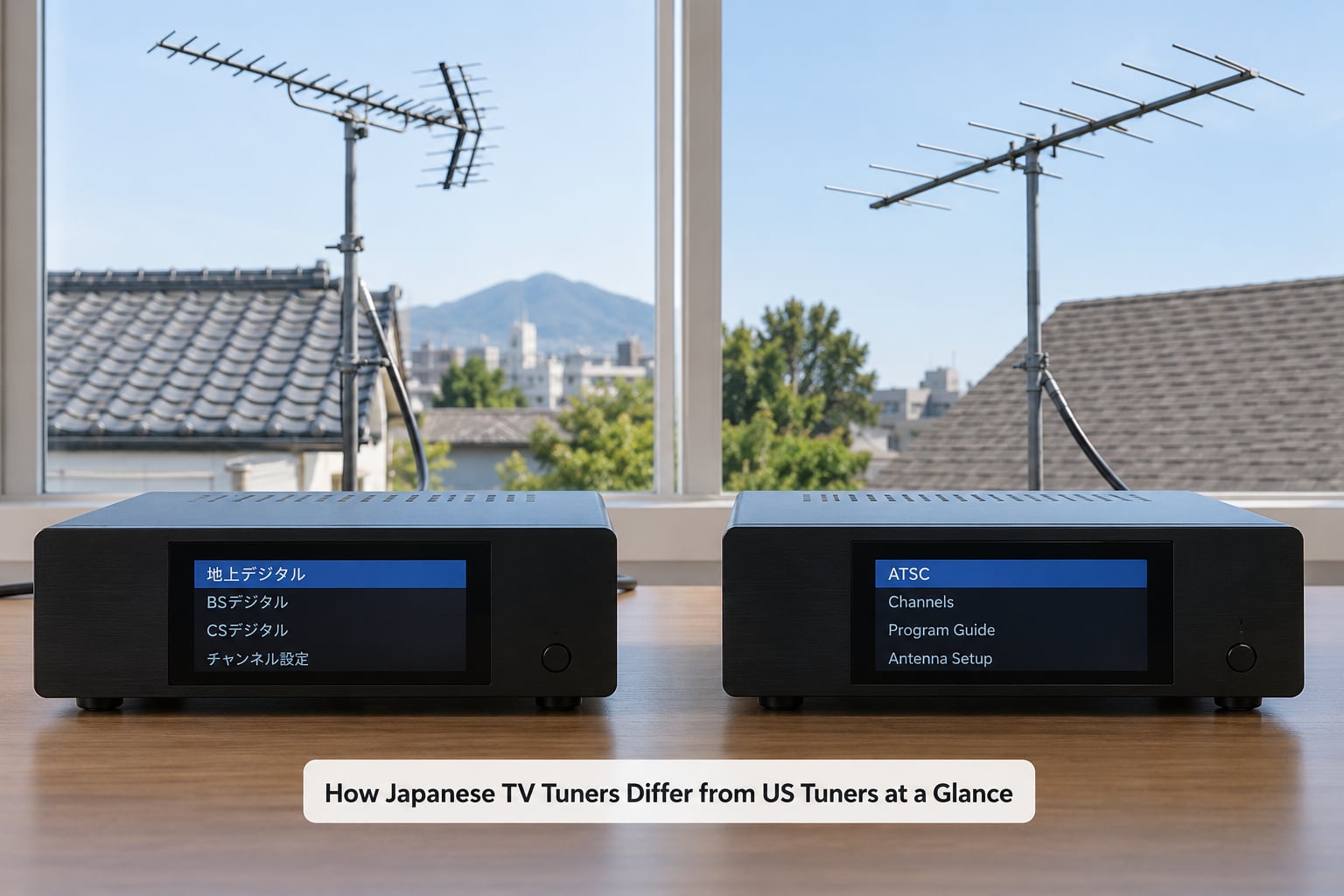
A Japanese TV tuner receives the ISDB-T digital broadcast standard on 8 MHz channels, while a US tuner receives ATSC 1.0 on 6 MHz channels, so the two tuners cannot be swapped. Japan also inserts a physical access card into every set, and its antenna plan sits almost entirely in the UHF band.
| Criterion | Japan | United States |
|---|---|---|
| Terrestrial standard | ISDB-T (defined by ARIB) | ATSC 1.0, with ATSC 3.0 in some cities (ATSC / FCC) |
| Channel bandwidth | 8 MHz | 6 MHz |
| Common modulation | 64-QAM, with 256-QAM for mobile reception | 256-QAM, with 8-VSB for weak-signal coverage |
| Terrestrial bands used | UHF only, roughly 470 to 608 MHz | Low VHF, high VHF and UHF |
| Access control | B-CAS card required in the set | None for broadcast TV |
| Audio codec | AAC | AC-3 (Dolby Digital) |
| Antenna connection | Coaxial RF in, usually one | Coaxial RF in, often two |
| Legacy video input | D-Terminal | Composite video and RCA inputs |
| Mains supply | 100V at 50 Hz | 120V at 60 Hz |
| Language of menus | Japanese | English, with regional variants |
| Buying implication | Only works in Japan, or as a decoder for signals sent to you | Works only in ATSC territories, including Canada and Mexico |
Read the table row by row rather than top to bottom. The standard row explains the electronics; the access card row explains why a Japanese set is often not even the right decoder; the mains row is the mundane problem that trips people up last.
Digital Broadcast Standards: ISDB-T vs. ATSC
ISDB-T is the terrestrial digital standard Japan built and runs under the Association of Radio Industries and Businesses (ARIB). ATSC is the family of standards defined by the Advanced Television Systems Committee and regulated in the United States by the FCC, with ATSC 1.0 still the standard carried in the tuner hardware you can buy today.
Both carry MPEG-2 transport streams and both deliver free-to-air channels over the air. That shared plumbing is exactly why people assume they are interchangeable, and it is where the assumption breaks.
Why ISDB-T and ATSC cannot talk to each other
A tuner does not merely amplify a signal. It demodulates a specific modulation scheme onto a specific channel plan, using filters and symbol timing that are fixed in silicon. Feed an ISDB-T demodulator an ATSC waveform and it produces noise, not a channel list.
ISDB-T itself was developed in Japan as an OFDM-based system with a flexible guard interval and support for one or two segments per channel, which is how it handles mobile reception on handheld receivers. ATSC 1.0 uses an 8-VSB single-carrier scheme. The practical outcome for buyers is simple: the demodulator in a Japanese set will never lock onto an American station.
Four reasons a Japanese tuner will never receive US broadcasts
There is a fixed list of blockers, and it is worth knowing all four before you spend money on a conversion idea.
- Wrong modulation. The demodulator looks for an ISDB-T waveform and finds an ATSC one.
- Wrong channel width. An 8 MHz filter bank cannot resolve a 6 MHz channel cleanly enough to lock.
- Missing bands. Many Japanese sets have no low VHF or high VHF tuner section at all.
- Missing access layer. Even where the two systems share transport stream plumbing, the decryption and service data expectations differ.
Notice that none of these is a quality problem. Antenna gain, cable length, amplifier choice, and patient channel rescanning are all irrelevant to the outcome.
ATSC 3.0 and what changes next
ATSC 3.0, marketed as NextGen TV, layers OFDM onto selected broadcasts and lets a station mix simulcast and file-based content. It is rolled out city by city in the United States, so coverage still varies widely.
Japan has not adopted ATSC 3.0, and ISDB-T has continued to evolve on its own roadmap through ISDB-Tb. The two ecosystems are not converging in any near-term sense, so a multi-standard tuner that handles both remains something you have to verify on the spec sheet rather than assume.
Why Japan chose a different standard
Three factors come up repeatedly. Spectrum efficiency mattered, because ISDB-T fits more usable data into a given channel and carries mobile reception natively. A national HD push shaped the timeline, since Japan moved to digital terrestrial television earlier than North America did.
Geography matters too. Japan’s dense, mountainous terrain made a single robust terrestrial standard with handheld reception a priority, and ISDB-T was adopted in 2003, well before ATSC. Once a country has built transmitters, receivers, EPG data and access cards around a standard, switching is not worth it.
Modulation and Channel Bandwidth
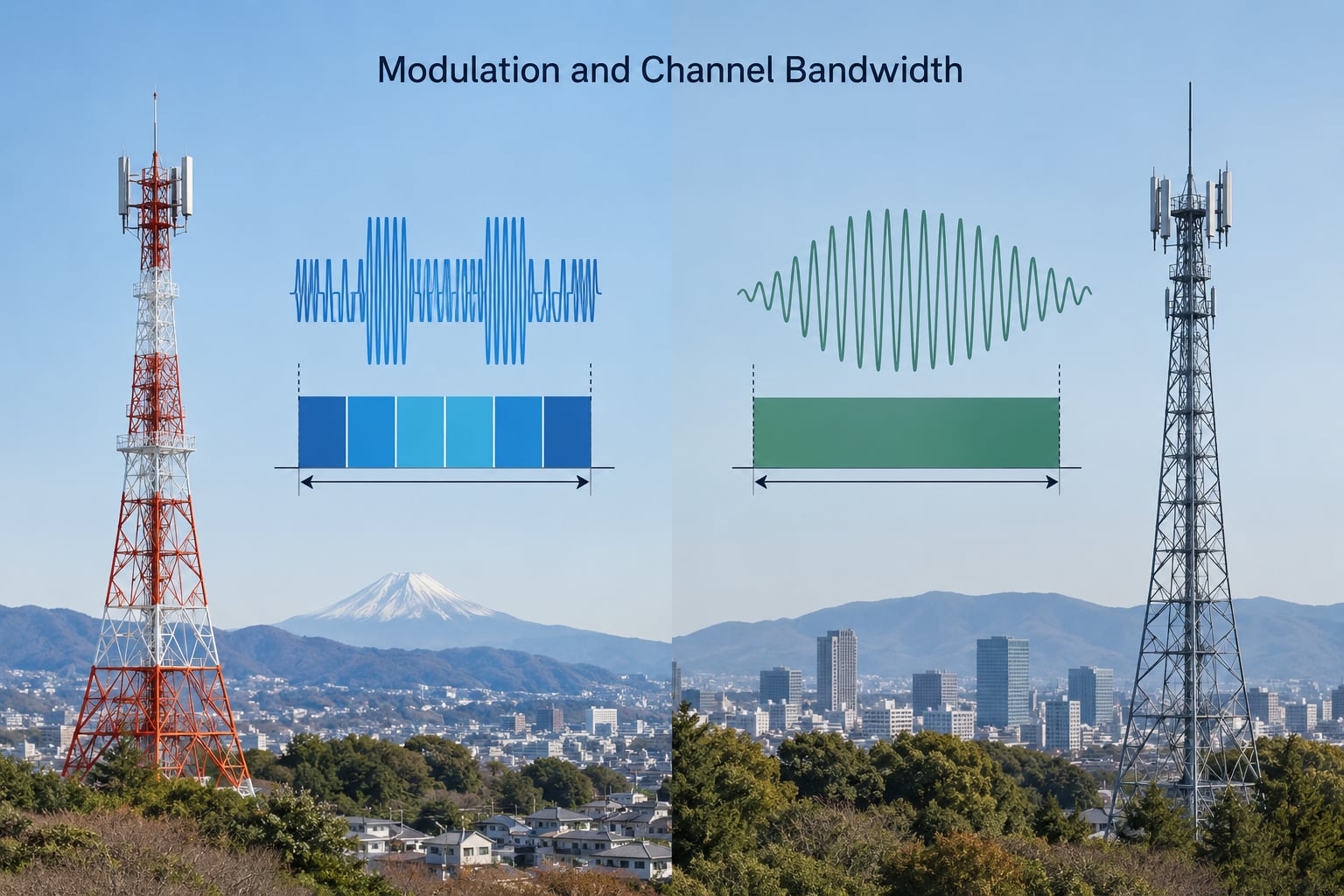
This is the section that answers the question most searchers actually have, which is why concrete numbers matter more here than adjectives.
Channel plan and bandwidth
Japanese terrestrial channels occupy 8 MHz of spectrum. North American channels occupy 6 MHz. The difference is not a small tolerance; it changes the carrier spacing, the filter roll-off, the symbol rate, and the guard interval budget, so a 6 MHz-tuned front end simply has no channel plan that lines up with an 8 MHz grid.
Modulation and signal strength
Japan commonly broadcasts 64-QAM per segment, and can use 256-QAM on a second segment for stationary sets. The US leans on 256-QAM, with 8-VSB available where coverage is marginal. Both approaches trade data rate against how robustly the signal survives, and both are chosen with real terrain in mind.
For a buyer the practical read is that reception quality is not the issue. A strong antenna in front of a wrong-standard tuner still yields zero channels.
Audio codecs
Japanese broadcasts carry AAC audio. ATSC carries AC-3, better known as Dolby Digital. Both decode to ordinary HDMI audio in practice, but it explains why an early capture card or converter built for one market can output silence or a sync error on the other market’s stream.
Regional Frequency and Reception Differences
Channel numbering and coverage are the next place imported hardware disappoints people, because they look like software problems when they are really geography problems.
Japan runs a UHF-first terrestrial plan
Japan’s terrestrial service sits almost entirely in the UHF band, roughly 470 to 608 MHz, which is channel 13 upward in Japanese numbering. That single-band plan is why Japanese rooftop antennas are physically small and why directional UHF panels are common on apartment balconies.
The US splits low VHF and UHF
American broadcasts are spread across low VHF near 54 to 72 MHz, high VHF from roughly 174 to 216 MHz, and UHF from 470 to 608 MHz. Channel numbering starts at channel 2, which is why a US antenna has to be broadband to cover everything.
What that does to your antenna
A Japanese set in North America has no low-band or high-VHF front end at all, so it would miss those stations even if it spoke ATSC. A US tuner in Japan will see the UHF band and still find nothing, because it cannot demodulate what is on it.
Amplifier and pre-amplifier requirements also differ. Local coverage maps and station counts are simply not comparable across the two countries, so any reception plan built from a Japanese channel list is meaningless in the US, and the reverse holds too.
What a channel scan looks like on each side
Imported sets usually fail in one of two ways, and the symptom tells you which problem you have. If the tuner powers on, accepts the antenna, and scans to completion but lists zero or a handful of channels, the standard mismatch is almost certainly the cause. If the scan finds plenty of stations and they are unstable or drop out, the set is demodulating the right system and you have a coverage or antenna problem.
The second case is the one worth diagnosing properly, because it is fixable with a better antenna, a rooftop mount, or a pre-amplifier. The first case is not fixable at any price.
Antenna Inputs, Connections, and Features
Here is the part that makes two sets look different on the back panel even before you switch them on.
| Feature | Japanese set | US set |
|---|---|---|
| Terrestrial antenna input | One coaxial RF input is typical | Two coaxial RF inputs are common on larger sets |
| Satellite input | BS/CS coaxial input for Japanese broadcast and communication satellites | Usually a connector for a separate set-top box or a dish from a satellite provider |
| Legacy analog input | D-Terminal, Japan’s own analog connector | Composite video with RCA audio, no D-Terminal equivalent |
| Digital video | HDMI, including ARC on many models | HDMI, including ARC on many models |
| Remote | Japanese-language on-screen display, sometimes with a Roman text toggle | English by default |
| Program guide | EPG fed over the broadcast signal, often with an app | Broadcast EPG or a guide supplied by the station |
| Mobile control | Remote-viewing apps tied to the maker’s servers, with Japanese market accounts | Maker apps tied to US market accounts |
One more distinction matters here. Terrestrial tuners, cable boxes, satellite receivers and internet television services are separate categories of hardware. A cable box does not receive over-the-air broadcasts, a satellite receiver does not, and an IPTV box receives nothing at all from an antenna. Comparing them to a TV tuner is a category error, and shopping lists built on that assumption end up with a box that cannot do the job.
Software, Power Standards, and Import Problems
B-CAS is Japan’s mandatory access control system for broadcast television, and it is the single biggest difference most people underestimate. The system encrypts broadcast channels and requires a physical card in a slot on the set. Full-size B-CAS cards go into TV sets, while mini B-CAS cards go into tuners and recorders, and a set with no card will not decrypt anything.
Cards also carry a validity period and need periodic re-authorisation while the set sits on the Japanese network. Outsiders cannot simply insert one and expect a fix; the card only helps if a Japanese tuner has already received the broadcasts in the first place, which brings us back to the standard.
The absence of anything equivalent in North America is structural rather than an oversight. Broadcast television there carries no access card because the model is a free public-service signal paid for by a licence fee rather than by a subscription. That is also why the B-CAS answer is not really a separate topic: it applies to Japanese hardware used in Japan, and it disappears the moment the hardware crosses a border and stops being able to receive anything.
On the software side, expect a Japanese-language interface, region-dependent firmware behaviour, and app stores that only issue accounts in Japan. Region locks in consumer TVs are usually about software and account regions rather than the tuner hardware itself, so unlocking a menu does not unlock a broadcast standard.
Electrically, Japan runs 100V at 50 Hz with type A plugs, and North America runs 120V at 60 Hz with type A or B. That gap is solvable with a step-down adapter, which is the easy problem. The hard problem is that even a perfectly powered Japanese set has no ATSC demodulator in it, which is the one no adapter fixes.
Which TV Tuner Should You Choose?
Match the tuner to the country where the set will physically sit and to the service you actually want. Everything else follows from those two answers.
- Living in Japan, wanting Japanese TV: buy ISDB-T hardware with a B-CAS slot. This is the mainstream case and the market is full of options.
- Living in the US or Canada, wanting local broadcast TV: buy ATSC hardware. This is the normal over-the-air path for cordcutters and the hardware is cheap and well supported.
- Needing both standards in one place: you need equipment that explicitly states dual-standard support on the spec sheet. Assume nothing, and check the manual rather than the listing.
- Watching cable, satellite or a streaming package: buy the box that provider requires. None of these are TV tuners in the over-the-air sense, and they will not be affected by the broadcast standard question at all.
Before buying or importing anything, run through this short checklist. Look up the broadcast standard for the destination country, confirm the mains voltage and frequency, confirm the tuner band coverage, and check whether the set needs an access card or a regional account. Then verify the connector situation, since a Japanese D-Terminal lead is not something you will find on a US shelf.
For used-market purchases specifically, ask the seller for the model number and photograph the tuner section of the rear panel and the label with the voltage rating. Check the return window against the transit time in both directions, because a set that ships for three weeks and then comes back for three weeks can outlast a short return policy. Customs handling and import duty can also surprise you, and those costs are not refundable even when the set itself is.
Ask specifically whether the set has been used and whether the card slot has been occupied, because a tuner sold without its B-CAS card is a common listing and an easy way to overpay for something incomplete.
The reverse direction deserves its own note. Using North American tuner hardware inside Japan fails for the same reason in mirror image: the hardware is tuned to a 6 MHz ATSC channel plan, and what is on the roof in Japan is ISDB-T. The hardware hobbyists who do succeed at this kind of work treat it as a tuner module swap rather than a full conversion, because the binding constraint is the module and its band plan, not the display or the remote.
That same logic applies to the FM band, where the US spans 88 to 108 MHz and Japan spans 76 to 92 MHz. Experienced technicians have converted Western radios down to the Japanese band for decades, which shows the operation is routine for them and a bad idea for anyone else.
One route does work well for people who want Japanese television from overseas, and it sidesteps hardware entirely. Home-installed network tuners such as the Pixela PoiTele XIT-3000WP and the Xit AirBox XIT-AIR120CW sit in a Japanese home, connect to the local antenna and BS/CS feeds, and stream the decoded channels over the internet to a viewer elsewhere. Overseas residents use them without a VPN, and the H.265 model suits bandwidth-limited connections. Two caveats from people who actually run them: remote viewing needs re-authentication roughly every 90 days while the tuner is on the network, and paid CS satellite channels still require an existing Japanese contract.
| Option | Effort | What it gets you |
|---|---|---|
| Buy local hardware where you live | None | Every over-the-air channel in that country, working normally |
| Network tuner installed in Japan | Someone in Japan must install it and own the accounts | Live Japanese broadcast, BS and CS channels viewed from abroad |
| Provider streaming service | Subscription and app store account | On-demand catalogues; live broadcast depends on rights |
| Tuner module swap or conversion | Service manual, parts, bench work | One foreign band in a piece of foreign equipment; no consumer support |
| Import a Japanese set as-is | Shipping and power | Very little. No ATSC, no North American stations |
My blunt take: importing a Japanese tuner for ordinary viewing is rarely worth the effort. If you moved countries and want the news and shows you grew up with, a streaming service or a network tuner in a family member’s home solves it in an afternoon.
Frequently Asked Questions
Can I use a Japanese TV tuner in the United States?
No, not for over-the-air viewing. A Japanese TV tuner demodulates ISDB-T on an 8 MHz channel plan, while US stations broadcast ATSC 1.0 on 6 MHz channels. There is no setting, firmware region change, or antenna that bridges the two. You can still use the set as a monitor through its HDMI inputs, which is what most importers end up doing.
Why does a Japanese tuner fail to find US channels?
Because the demodulator cannot interpret the incoming waveform. US terrestrial stations transmit 256-QAM ATSC 1.0 on 6 MHz channels, and a Japanese tuner is built to demodulate ISDB-T on 8 MHz channels. It also lacks the low VHF and high VHF front end that many US stations use. The result is a clean channel scan that returns nothing.
Do I need an antenna to use a digital TV tuner?
Yes. A terrestrial TV tuner receives broadcast stations over the air through a rooftop, window, or indoor antenna connected to the coaxial RF input. Cable and satellite services arrive through their own boxes and connectors, and internet television streams over a network, so none of them use the antenna port. If you want free broadcast channels, plan for a real antenna rather than the small stick supplied with the set.
Can one tuner receive both Japanese and US broadcasts?
Only if the manufacturer explicitly states support for both ISDB-T and ATSC on the specification sheet, and even then reception depends on the band plan and the region the firmware was built for. Consumer television sets are almost always single-standard. Multi-standard receivers exist in broadcast, professional, and automotive contexts, but verify the claim in the manual before buying rather than trusting a marketplace listing.
Are cable, satellite, and terrestrial TV tuner boxes interchangeable?
No. A terrestrial tuner decodes broadcast signals arriving from an antenna, a cable box decrypts a provider feed delivered by coaxial cable, a satellite receiver decodes a signal from a dish, and an internet television box decodes a stream from a server. They share an HDMI output and nothing else. Buying the wrong one means a box that cannot receive the signal you actually have.
Conclusion
How Japanese TV tuners differ from US tuners comes down to two questions asked before anything else: what broadcast standard does the destination country use, and where will the hardware physically sit. Answer those and the rest of the decision follows quickly.
Confirm the supported standard, the mains voltage and frequency, the antenna connector, and the local television service before you buy. Updated for October 2026.