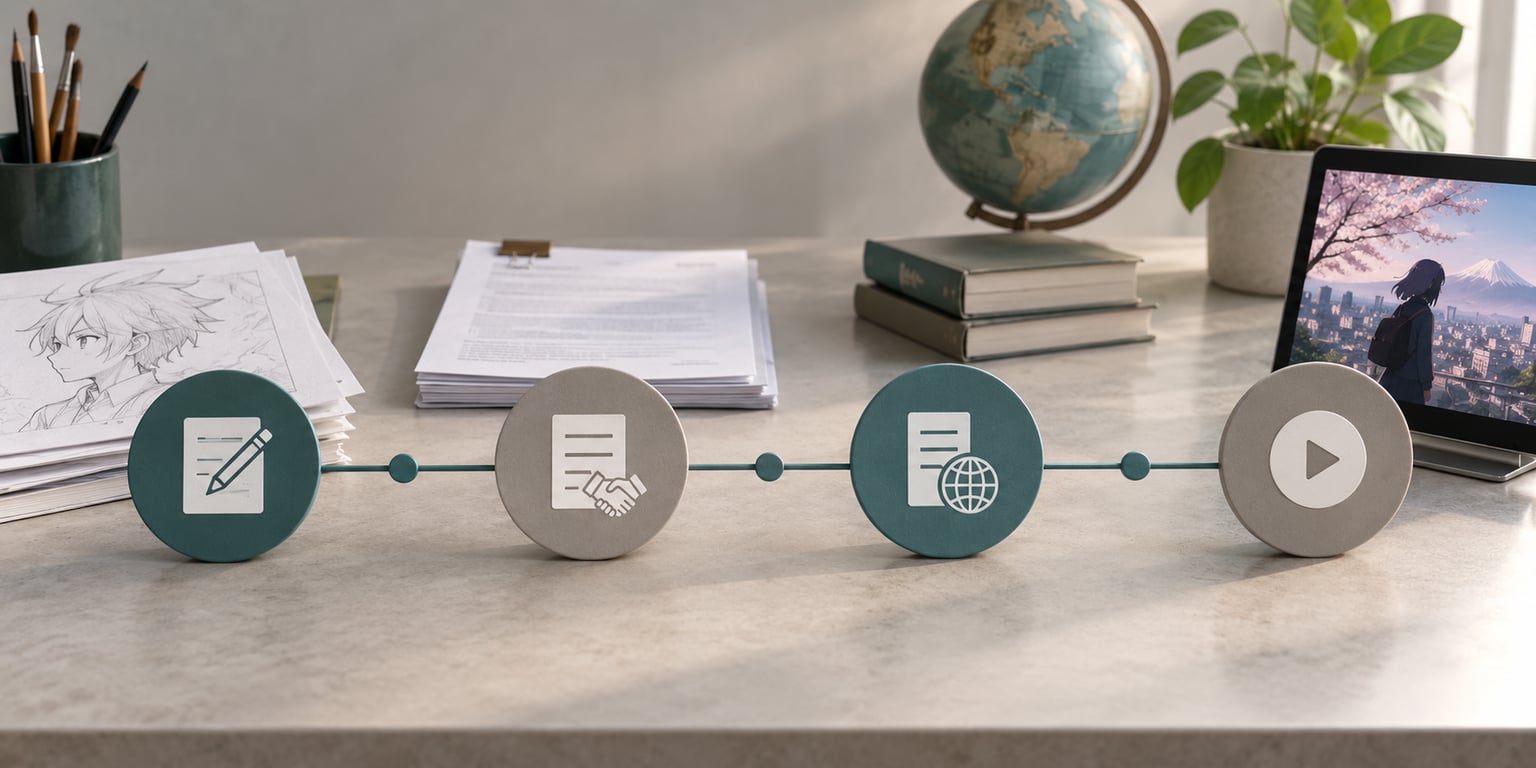
Anime releases are delayed overseas because rights are licensed territory by territory, and nothing ships to another country until a distributor there has negotiated those rights, cleared the music, finished the dub or subtitles, and scheduled the title on its own calendar. On top of that sit unfinished episodes, local content rules, and platform programming decisions.
The frustrating part is that almost none of this is a production problem. The show is usually finished and sitting on a hard drive in Tokyo months before anyone outside Japan can watch it legally. What you are waiting on is paperwork, translation and a marketing plan.
Table of Contents
- 1Why Anime Releases Are Delayed Overseas: The Main Causes
- 2What Does an Overseas Anime Release Involve?
- 3How Licensing Affects Why Anime Releases Are Delayed Overseas
- 4What territory-specific rights mean for one series
- 5Why Production and Mastering Dates Matter
- 6How Dubbing, Subtitles, and Localization Add Time
- 7Why Censorship and Local Reviews Can Cause Delays
- 8How Streaming Launch Schedules Affect Release Dates
- 9How Long Do Overseas Anime Releases Usually Take?
- 10How Can Viewers Find the Legitimate Release Date?
- 11What Is a Release Delay and What Is a Distribution Problem?
- 12Frequently Asked Questions
- 13Why do some anime episodes arrive overseas later than the Japanese broadcast?
- 14Are overseas anime releases always delayed for dubbing and subtitles?
- 15Why are only some episodes available on an international streaming service?
- 16Can territorial licensing prevent an anime from streaming in a particular country?
- 17Is a shorter delay between the Japanese and overseas releases always better?
- 18Conclusion
Why Anime Releases Are Delayed Overseas: The Main Causes
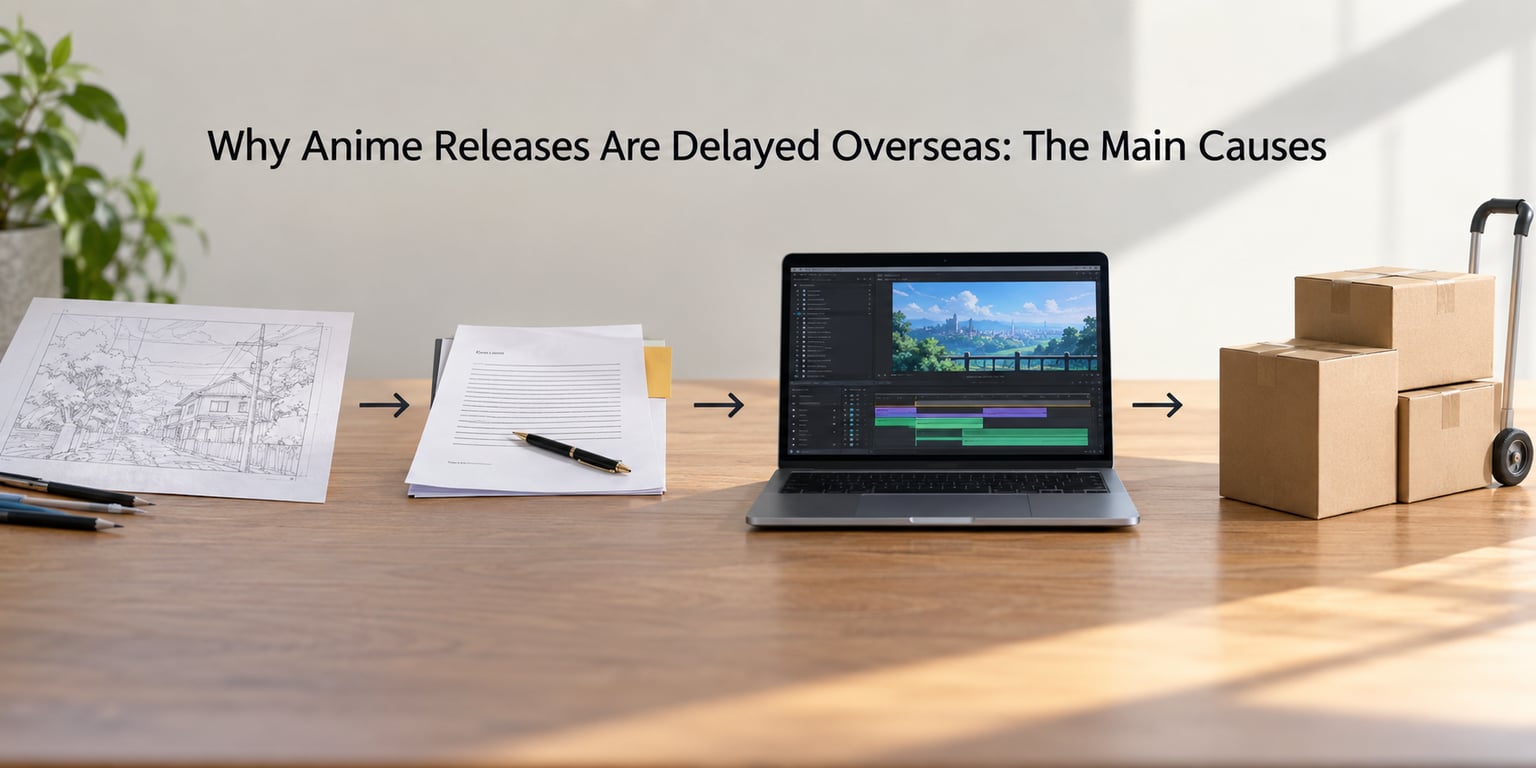
There is no single reason, and treating it as one leads to bad conclusions. A title can be delayed by any combination of the following, and the mix changes completely from one series to the next.
- Territorial rights have to be sold separately. Nobody owns “the rights” to an anime outright. A committee of companies funds it, and those companies license different territories to different buyers, on different timetables.
- Music and third-party clearance is not instant. Opening and ending themes, licensed tracks and sponsor material can hold up a delivery until usage permission is confirmed in writing.
- Localization is a production job. A dub needs scripts, voice recording, editing, mixing, proofreading and quality control. Subtitled versions need translation, timing and a review pass.
- The episode has to be finished first. Airing in Japan does not mean a final cut exists. Corrections, redraws and quality checks keep running after broadcast.
- Someone has to decide it is worth releasing. A title only gets an overseas release if a distributor expects to earn something back, and that judgement is made territory by territory.
- Local rules and platform scheduling apply. Broadcast age ratings, sponsor requirements, content codes and a streaming service’s quarterly programming all set the final date.
What Does an Overseas Anime Release Involve?
Overseas distribution is simply the movement of a finished work out of Japan and into another market. The arrangements differ enough that people often use the word loosely for five different things.
Japanese broadcast is the original television run in Japan, usually late at night, and it is the premiere for most of the world. Simulcast means an episode reaches international streaming services within hours of the Japanese broadcast, which only works when the rights are already cleared for those regions.
Licensed streaming release means a platform has bought territory rights and puts the show in its catalogue, usually with a subscription and sometimes only in selected countries. Home video release is the Blu-ray and disc edition, which needs finished masters and manufacturing lead time. Television syndication is the older route where a network buys the show for broadcast, and it is where age ratings and sponsor rules do the most damage to the cut.
How Licensing Affects Why Anime Releases Are Delayed Overseas
Licensing is the single biggest source of delay, and the reason is structural: the party who wants to show the anime in your country is rarely the party that produced it.
An anime is funded by a production committee, a group of companies that pools money and shares the commercial risk. A television station that commissioned the series usually holds broadcast rights, a publisher may hold print and merchandising rights, and a music company holds the soundtrack. Overseas streaming, home video and theatrical rights are sold off separately, sometimes to the same company, sometimes to three rivals who will not cooperate with each other.
Those agreements carry conditions. Exclusivity clauses can block a faster partner from taking the title, and a licence signed with one platform can mean nothing else can carry it for a fixed period. A distributor also needs enough runway to recover what it paid, which is why short broadcast windows and late home video dates often go hand in hand.
What territory-specific rights mean for one series
The same anime can air in one country on a Monday, appear in another on a streaming service three months later, and be withdrawn entirely in a third because no rights were ever sold there. That is not a malfunction. Nobody licensed it, so nobody is obliged to show it.
Why Production and Mastering Dates Matter
Japanese broadcast dates are air dates, not delivery dates. A late-night slot will happily start an episode that is ninety percent finished, and the remaining ten percent is corrected over the following weeks.
Once the final cut is locked, the master file has to be prepared for export. That means a check of picture and sound, compliance with the specifications of whichever platform or pressing plant receives it, and often a region-specific version with edited material. Broadcast masters and streaming masters are not always the same file, and a network version can carry different credits and a different cut from the one a streaming service receives.
Concours-style corrections and quality checks mean an episode can change after it has aired. If a distributor insists on the final version, the delivery schedule moves back by weeks, not days.
How Dubbing, Subtitles, and Localization Add Time
Localization is the slowest part of the pipeline because it is a small production, run to deadlines, with people who need to be booked.
A subtitled version needs translation, adaptation of idioms and honorifics, timing against the finished cut, typesetting, and two rounds of review from the licensor and the original creators. Anyone who has watched a subtitled episode credits itself for how long a scripted line was left on screen; that padding is the visible trace of negotiation over translation choices.
A dub is heavier. Scripts are adapted rather than translated, voice actors are cast and recorded in a studio, the sessions are edited and mixed, and the result is checked for lip sync, length and consistency. Studios book capacity months ahead, so a dub that has not been commissioned when the show airs will not exist when the show is ready to sell. The original creator often has approval rights over a dub script, which adds a feedback cycle nobody can schedule around.
Why Censorship and Local Reviews Can Cause Delays
Content review is not one global process. It varies by platform, by country and by whether the release is a broadcast, a stream or a disc, and a cut acceptable in one market can be unacceptable in another.
Streaming services apply their own standards, which may require edits or a different age rating. Broadcasters work to national classification rules and often to sponsor guidelines, which can force changes to specific scenes. Merchandise tie-ins add another layer, since sponsor visibility is sometimes tied to what appears in the cut.
Each of these reviews is a gate someone has to pass. When a title needs approval in several territories, the release waits for the slowest one rather than the fastest.
How Streaming Launch Schedules Affect Release Dates
Even with every right cleared and every master delivered, a platform may not release the show the day it is ready. Catalogue acquisitions are planned, not impulsive.
Some titles are held for a quarterly announcement. Some arrive as a full-season batch rather than episode by episode. Some stagger availability, dropping a few episodes a week because a weekly slot carries a licence fee that a batch does not. A few launch after Japanese broadcasting has already finished, and occasionally a licence is picked up years later and released with almost no announcement at all.
None of that is a delay in production. It is a delay in scheduling, and it is the reason a fully aired series in Japan can still be new on a streaming service in your country months later.
How Long Do Overseas Anime Releases Usually Take?
There is no standard delay, which is the honest answer to anyone expecting a fixed number. The range below reflects typical arrangements rather than guarantees, and the same title can sit at opposite ends of it depending on the deal.
| Release arrangement | What has to happen first | Typical wait after the Japanese premiere |
|---|---|---|
| Simulcast streaming | Streaming rights pre-cleared for those regions, broadcast master delivered | Hours to a couple of days |
| Licensed streaming, catalogue drop | Territory licence signed, subtitles finished, platform schedule slot | One to six months |
| Staggered weekly streaming | Everything above, plus a weekly slot the platform wants | Same as above, spread across the season |
| Home video release | Disc master prepared, subtitling or dub completed, manufacturing lead time | Three to nine months |
| Theatrical film, subtitled | Film finished, licence, theatrical bookings, subtitled print | Several months to over a year |
| Television broadcast | Network buy, classification review, sponsor and standards approval | One to three years |
Read the table as a range of normal, not a promise. A title licensed years after broadcast and dropped onto a service with no dubbing tradition will break every row in it at once.
How Can Viewers Find the Legitimate Release Date?
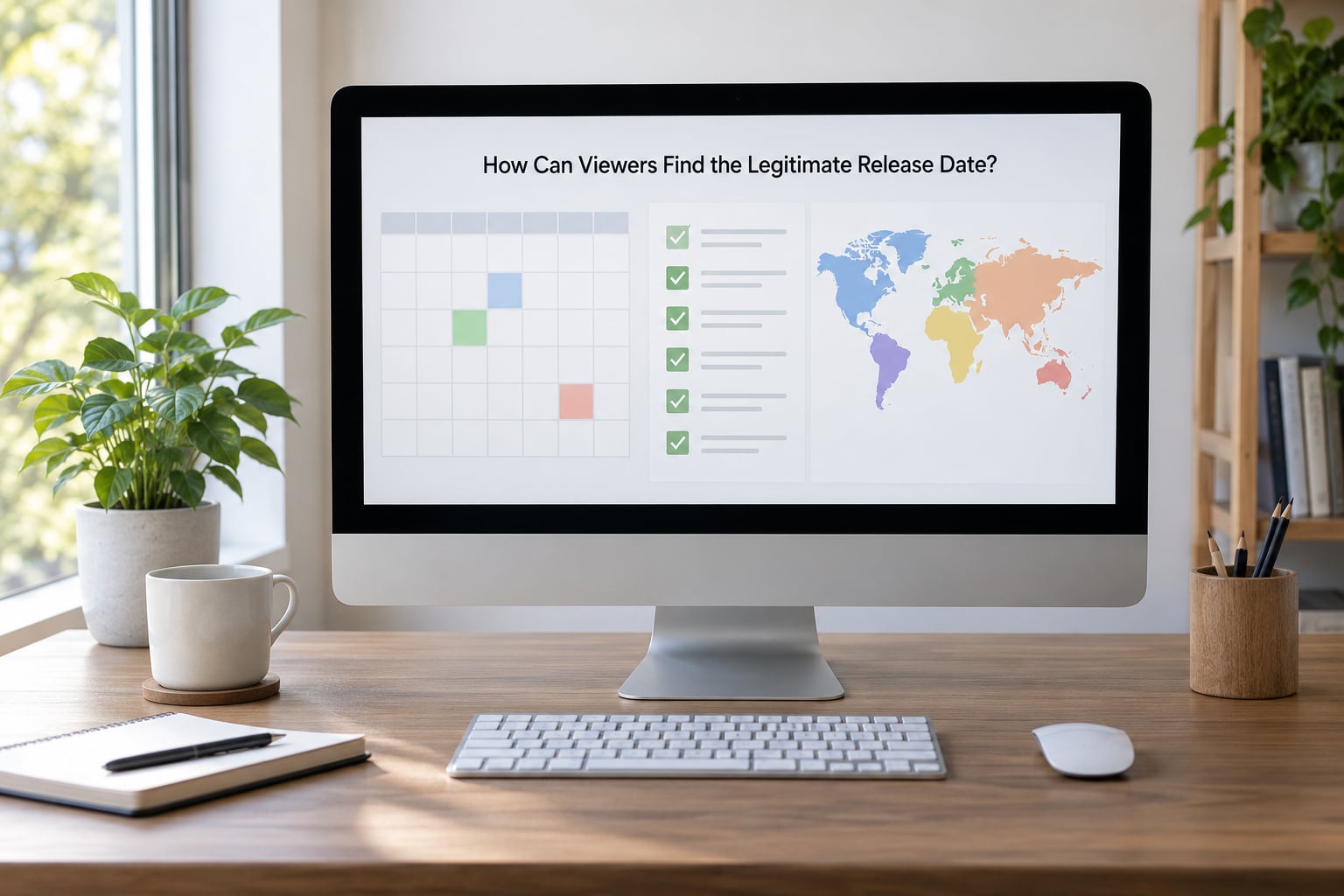
The reliable answer is the title’s own release page, not an upload listing. A date you found on an unofficial site tells you when someone uploaded a copy, which is not a schedule anyone agreed to.
Work through it in this order. Check the official announcement from the studio or publisher for the licence, then check the platform’s own episode list for your specific country, since availability pages differ by region. If a service shows the series in its catalogue but not in your location, that is a rights gap, not a bug.
Finally, remember that pages get updated. A date you saw last month may be revised in 2026 as schedules move, so re-check the platform page closer to the date rather than trusting an old screenshot or a saved announcement.
What Is a Release Delay and What Is a Distribution Problem?
A release delay is planned. The title is coming, the date is being worked towards, and the pipeline is full of people whose job depends on the next stage finishing on time.
A distribution problem is unplanned, and it looks different. The typical signs: a title announced as licensed that never appears in any store or catalogue, episodes missing from a season, a series playable in one country and absent in yours, a service that quietly removes a title, or repeated playback failures after a rollout. None of those are a schedule, and none will resolve by waiting.
So the honest diagnostic is simple. If the platform has published a date and keeps updating it, you are looking at a normal overseas delay caused by licensing, localization and scheduling. If there is no date, no licence announcement, and no catalogue entry in your region, the problem is a rights gap and waiting will not fix it.
Frequently Asked Questions
Why do some anime episodes arrive overseas later than the Japanese broadcast?
Because the international version often does not exist when Japan airs. A distributor needs territory rights, a finished master, subtitles or a dub, and clearance for music and third-party material before an episode can be shown abroad. Simulcasts skip most of that only when the rights are already pre-cleared for those regions, which is why some titles arrive within hours and others take months.
Are overseas anime releases always delayed for dubbing and subtitles?
No. A subtitled streaming release needs translation, timing and a review pass, which is quicker than a full dub but still takes weeks. Dubs are slower because they require casting, studio recording, editing, mixing and creator approval of the script. Some titles are licensed subtitled-only and never get an English dub at all, since dubbing only makes commercial sense on a home video edition.
Why are only some episodes available on an international streaming service?
Usually because the service is still waiting on masters rather than because it chose to hold episodes back. Japanese broadcast runs ahead of final delivery, and a platform releases what it has received while later episodes finish correction and mastering. Some services also stagger episodes across a weekly slot. A batch drop of a whole season usually means every master arrived together, not that the rest were withheld.
Can territorial licensing prevent an anime from streaming in a particular country?
Yes, and it is more common than most viewers realise. Overseas streaming, broadcast, home video and theatrical rights are sold separately by territory, so a title can be licensed for North America and Europe while nothing is sold in Australia or Southeast Asia. A catalogue page may appear in search results and still refuse playback in your location, which means the rights simply were never granted there.
Is a shorter delay between the Japanese and overseas releases always better?
Not necessarily. A very short gap usually means the Japanese run was near-complete, which correlates with a production that was behind schedule to begin with. It can also mean subtitles were rushed through a single review pass. A two or three month wait is the ordinary rhythm of localization, dubbing and scheduling, and a well-made subtitled release with proper review is usually worth more than an immediate one.
Conclusion
Start with the title’s own release page in your country, not a general announcement or an upload listing. If a date exists, the delay is ordinary paperwork and you know when to check back. If nothing is listed and no licence was ever announced, the honest answer is that no one has bought the rights for you, and no amount of waiting changes that.