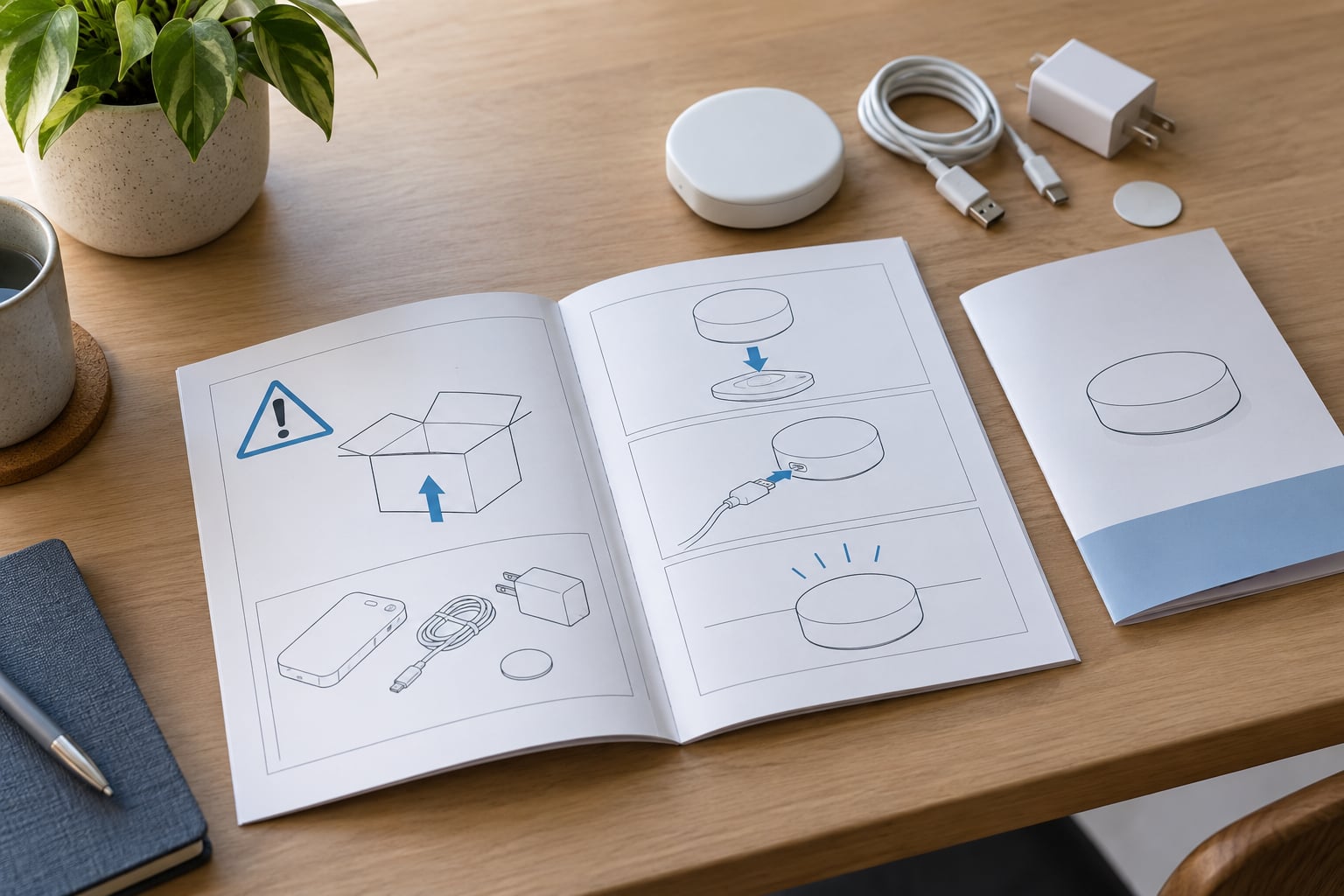
A Japanese instruction manual, written 取扱説明書 (torisetsu shō), is a short, heavily illustrated document built from self-contained sentences, numbered steps, labelled diagrams and prominent hazard symbols, so that a first-time user can finish a task by looking at a picture rather than reading a paragraph of prose. Knowing how Japanese instruction manuals are written means knowing where to look on the page first.
Most people first meet one of these documents at a shop counter in Tokyo, in a product box, or on a workbench where imported equipment has just been installed. The layout feels strange at first: almost no running text, a wall of line drawings, boxes with heavy borders. It is not decoration. Every convention carries a specific piece of information.
The short version
- Text names the part, states the action, warns about the consequence — nothing else.
- Steps are numbered and cross-referenced to figures (図, zu) and tables (表, hyō) rather than described.
- Warnings are colour-coded and fixed in wording: 危険, 警告, 注意, お願い.
- Manuals run short because the page is the interface and the reader is assumed to have no patience, no prior knowledge and possibly poor eyesight.
- A copy of the manual has to ship with the product, which shapes length, print cost and legal review.
- Export versions are localised, not translated literally, so step order and heading names change between markets.
What follows walks through the structure, the language, the symbols and the places where readers most often go wrong. The examples use real terminology with romaji so you can follow even if you read no Japanese at all.
Table of Contents
- 1What Makes Japanese Instruction Manuals Different?
- 2Text is rationed
- 3Steps are numbered, never narrated
- 4Illustrations carry the meaning
- 5Warning language is fixed
- 6Register stays polite but flat
- 7One idea per line
- 8Who actually writes them
- 9How Japanese Instruction Manuals Are Structured
- 10How the Language Is Written for Clarity and Brevity
- 11Sentence rules
- 12Which script does what
- 13Terminology is locked
- 14A short glossary of documentation terms
- 15How Translations Change the Instructions
- 16Subjects come back
- 17Sentences get reordered
- 18Politeness is dropped, urgency is added
- 19Measurements and terms are localised
- 20What gets lost
- 21Machine translation makes it worse
- 22How to Read Symbols, Diagrams, and Numbered Steps
- 23The symbol key
- 24Reading the diagrams
- 25Cross-references are the map
- 26Where the small print hides
- 27What Readers Most Often Misunderstand
- 28Reading order and translation order differ
- 29Model numbers decide everything
- 30Headings look generic
- 31Troubleshooting sections are thin
- 32Prior knowledge is assumed
- 33Assumptions about the reader
- 34Why Manual Design Matters for Products and Users
- 35Safety outcomes
- 36Setup success on the first attempt
- 37Repairability and longevity
- 38Support load
- 39Accessibility, and its limits
- 40The format is changing
- 41Frequently Asked Questions
- 42What are Japanese instruction manuals called?
- 43Why are Japanese manuals so short and full of pictures?
- 44How are Japanese manuals different from Western ones?
- 45Do Japanese products come with English manuals?
- 46How do I read a Japanese manual without reading Japanese?
- 47Are Japanese instruction manuals required by law?
- 48Conclusion
What Makes Japanese Instruction Manuals Different?
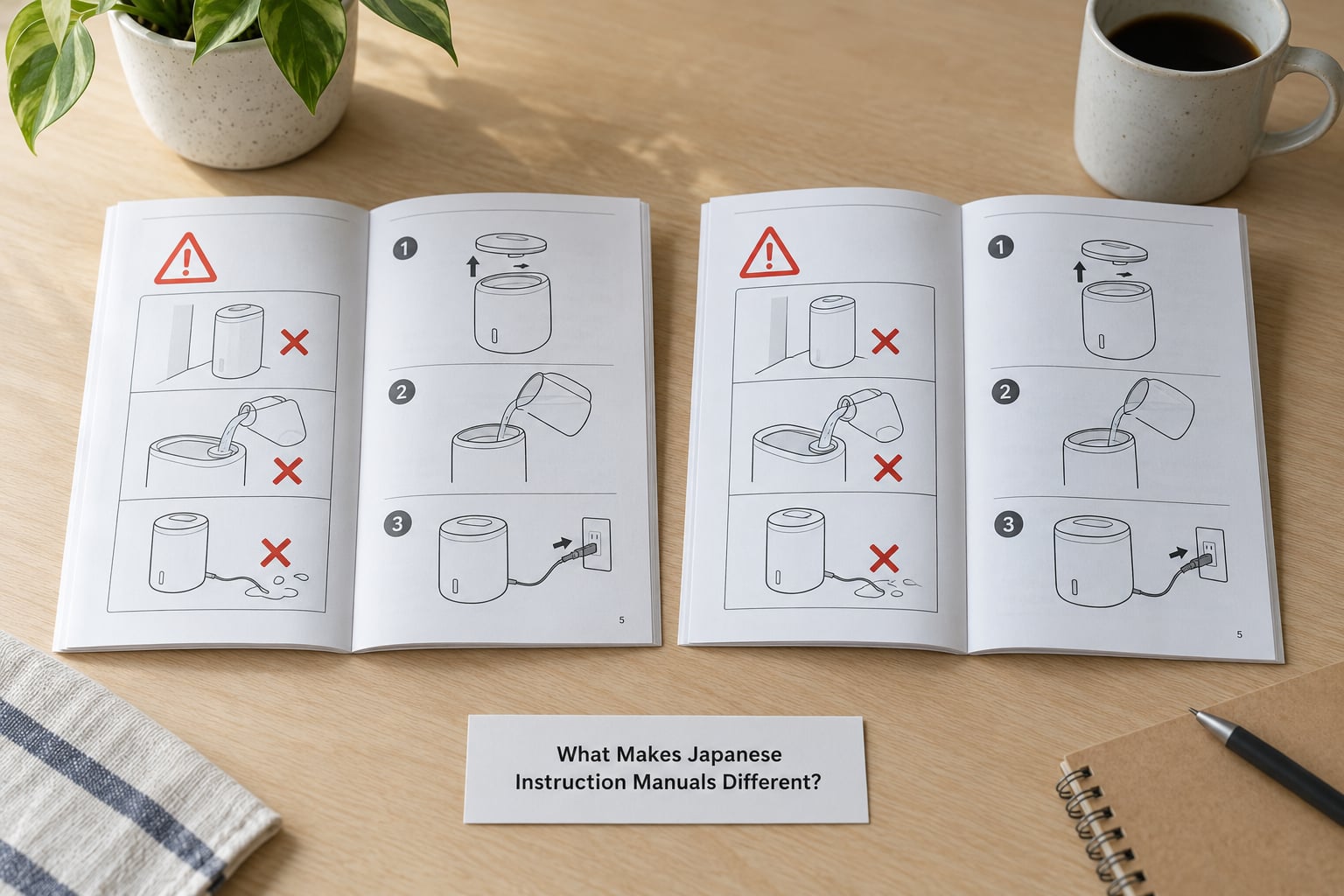
Japanese manuals are written around six conventions, and they show up in almost every document from a rice cooker to an industrial robot controller.
Text is rationed
A typical step gives you one action, one object and one consequence — plug the power plug into the outlet, with no sentence around it. Sentences rarely exceed twenty characters because kanji carry so much meaning per character. Writers aim for a page a reader can scan in seconds, not parse.
Steps are numbered, never narrated
Procedures run as 手順 (tejun), a numbered sequence, often with circled figures ①②③ used inside the text to point at a specific spot in a diagram. Step 2 refers to part 3 in figure 1 rather than describing it again in words.
Illustrations carry the meaning
Exploded-view parts diagrams, isometric cutaways, close-ups of an operation panel. The drawing and the sentence beside it are one unit of instruction, not decoration supporting the text. On a camera manual, a single dial might be drawn larger than a full page.
Warning language is fixed
Hazard wording is not stylistic flourish. Terms such as 危険 (kiken, danger), 警告 (keihoku, warning), 注意 (chūi, caution) and お願い (onegai, request) carry defined severity, and their placement in a bordered box is part of the standard.
Register stays polite but flat
Manuals mostly use the です/ます form, the polite register, stripped of warmth. Keigo (polite language) appears in a few stock phrases, but the tone is closer to a checklist than to a customer service script.
One idea per line
Layout and language agree on this. Each line carries a single action or fact, which is why Japanese technical writing often mandates one sentence per line — it makes the page readable at a glance and easy to check against a diagram.
Who actually writes them
Larger manufacturers run in-house documentation departments with technical writers who draft, illustrate and review manuals full time. Smaller companies hand the job to a specialist agency or to a staff engineer with a template. Either way, a draft goes through engineering review, then safety and legal review, then a proof read by someone who has never used the product.
How Japanese Instruction Manuals Are Structured
The document order is remarkably stable across categories. Knowing the sequence tells you where to look before you start translating the page in your head.
| Section | Japanese label | What to check there |
|---|---|---|
| Cover information | 表紙 / 取扱説明書 | Exact model number. Everything after this page assumes that number. |
| Safety notices | 安全上のご注意 | Hazard list. Read this before anything else, especially for heating devices and batteries. |
| Parts list | 部品表 / 付属品 | What came in the box, with the number that matches the callout in each diagram. |
| Setup and assembly | 組み立て / 設置 | Ordered steps for first-time setup, usually the longest illustrated sequence. |
| Operating steps | 使い方 / 操作方法 | Normal use, broken into tasks rather than described as a narrative. |
| Cleaning and care | お手入れ / 清掃 | What is safe to wash, and what must stay dry. |
| Maintenance | 保守点検 | Intervals and consumable part numbers. |
| Troubleshooting | トラブルシューティング | Symptom-to-cause table, often less detailed than the equivalent Western page. |
| Specifications | 仕様 / スペック | Numbers, dimensions, power draw, weight. |
| Warranty and support | 保証 / お問い合わせ | Contact route and coverage period. |
Two rules sit behind that structure. First, the manufacturer must supply an original copy of the manual with the product, the 原本正本 (honke shō) requirement, so the document has to be printable, shippable and self-sufficient. Second, manuals sit inside the Japanese Industrial Standards framework (JIS), particularly the JIS Z series on product safety labelling and presentation, which is where the shape of the warning boxes and pictograms comes from.
How the Language Is Written for Clarity and Brevity
The writing style is short by design, and the rules behind it are consistent enough to learn in an afternoon.
Sentence rules
Subjects are dropped whenever the action makes them obvious. Modifiers usually come before the noun they attach to, and the negative or conditional clause often follows the verb. Punctuation is limited, so a line of manual text can look spare to an English reader but still be doing three things at once.
Which script does what
Three writing systems appear on the same page, each with a job.
| Script | Example | Used for |
|---|---|---|
| Kanji | 注意 | Content words, safety terms, headings, part names. Dense meaning per character. |
| Hiragana | を読み込む | Grammar, verb endings, particles that glue a sentence together. |
| Katakana | リモコン | Loanwords: remote control, sensor, menu, brand-derived terms. |
That last row explains why a manual page can feel half-English even to a reader with no Japanese: technical vocabulary arrives as katakana, while the verbs and warnings stay Japanese.
Terminology is locked
Each concept gets one approved term for the life of the product, and it is reused verbatim in the body text, the diagram labels, the troubleshooting table and any web version. Consistency beats elegance here, and it is why Japanese manuals often look repetitive.
A short glossary of documentation terms
These fifteen appear often enough to be worth recognising on sight.
| Japanese | Romaji | Meaning |
|---|---|---|
| 取扱説明書 | torisetsu shō | Instruction manual |
| 取扱指示書 | torisetsu shijisho | Instruction sheet, shorter form for safety-critical goods |
| 取扱注意 | torisetsu chūi | Handling cautions |
| 安全上のご注意 | anzenjō no go-chūi | Safety instructions |
| 危険 | kiken | Danger, highest hazard level |
| 警告 | keihoku | Warning |
| 注意 | chūi | Caution |
| お願い | onegai | Request or note, lowest severity |
| 禁止 | kinshi | Prohibition |
| 必ず | kanarazu | Without fail, mandatory action |
| 図 | zu | Figure, cross-referenced from the text |
| 表 | hyō | Table |
| 手順 | tejun | Procedure, ordered steps |
| 部品 | bubuhin | Part, component |
| トラブルシューティング | toraburu shūtingu | Troubleshooting section |
Note the two forms of politeness. The です/ます style (ですます体) is the default for anything addressed to a user. The である style (である体) is plain and declarative, used in specifications and reference tables where a softer tone would be out of place.
How Translations Change the Instructions
An English manual from the same factory is not a translation of the Japanese one. It is a rewrite produced from the same source material, and the differences are systematic.
Subjects come back
Where the Japanese drops the actor, the English supplies one: “Insert the plug” becomes “Insert the power plug into the outlet.” Restore the implied subject or the step turns ambiguous.
Sentences get reordered
English needs a subject before the verb, so modifiers that preceded a noun in Japanese often move behind it. The Japanese order is more compact precisely because the kanji already implies the relationship.
Politeness is dropped, urgency is added
Keigo has no clean English equivalent, so it is usually cut. Some versions compensate with sharper safety verbs — “must,” “never” — which changes the tone more than a translator realises.
Measurements and terms are localised
Units, plug types, voltages, regional model numbers and local support contacts are replaced. A manual for the same product line can differ by market in the part names alone.
What gets lost
Illustrated density drops first. Export manuals are longer in prose and thinner in diagrams because the illustration package costs more to localise than the text does. A manual that never explains why a step matters also loses that reasoning; Japanese originals often carry a one-line 理由 (reason) under a step, and that line frequently disappears.
Machine translation makes it worse
Feeding a manual through a general translation tool produces fluent-looking English with inconsistent terminology, since no glossary is applied. On a document where one term means the same part across forty pages, that inconsistency is how people end up looking for a part that does not exist. Professional localisation always builds a term base first.
How to Read Symbols, Diagrams, and Numbered Steps
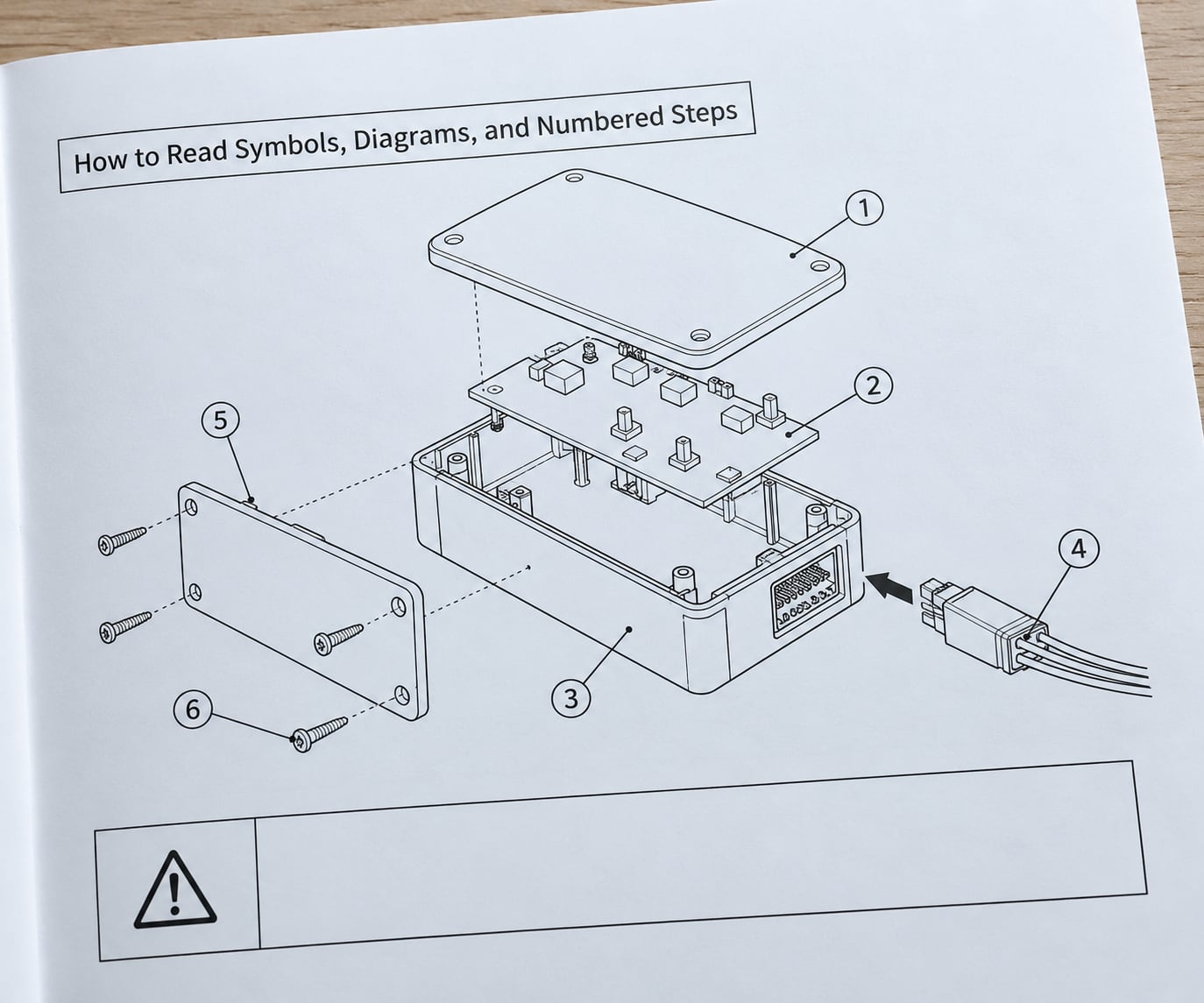
You can read most of a Japanese manual without Japanese by treating the page as a sequence of fixed positions. Work top to bottom: header, figure, numbered callouts, text block, warning box, cross-reference.
The symbol key
Symbols come from a shared pictogram set, so the same shape means the same thing across brands and industries.
| Symbol | Japanese label | Meaning |
|---|---|---|
| Triangle with an exclamation mark | 警告 / 危険 | Warning or danger. The severity depends on the text inside, not the shape. |
| Circle with a diagonal slash | 禁止 | Prohibited action. |
| Circle around a hand or part | 必ず | Mandatory action, must be done as shown. |
| Open book icon | 説明書を読む | Refer to the manual before continuing. |
| Arrows | 向き | Insertion direction, movement direction, airflow or water flow. |
| Circled digits ①②③ | — | Callouts matching the numbered part list and step text. |
| Exploded view | 分解図 | Assembly order, usually read outward from the centre. |
| Cross-section cutaway | 断面図 | Internal layout, showing what is hidden inside the case. |
Reading the diagrams
Line drawings are literal, not perspective-correct, and that helps. The part drawn at the point of your hand is the part you hold. Dashed lines show hidden or internal elements, and a part shown detached in an exploded view is removed and refitted in the numbered order.
Cross-references are the map
When a step says 図2 or 表1, it is pointing at the figure or table with that number. Those references let you skip straight to the one panel you need instead of reading the surrounding page. The text near a diagram names the action; the diagram carries the detail.
Where the small print hides
Warning text is frequently set smaller than the body and boxed in a thin border at the page edge. Anything in a border deserves a read before you power anything up, particularly for lithium batteries, gas appliances and anything with a rotating blade.
What Readers Most Often Misunderstand
Most of the frustration people report comes from a handful of predictable places.
Reading order and translation order differ
Machine translation reorders words into English grammar and loses the visual cue that told you which object the sentence referred to. Working from the diagram forward, rather than from the translated sentence, avoids the problem entirely.
Model numbers decide everything
A manual covers one model, sometimes one region of one model. Instructions, torque values and part numbers change between variants that look identical, and the only signal is the code on the label. Check it against the manual cover before you follow a single step.
Headings look generic
Many manuals use the same three or four headings for every task, so 準備 (preparation) can mean something different in each section. The first numbered step under a heading tells you what the task actually is.
Troubleshooting sections are thin
They list symptoms and one cause each, which reads as a quick fix rather than a diagnostic tree. If your symptom is not listed, the answer is often in the operating section rather than the fault section.
Prior knowledge is assumed
Documents for experienced operators assume you already know what a torque wrench or a balanced load is. Consumer manuals assume less, and industrial ones assume a great deal, which is why the same reading habits do not carry across categories.
Assumptions about the reader
The same page has to work for an eighty-year-old first-time buyer and a technician. Some forums note that the density feels overwhelming when you cannot read the language, because layout alone carries less information than a native reader gets from every sentence. That gap is the honest limit of the illustration-led format.
Why Manual Design Matters for Products and Users
Manual writing is treated as a compliance and engineering function, not a marketing one, which shapes the design in ways readers notice only indirectly.
Safety outcomes
When warning boxes are graded by a standard and reviewed by legal teams, the severity of a hazard is communicated consistently across a product line. That is a safety system, not a stylistic one.
Setup success on the first attempt
A manual that gets a user from box to working state without a support call has measurable value to the manufacturer. Dense illustrations reduce assembly errors precisely because there is no ambiguity to misread.
Repairability and longevity
Exploded diagrams with callout numbers double as a parts map. Someone repairing a device years later can identify a component from the manual that shipped with it, which supports longer product lifespans.
Support load
Every unclear manual generates tickets. Every well-drawn diagram removes some of them, and support cost is the number most product teams actually watch.
Accessibility, and its limits
Large print, high-contrast line art and one idea per line all help older users and anyone reading in poor light. Small warning text and heavy kanji density still work against them, which is a fair criticism of the format.
The format is changing
Printed manuals increasingly shrink to a setup insert plus a QR code, with the full document hosted online and updated after the box was sealed. The writing conventions mostly survive the move, but troubleshooting content is where the web version gains the most.
Frequently Asked Questions
What are Japanese instruction manuals called?
They are called 取扱説明書 (torisetsu shō), which covers most consumer and industrial products. Shorter documents for safety-critical goods are labelled 取扱指示書 (torisetsu shijisho). Related labels you will see on the same page include 取扱注意 for handling cautions and 安全上のご注意 for the safety notice block. A copy of the manual must ship with the product, a rule referred to as the 原本正本 requirement.
Why are Japanese manuals so short and full of pictures?
Because the page is the interface. A manual is small, printed cheaply, and read by people who have no patience and no prior knowledge, so each line carries one action and each diagram carries the detail. Manufacturers must also supply a physical copy with every unit, which puts a hard ceiling on page count. Kanji compress meaning, so short sentences lose very little.
How are Japanese manuals different from Western ones?
A Japanese manual spends far more of its area on line drawings and far less on running prose. Steps are numbered and cross-referenced to figures (図) and tables (表) rather than described in paragraphs. Warning wording is graded and fixed, using 危険, 警告, 注意 and お願い in defined boxes. Export versions add back subjects, lengthen sentences and thin out the illustrations during localisation.
Do Japanese products come with English manuals?
Often, but not always. Export models usually ship with a localised English manual, and some products sold in Japan carry Japanese only. Manufacturers treat the Japanese document as the master and build the export version from the same source material, so it is a rewrite rather than a word-for-word translation. Searching the model number plus the brand name usually finds a downloadable manual in another language.
How do I read a Japanese manual without reading Japanese?
Start at the parts list (部品表) and match its numbers to the exploded diagram. Then find the numbered step that performs your task and follow the callouts in order, since text and diagram are one unit of instruction. Check the warning boxes along the page edge before applying force or power. Finally, confirm the model number on the manual cover matches the label on your device, because instructions differ between variants.
Are Japanese instruction manuals required by law?
The manual has to be supplied with the product, a requirement known as 原本正本, and its content has to satisfy consumer product safety regulation. Warning phrasing and pictogram presentation follow conventions set out in Japanese Industrial Standards, particularly the JIS Z series on product safety labelling. The exact legal detail varies by product category, so the manual for a specific appliance is the authority for that appliance.
Conclusion
Japanese instruction manuals are written the way they are because the page has to do the work, not the prose. Short sentences, one idea per line, numbered steps tied to labelled diagrams, and graded warning boxes all point the same way: find the diagram, find the numbered callout, follow the arrow.
When you open one, check four things before anything else. Confirm the model number on the cover matches your device. Read the safety block (安全上のご注意) end to end. Find the parts list (部品表) and match it to the exploded diagram. Then locate the numbered step for your task and follow the callouts rather than translating the sentence around it. That sequence works whether the manual is in Japanese, in English, or in the usual mix of the two, and it holds up as more manuals move to a QR-linked web page.