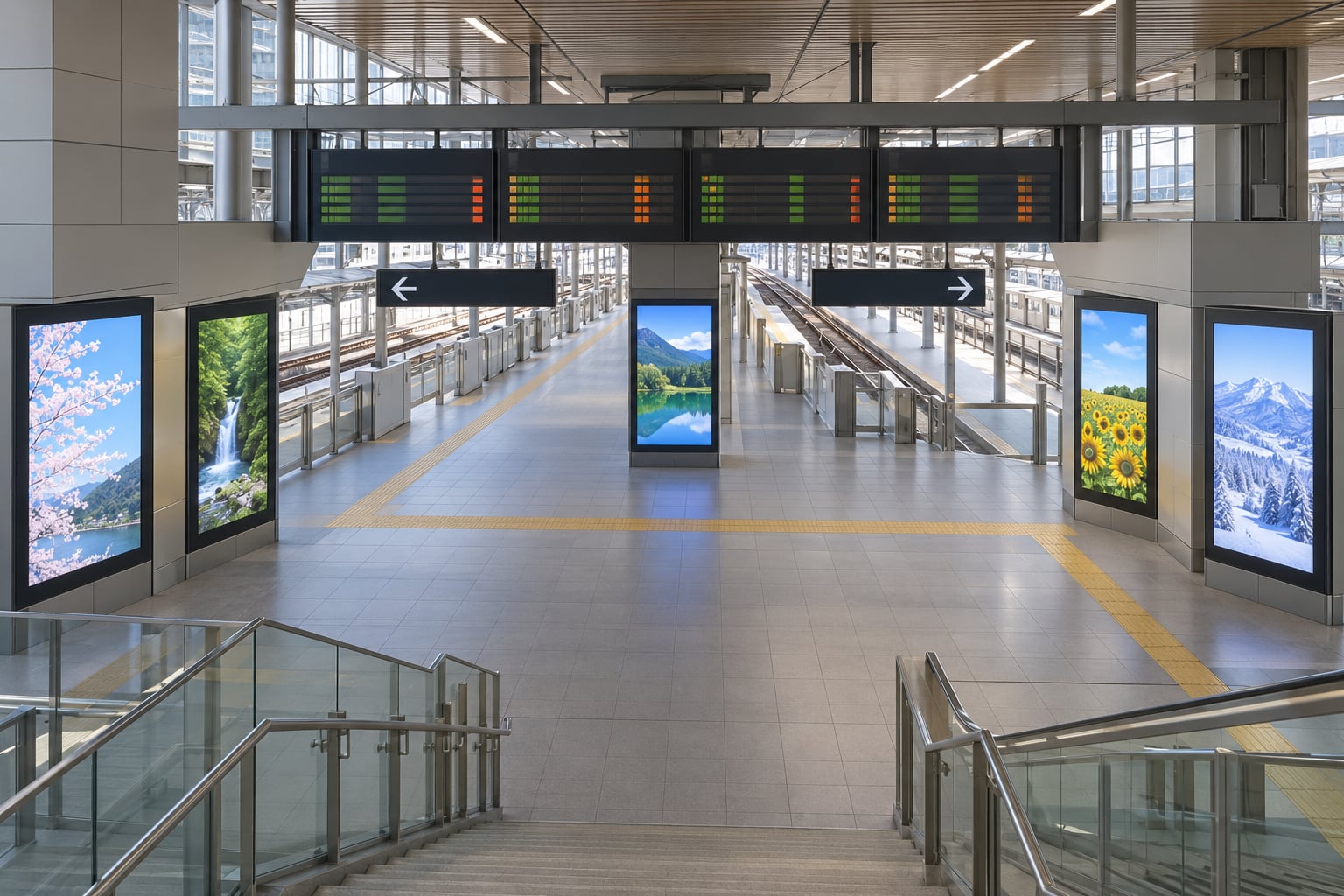
Japanese train stations have so many screens because each one is doing a job: telling you which platform your train leaves from, getting you through an interchange, warning you when the network has broken down, or selling to you while you wait. Every major operator runs all four on hardware it owns.
The scale helps explain it. Tokyo handles roughly eight million rail trips a day, and around 57 percent of trips in Tokyo Prefecture are made on public transport, with about 80 percent of those by train. Stations like Shinjuku and Ikebukuro are not transport stops so much as enclosed public squares where several railway companies share one concourse.
Table of Contents
- 1Why Japanese Train Stations Have So Many Screens
- 2A captive audience with nowhere else to look
- 3The network is genuinely complicated
- 4The information was built for visitors who cannot read Japanese
- 5It is a business
- 6What Kinds of Screens Appear in Japanese Train Stations
- 7How the Screens Help Passengers Find the Right Train
- 8What Each Screen Type Is Used For
- 9How Do Screens Support Safety and Emergency Response?
- 10Why Are There So Many Advertisements?
- 11Why Do Screens Look Different Across Stations?
- 12How Do Train Information Systems Stay Consistent?
- 13Frequently Asked Questions
- 14Why do Japanese train stations have so many digital screens?
- 15Are the screens mainly for advertising or passenger information?
- 16Do Japanese station screens display information in English?
- 17Why can different screens in the same station show different platform information?
- 18How do screens help during earthquakes or train disruptions?
- 19Are all screens operated by the same railway company?
- 20What to Notice First in a Japanese Station
Why Japanese Train Stations Have So Many Screens
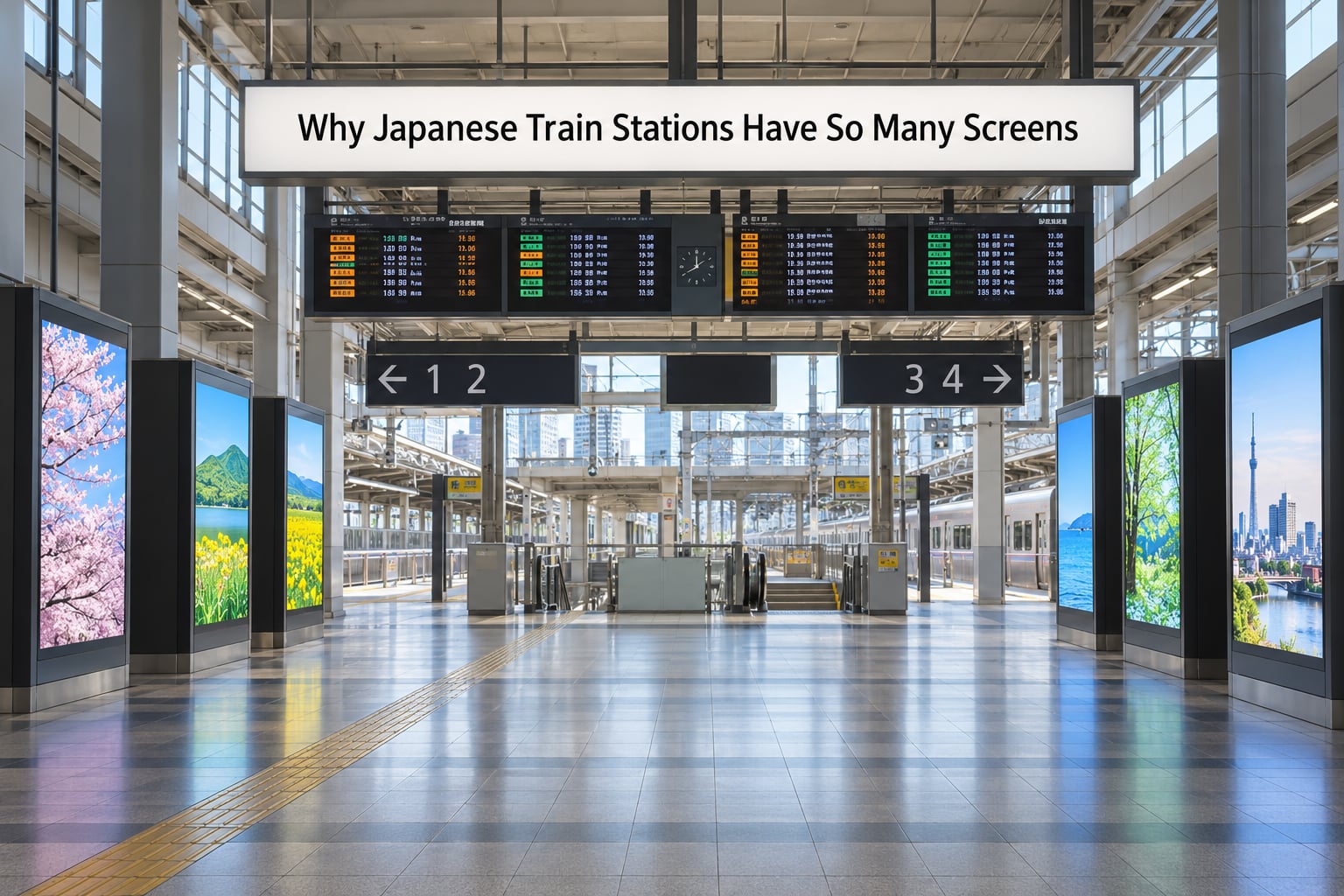
Four forces push the count up, and none of them is decoration. Once you see them separately, the density stops looking like clutter and starts looking like infrastructure plus a media business sharing the same walls.
A captive audience with nowhere else to look
A typical commuter in Tokyo spends an hour getting to work and an hour getting home, most of it standing or sitting in stations and trains. A Japanese commute is long enough that a screen is read rather than glanced at, which is exactly the condition media buyers look for.
It also explains a detail regular riders mention: people genuinely fall asleep on trains and in waiting rooms. A screen that never stops changing is a better thing to sit next to than a blank wall.
The network is genuinely complicated
A single station can serve several unrelated operators on stacked levels. Shinjuku handles on the order of three million passenger movements a day across JR lines, metro lines and private railways, and Ikebukuro is similar in character.
Because a concourse may be several floors tall with platforms at both ends, no single board can be seen from everywhere. Operators solve that by repeating the same information on multiple screens at different heights and angles, so wherever you are standing, one of them is in your eyeline.
The information was built for visitors who cannot read Japanese
Station design in Japan has been pushed toward legibility for decades, starting with the pictogram language developed for the 1964 Tokyo Olympics. Tokyo Metro introduced station numbering in 2004, and by the time of the 2020 Games, station numbering and multilingual signage had been rolled out across the major network.
The intent was simple: a visitor who reads no Japanese should still be able to find a platform, follow a line colour and reach a transfer. Screens are the live half of that promise.
It is a business
Advertising is the fourth reason, and the one that shapes the numbers most visibly. Operators sell station media through dedicated subsidiaries such as Tokyo Metro Ad Agency, and digital out-of-home inventory is priced by measured impressions rather than by static poster space.
LIVE BOARD, for example, sells a network of 26 screens at Seibu Ikebukuro station built from 86-inch 4K LCD units, with audience measured by camera rather than estimated. Operators also face direct pressure to raise non-fare revenue: Osaka Metro was privatised in 2018, and Tokyo Metro has an initial public offering planned for around April 2027.
What Kinds of Screens Appear in Japanese Train Stations
The vocabulary is worth learning because it is where visitors get stuck. In Japanese, the departure board is a hatsubaishō (発車標), and the mechanical split-flap boards still seen on local and regional lines are 翻表示, often called Janus displays in English.
| Screen type | Where you meet it | What it shows | Who pays for it |
|---|---|---|---|
| Departure board (hatsubaishō) | Concourse ceilings and platform areas | Time, destination, platform, stopping pattern, train type | Railway operator, information feed |
| Split-flap board (翻表示) | Local and regional stations | Rolling rows of destinations and times | Operator, retained where footfall is low |
| Platform indicator | Along the platform edge or overhead | Platform number, arriving train, carriage position | Operator |
| Gate display | Above the ticket gates | Which gates to use, IC card and fare guidance | Operator |
| Service alert display | Anywhere in the station | Delays, suspensions, earthquake and evacuation messages | Operator, mandatory public service |
| Advertising screen (DOOH) | Gates, corridors, elevator lobbies | Full-motion commercial creative | Media owner selling impressions |
| In-car monitor | Above train doors and in saloons | Next stop, channel, campaigns | Operator and in-train media sales |
| Ticket machine panel | Vending machines | Fare search, route and ticket purchase | Operator |
Only the first five are information screens. Everything in that table from the advertising row down exists because someone is selling space or attention.
How the Screens Help Passengers Find the Right Train
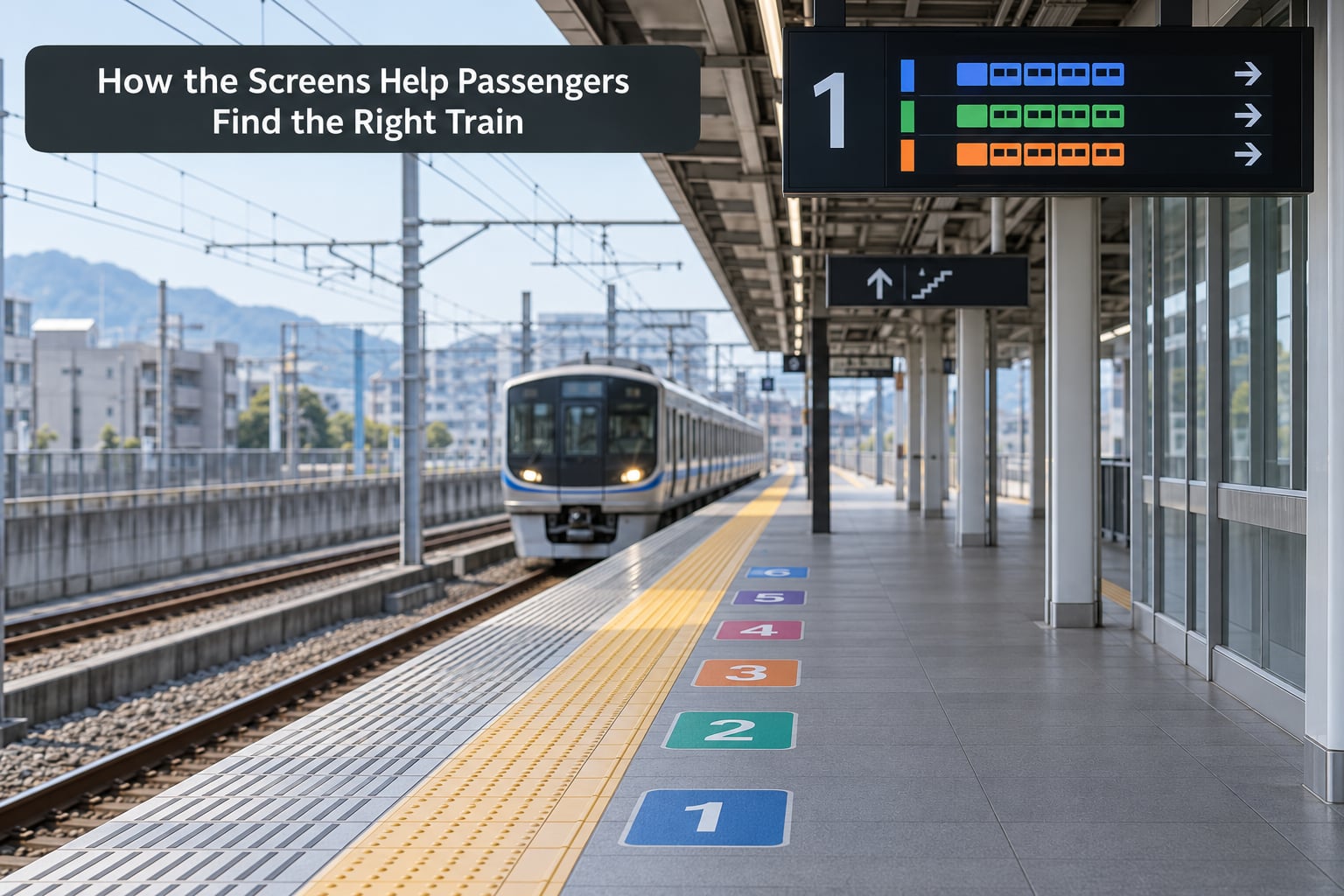
The point of repeating information is that each screen answers one decision. Standing under a concourse board, you learn which train goes where and when. Walking down to the platform, the indicator confirms the platform number. Waiting at the yellow line, the carriage-position markers tell you where to stand so you are near a door when the train stops.
What Each Screen Type Is Used For
A departure board gives you the whole picture at once: several trains at a time, each with its time, destination, stopping pattern and platform. Next-train indicators near a corridor or stairwell show a smaller list, usually just a few upcoming services, because you have already chosen a direction and only need the next one.
Platform signs narrow it further. They confirm the number, show the train forming your service, and often mark where a particular carriage will stop, which matters if you are travelling with a bicycle, a wheelchair or a large bag.
Ticket-gate displays handle the last step. They tell you which gate is serving your train at a busy station, and during disruptions they carry the notice about which gate is closed and where to go instead.
Advertising screens have no role in that chain, even when they sit directly above the information. Learning to separate them by content rather than by position is most of what it takes to stop feeling overwhelmed.
How Do Screens Support Safety and Emergency Response?
Safety messaging is a first-class use of the same hardware, not an afterthought. Japan’s rail operators run earthquake early warning, and when it triggers, information displays across the station switch to service status and instructions. Passengers are trained to stop, not run, and the displays carry that message in several languages.
Disruption is the routine version of the same job. Trains run frequently and tightly coupled, so a delay at one station propagates. A suspended line or a track fault means every board in the building needs new information within seconds, which is why delay notices occupy a dedicated category on virtually every screen rather than scrolling past.
Smaller safety uses include door warnings, platform screen door announcements, and emergency exit guidance in several languages. Train enthusiasts have documented the failure modes too: boards that crash or stay locked on a stale time are a recurring complaint on rail forums, and when they happen, the station falls back on printed notices taped to the gates.
Why Are There So Many Advertisements?
Because a station is one of the few indoor spaces in Japan where a large audience is stationary, unhurried and cannot look away. Digital out-of-home formats suit that condition: they need no poster change, can rotate by time of day, and can be sold against measured audience rather than estimated footfall.
The money has a destination. Advertising and media revenue sit alongside the fare business on the operator’s income statement, and in an era of rising maintenance costs on ageing infrastructure, they cover costs that fares alone would not. A new 86-inch 4K unit at a hub like Seibu Ikebukuro is an expensive asset, and it is only sensible if the ad slots beside it sell.
It is also fair to say this goes too far in places. Loud looping video and audio ads are the most common complaint from residents and visitors on travel forums, and rail enthusiasts describe stations as always something to see, which is affectionate and slightly weary at the same time. Concentration itself is a safety issue: concourses physically cannot hold standing crowds without visual anchors, so some of the screen count exists for crowd management rather than for either information or advertising.
Why Do Screens Look Different Across Stations?
Every station reflects its own conditions. Size and ridership set how much inventory exists. The operator matters, since JR East, Tokyo Metro, Toei Subway and the private railways each run their own feeds and their own ad subsidiaries. The age of the station matters most of all: a postwar suburban platform keeps split-flap boards because replacing them with LEDs would not pay for itself at that footfall, while a rebuilt interchange is essentially a new retail and media environment.
Layout shapes it too. Long corridors and stacked levels need more repeated boards. Narrow platforms can only take a strip of indicators along the edge. And where concourse space is rented out to shops, the ad screens tend to shrink.
| City | Information approach | Advertising density |
|---|---|---|
| Tokyo | Multiple operators, station numbering, line colours, repeated boards at every decision point | Very high, often integrated into the same housings as information |
| London | Line-name identity with countdown-style displays, fewer repeated boards | Growing on newer lines, traditionally on platforms and escalators |
| Paris | Legacy mechanical boards replaced largely by LCD, heavier reliance on printed and audio information | Modest, concentrated at the largest stations |
| New York | Station name and countdown displays, with information carried more by audio and apps | Platform and in-car, less integrated with wayfinding |
Tokyo is unusual less because it advertises more than everywhere else and more because it fuses advertising with information into single, repeated hardware instead of keeping them apart.
How Do Train Information Systems Stay Consistent?
Each operator runs one operational system for trains, and every information screen at that station is a display attached to it. Signalling and train control know where each service is and where it is booked to berth, so a platform assignment or a delay update propagates from one source to every board, the station announcements and the operator’s own app at the same time.
Third-party apps such as ekitan, Navitime and Google Maps read the same kind of feed and present it on your phone. That is useful for planning before you leave home. It is not a substitute on the platform, because phones are awkward in a crowd, batteries run down, and you want the answer in front of you rather than in a pocket.
When screens do disagree, the difference is usually timing. A board at the far end of a concourse may be a second or two behind the one at the gate, and a printed notice taped up next to a working LED board usually reflects a decision made minutes earlier. Trust the largest, closest, most recently updated display, and check the operator’s app if two of them conflict.
Frequently Asked Questions
Why do Japanese train stations have so many digital screens?
Four pressures drive the number: commuters spend a long, stationary time in stations; the network is layered and multi-operator so information has to be repeated at every decision point; signage was standardised from the 1964 Olympics onward so visitors could travel without reading Japanese; and operators sell advertising space on the same hardware. Information and commercial display simply share the concourse.
Are the screens mainly for advertising or passenger information?
Both, in roughly equal measure in a big hub, and they are usually side by side. Information screens carry departures, platforms, delays and emergency notices. Advertising screens sit at gates, corridors and elevator lobbies and are sold by the operator’s media subsidiary. Learning to read content rather than position is what stops the two from blurring together.
Do Japanese station screens display information in English?
On major lines and in stations built or rebuilt for the 2020 Games, yes, usually English with Chinese and Korean added. Older stations are more Japanese-first. Because English coverage is uneven, many visitors navigate by line colour, station numbering, platform numbers and the letter-prefix codes on train names, all of which work without reading Japanese at all.
Why can different screens in the same station show different platform information?
Usually a timing gap rather than a real contradiction. Displays at opposite ends of a long concourse update a second or two apart, and a platform assignment can change when a service is held or rerouted. The largest, closest and most recently updated board is the one to trust, and the operator’s app usually confirms it within seconds.
How do screens help during earthquakes or train disruptions?
The same network that shows departure times switches to alerts. Earthquake early warning triggers station-wide notices with instructions and status, and delays or suspensions push revised departure times onto every board within seconds. Because trains are tightly coupled, one problem affects many services, so disruption information is treated as a permanent category on every display rather than an occasional message.
Are all screens operated by the same railway company?
No. A single interchange can host JR East, Tokyo Metro, Toei Subway and one or more private railways, each running its own information feed and its own advertising subsidiary. On top of those sit media-owned networks sold separately. That is also why English, numbering and layout are not always identical between operators, even inside one building.
What to Notice First in a Japanese Station
Check the largest overhead departure board first. It tells you the train, its time, its destination, its platform and whether it stops everywhere, which is the information you need before anything else.
On the way down, confirm the platform indicator and the carriage position markers so you are standing where you will not have to shove. Then look for anything in a different colour or with an alert symbol, because that is a delay, a suspension or a safety notice and it changes your plan.
Treat the advertising as background. It is there because the wait is long and the audience is captive, and in a station this dense that combination is a commercial asset as much as it is an information system.
Last updated: October 2026