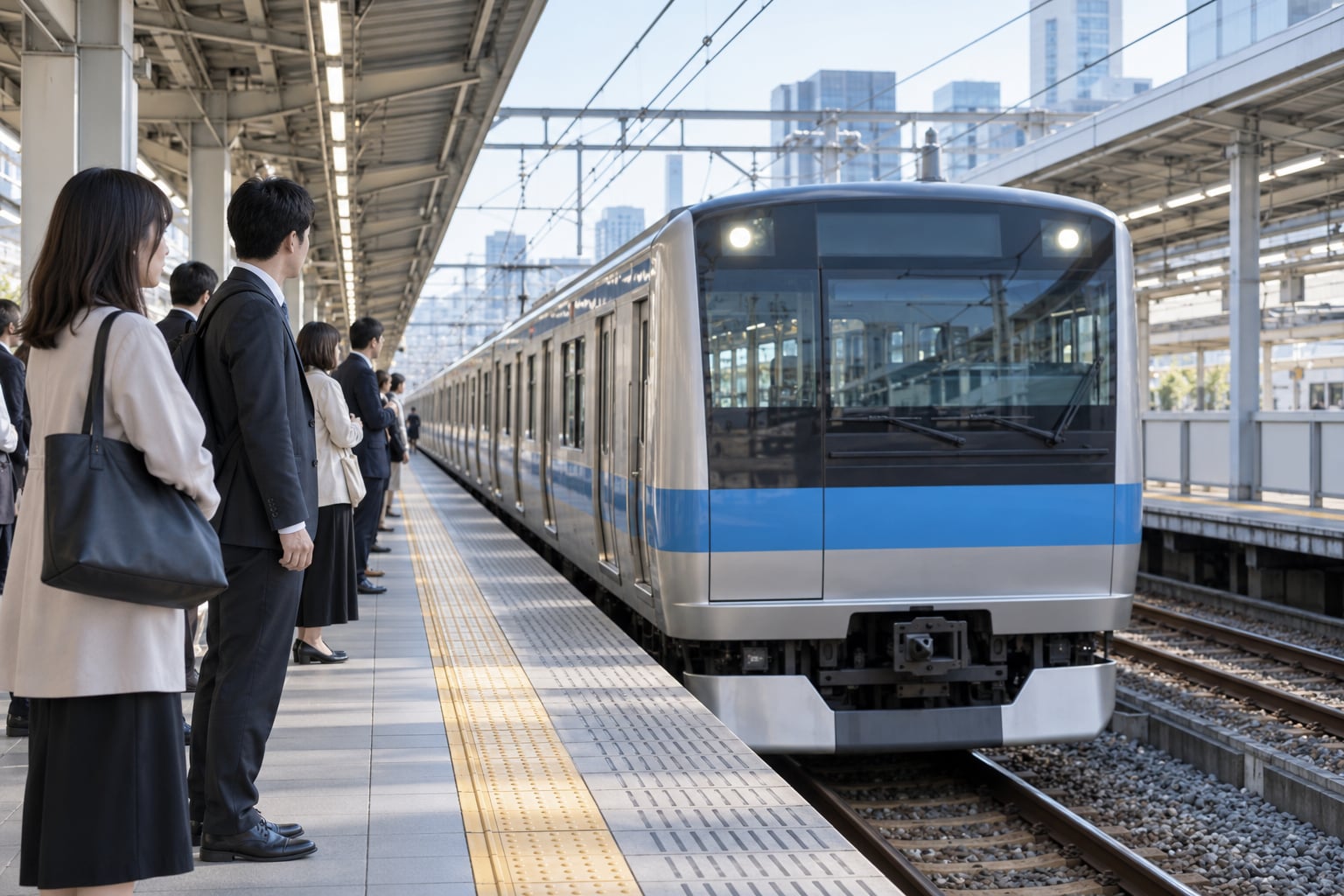
Japanese trains run on time because punctuality is built into the system instead of hoped for. Dedicated tracks with almost no level crossings, running times padded to leave recovery margin, connections kept short so no train ever waits, centralised signalling, dispatchers who decide fast, nightly inspections and heavily drilled staff all work together to stop a small delay from spreading.
There is also a myth-busting part to the story. The famous figure everyone quotes, an average delay of roughly 24 seconds a year on the Tokaido Shinkansen published by JR Central, describes high-speed line running on its own dedicated track. Tokyo rush-hour commuter lines, subway lines and rural single-track services tell a messier story, and a transport ministry report drew attention to how often rush-hour services in Tokyo actually run behind. The reputation is real, but it is uneven.
Key takeaways
- Punctuality is an operating system, not a personality trait. Culture is the last layer on top, not the foundation.
- Timetables are built with slack. Scheduled journey times include recovery margin so a train can work off a few lost minutes without disturbing the next service.
- No train waits for a connecting passenger. This rule, called oi-koshi, is the single most important reason a delay does not cascade.
- Dedicated track removes conflicts with freight, slower regional services and road traffic at level crossings.
- Staff are trained to act, not to comply. Dispatchers and station staff hold, skip stops and restore service order within minutes.
- Delays happen. Operators publish delay certificates, and rush-hour commuter services can run several minutes behind.
Table of Contents
- 1Why Japanese Trains Run on Time
- 2What Does On-Time Mean for Japanese Railways?
- 3How the System Keeps the Network Moving
- 4Why Japanese Trains Run on Time in Practice
- 5Private Operators Compete on Reliability
- 6Dedicated Tracks Reduce Conflicts
- 7Standardized Procedures and Human Training
- 8How Technology Supports Punctuality
- 9Why Culture Helps but Is Not the Whole Answer
- 10Can Japanese Trains Be Late?
- 11Frequently Asked Questions
- 12Are all Japanese trains always on time?
- 13How punctual are Japanese trains compared with European or US rail networks?
- 14Do Japanese train operators cancel trains instead of accepting delays?
- 15What happens if a Japanese train is delayed by several minutes?
- 16Is the Tokyo Metro fully automated?
- 17Why can a minor problem sometimes cause major disruption on a Japanese railway?
- 18Conclusion
Why Japanese Trains Run on Time
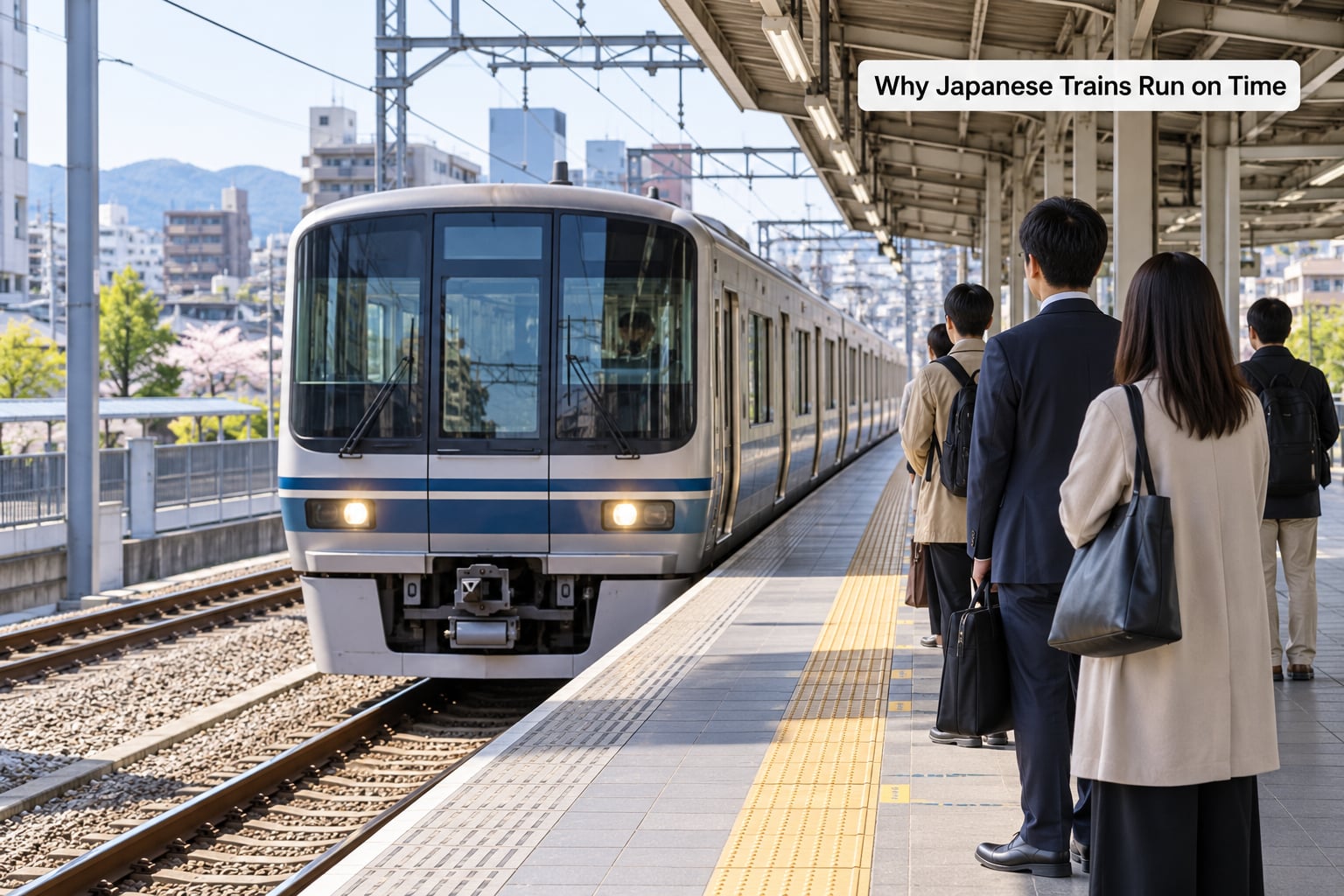
The honest answer is that no single thing makes Japanese railways punctual. It is four layers that reinforce each other: dedicated infrastructure, a timetable built with slack, an operations control centre staffed by people empowered to act, and a passenger population that boards in an orderly way.
Remove any one layer and the others still function, but punctuality gets harder. A railway that shares tracks with freight has conflicts it cannot schedule away. A railway with no timetable padding cannot absorb a slow door. A railway where a driver must phone for permission before skipping a station cannot recover quickly.
I have ridden commuter lines, the subway and long-distance services enough to notice that the difference is not visible in the station. It shows up in the recovery behaviour. A train two minutes down at one stop is usually back on time three stops later, because the crew and the control room have already decided what to give up.
JR Central, which operates the Tokaido Shinkansen, reports an average annual delay of about 24 seconds including days with typhoons and heavy rain. That number is a headline, but the operating philosophy underneath it is the interesting part.
What Does On-Time Mean for Japanese Railways?
On-time has a stricter definition here than in many countries, and it applies to the whole run rather than the headline arrival. Operators measure the delay at each station against the timetable, so a train that starts on time, runs three minutes late for an hour and then catches up is not counted as punctual for that hour.
JR Central publishes service performance on a threshold measured in minutes, and most urban operators set internal targets far tighter than the public threshold. Passengers notice the difference because announcements at the station give the delay in minutes, often with a specific reason attached.
When a service runs late enough to matter, an operator can issue a tardo keisho, a delay certificate, which lets passengers travel on a later service without buying a new ticket. JR companies commonly issue these when a train is delayed by around five minutes or more. This is the origin of the tourist idea of a five-minute rule: it is a compensation threshold, not an official tolerance for lateness.
| Service type | Typical delay profile | Recovery options available |
|---|---|---|
| Shinkansen (dedicated high-speed track) | Often under one minute; average reported around 24 seconds a year | Skip stops, hold for a preceding service, adjust connections at terminals |
| JR commuter lines in Tokyo | Usually minutes rather than seconds; rush hour can run late regularly | Overtaking at passing loops, short turns, skipping less-used stops |
| Tokyo Metro and private subway lines | Generally tight, with short dwells and frequent service | High-frequency service absorbs irregularity, extra trains inserted at busy hours |
| Private commuter railways (Odakyu, Keio, Tokyu and others) | Varies by line; congestion can push delays into the 5 minute range | Through-running onto other lines, platform holds, selective stopping |
| Rural single-track lines | Fewer trains, single-track operation, no recovery capacity mid-route | Limited; delays can last until a train arrives from the opposite direction |
There are two more operational decisions that sit behind the punctuality target. Rapid delay means the operator accepts a delay now to protect the rest of the timetable. Suspension means stopping service entirely when conditions are unsafe, for example during a typhoon or after an earthquake. Neither is a failure; both are choices made to keep the network from failing as a whole.
How the System Keeps the Network Moving
The parts of the system only work because they are designed together, so it is worth walking through them in the order they interact.
Route planning and dedicated infrastructure. High-frequency urban lines get their own track, with track shared only between services of similar speed. Level crossings have largely been eliminated, which removes the single largest source of unplanned delay in older networks.
Timetables built with slack. Scheduled running times include padding, so the plan already assumes a small loss somewhere. A train scheduled to take 20 minutes over a segment that takes 18 minutes under normal conditions has two minutes of margin built in.
Short minimum connection times. The schedule is arranged so that a missed connection is rarely the end of the journey. The next service in the same direction is usually a few minutes away, so passengers have a second chance.
Skilled dispatchers. A control room monitors the whole line, not just one train. Dispatchers watch for the delay forming, decide where to add capacity and instruct crews.
Quick decisions. Holding a train, skipping a stop or changing running order are routine tools, available to crews and controllers under standing authority. No one has to escalate before acting.
Why Japanese Trains Run on Time in Practice
Take a subway train on a weekday evening that leaves its first station thirty seconds late because of crowding at the doors. The delay is recorded automatically and shows on the control room display.
The controller does three things at once. First, the train ahead has space, so the late train is held briefly at the next station to recover. Second, the following train is not held, because holding it would move the problem backwards in time. Third, if the delay is still there three stops on, the crew drops a planned stop at a quiet station and gains the time back.
Because no train was waiting for a passenger, nobody else got delayed. Because the schedule had padding, the recovery margin absorbed the first half-minute. Because the stop could be dropped under standing authority, the second thirty seconds went too. The delay never reached the passengers on the other trains, which is the real point of the exercise.
The same logic runs in reverse on busy commuter lines. When a train runs late into a terminal, it is often turned short so it can enter service again on time, and passengers are moved onward by other services. The individual journey is degraded slightly so the network is not.
Private Operators Compete on Reliability
Japanese rail is not a single state system. JR Group companies run the national network, Tokyo Metro operates the core subway, and dozens of private railways run commuter lines into the suburbs, many of them subsidiaries of department stores or construction firms with land along the route.
For all of them, punctuality is a commercial requirement. A railway whose trains arrive reliably can fill the catchment area between its stations with housing and shops, then sell long season passes. Passengers who can rely on the 8:12 arriving at 8:12 will buy a monthly ticket for years. Chronic lateness has a direct financial cost, because an unreliable railway cannot market a commute with a fixed departure time.
Reliability is also the marketing claim itself. Operators publish punctuality figures and rank against each other, and a private line with a good record gains passengers from a competitor nearby. That competitive pressure is part of why service quality keeps improving even on lines with no subsidy.
Cooperation matters just as much as competition. Tokyo Metro and the private railways run through services onto each other’s tracks, so the timetable is negotiated between companies that compete for the same passengers. A delay caused by one operator’s congestion becomes everyone’s problem, which is why control rooms share information across corporate boundaries.
Dedicated Tracks Reduce Conflicts
Segregated track is the part of the puzzle that other countries find hardest to copy, because it depends on land use decisions made decades ago. A dedicated line can run every two or three minutes in each direction without asking permission from freight, regional services or road traffic.
That density is what makes recovery possible. On a high-frequency line, a delayed train is one of many, and passengers have alternatives within minutes. On a rural single-track line, a delayed train can block the only path for the opposite direction, so recovery takes much longer and the delay can spread to services two hours away.
Fast boarding supports the same goal. Levers beside the doors, pre-marked boarding positions on the platform, wide doors and a short dwell mean a train carrying hundreds of passengers loads and departs on schedule. On subway lines, dwell times of around half a minute are normal.
Urban rapid transit and conventional main lines are different animals. Shinkansen services run on their own standard-gauge track and never meet a slower train. Conventional lines mix everything, which means they need more careful timetable construction and have fewer recovery options. That difference is a large part of why the average delay figures people quote are drawn from bullet trains rather than from the network as a whole.
Standardized Procedures and Human Training
Trains are driven by people, and the reliability of a human-driven system comes from how those people are trained. Drivers and conductors start with long qualification periods that include theory, simulator work and supervised running before they are allowed near a passenger service.
Onboard, procedures are written down precisely. Confirming the schedule, checking equipment, and pointing at or touching indicators are drilled steps rather than habits that vary by crew. Conductors point at signs and mumble through the schedule during a run; rail enthusiasts have watched this for years and it looks odd from outside until you realise it is a memorised sequence tied to the timetable.
Station staff and controllers train for the abnormal case, which is where punctuality is actually won. Emergency drills, evacuation practice, rules for holding and skipping, and simulations of a passenger taken ill on a moving train are all part of the syllabus. Controllers work through scenarios rather than improvising during them.
This has to be said honestly: punctuality has a human cost. The Amagasaki derailment on the JR West Fukuchiyama Line, in which a train overran a speed restriction and derailed into a building, killed more than a hundred people. Pressure on drivers to keep tight schedules, and punishing corporate cultures, were examined closely afterwards, and the reforms that followed included changes to how speed is managed and how staff are supported. Nothing about this topic should be read as a celebration of pressure.
How Technology Supports Punctuality
Signalling systems do much of the work that culture gets credit for. Automatic train protection enforces speed limits and braking curves automatically, so overspeed is physically limited rather than discouraged. On lines with automatic train operation, the system controls acceleration, coasting and braking between stations, and drivers mainly handle exceptions and door operations.
Centralised traffic control pulls line control into a single location where controllers see the position of every train at once, rather than each train reporting to a local signal box. That visibility is what makes quick recovery possible, because a controller can see an approaching conflict several stations before it happens.
Monitoring goes deeper than position. Track geometry recording cars measure alignment while running, wheels are checked for defects at nightly inspection, and overhead line and pantograph condition are checked on the same cycle. Data feeds passenger information systems, so the platform boards and apps show the same delay and reason the control room sees.
It is worth correcting a common belief here: Japanese trains are not fully automated everywhere. Automated operation is used on specific metro and commuter lines, much of the Shinkansen is driver-led with high automatic protection, and most conventional lines have drivers doing everything except enforcing speed. Technology here reinforces written procedure and trained judgement, and it does not replace either.
Why Culture Helps but Is Not the Whole Answer
Social behaviour does contribute, and it is the part foreign visitors notice first. Queues at platform markings, boarding in seconds, nobody holding a door open for a friend running down the stairs, and a default expectation that everyone arrives before the train rather than at it.
There is a phrase that captures the philosophy: ichi-go ichi-e, one time, one meeting, an encounter that will not repeat. It is the cultural justification for never holding a train for a connecting passenger. Missed the connection, take the next one.
The arrival custom often described as juppun mae koudou, acting ten minutes early, is the same idea applied to appointments, meetings and travel. Nobody plans to arrive exactly on time because a few minutes of margin is considered wise.
But culture is the weakest layer if it stands alone. People queue neatly because platforms are marked and staff direct them, and boarding stays fast because trains are frequent and connections are frequent. No amount of politeness makes a busy platform load a train in twenty seconds. The behaviour works because it is embedded in infrastructure, training, schedules and incentives, and punctuality would survive a less orderly passenger population.
Can Japanese Trains Be Late?
Yes, and they are. Operators announce delays with a specific reason rather than a vague apology, and the vocabulary is oddly memorable. A crowded platform is konsen (congestion). A person on the track is jinshin jiko, announced as a suspension until recovery. A sick passenger is kyoubinin kyuujo, a medical rescue call.
Other announcements are wonderfully specific. Sha kensho is a rolling stock inspection. Door kensho is a door check, done when a door sensor is unhappy and staff will not release it until it is fixed. Touba is a fallen tree, ooame and tsuyokaze are heavy rain and strong wind, and shika to shogetsu means a collision with a deer, which is genuinely common on rural lines in parts of the country.
| Announcement | What it means | Typical response |
|---|---|---|
| Konsen | Congestion at a station or on board | Hold at platform, deploy staff, passengers left at the next stop |
| Jinshin jiko | Person on the track | Line suspended while recovery takes place |
| Kyoubinin kyuujo | Sick passenger needing help | Emergency stop, ambulance met at a convenient station |
| Sha kensho | Rolling stock inspection | Delay worked off at the terminus or short turnaround |
| Door kensho | Door sensor check | Train held at the next station while staff resolve it |
| Touba | Fallen tree blocking the line | Crew or maintenance team clears it; can be slow on rural lines |
| Ooame, tsuyokaze | Heavy rain, strong wind | Speed restrictions, or service suspended entirely |
Weather is the biggest external variable. Typhoons can shut down coastal lines for a whole day, and heavy snow on northern lines forces reduced speeds and longer journeys. For earthquakes, the Shinkansen runs on an early warning system that stops trains before the shaking arrives, combined with seismic isolation and flexible track that is designed to let the ground move beneath a train rather than against it.
Equipment failure and accidents also produce delays, and a rush-hour backlog at a busy terminal can take a couple of hours to clear even after the cause is gone. A few late trains are not the same as a failing system, and treating them as one is where the public debate usually goes wrong.
Frequently Asked Questions
Are all Japanese trains always on time?
No. The famous punctuality figure describes the Tokaido Shinkansen, which JR Central reports averages about 24 seconds of delay a year even on typhoon days. Tokyo rush-hour commuter lines and private railways regularly run several minutes behind, and rural single-track lines have far less room to recover. Treat the reputation as uneven rather than universal.
How punctual are Japanese trains compared with European or US rail networks?
On high-speed routes the gap is enormous, since average delays are measured in seconds or fractions of a minute rather than tens of minutes. On conventional urban and regional services, the difference narrows considerably, and busy commuter lines in any country experience congestion-related delay. Japan is unusual less for perfection than for how rarely small delays become large ones.
Do Japanese train operators cancel trains instead of accepting delays?
Both. Short stops can be dropped and services can be turned short at a terminus, which keeps the network running while degrading one journey. Full cancellations happen for safety reasons such as typhoons, earthquakes or track inspections, not to tidy the timetable. In those cases operators usually offer travel on later services through the delay certificate system.
What happens if a Japanese train is delayed by several minutes?
Other trains are not held to wait for you, so the practical advice is to take the next service in the same direction, which is usually minutes away. If the delay reaches roughly five minutes on JR services, you can usually request a delay certificate and travel on a later train without buying another ticket. Staff at the station can explain the arrangement.
Is the Tokyo Metro fully automated?
Not entirely. Some Tokyo Metro lines operate with unattended automated running where drivers do not operate the train in the normal sense, while many other lines are fully driver-operated with automatic train protection that enforces speed and braking. The network is mixed, so it is worth checking the specific line rather than assuming all Tokyo Metro services are driverless.
Why can a minor problem sometimes cause major disruption on a Japanese railway?
Where there is no recovery capacity. A single-track rural line has one path for both directions, so a stopped train blocks everything behind it until it moves. On a busy urban line the same issue appears as crowding and platform holds as trains stack up behind the problem. Dedicated track and high service frequency are what remove this fragility.
Conclusion
Japanese trains run on time because punctuality is a coordinated system rather than a single technique. Dedicated infrastructure removes conflicts, timetables carry built-in recovery margin, no train waits for a connecting passenger, controllers have the authority and the information to act quickly, and staff are drilled for the abnormal case rather than only the timetable.
The part worth remembering when you travel there is this: the timetable is an outcome, not a guess. It was built with the expectation that small things go wrong, so treat the departure time as reliable, take the next train if you miss a connection, and check live service information during weather or disruption. The 24-second figure is real, and so is the crowded platform at 8am in Tokyo.