The fastest way to follow Japanese game announcements in English is to build a three-layer pipeline: two English-language mirrors that translate Japanese gaming news for you, a handful of Japanese originals you check once a week, and a translation toolchain for anything the mirrors have not reached yet. Set it up once, twenty minutes a day, and you stop finding out weeks late.
Most English sites do not report the news first. They translate it, sometimes within the hour, sometimes never. Knowing which layer a piece of news came from tells you how much to trust it and how soon a proper English write-up will exist.
The whole setup takes about an hour. I rebuilt mine end to end during Tokyo Game Show season, and the only part I now wish I had done sooner was the calendar.
Table of Contents
- 1What You Need
- 2Step-by-Step
- 3Start with official English game channels
- 4Find the original Japanese announcement
- 5Translate the announcement without losing the meaning
- 6Verify the announcement across multiple sources
- 7Save announcements to a release and news calendar
- 8Set alerts and build a repeatable routine
- 9Common Mistakes
- 10Frequently Asked Questions
- 11Can I follow Japanese game announcements if I do not read Japanese?
- 12What is the best way to find Japanese game news before English sites report it?
- 13How do I know whether a Japanese game announcement is official?
- 14Should I rely on Google Translate for Japanese gaming announcements?
- 15Does a Japan-only announcement mean the game is coming to the West?
- 16What time do Japanese game showcases start in my time zone?
What You Need
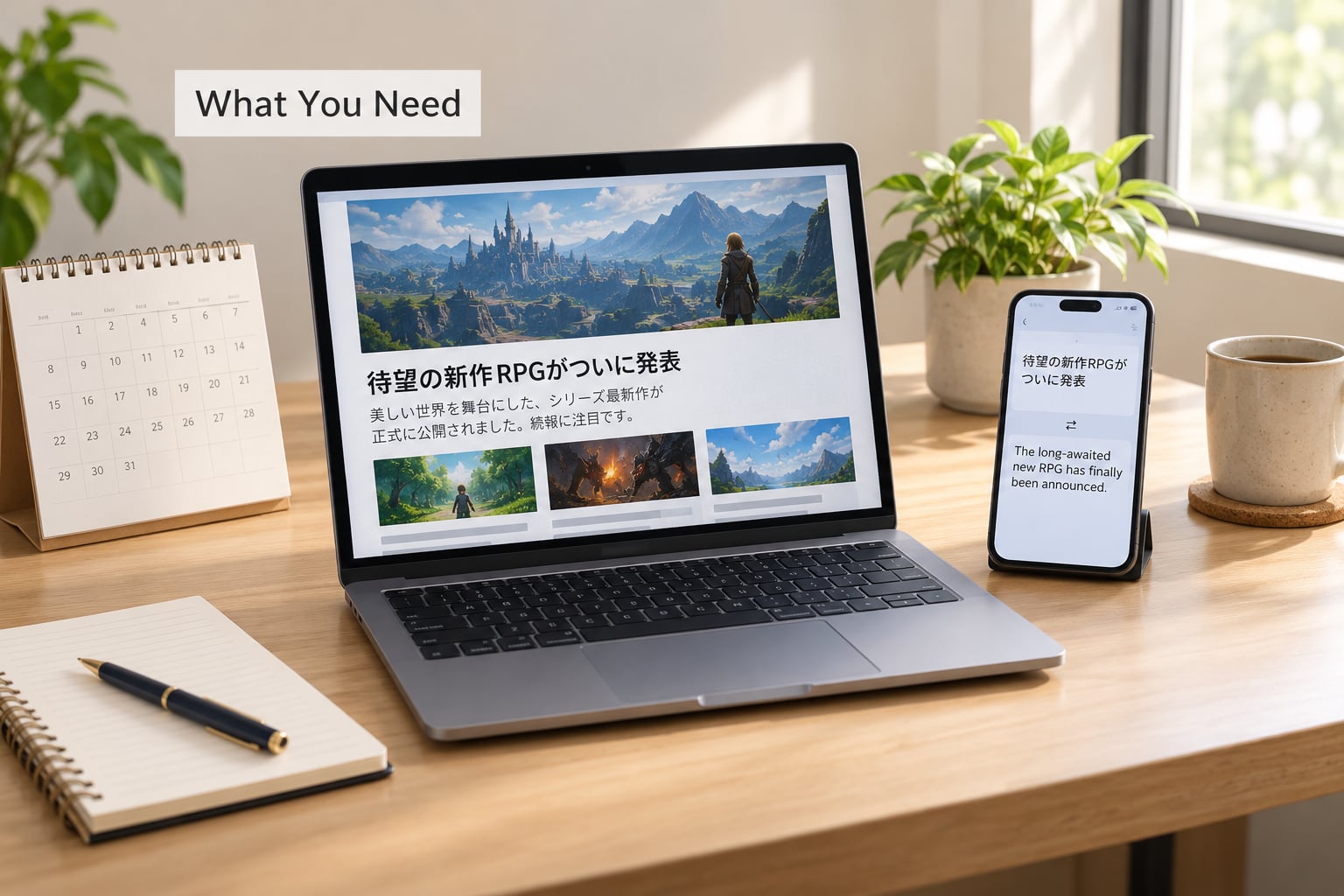
Six things, and none of them cost anything:
- A browser with automatic translation. Chrome, Edge, Firefox and Safari all translate Japanese pages on request, and Chrome and Edge can do it the moment a page loads. This is the single most useful tool in the whole setup.
- A second translation engine. Keep DeepL or Google Translate in a tab for cross-checking, because engines disagree most often on names and numbers.
- An RSS reader. Inoreader or Feedly. Both handle Japanese-language feeds fine because RSS reads the text, not the page.
- A tracking table or calendar. Google Calendar, Notion or Airtable. One of them, not four.
- A bookmark folder for sources. One folder, labelled JP sources, so you add to it instead of hunting for it later.
- A notification budget. Decide now that you will allow ten sources to interrupt you. More than that and you mute the whole system within a month.
Step-by-Step
Seven steps, in order. The first two get you most of the value on their own, so do not wait until you have set up all seven before you start reading.
Start with official English game channels
The English layer is where you should spend most of your time. Three outlets do the bulk of the translating work, and they are worth subscribing to individually rather than hoping an aggregator surfaces them.
Gematsu covers Japanese and Western announcements with platform tags, exact timestamps and converted event times. Its upcoming events block already does the time-zone maths for you. Siliconera is the one that goes deepest on Japan-only material: arcade events, merchandise, indie projects and developer interviews that Western outlets skip, with named bylines on every translated piece. Active Gaming Media is a smaller, fast roundup-style site useful as a second pair of eyes.
Then add the publishers themselves. Nintendo, Sony Interactive Entertainment, Sega, Bandai Namco, Capcom, Square Enix and Koei Tecmo all run English newsrooms, YouTube channels and newsletters, and a first-party announcement posted there is the ground truth that everything else repeats.
Confirming a source is genuine takes thirty seconds. Check that the domain has not been squatted with one letter changed, that the account has a verified badge and a history of official posts, and that a matching item appears on the publisher’s own site. Fan accounts repost official art with no link back; the fix is to ignore anything you cannot trace to a domain or an official channel.
Find the original Japanese announcement
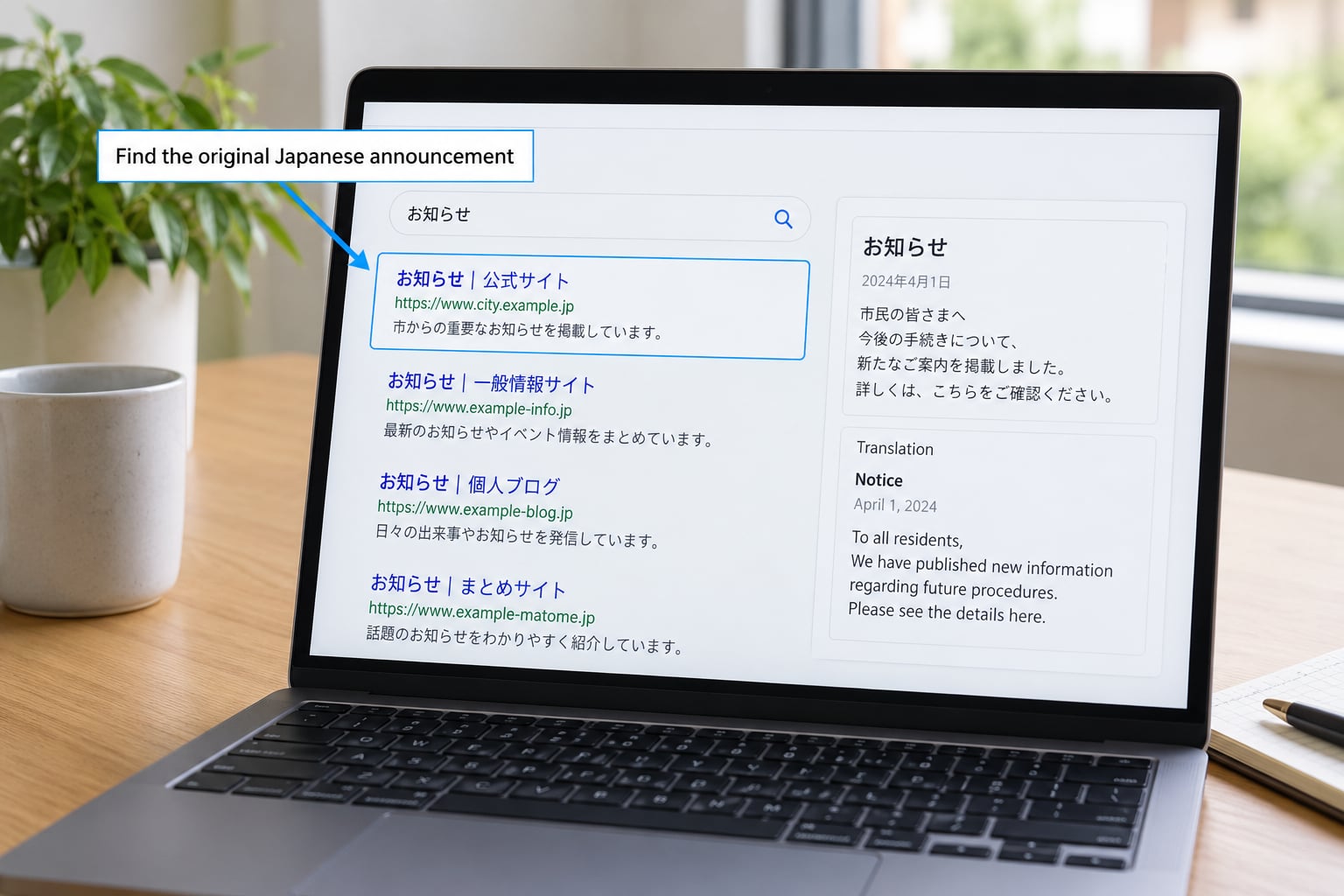
Japanese-first news is where translation lag, delay notices and small studio announcements live. Once you know a few words of Japanese, you get to these days or weeks before the English layer does.
The outlets to know: Famitsu for release dates, sales figures and award lists; 4Gamer for hardware, mobile and long interview pieces; Automaton Media for straight news with a good archive; Denfaminicogamer for Nintendo and Pokémon coverage; and Famitsu Online for breaking news as it happens.
Searching the game title with the right Japanese term does most of the work. Use these:
- 発表 – the announcement itself
- 発売 / 発売日 – release and release date
- 新作 – new title, 続編 – sequel
- アップデート – update, イベント – event
- 発売延期 – a delay, worth searching monthly
- ティザー – teaser, 海外発売 – overseas release
A useful habit: search “game title + 発売予定” for a planned release and “game title + 発売延期” when you are waiting on a date you already know. The second search is how you catch a delay on the same day it happens.
Translate the announcement without losing the meaning
Machine translation is fine for headlines and rough sense. It is not fine for release dates, and that is where people get burned.
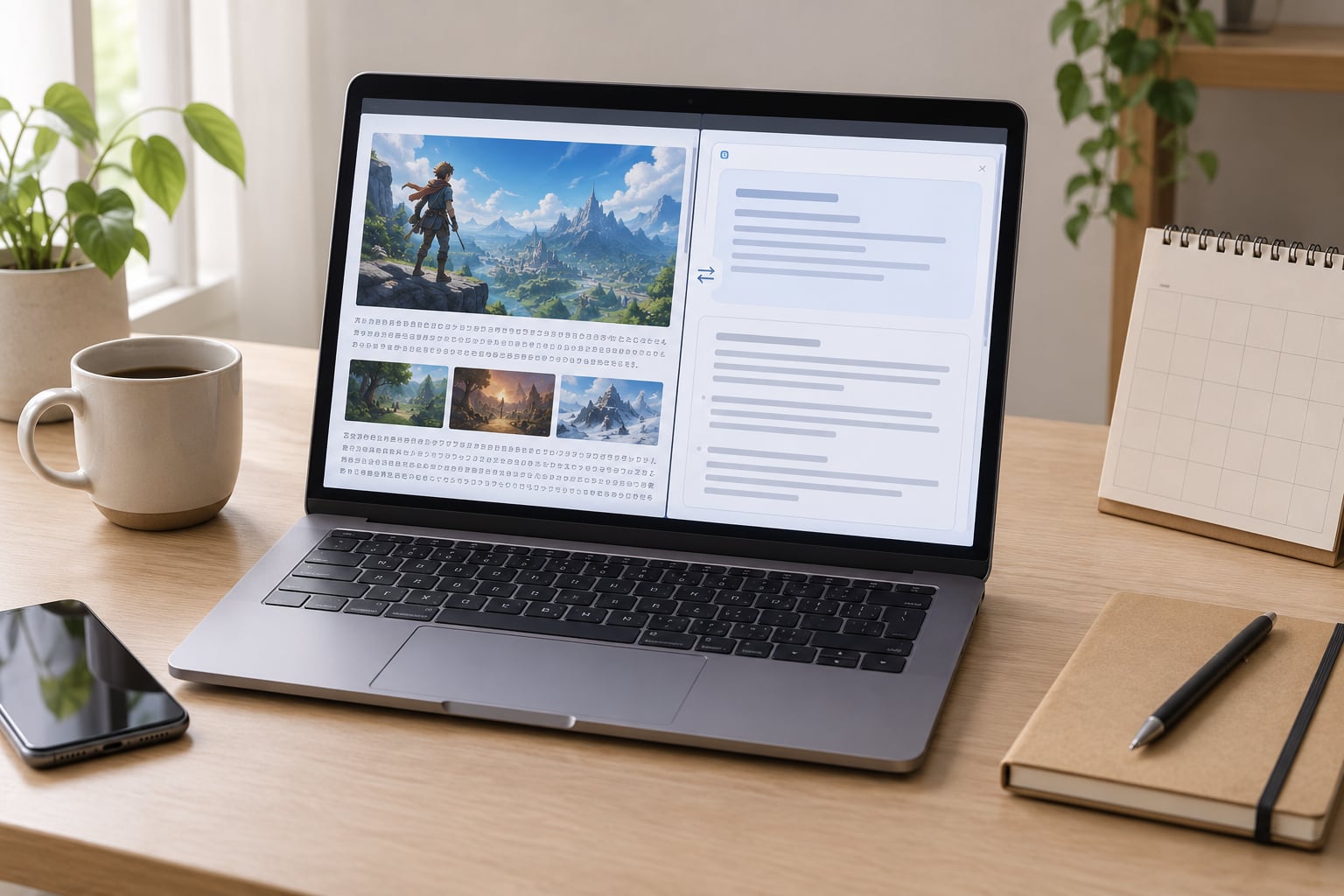
Workflow: let the browser translate the page, then paste the one paragraph that matters into a second engine and compare. When the two disagree, trust neither until you have checked the numbers against the original characters. Japanese date formats, platform shorthand and franchise-specific vocabulary are the usual casualties.
Here is how to follow japanese game announcements in english when the English write-up does not exist yet. Read the Japanese, note the words you cannot place, and look them up in the glossary below rather than guessing from the machine output. Ten minutes of verification saves you from booking the wrong month.
| Japanese | Romaji | English meaning | What to verify |
|---|---|---|---|
| 発表 | hyouji | Announcement | Whether it is a reveal, a date or an update |
| 発売日 | hatsubaibi | Release date | Day, month, year; Japanese dates run year, month, day |
| 発売予定 | hatsubai yotei | Scheduled release | Planned, not confirmed; windows can slip |
| 発売延期 | hatsubai enkei | Release delayed | New date, or no new date at all |
| 新作 | shinsaku | New title | Same series or brand new IP |
| 続編 | zokushin | Sequel | Numbering, since Japan counts differently |
| 体験版 | taikenban | Demo or trial version | Platform and store |
| 配信 | haishin | Distribution or live stream | Where to watch, and the time in JST |
| 同時発売 | douji hatsubai | Simultaneous release | Usually means no localization delay |
| 海外発売 | kaigai hatsubai | Overseas release | Territories named; often excludes China |
Verify the announcement across multiple sources
Two sources agreeing is usually enough; one source is a starting point. Check the publisher’s own site, then the Japanese official social account, then an English mirror, then the platform store listing. Where all four line up on date and platform, you can stop reading.
Japanese coverage makes rumor wording easy to spot. 噂 means rumor, リーク means leak, and 情報 is often hedged information. Official posts use the plain formula of publisher name plus developer name plus 発表します. If a post is a screenshot with no link and no named source, it is a rumor no matter how official it looks, and the fix is simple: wait for the publisher to post it themselves.
The reverse check matters too. When a delay lands only on Famitsu and never reaches the publisher’s site, the store listing, or an English mirror within a few hours, it may be a misreading or an error. Give it a day before you change a plan.
Save announcements to a release and news calendar
This is the step that turns reading into tracking. Record eight fields per announcement and the follow-up stops being a memory test: announcement date, reveal or showcase date, release window, platform, language support, source link, translation status, and a follow-up date.
Set reminder offsets rather than dates. A follow-up four weeks before a release window catches a quiet delay; another two weeks before it catches the second wave of platform details.
Handle time zones once and set the habit. Japanese announcement times are JST, which is UTC+9 with no daylight saving. Japan is 13 hours ahead of New York in summer and 14 hours ahead in winter, 8 hours ahead of London, 17 hours ahead of Los Angeles in summer and 18 in winter. Most showcases start between 11:00 and 13:00 JST, which lands late evening or overnight in Europe and the Americas. Convert once when you save the event, and never again.
When you have been away for a couple of weeks, do not scroll back through everything. Go to the tag and archive pages instead: each English mirror keeps dated archives and per-title tags, so you jump straight to the games you follow and read what changed. Two outlets plus one Japanese original takes about twenty minutes.
Set alerts and build a repeatable routine
Alerts only work if they arrive in one place. The configuration that has held up for me:
- RSS in Inoreader or Feedly for the English mirrors and the Japanese originals. Feed the folder, not your whole inbox, and read it twice a day rather than watching it.
- An X list of official Japanese accounts: publisher, developer and the Japanese outlets. Lists keep the timeline clean in a way keywords alone do not.
- YouTube subscriptions for official channels, with notifications on for the publishers you care about and off for everything else.
- One newsletter, because email is where a full announcement roundup with corrected details tends to land first.
A routine beats a feed. Two sessions of about twenty minutes, morning and evening, is more than enough. Morning covers new announcements and delays. Evening covers showcase announcements, which in Japan usually drop in the afternoon and reach English sites overnight. During a show week, add a third pass only for the days you actually want the full roundup.
Common Mistakes
Six errors, each with the fix:
- Treating a reposted screenshot as an announcement. Fix: trace it to a publisher domain or official channel. If there is no link, wait.
- Trusting machine translation for dates and numbers. Fix: cross-check every date, platform label and figure in the original characters before you plan around it.
- Mixing up announcement dates and release dates. Fix: label both columns separately. 発表 never means shipping that day.
- Following unverified reposts of official accounts. Fix: verified badge, correct handle, history of official posts. Then confirm on the publisher site.
- Ignoring Japanese-only terminology. Fix: learn the ten words in the glossary and use them as search terms. It is a small time investment that pays off every search.
- Treating aggregator volume as importance. Fix: one quiet delay notice from a publisher matters more than a dozen aggregated listicles. Read publishers first and aggregators last.
Frequently Asked Questions
Can I follow Japanese game announcements if I do not read Japanese?
Yes, and most readers never need to. English mirrors like Gematsu and Siliconera translate Japanese gaming news within minutes to hours of the original post, and both are worth subscribing to individually. Learn ten Japanese keywords as search terms rather than learning the language, and you will catch delay notices and small studio announcements days before any English write-up appears.
What is the best way to find Japanese game news before English sites report it?
Follow the Japanese websites and official social accounts of publishers, developers, the console platforms and the Japanese gaming media: Famitsu for release dates and sales, 4Gamer for hardware and interviews, Automaton Media for straight news, Denfaminicogamer for Nintendo and Pokemon. Search the game title with terms such as 発表 for an announcement or 発売延期 for a delay to surface the original post.
How do I know whether a Japanese game announcement is official?
Check that the post comes from the publisher or developer verified domain or established social account, and look for the same information on its official news page or press release. Japanese coverage separates rumors clearly: 噂 means rumor, リーク means leak, while official posts use the plain formula of publisher plus developer plus 発表します. A screenshot with no source link is a rumor.
Should I rely on Google Translate for Japanese gaming announcements?
Good enough to scan, not good enough to plan around. Translation engines disagree most often on dates, franchise names and platform shorthand, and Japanese date order catches people out. Treat machine translation as a first pass, keep the original link open, and verify every date and number against the Japanese characters before you act on it.
Does a Japan-only announcement mean the game is coming to the West?
Not necessarily, and the wording tells you more than the fact of the announcement does. Look for 海外発売 for an overseas release or 同時発売 for a simultaneous launch, which usually means no localization wait. If the post names only Japanese platforms and a Japanese release window, treat it as Japan-only until an English publisher or store listing says otherwise.
What time do Japanese game showcases start in my time zone?
Japan Standard Time is UTC+9 and never changes, so convert once and set your calendar in local time. Most showcases start between 11:00 and 13:00 JST, which is late evening or overnight across Europe and the Americas. Gematsu and similar outlets also publish upcoming events already converted, which removes the calculation entirely.
Start with three subscriptions today: one English mirror, one second English mirror, and one Japanese original. Then spend twenty minutes building the tracking table with your eight fields, convert one showcase time to JST, and you are tracking Japanese game announcements in English properly rather than stumbling onto them a week late.