Japanese warranties are strict because three forces push in the same direction: the Product Liability Act makes makers answerable for defects, the Act on Specified Commercial Transactions forces repair businesses to disclose costs and give estimates in advance, and the Consumer Contract Act voids blanket exclusions. Brands cannot quietly write defects out of coverage, so they defend the edges of the policy instead.
I have read enough Japanese warranty cards and enough support threads to know where readers get stuck. The strictness is real, and it comes with genuine legal teeth. But it is not the same as being difficult, and it is not the same as generous either.
This guide covers why Japanese warranties are strict the way they are, which statutes produce that strictness, how the different layers of protection fit together, and what to do when a claim gets refused. It is written for anyone buying electronics, cameras, appliances or vehicles in Japan, including residents, importers, expats and short-term visitors.
Table of Contents
- 1What Does It Mean When Japanese Warranties Are Strict?
- 2Three questions that settle most disagreements
- 3Why Do Japanese Companies Use Strict Warranty Conditions?
- 4How Do Japanese Consumer Guarantees Work?
- 5Product Liability Act
- 6Act on Specified Commercial Transactions
- 7Consumer Contract Act
- 8Warranty legal baseline: Japan vs EU vs United States
- 9What each statute actually requires
- 10Why Japanese Warranties Are Strict for Electronics
- 11Why Japanese warranties are strict about serial numbers and receipts
- 12Where the real disputes happen
- 13Why Japanese Warranties Are Strict for Online and Marketplace Purchases
- 14What Restrictions Do Japanese Warranty Policies Usually Include?
- 15Why Japanese Warranties Are Strict in Practice
- 16How Can You Check a Japanese Warranty Before Buying?
- 17What Should You Do If a Japanese Warranty Claim Is Denied?
- 18Frequently Asked Questions
- 19Are Japanese warranties stricter than warranties in other countries?
- 20Does buying a Japanese product overseas void its warranty?
- 21Why do manufacturers request the serial number and proof of purchase?
- 22Can a Japanese retailer repair a product outside its warranty?
- 23What happens if a Japanese warranty excludes accidental or liquid damage?
- 24Are Japanese consumer guarantees the same as manufacturer warranties?
- 25Conclusion
What Does It Mean When Japanese Warranties Are Strict?
Strict means the manufacturer spends real effort defining exactly when coverage applies, and then asks you to prove you fall inside those definitions. Coverage periods are precise, serial numbers are checked, receipts are required, repairs must go through authorized service centres, and a long list of excluded damage sits at the back of the document.
It helps to separate two things that get tangled together. A manufacturer warranty is a promise the company makes, with its own duration and its own exclusions. Statutory rights are what the law gives you regardless of what the warranty card says. A brand can offer a narrow warranty and still owe you more than that under consumer law, which is exactly why the strict paperwork is not automatically the whole picture.
Conditions also vary more than most shoppers expect. They change by product category, by brand, by model, by seller and by where the purchase happened. A camera body and a refrigerator from the same company can carry different terms, and the same model bought through an authorized distributor versus a marketplace listing can carry different support.
Three questions that settle most disagreements
Was the unit sold for the Japanese market through an authorized channel? Is the serial number on the unit the one recorded at purchase? And does the failure fall under defect or under the wear-and-tear language? Nearly every denied claim I have seen turns on one of those three.
Why Do Japanese Companies Use Strict Warranty Conditions?
Traceability is the first reason. A serial number ties a specific unit to a specific production run and a specific sale date. Without that link, a warranty is an open-ended liability, and no manufacturer of a physical product can carry a balance sheet built on open-ended liability.
Second, quality control happens before the invoice, not after. Japanese manufacturing culture puts enormous weight on catching defects at the assembly line rather than at the service counter, and warranty terms are one of the pressures that keeps that discipline funded. A strict claim process is expensive; it is also the reason a claim gets paid quickly once it clearly qualifies.
Third, repair quality is controlled on purpose. Authorized service centres use specified parts, specified adhesives, specified calibration routines. Letting any shop open any product would scatter warranty costs across thousands of independent operators and hand the brand a reputational problem it could not control.
Fourth, there is fraud. Warranty fraud is a well-known category of abuse everywhere, and stricter conditions are one of the cheapest ways to slow it down. Serial verification, purchase records and channel checks all raise the effort required to mount a false claim.
Fifth, and less openly discussed, warranty eligibility is a distribution-control lever. A 2020 paper in the Journal of Economic Behavior and Organization examined parallel imports and after-sales repair directly, and documented a major Japanese camera maker’s overseas subsidiary refusing both warranty service and paid repair on parallel-imported units. The academic framing is blunt: restricting after-sales service to authorized-channel products raises prices elsewhere. Consumers experience the same policy from the other end, as a refusal.
How Do Japanese Consumer Guarantees Work?
Three statutes do most of the work, and each one pushes on a different part of the problem.
Product Liability Act
This is the statute that makes defect coverage feel close to automatic. Under it, a manufacturer can be liable for damage from a defective product without the consumer first having to prove negligence. When a product fails in a way that counts as a defect, the burden of explanation shifts toward the company, which is the reverse of how many shoppers expect to argue.
Act on Specified Commercial Transactions
This one governs the repair side of the business rather than the product. Repair services are treated as specified commercial transactions, which brings disclosure obligations: the repairer has to state what will be done, disclose charges, and provide an estimate in advance for work above a statutory threshold. It also brings a cooling-off framework for certain distance purchases. The practical result for a shopper is that you are entitled to a number before the work starts, not a surprise afterwards.
Consumer Contract Act
This statute voids unfair terms in consumer contracts. Blanket warranty exclusions are exactly the kind of clause it targets. A manufacturer cannot write “we decide what counts as a defect and that decision is final” and expect a Japanese court to treat it as binding. A forum user on a Dell support board made precisely this argument when a Japanese branch refused a keyboard repair, citing Civil Code Article 562 alongside the Consumer Contract Act.
Warranty legal baseline: Japan vs EU vs United States
| Point | Japan | European Union | United States |
|---|---|---|---|
| Statutory defect liability | Product Liability Act, no need to prove maker negligence | General product safety and consumer goods directives, national implementation varies | State tort law plus the Magnuson-Moss Warranty Act for written warranties on consumer goods |
| Minimum warranty length | No single blanket minimum for all consumer goods; statutory rights sit underneath the warranty | Two-year liability for goods under the Sale of Goods directive, separate from a manufacturer guarantee | No federal minimum; many categories carry no statutory warranty at all |
| Repair disclosure | Advance estimate and cost disclosure rules for repair services under specified transaction rules | Repair and spare-parts rules strengthened in recent years, member-state detail varies | Mostly state-level repair and lemon law territory |
| Blanket exclusions | Void under the Consumer Contract Act | Void under unfair terms rules | Generally permitted if clearly disclosed, unless unconscionable |
| Typical geographic reach of a domestic warranty | Japan only for most Japan-market products | EU-wide for goods bought by a consumer in the EU | US, sometimes Canada, brand by brand |
The table is the short version of the argument. Japan does not simply hand out longer warranties. It makes it harder for a company to dodge one, then lets the company be precise about scope.
What each statute actually requires
| Law | What it requires | What you notice as a shopper |
|---|---|---|
| Product Liability Act | Manufacturers can be held liable for defects without proof of negligence | A clear defect is argued on its own merits rather than fought over with a failure log |
| Act on Specified Commercial Transactions | Repair services require disclosure of charges and an advance estimate above the statutory threshold | You get a number before work starts instead of a bigger number after pickup |
| Consumer Contract Act | Unfair terms, including blanket warranty exclusions, are void | Warranty fine print has less power than it would in some other markets |
| Civil Code Article 562 | A seller or service provider must be given the chance to cure a non-conformity | A first refusal to repair or replace before you escalate is the normal starting point |
Why Japanese Warranties Are Strict for Electronics
Electronics is where the conditions bite hardest, because the failure modes are numerous and the components are small. A laptop can fail at the hinge, the battery, the display backlight, a single key switch or the charging port, and those failures get classified differently.
Why Japanese warranties are strict about serial numbers and receipts
The serial number answers which unit this is. The receipt answers where and when it was sold, and through whom. Without both, a manufacturer has no way to confirm the unit is one it sold into the domestic channel on a date covered by the policy, and the claim stops before it starts. Keep the paper warranty card, the box, and the receipt together for the whole coverage period, because that set is what gets requested later.
Authorized service centres matter for the same reason. A repair performed by an independent shop can void coverage even when the part that failed was genuinely defective, because the brand cannot attest to the work or the parts used.
Where the real disputes happen
Most electronics claims do not fail on grand design. They fail on classification. A dead backlight becomes normal wear, a key that no longer registers becomes a cosmetic issue, a swollen battery becomes user damage. In a well-documented case on Dell’s community board, a Japanese branch refused a keyboard replacement on a paid extended warranty, treating a loose key as cosmetic wear while the non-functional indicator LEDs went unaddressed, despite support reportedly acknowledging the lighting fault would normally be covered.
The same thread shows a second pattern worth knowing: a small fault quoted as a whole-unit issue, so repair cost approaches replacement cost. That user also found burn marks on an AC adapter, attributed by support to an earlier service visit, and was quoted for repair rather than replacement. Forum complaints about Japanese service desks elsewhere follow the same outline: an estimate given on the phone turning into a substantially larger invoice, multi-round diagnostics before pickup is even arranged, and responses that are brief without directly answering the question asked.
Why Japanese Warranties Are Strict for Online and Marketplace Purchases
Where you buy changes the support outcome more than almost anything else. Most manufacturers treat the channel as part of the warranty. A unit sold through an authorized distributor, the manufacturer’s own Japanese store, or a marketplace listing that the brand has approved is straightforward. A unit sourced through a parallel importer is a different case.
A parallel import is a genuine product, bought through a channel the manufacturer did not choose. It may be a Japan-market model sold to another market, a foreign-market model resold in Japan, or a grey-market unit with no domestic sales record at all. Brands commonly limit warranty service and even paid repair to these units, because the company cannot verify sourcing, local safety certification, or the parts supply chain behind them. The economic research cited earlier shows this is an active commercial strategy, not an accident of admin.
Most Japan-market warranties are also domestic-only. Take the unit to another country and coverage usually ends, because the service network, parts supply and local regulations behind the warranty do not travel with it. The reverse is not automatically true either: a Japanese-market unit is not an international unit, and buying it in Japan does not create worldwide coverage.
One nuance worth adding. A global brand’s presence in Japan does not necessarily change the geography of its Japanese warranty. Readers on a smart-glasses forum asked whether a Japan-sourced headset carried coverage in their home market and found no automatic answer, because the question is entirely about how that particular serial number was registered and through which channel.
What Restrictions Do Japanese Warranty Policies Usually Include?
Most domestic Japanese warranty cards carry a version of the same list. Expect to see:
- A time limit. Coverage runs from the purchase date, not from manufacture, and rarely extends automatically.
- A serial-number check. The number on the unit must match the sales record, and mismatches end the claim immediately.
- Proof of purchase. A receipt or invoice from the seller is usually mandatory, and many brands will not accept a screenshot of an online order alone.
- Geographic limits. Service is provided in Japan, often only through a listed service centre.
- Authorized repair only. Opening the unit yourself, or using an independent repairer, can void coverage.
- Accident and liquid exclusion. Drops, pressure damage and liquid ingress are almost always excluded from the standard warranty.
- Tampering exclusions. Unauthorised modifications, third-party software and non-genuine parts are commonly listed.
- Wear and tear. Deterioration from normal use is excluded, and this is the clause most often argued over.
- Commercial-use limits. Business, rental and institutional use is often outside consumer coverage entirely.
- Accessory limits. Coverage on bundled or optional accessories is frequently shorter than on the main unit.
- Parts availability. Brands publish a period during which service parts and technical support will be supplied, after which support may end.
- Cost of disposal or return. Some policies charge for collection, or for a unit that cannot be economically repaired.
Read that list with the statutes in mind. Accident and liquid damage being excluded from a manufacturer warranty is entirely normal, and it is separate from whether a defect caused the damage. The two questions get tangled when a failed component is described as water damage without evidence of water.
Why Japanese Warranties Are Strict in Practice
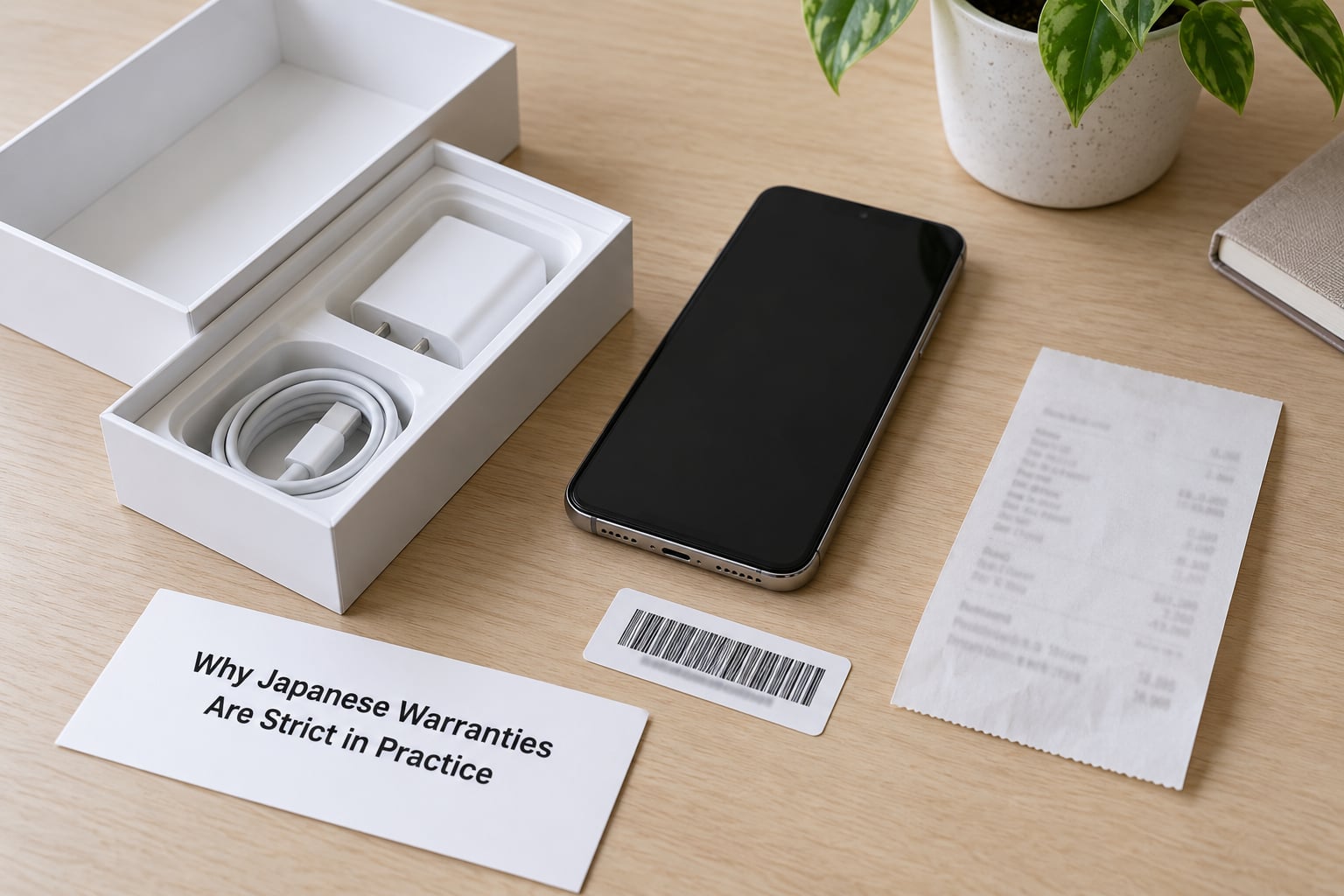
Here is how the same policy produces two different outcomes.
The accepted claim. A camera body develops intermittent shutter-stall errors eight months after purchase at an authorized dealer. The owner has the paper warranty card, the receipt, and the serial number matching the box. Support collects the unit, runs diagnostics, identifies a shutter unit fault consistent with a manufacturing defect, and repairs it under warranty with no charge. The strict conditions did their job. Because documentation was complete and the fault matched a defect description, nothing else needed arguing about.
The declined claim. A laptop purchased through a marketplace listing from a third-party reseller stops charging. The buyer has an order confirmation, but the unit is a grey-market import with no domestic sales record. The serial number is not recognised in the Japanese channel, so there is no domestic warranty attached to it at all. Repair is offered at cost. This is not a dispute about the fault; it is a dispute about provenance, and strict channel rules decided it before the hardware was ever examined.
What separates those two cases is preparation, not luck. Before you ever contact support, capture the serial number, photograph it and the unit, keep the receipt and warranty card together, and write down when the fault started and what you were doing at the time. Save every email and reference number. If you get a refusal, ask for it in writing with a stated reason, because a written reason is something you can argue with later and a phone call is not.
One more piece of documentation that costs nothing and is often skipped: user registration. Registering the unit with the manufacturer ties the serial number to your contact details and purchase date, and it frequently unlocks repair history that a service centre would otherwise ask you to prove.
How Can You Check a Japanese Warranty Before Buying?
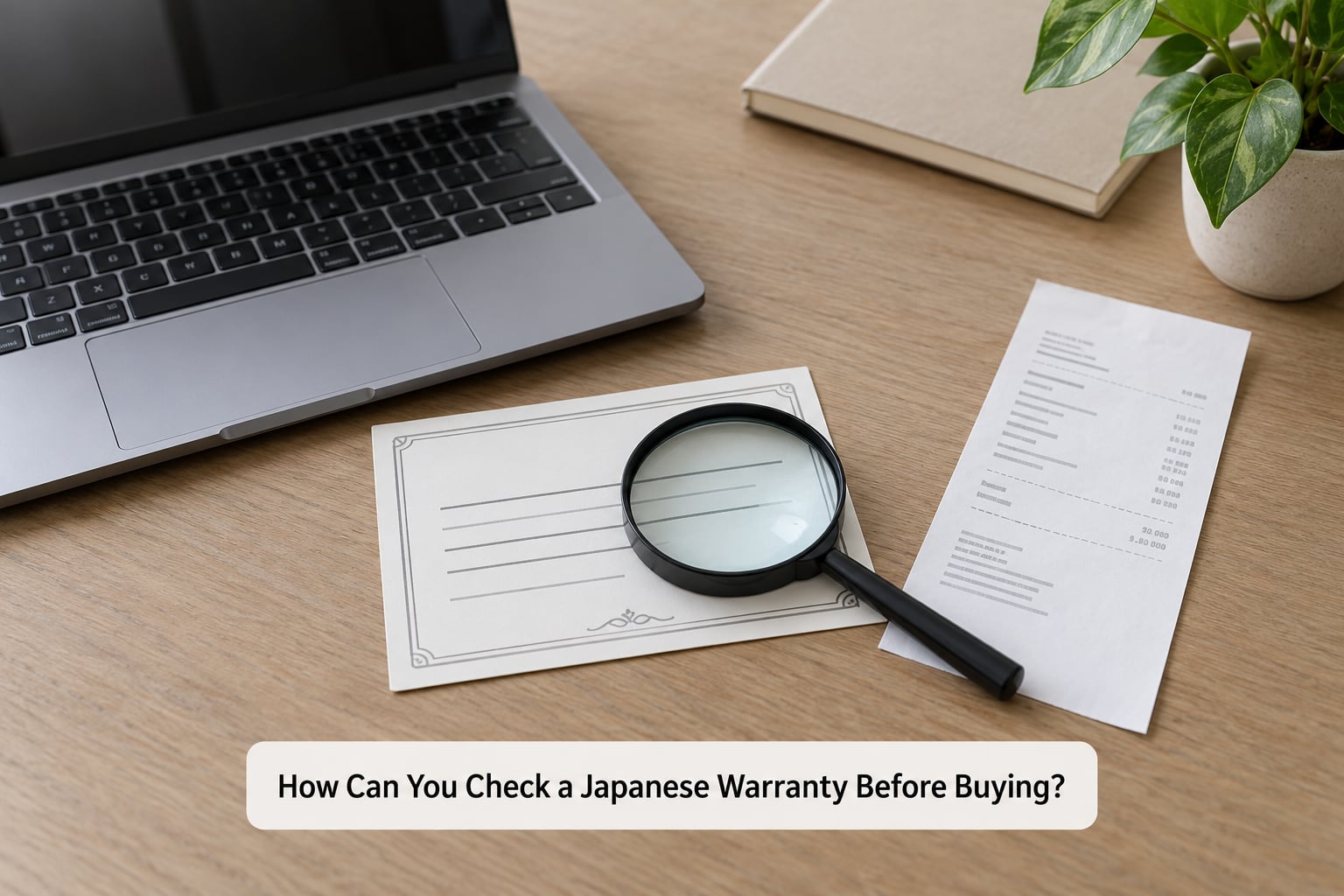
Most of the checking happens before you pay, and all of it happens in the shop or on the product page.
Confirm the duration and its start point. Ask what the coverage length is and whether it runs from purchase date or manufacture date. Imported stock can already be months old when you buy it.
Identify who the seller is and who warrants the product. These can be different entities. A marketplace listing may be sold by a third party while the brand warrants the unit, which is fine, but you want to know before something breaks.
Check whether the channel is authorized. Look for the manufacturer’s distributor or the brand’s own store. If it is neither, ask directly whether warranty service applies, and get the answer in writing before you pay.
Find the service network. Ask where authorized service centres are located and whether you need to ship the unit or can drop it off. For a large appliance, pickup and return logistics are a bigger practical factor than the warranty length.
Read the exclusion list properly. Look specifically for liquid, accidental, wear-and-tear and commercial-use language, plus any requirement about who performs repairs.
Check the parts availability period. Brands publish how long they will supply parts for a model. On an appliance you plan to keep for a decade, that number matters more than the two-year figure.
Understand the return rights separately. Statutory rights sit alongside the manufacturer warranty and are not the same thing. A retailer return window and a manufacturer repair promise do not expire on the same day, or necessarily under the same conditions.
Check the language. Japanese warranty terms are usually written in Japanese. If you cannot read them, ask the seller for a summary in writing rather than relying on an in-store verbal assurance you will not be able to prove later.
On extended coverage, the honest answer is that it is worth checking in two specific cases: a product expensive enough that a component-level repair would be painful, and a category where wear-and-tear classification is genuinely contested. It is worth skipping when the failure you are worried about is an excluded cause, because an extended warranty that does not cover the fault you expect buys nothing. Forum buyers have reported paying for extended coverage that still did not cover the specific failure that motivated the purchase.
What Should You Do If a Japanese Warranty Claim Is Denied?
A refusal is usually a process problem before it is a legal one. Work up this ladder in order, and keep a written record at every step.
- Ask the manufacturer for the reason in writing. Request the specific clause relied on. A refusal citing “policy” with no clause named is not something you can evaluate.
- Push back once, using the right language. Ask whether the fault is being classified as a defect or as wear and tear, and ask for the diagnostic basis. Naming Civil Code Article 562 and the Consumer Contract Act changes the shape of the conversation.
- Use the authorized service centre. Service centres frequently have more room to classify a fault as a defect than a general support line does, and their findings carry weight with the brand.
- Go back to the retailer. For consumer goods bought in-store, the retailer carries its own responsibilities to the customer, which is sometimes a faster route than the brand.
- Contact a consumer affairs centre. Japan’s consumer affairs centres and the Kokusen consumer hotline handle complaints and can advise on your rights and on how to put a claim in writing.
- Consider Small Claims Court. For a small dispute, this is a low-cost formal route. Requirements and fees vary, so check what applies to your claim before filing.
Two things to keep in mind throughout. Statutory rights do not depend on the warranty card, so a narrow manufacturer warranty is not the ceiling on what you are owed. And the same legal strength that makes a defect claim enforceable is why companies push hard on geography and channel, where the position is much weaker for them.
Frequently Asked Questions
Are Japanese warranties stricter than warranties in other countries?
Not in duration, mostly in enforceability. Japan does not set one blanket minimum warranty length for all consumer goods the way the EU sets a two-year liability baseline. What Japan does is make defect claims harder to escape, through the Product Liability Act and the Consumer Contract Act. The result feels stricter in practice because coverage is precisely defined and defended.
Does buying a Japanese product overseas void its warranty?
Usually yes for a Japan-market unit, because most domestic warranties are valid in Japan only and are tied to a domestic sales record. Some global brands run separate international programmes, and some service centres will repair an out-of-area unit at cost rather than free. Check the specific brand before you assume coverage travels with the device.
Why do manufacturers request the serial number and proof of purchase?
The serial number identifies which unit you own and ties it to a production run and a sale date. The receipt proves it was sold through a channel the manufacturer supports, on a date inside the coverage period. Without both, the company has no verifiable link between your device and any warranty obligation, so most claims stop there.
Can a Japanese retailer repair a product outside its warranty?
Usually yes, as a paid repair. Retailers and authorized service centres commonly handle out-of-warranty work at cost, and repairability rules in Japan require advance estimates and cost disclosure for repair services. The key point is that statutory rights can still apply if the fault was a defect, so a paid repair is not always the only option open to you.
What happens if a Japanese warranty excludes accidental or liquid damage?
The manufacturer generally owes nothing under that warranty, and an extended plan often excludes the same causes. What still matters is whether the damage label is accurate. A failed component described as liquid damage without evidence is worth challenging, and statutory rights remain available if the product was defective rather than damaged. Get the reason in writing first.
Are Japanese consumer guarantees the same as manufacturer warranties?
No, and the distinction is the most useful thing to understand. The manufacturer warranty is a company promise with its own duration and exclusions. Consumer guarantees come from statute and sit underneath it, including repair or replacement rights for defective goods. A narrow warranty card does not remove those statutory rights, so a refusal is worth challenging on both levels.
Conclusion
Japanese warranties are strict because the law leaves brands no room to write defects out of coverage, and because the commercial value of warranty access sits with authorized channels. The strictness shows up as narrow geography and precise conditions, not as short coverage on clear defects.
So check five things before you pay: whether the seller is authorized, what the serial number and receipt situation will be, where the service centre is, what the exclusion list actually says, and when the parts availability period ends. Keep the paperwork together for the whole coverage period. Those five checks resolve most of the problems people end up writing angry support threads about.