The short answer is that all six major Japanese driver assistance systems are SAE Level 2: they watch the road, warn you, brake for you and hold a lane for you, but none of them drives the car on its own. Toyota Safety Sense, Honda Sensing, Nissan ProPILOT, Subaru EyeSight, Mazda i-ACTIVSENSE and Mitsubishi’s FCM/360 Degree Monitor cover the same core functions, and the real differences show up in tuning, sensor hardware and which models get them fitted.
That last point is where most comparisons go wrong. A brochure for a top-spec hybrid and a loan car on the entry trim can carry the same badge and behave very differently. What follows breaks the six suites down feature by feature, then maps them to the driving situations people actually deal with in Tokyo traffic, on the expressways and in a snow season.
One thing worth saying early, because it colours every section below: the way Japanese brands tune lane keeping is deliberately gentle. Drivers on Japanese Tesla forums note that Japanese-brand lane keeping works on straight roads and gives only a light assist through curves, while some European systems actively steer through a bend. That is a comfort and approval choice, not a capability gap.
Table of Contents
- 1How Japanese Driver Assistance Systems Compare at a Glance
- 2What Counts as a Driver Assistance System?
- 3How the six suites differ in tuning and hardware
- 4Which Collision Warning and Automatic Emergency Braking Features Are Standard?
- 5How Do Adaptive Cruise Control and Lane-Keeping Features Compare?
- 6How Do Traffic Jam, Navigation, and Driver Monitoring Features Compare?
- 7Which Systems Work Best in Japanese Cities, Highways, and Bad Weather?
- 8How Availability and Price Vary by Model and Trim
- 9Which Should You Choose?
- 10Frequently Asked Questions
- 11Can any Japanese driver assistance system drive the car by itself?
- 12Which Japanese ADAS is best for heavy city traffic?
- 13Can these systems be used in rain, snow, or dense fog?
- 14Does adaptive cruise control work in every Japanese driving situation?
- 15How do I check which driver assistance features are fitted to a used car?
- 16Do Japanese driver assistance systems reduce insurance costs?
- 17Bottom Line
How Japanese Driver Assistance Systems Compare at a Glance
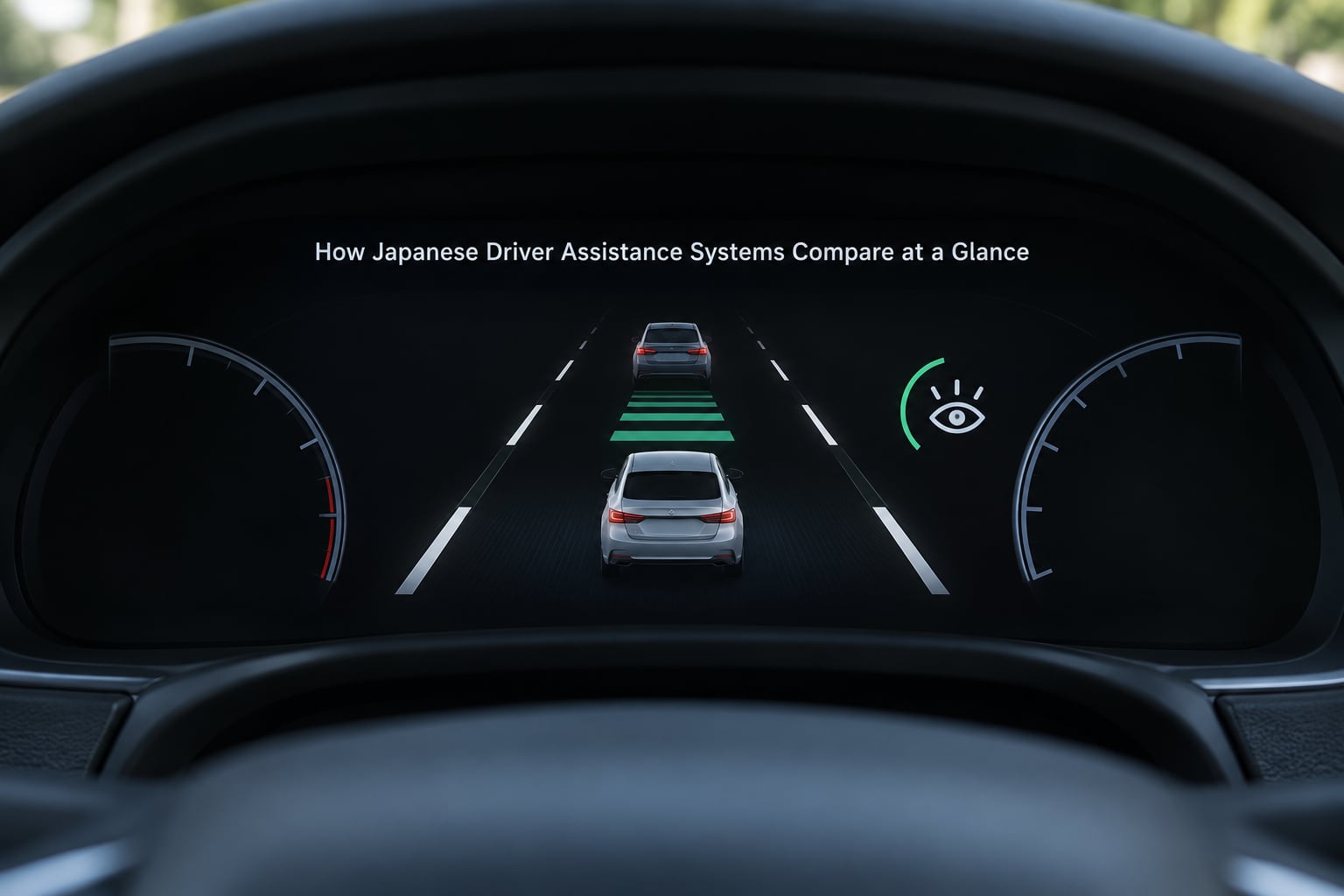
Here is the six-suite version first. Read it as a shape rather than a verdict, because fitment changes by model year and market.
| Suite | Typical sensor stack | Adaptive cruise control | Lane support | Driver monitoring | Standard fit |
|---|---|---|---|---|---|
| Toyota Safety Sense | Forward camera, millimeter-wave radar, ultrasonic sensors | Dynamic Radar Cruise Control, full stop in newer generations, Proactive Driving Assist, Curve Speed Management | Lane Departure Prevention with steering assist; recent versions brake and steer to keep you in lane | Drowsiness and hands-off warnings in recent generations | Largely standard across most of the range |
| Honda Sensing | Forward camera, millimeter-wave radar, plus ultrasonic for low speed | Adaptive Cruise Control with low-speed follow, typically stopping at around 10 km/h rather than a full stop | Lane Keeping Assist centres gently; Road Departure Mitigation brakes as well as steers | Driver Attention Monitor in later generations | Standard on most current models |
| Nissan ProPILOT | Forward camera, millimeter-wave radar, side and rear sensors | ProPILOT Assist with stop-and-go in traffic jam assist, plus map-linked cruise | Lane Departure Prevention and Intelligent Lane Intervention | Driver Attention Alert in later generations | Usually fitted above the base trim or bundled with a driver-assist pack |
| Subaru EyeSight | Stereo front camera pair, wide-angle mono camera, front and side radar depending on version | Adaptive Cruise Control that can come to a complete stop and resume from a standstill | Lane Centering Function with continuous light steering | Driver Attention Monitor standard where EyeSight is fitted | Standard on most Subaru models, though the feature set varies by generation |
| Mazda i-ACTIVSENSE | Forward camera and radar, plus ultrasonic and surround cameras | Mazda Radar Cruise Control with low-speed follow; works in a narrower speed band than some rivals | Lane Departure Warning and Lane Keep Assist; keeps assist light in bends | Driver Monitoring with active driving assist on higher trims | Standard on most of the range |
| Mitsubishi FCM and 360 Degree Monitor | Forward camera, millimeter-wave radar, ultrasonic sensors, multiple surround cameras | Adaptive Cruise Control on equipped models | Lane Departure Warning and prevention, with emergency steering assist on some cars | Driver Attention Alert on newer models | Varies widely by model; strongest on recent SUVs and hybrids |
Three differences explain most of what you feel from behind the wheel. First, whether adaptive cruise control stops fully and restarts on its own: EyeSight and recent Safety Sense do, Honda and Mazda mostly follow at low speed instead. Second, how much steering the lane function will apply on a curve. Third, which suite actually monitors the driver, since a system that warns you for looking away is doing something Honda and Toyota only added recently.
What Counts as a Driver Assistance System?
A driver assistance system, or ADAS, is any electronic system that senses the environment and acts on it while the driver stays in charge. That last clause is the whole point, and the reason every suite covered here is classified as SAE Level 2.
The SAE scale runs from Level 0 to Level 5. Level 0 is a car with no assistance. Level 1 handles either steering or speed, not both, which is where old cruise control or old lane departure warnings sit. Level 2 handles both steering and speed at once, which is what adaptive cruise control plus lane centring is. Level 3 lets the system take over the driving task in defined conditions while a driver watches, Level 4 removes the driver entirely inside a mapped operating area, and Level 5 removes the driver everywhere.
Everything sold as a Japanese driver assist package today is Level 2, sometimes marketed as Level 2+ for the newer generation systems that add map data and curve awareness. Nobody in Japan is selling you a Level 4 car you can buy and sleep in. The distinction matters more than the marketing because a Level 2 system assumes your hands are on the wheel and your eyes are on the road, every second.
So which functions are worth understanding first? Four cover most of the daily benefit: automatic emergency braking, adaptive cruise control, lane support, and blind spot or cross traffic alerting. The rest are refinements of those.
How the six suites differ in tuning and hardware
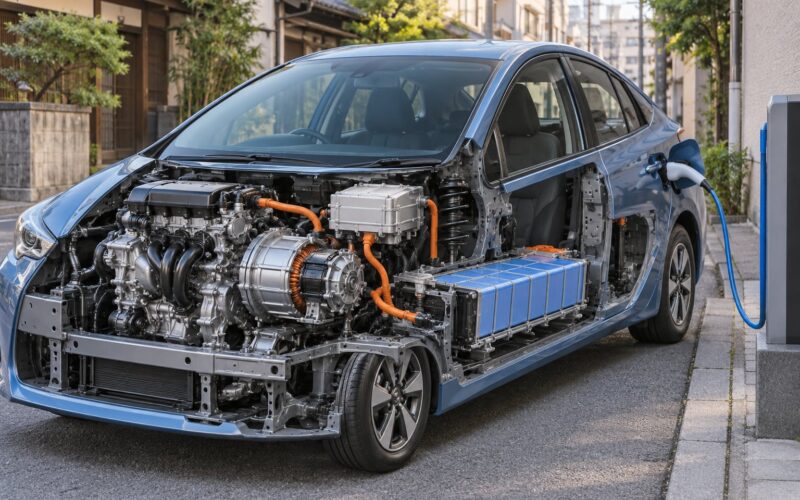
Hardware explains much of the behaviour. Subaru uses a stereo camera pair for depth plus a wide-angle mono camera for nearer objects, which is why EyeSight is often quick to react to pedestrians close to the car. Toyota’s newer Proactive Driving Assist and Honda’s later systems lean harder on radar for speed control and camera for lane geometry.
There is also a supplier layer underneath. DENSO and Hitachi Astemo build much of Toyota’s stack, Hitachi Astemo developed Subaru’s original EyeSight hardware, and Bosch and Continental supply competing hardware across several brands. It explains why two suites with different badges can feel unusually similar, and why one badge can feel different across two generations.
Which Collision Warning and Automatic Emergency Braking Features Are Standard?
Automatic emergency braking is the least contentious part of the comparison, because all six suites now offer forward collision warning with pedestrian detection and automatic braking, and most are standard rather than optional. That was not true a decade ago; it is the single biggest change in how Japanese ADAS suites compare over time.
The differences are in range, sensitivity and what happens after the warning. EyeSight’s stereo pair gives it strong near-field detection, so it tends to react early to a pedestrian stepping out at close range. Honda’s Collision Mitigation Braking System is tuned to feel smoother and later, which owners read as less nervous but also less urgent.
Throttle management is the sleeper feature. If you are stopped behind someone and press the accelerator before you have looked up, several suites cut or delay the throttle for a moment and buzz a warning. Subaru and Toyota both do this well. It is the feature drivers notice most once they have triggered it accidentally, and it is the one they stop noticing after a week.
Rear cross traffic alert and blind spot monitoring are more uneven. Blind spot monitoring is close to standard across all six brands now. Rear cross traffic braking, which actually stops the car, is patchier and tends to appear on newer models and higher trims. Honda’s LaneWatch is a different approach entirely: a camera mounted in the rear door mirror renders the blind corner on the centre display, and there is no equivalent from Subaru or Mitsubishi.
What none of these systems solve is certainty in heavy rain, standing water or fog. Cameras lose contrast, radar can pick up reflections, and every manual in this category says plainly that performance degrades in poor visibility. If you drive somewhere with real winter conditions, treat that caveat as a design limit rather than a defect.
How Do Adaptive Cruise Control and Lane-Keeping Features Compare?
Adaptive cruise control is where the suites separate most clearly. Subaru EyeSight can bring the car to a complete stop and will pull away again when the vehicle in front moves, which makes it usable in queues and in slow city traffic. Honda’s system follows at low speed and will typically stop for a stationary obstacle, but re-accelerating on its own in a jam is not its strength. Recent Toyota and Nissan generations have closed most of that gap.
Mazda’s radar cruise control works across a narrower speed band than the others and pairs with a low-speed follow function that is best suited to moderate traffic rather than dense stop-start congestion. Mitsubishi’s system behaves similarly, with the focus on models where it is paired with the 360 Degree Monitor for low-speed manoeuvring.
Lane support is the other half. Every suite warns on drift, but steering assist differs in strength. Japanese systems, as that Tesla-owner forum thread puts it, do some real work on straights and back right down on curves. That is a deliberate calibration choice and it is consistent across Toyota, Honda, Nissan, Mazda and Mitsubishi. Subaru’s Lane Centering Function is generally reported as the most assertive of the Japanese group, which is exactly why owners compare its braking and steering as more aggressive.
Curves also expose the difference between speed management and steering. Toyota’s Curve Speed Management reads the road ahead and slows the car before a bend it cannot hold, rather than waiting for the lane system to fight the corner. On long mountain roads that single feature changes the whole feel of a car, because you arrive at the bend already at a sane speed instead of braking hard mid-corner.
Phantom braking deserves a mention here. Owners on Reddit forums for Subaru, Honda and Toyota report occasional hard braking for vehicles they did not register as real threats, most often on wet roads or when a truck cuts in. Across the group it is an occasional event rather than a daily complaint, but it is the reason experienced drivers learn where the sensitivity settings live.
How Do Traffic Jam, Navigation, and Driver Monitoring Features Compare?
Traffic jam assistance is where the newest generations separate from the old ones. Traffic Jam Pilot in recent Toyota and Nissan cars, and the equivalent functions elsewhere, hold the lane and manage speed in dense stop-start queues on marked roads. Their limits are honest: they need clear lane markings, they disengage when markings fade, and none of them is a licence to look at a phone.
Map-linked road guidance is the other step up. Using map data ahead, these systems slow for curves and adjust speed before a turn rather than after it. Toyota’s Proactive Driving Assist and Nissan’s ProPILOT Assist both work this way in their latest versions, and it is the feature that most separates a two-generation-old car from a current one on the same motorway.
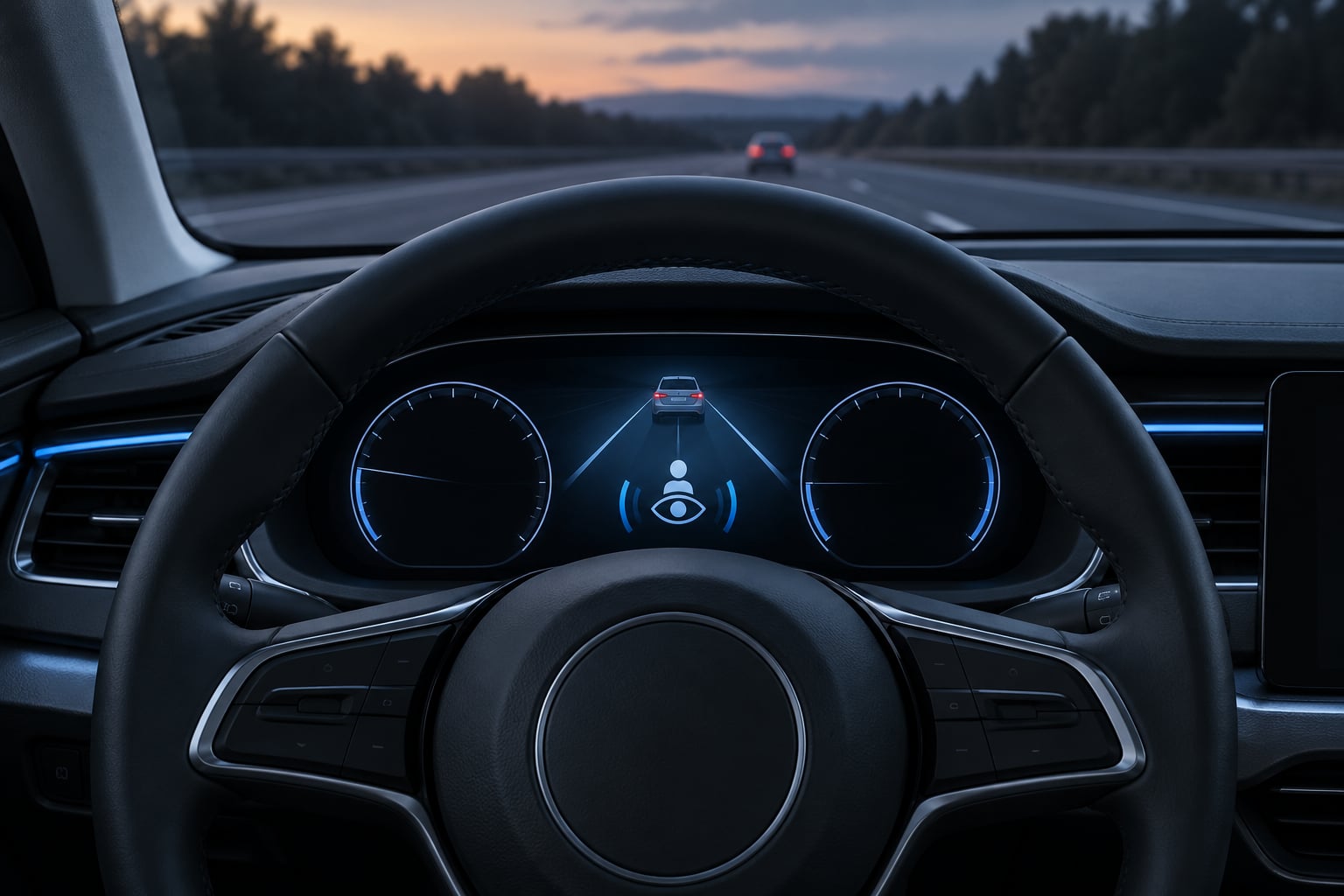
Driver monitoring is the newest battleground and the least evenly matched. Subaru’s Driver Attention Monitor has been fitted for years and uses the stereo camera pair to watch for eyes leaving the road. Honda’s Driver Attention Monitor and Toyota’s hands-off and drowsiness warnings arrived more recently. Nissan, Mazda and Mitsubishi each offer some form of attention alert, but coverage across the range is patchy. Mazda’s Driver Monitoring on higher trims is more thorough than most because it watches the face rather than just the road scene.
Owners are often surprised by how strict these warnings are. Forum threads about Honda and Toyota systems describe alerts that escalate quickly at motorway speeds. Nothing is broken; the systems are simply designed to be annoying early rather than late, and the escalation rate can usually be softened in the vehicle settings.
Which Systems Work Best in Japanese Cities, Highways, and Bad Weather?
Pick a use case and the answer changes, because each suite is tuned for different road furniture. Japanese cities are about narrow streets, bicycles, pedestrians appearing from between parked cars and blind corners. Expressways are about long, fast, mostly empty lanes with construction zones and curve speed to manage. Winter roads are about the limits of every camera.
For dense city driving, the suite that stops and restarts cleanly in a queue wins, which points to EyeSight and the latest Safety Sense and ProPILOT. Honda’s low-speed follow is adequate but the driver will end up managing the restart. For blind corner entry and parking, Mitsubishi’s 360 Degree Monitor is the most useful single tool in this group, and Toyota and Nissan offer their own versions on selected models.
For long expressway commutes, map-linked cruise and curve speed management matter more than anything else, which favours the newest Toyota and Nissan hardware. For mountain roads, curve speed management is worth more than lane centring, because a system that slows before the bend is more valuable than a system that straightens the car within it.
For bad weather, be realistic. Radar-led adaptive cruise control holds up better in heavy rain than camera-only setups, and steering assist is the first thing to degrade when road markings disappear under water or snow. That is exactly when a Japanese system will reduce its assist and hand back control, and it does so quietly rather than dramatically. Clean the camera housing before a storm, and check whether the car has a heated or self-cleaning front camera if you live somewhere with heavy snow.
Nobody should rank these suites on safety performance from crash-report counts alone. Aggregated US crash-report figures get quoted constantly, but they mostly track how many of each brand were on the road, how often and how they were driven, not how often a system fails. A brand with a small number of cars on the road produces small counts, which owners of the smaller-selling marques point out themselves.
How Availability and Price Vary by Model and Trim
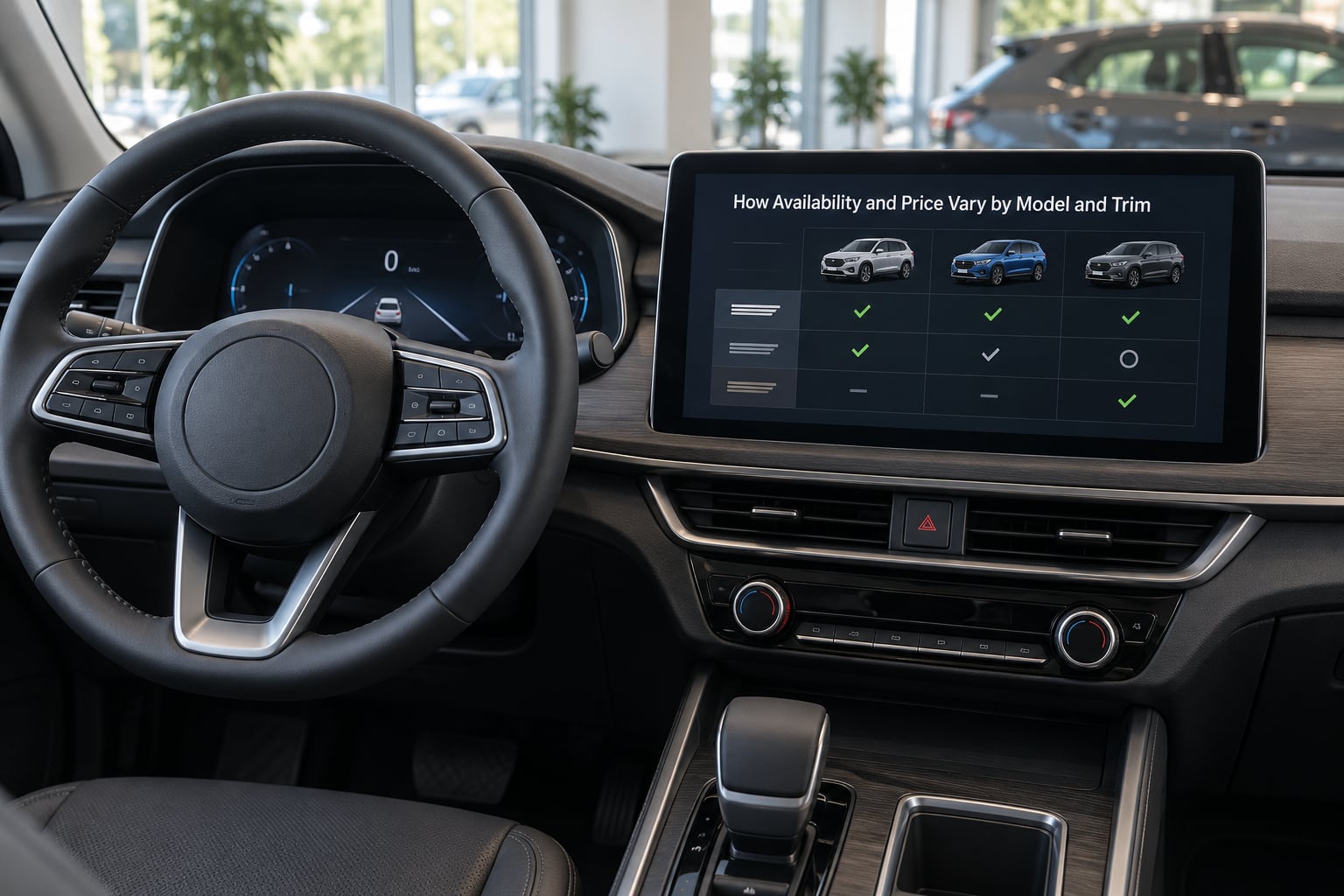
This is where comparisons go wrong most often, so treat any statement about what a suite includes as model-year specific. Japanese ADAS availability varies across manufacturers, models, trims, generations and markets, and a suite name alone tells you very little about a specific car.
The direction of travel is clear even when the details differ. Advanced suites that were options fifteen years ago are now standard on most models from Toyota, Honda, Subaru, Mazda and Nissan, usually because regulation and safety ratings pushed them there. Mitsubishi is the most uneven of the six, with strong fitment on recent SUVs and hybrids and thinner coverage elsewhere. Nissan has historically put its driver assist package above the base trim, so the cheapest model in a range is often the one without it.
Generations matter as much as trims. Safety Sense moved from version 2.5 to 3.0 to 4.0, with Proactive Driving Assist, improved curve handling and broader driver monitoring arriving in the later steps. Honda Sensing 3.0 brought the 360 Degree Monitor and a more capable parking sensor set. EyeSight 4.0 and i-ACTIVSENSE generation 2 reworked the underlying sensing, which is why owners comparing an older car to a current one often see a bigger jump than the badge suggests.
Ownership cost adds a wrinkle. Some functions arrive as part of a connected-services package, which can mean a subscription or a trial period before the feature stops working on a used car. Check what is hardware, what is software and whether anything needs an active account.
Before a test drive, open the vehicle settings menu and confirm four things. Which safety functions are present and enabled. Whether adaptive cruise control stops fully. Whether lane support is available and at what speed. Whether driver monitoring exists on this trim. All four are quicker to verify from the driver’s seat than from a brochure, and the answer will not change once you have signed anything.
Good news if you are buying used: the hardware rarely fails in a way that removes whole functions. A dirty or misted camera reads as a fault on several suites, and a blocked sensor behind a bumper cover does the same. If a car arrives with warnings you cannot clear, look at the sensors before you look at the electronics.
Which Should You Choose?
There is no universal winner, because the vehicle and its equipment package matter more than the badge. Match the suite to how and where you drive.
For heavy urban traffic and frequent stops, look at EyeSight or the current Safety Sense and ProPILOT generations, where full stop and restart in a queue is the behaviour you will notice daily. For blind corners and tight parking, prioritise whichever car in your shortlist carries a 360 Degree Monitor, which currently means selected Toyota, Nissan and Mitsubishi models.
For long highway commutes, weight map-linked cruise and curve speed management above everything else, and check the model year rather than the trim badge. That is where a three-generation gap shows up most. For drivers who want the system to nag them into staying attentive, Subaru’s long-standing driver monitoring and Mazda’s face-based system on higher trims are more thorough than most.
For anyone in a poor-weather region, buy on the heated or self-cleaning camera option and accept that steering assist will back off when markings disappear. For buyers who have already chosen a model, the honest answer is that you are choosing that car’s fitted package, not choosing a system.
Frequently Asked Questions
Can any Japanese driver assistance system drive the car by itself?
No. Every suite sold in Japan today, including Toyota Safety Sense, Honda Sensing, ProPILOT, EyeSight, i-ACTIVSENSE and Mitsubishi FCM, is SAE Level 2 assistance. The system steers, holds speed and can brake, but a licensed driver stays responsible for the driving task at all times. Some functions disengage automatically when conditions fall outside their operating limits, which is a limitation, not a handover to autonomy.
Which Japanese ADAS is best for heavy city traffic?
For stop-and-go urban driving, favour the suites whose adaptive cruise control comes to a full stop and restarts by itself: Subaru EyeSight and the newest Toyota Safety Sense and Nissan ProPILOT generations. Honda and Mazda systems tend to follow at low speed and leave the restart to the driver, which is workable but tiring in a long jam. Pair this with a 360 Degree Monitor if blind corners and parking are part of your day.
Can these systems be used in rain, snow, or dense fog?
They degrade rather than fail. Cameras lose contrast in heavy rain, fog or snow, and lane centring usually reduces its steering input when markings fade, which is correct behaviour. Radar-based cruise control holds up better than camera-only setups in rain, but radar can pick up reflections in standing water. Expect features to switch off on their own in poor visibility, and check for a heated or self-cleaning front camera if you drive in snow.
Does adaptive cruise control work in every Japanese driving situation?
No, and the limits are documented in each owner manual. It generally needs a recognisable vehicle ahead, clear lane markings for the lane functions, and it disengages in heavy rain, fog, construction zones and on unmarked roads. Japanese systems are also tuned to assist gently on curves rather than steer hard through a bend, so on mountain roads expect the speed to be your responsibility while the bend is taken.
How do I check which driver assistance features are fitted to a used car?
Read the model year and trim badge first, then confirm in the vehicle settings menu: which safety functions are enabled, whether adaptive cruise control stops fully, whether lane support is present, and whether driver monitoring exists on that trim. Check for a clean front camera and clear radar covers, because a blocked sensor triggers warnings that look like a fault. The build sheet or dealer service history is more reliable than the trim name alone.
Do Japanese driver assistance systems reduce insurance costs?
Some insurers offer discounts for vehicles with a named driver assist suite, particularly for automatic emergency braking and blind spot monitoring, but the discount varies widely by insurer, market and vehicle. Ask for the reduction in writing and confirm which specific features qualify, since some insurers discount only on a stated list. Rules and rates change, so treat any saving as a possible discount rather than a guaranteed figure.
Bottom Line
Start with the exact vehicle: model, trim, model year and which safety package is fitted, then verify its functions and limits in the settings menu and during a controlled test drive of a road you know. The owner’s manual for that car settles everything a comparison article cannot.