CDs still sell in Japan because a Japanese CD has never really been sold as a music file. It is a collectible, an artwork object, a lottery ticket for an idol handshake event, and a visible way to back an artist. Predictable new-disc pricing, dense record retail and late streaming adoption keep that whole system running.
That is the short answer, and it explains something visitors notice quickly: walk into any major station in Tokyo and the CD sections are still busy, staffed and carefully merchandised. The rest of this guide breaks the reasons apart, looks at who actually buys, and gets honest about a market that has been shrinking for two decades.
One thing worth saying up front, because most write-ups leave it out. This is not a booming market. Recorded-music revenue from physical products peaked at roughly 587.8 billion yen in 1998 and sat near 123.2 billion yen by 2021, about a fifth of the peak. Physical disc volume fell under 100 million a year in 2018. What survives is not mass-market scale. It is a deep, unusually motivated niche.
Table of Contents
- 1What Is the CD Market Like in Japan Today?
- 2Why Do CDs Still Sell in Japan?
- 3Habit and Trust in Physical Music
- 4Affordable CD Prices and Hardware That Still Works
- 5Collectors, Limited Editions, and Resale Demand
- 6Why Streaming Arrived Late in Japan
- 7Why CDs Still Sell in Japan Even as Streaming Grows
- 8Which Japanese CD Buyers Keep the Market Alive?
- 9Where Are CDs Most Popular in Japan?
- 10Is CD Demand Here to Stay?
- 11How to Choose a CD in Japan
- 12Frequently Asked Questions
- 13Why do Japanese consumers still buy CDs instead of streaming?
- 14Are CDs in Japan mainly bought by older listeners?
- 15Do limited-edition Japanese CDs hold their resale value?
- 16Can I play Japanese CDs on a Western CD player or DVD player?
- 17Is buying CDs cheaper in Japan than ordering them online?
- 18Conclusion
What Is the CD Market Like in Japan Today?
Start by being precise about what counts. When people talk about CD sales in Japan they mean recorded audio compact discs sold as music product: new releases, second-hand copies, collector editions and giveaway discs bundled with magazines or bought at events. They do not mean CD-ROM software, which is a different industry entirely.
Second, separate continuing demand from nostalgia. Nostalgia is real, but it cannot explain why physical purchases skew young in specific categories. The loudest buying in Japanese shops is often teenagers and people in their twenties buying idol and K-pop releases, not retirees buying Sixties reissues. What looks like nostalgia from outside is often a current transaction with a current motive.
Third, treat every headline figure with the year attached. Japan’s physical share of recorded music revenue was around 70% in 2021 against roughly 10% in the United States in the same year. An older widely quoted figure put physical at 85% of album sales in Japan against 57.2% in the US and 64% in the UK, but that was reported in 2014, before streaming had settled. Neither number is wrong; they describe different years and different measures.
| Segment | What it is | Who buys it | How it behaves |
|---|---|---|---|
| New mainstream releases | Standard edition pressed at scale, usually sold with an obi strip (the paper band around a sealed case) intact | Broad casual audience, gift buyers, fans of Japanese and Korean catalogues | Predictable and narrow in price; heavily front-loaded into release week |
| Collector and limited editions | Numbered variants, photobook editions, anniversary boxes, deluxe sets | Dedicated collectors, K-pop and J-pop fans buying several copies | Short print runs, older releases get scarce, second-hand prices firm up |
| Second-hand and used | Shops with trade-in counters plus marketplaces such as Mercari and Yahoo Auctions | Budget buyers, collectors filling gaps, fans hunting specific bonus tracks | Very large and very cheap; the main way new collectors start |
| Giveaway and promotional discs | Free or low-cost discs handed out at events, bundled with magazines, included with other purchases | Existing fans who already follow the act | Low commercial value, high signalling value; keeps the format present in daily life |
Collectors on collector forums point out that supply of Japanese pressings is not uniform across the decades. Early discs from the 1982 launch era are genuinely hard to locate, partly because obi strips were thrown away the moment a case was opened. From 1988 onward availability is broad.
Why Do CDs Still Sell in Japan?
Five forces hold this market up, and they reinforce each other. Take any one away and the others would have carried less weight on their own.
Habit and Trust in Physical Music
A physical release can be held, shelved, shown, gifted and resold. An account, a subscription and a cloud library do none of that without friction. Japanese listeners grew up buying discs at a record shop, and that behaviour has aged into a trust relationship: what arrives is what was advertised, and it will still be there in ten years without depending on a licence.
That trust is also a defence against disappointment. Streaming catalogue losses are a recurring complaint in Japanese fan communities, where an album can disappear from a service between one purchase and the next. Owning the object removes the argument entirely.
Affordable CD Prices and Hardware That Still Works
New mainstream discs in Japan sit in a narrow published band, and that predictability is doing most of the work here. A buyer ordering three copies for lotteries knows roughly what each one will cost before leaving the shop, which makes multi-copy buying a budget decision rather than a gamble.
Used copies are where prices get genuinely low. Trade-in counters and online marketplaces have turned a decade of shelf turnover into a cheap catalogue, so new collectors in Japan usually start by spending very little. Compared with importing a Japanese edition from overseas, in-person buying also removes shipping, proxy fees and the risk that a second-hand listing arrives in worse condition than described.
Hardware matters too. Compact discs are recorded audio, so there is no region code and nothing to configure. A disc bought in Tokyo plays in a CD player, a DVD player or a car stereo anywhere in the world.
Collectors, Limited Editions, and Resale Demand
Japanese idol and K-pop releases routinely ship in several variants at once, and the variants differ in ways that matter to buyers: a photobook, a serial-numbered insert, a bonus track, a different jacket, a bundled concert ticket lottery. Collecting the jacket for its artwork alone is common enough that it has a name, jake-gai.
Supportive buying has a name too: oshi-katsu, meaning supporting your favourite artist. Because copies are entered into lottery draws for handshake events and can carry voting rights, fans buy several of the same single. Collectors describe buying five to twenty copies of one release for the lottery entries alone, and never playing them.
Resale demand follows the same logic. An out-of-print bonus track or a discontinued photobook edition becomes harder to find the longer it is gone, and second-hand prices reflect that. Unopened copies with the obi strip intact command noticeably more than opened shelf copies.
Why Streaming Arrived Late in Japan
Physical sales did not lose to streaming in Japan overnight. Paid downloads arrived weakly, partly because free streaming and file sharing absorbed the early demand, and local platforms such as Line Music built habits before Spotify took hold in 2018. By the time subscription streaming became the default way to listen, physical was already a mature, well-served routine with its own shops, its own charts and its own resale market.
Digital distribution in Japan is now enormous. It is simply larger, not dominant, and for a few specific behaviours the physical object still does work no service does.
Why CDs Still Sell in Japan Even as Streaming Grows
Charts count physical sales. Oricon and Billboard Japan weight shipped discs heavily, so buying a copy moves an artist’s chart position in a way a stream does not. For fans, that turns a purchase into a visible act of support with a measurable result, which is exactly what the rank-and-file idol audience wants.
Giftability, durability and independence from a subscription also hold. A disc works with equipment already in the home, travels without a connection, and can be handed to someone who does not have an account. None of that makes the format permanent or future-proof, and streaming service keeps taking share. It makes the physical version the better fit for particular jobs.
Which Japanese CD Buyers Keep the Market Alive?
Dedicated collectors buy limited editions, anniversary sets and anything numbered, and they keep the second-hand market active for retired titles. Idol and K-pop fans are the fastest-growing group: teenagers and people in their twenties buying multiple copies of the same single for lotteries, voting rights and display. They also follow overseas catalogues, and collectors on forums regularly report choosing the Japanese edition specifically for its bonus content.
Older listeners remain a dependable share of the market, particularly for city pop, 1980s and enka, and they know exactly which pressing they want. Casual physical shoppers pick up mainstream new releases without much ceremony; for them a disc is simply how music is sold, the way bread comes in a bag.
Gift buyers show up heavily around seasonal periods and for younger listeners who do not have accounts. Resale customers treat new or limited releases as inventory to be flipped, and the presence of that group keeps secondary prices honest rather than purely speculative.
Where Are CDs Most Popular in Japan?
Specialist record shops are the heart of it. Tower Records, HMV and the large independent shops in areas such as Shibuya, Akihabara, Nakano and Osaka carry deep new-release walls plus substantial second-hand counters, and Tokyo offers by far the widest selection for a visitor hunting one specific edition.
Online, Japanese marketplaces such as Mercari and Yahoo Auctions dominate the second-hand side, alongside specialist import retailers. Auction platforms can be awkward for non-residents, often requiring a local contact or a shopping proxy, and proxies add fees that eat into the saving. Direct specialist retailers are the simpler route for a visitor who wants a known condition and a straightforward invoice.
Concert and event retailers, discount electronics and department-store counters cover the rest. Popularity and availability vary a lot by city, by title and by edition, so a title that looks impossible to find in one shop may be sitting in a trade-in bin two streets away.
Is CD Demand Here to Stay?
Probably not at the same scale, and pretending otherwise would be dishonest. Mass-market physical sales have been declining for years, CD-player adoption is falling as cars and computers drop optical drives, and manufacturing costs for short print runs of premium packaging are not falling. Every one of those trends pushes the wrong way.
What is holding is the premium tier. Limited runs, photobook editions and idol releases are closer to a manufactured collectible than to an audio carrier, and collectors treat them accordingly. Vinyl is quietly doing the same kind of work in Japan, rising from roughly 105,000 records in 2010 to well over a million by 2019.
The realistic outlook is a smaller, more specialised market that keeps existing for decades rather than one that either collapses or grows. Anyone planning to buy records in Japan can do so with confidence; anyone planning a business case around high-volume new-disc sales should look at the numbers twice.
How to Choose a CD in Japan
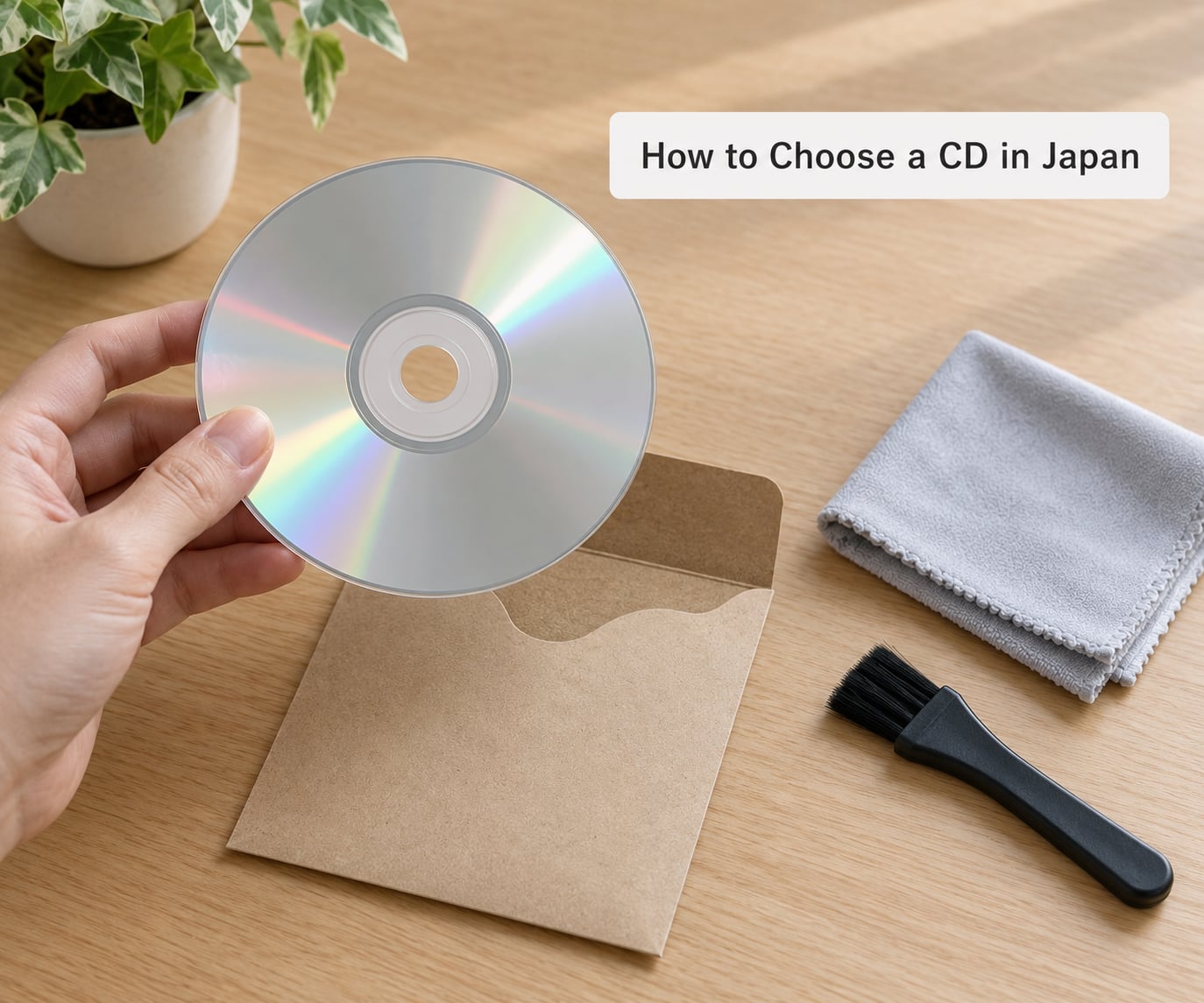
Check the disc type first if condition details are unclear. Audio CDs, DVDs and data discs all appear in the same bins, and only audio discs carry music. A jewel case holding a silver disc with printed artwork on the face is a music CD; a disc in a slim cardboard sleeve or a blue box is usually DVD or data.
Read the obi strip. The paper band carries the catalog number, the release date and the edition name, and it proves the copy is unopened. It also tells you which of several near-identical versions you are holding. For Japanese pressings specifically, the catalog number confirms whether a bonus track is the domestic exclusive.
Then decide which version you actually want. Japanese releases of major albums often run to five or more variants, and they are not interchangeable. Compare the track list, not the artwork, and expect the photobook and anniversary versions to cost considerably more than the standard edition.
Add up the landed cost before committing. Import postage and a shopping proxy fee can exceed the price of the disc itself, which makes in-person buying the better deal for anyone already in Japan. For used copies, check the disc surface under light, run a soft cloth along any scratch direction rather than across it, and treat a disc with a radial scratch near the label as a skip risk.
Finally, confirm you can play what you buy. Compact discs are region-free audio, so any standard player will handle them. Higher-fidelity variants such as SHM-CD and Blu-spec CD play normally everywhere but only reveal their benefit on compatible hardware.
Frequently Asked Questions
Why do Japanese consumers still buy CDs instead of streaming?
Because a Japanese CD carries things a stream does not: bonus tracks found only on the domestic edition, photobooks, serial-numbered inserts, obi strips, handshake-event lottery tickets and vote tokens. Physical copies also feed the Oricon and Billboard Japan charts, so buying one moves an artist’s rank. Streaming is growing fast, but the physical object still does jobs the service cannot.
Are CDs in Japan mainly bought by older listeners?
Older listeners are a reliable share, particularly for city pop, 1980s and enka, but they are no longer the whole picture. Idol and K-pop buying skews teenage and twenty-something, and those fans often buy several copies of the same single. Family and gift traffic is steady too. The honest read is a broad base with one very loud, very young segment sitting on top of it.
Do limited-edition Japanese CDs hold their resale value?
Often better than the standard edition, for the same reasons new sales are strong. Limited print runs, numbered inserts, photobooks and out-of-print bonus tracks stay wanted after a title is withdrawn, and second-hand pricing on Mercari and Yahoo Auctions reflects that. Condition decides the rest: an unopened copy with its obi strip intact is worth far more than an opened shelf copy.
Can I play Japanese CDs on a Western CD player or DVD player?
Yes. Japanese pressed discs are standard Red Book audio, so they play in any CD player, including DVD players sold in Europe and North America, and they carry no region code because they hold audio rather than video. Multi-disc sets read fine on ordinary players. Higher-fidelity variants such as SHM-CD and Blu-spec CD also play everywhere, but only compatible hardware shows the difference.
Is buying CDs cheaper in Japan than ordering them online?
It depends on the release. New mainstream discs sit in a narrow published price band, so buying several in person rarely beats a Japanese online order once shipping is added. Used copies in shops and through Mercari are usually cheaper than importing the same title. Collector editions with photobooks and numbered inserts often cost more in Japan than the international edition of the same album.
Conclusion
So why do CDs still sell in Japan? Not because the format sounds better, and not because people are stuck. Physical music here is a behaviour system: predictable new-disc pricing, shops that still carry deep, charts that count what you buy, editions that differ meaningfully from one another, and fan cultures where buying several copies is a normal act of support.
Before your first purchase, check the catalog number on the obi strip, confirm it is an audio disc rather than a DVD, compare the variants of a multi-edition release, and work out the landed cost once shipping and proxy fees are included. Buy from a specialist shop or a reliable Japanese retailer, and keep the disc out of direct sunlight and away from heat. That is the whole ritual, and it explains the sales.